Friday mystery object #385

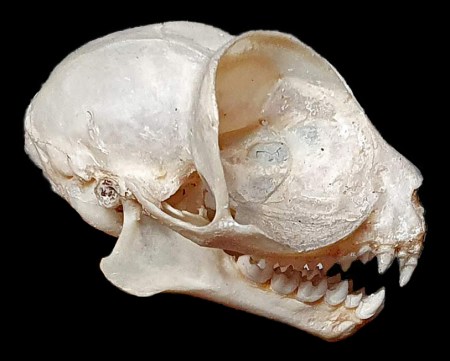
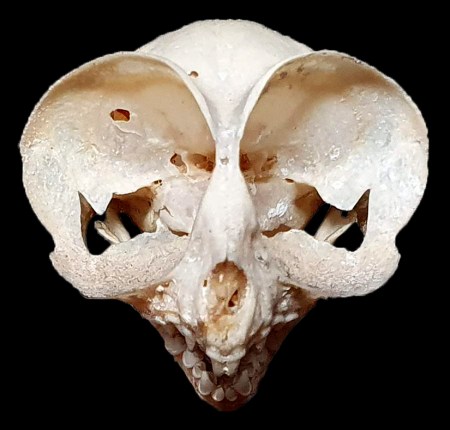
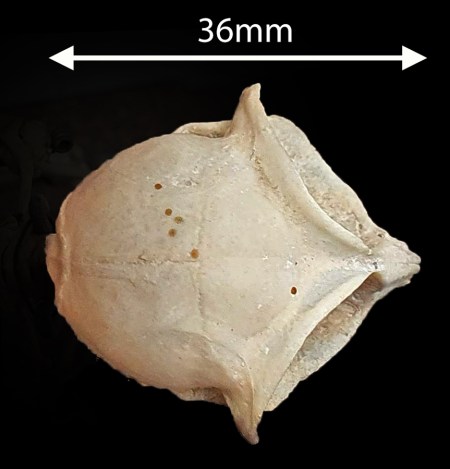
This week I have a mystery object from the Dead Zoo that I think you’ll probably find easy to get to genus, but then I think it’ll get much more difficult:

mystery385dorsal

mystery385lateralmystery385anterior

If it proves too hard to work out the species I have a clue that might help and I’ll add it to the post next week. Have fun!

Aaand, here’s your clue! This is where the label says it’s from. I hope that helps!

wp-1593445090171..jpg

Friday mystery object #384 answer

Last week I gave you this unusual looking skull to have a go at identifying:
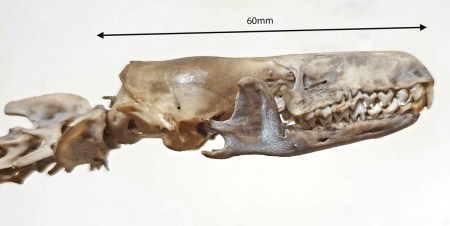
mystery384

That low and elongated shape, combined with the large number of teeth and absence of a zygomatic arch – all within the context of the relatively large (but still quite small) size – all combine to narrow this down to just a few possible options.

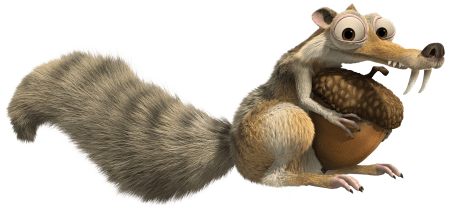
There are a bunch of critters in what used to be called the “Insectivora“, back in the dim and distant days of my undergraduate studies. This wastebasket for things that look like they should be chasing acorns in a cartoon was rightly broken up into more meaningful cladistic groups during the great molecular taxonomic revolution in the dying days of the last century.
ice_age_png31

Scrat, a fictional sabre-toothed squirrel that looks like every third member of the old ‘Insectivora’

To be fair, there’s a reason why the “Insectivora” lasted as long as it did and why it took molecular research to finally tease the various groups apart. They don’t have many strong distinguishing anatomical features that are seperate them into clear higher level groupings. Sure, they look a bit different at the family level, but any higher than that and they smoosh into bunch of small toothy critters, many with no cheekbones to speak of.

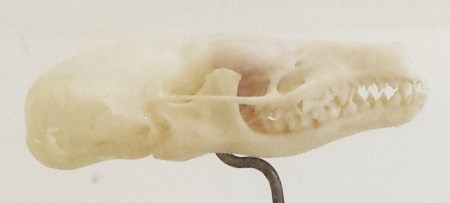
However, some do have a zygomatic arch, such as the talpid moles and desmans, so it’s not one of them:
mystery330b-e1526623553591

Skull of European mole Talpa europaea Linnaeus, 1758

It also lacks the large orbits of something like a Sengi or Elephant Shrew:
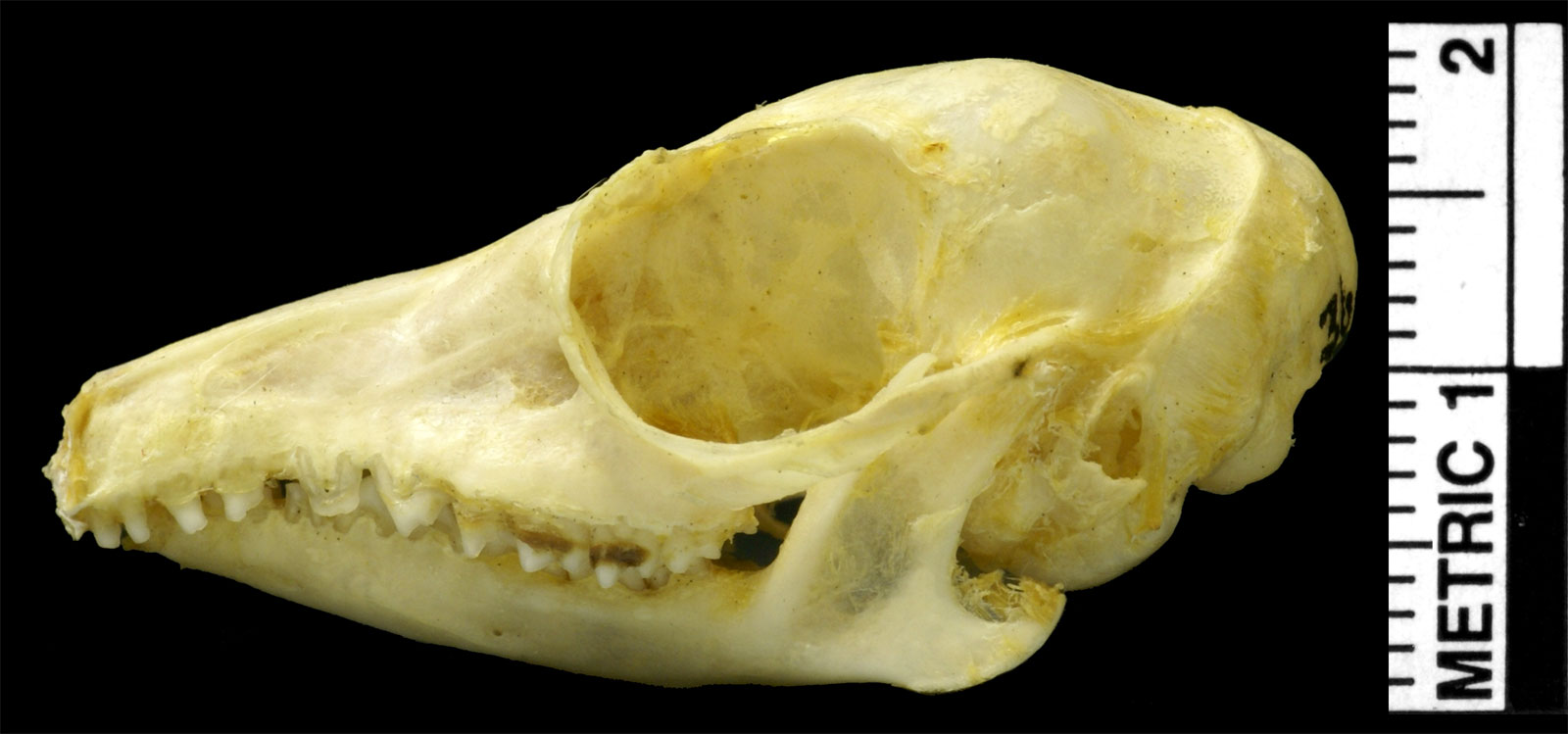
Skull of a North African Sengi Elephantulus rozeti (Duvernoy, 1833).

It also lacks the well-developed sagittal and nuchal crest you’d associate with the Malagasy tenrecs:
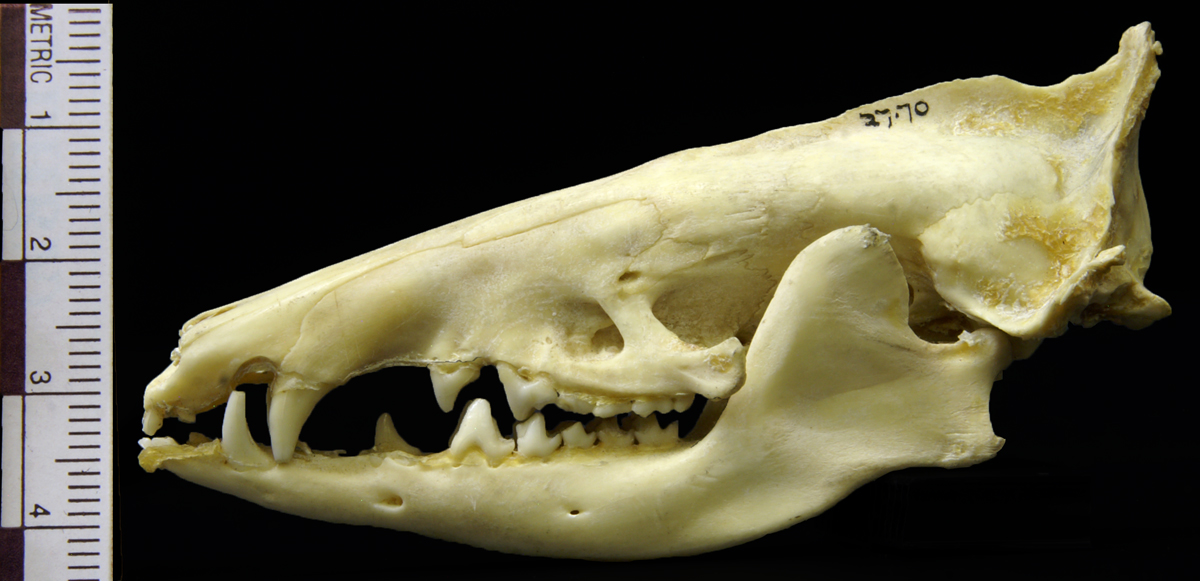
Skull of a Tail-less Tenrec Tenrec ecaudatus Lacépède, 1799.

It also lacks the backwards projecting nuchal crest of a solenodon and it’s just too big for one of the true shrews – the largest of which is the Asian House Shrew with a skull length of around 38mm.

So this specimen isn’t as hard to recognise as it could be. The very flat top to the skull with the nostrils up high is a bit of a clue – something often (although not always) associated with aquatic animals. On closer inspection there are two likely suspects – the Web-footed Tenrec or one of the Otter Shrews (which are neither otters nor shrews).

The area around the occipital is a dead give-away here. The Malagasy Web-footed Tenrec Limnogale mergulus (Major, 1896) has an occipital region that’s hard to see in a side view, because the parietals extend down quite low, whereas the Otter Shrews have much higher parietal margin that exposes the occipital region – just like we see in the mystery object.

Finally, the size is give-away. As many of you recognised and hinted at (occasionally with some dodgy puns – I’m looking at you Tony), this is a Giant Otter Shrew Potomogale velox (Du Chaillu, 1860). These semiaquatic relatives of the tenrecs are unusual in how they swim, lacking webbed feet and relying on a laterally flattened tail to swim using a fish-like undulation. So well done to Jane, Tony Irwin, katedmonson, Allen Hazen, Rémi and everyone else who managed to work out this weird mystery.

Friday mystery object #383 answer

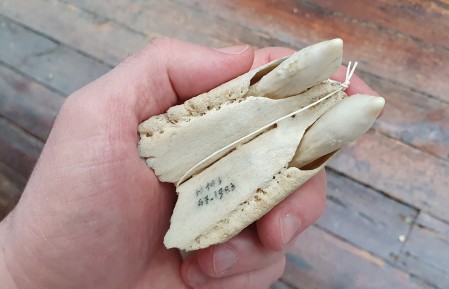
Last week I gave you this slightly mean mystery object from the Dead Zoo to have a go at identifying:

wp-1590685198270.jpg

I say it’s mean because it’s just a small fragment from the tip of the lower jaw. It does have some pretty distinctive teeth in it, so it’s probably not the most difficult mystery object I’ve shared, but it’s also from a species in a group of animals that are quite poorly known.

That said, Chris Jarvis was the first to comment and got it right immediately. However, there was a lot of subsequent discussion about how to be sure, given the poor representation of comparative specimens available and the similarities between this species and others in the family. That family is the Ziphiidae, which are the the Beaked Whales.

These cetaceans are rarely seen due to their deep water habits, sometimes diving to depths of nearly 3km (although more usually around 1km) to feed mainly on deepwater squid that they detect using echolocation. Most of what’s known about them comes from strandings – which is where this mystery specimen comes from.

The males tend to be smaller than the females, but the males of most of the 21 Beaked Whale species have tusk-like teeth that they probably use to fight over females, although the behaviour hasn’t been recorded, only deduced from scars and the behaviour of other animals with similar sexually dimorphic characters (there’s an interesting paper on the evolution of the tusks by Dalebout et al. 2008 is you’re interested [pdf]).

The teeth occur in different parts of the jaw and have a different shape depending on the species, so the fact these are located at the tip of the lower jaw means quite a lot of the species can be discounted. If you want to be able to do the narrowing down easily I recommend an old and somewhat unwieldy to navigate, but still very useful online resource – the Marine Species Identification Portal. If you can work out the navigation you can find small line drawings of the skulls of all species in lateral view.

Once you get that far it becomes easier to search for more detailed images of the couple of species it might be, which can yield some great 3D scans to help you work it out. Both Chris Jervis and katedmonson found examples and shared the links in the comments. Here’s a nice one from the NHM, London:

This species (the Cuvier’s Beaked Whale) clearly has bigger tusks than the mystery specimen, which you can see as a scan on the excellent Phenome10K resource*. The mystery object is the distal portion of the mandible of a male True’s Beaked Whale Mesoplodon mirus True, 1913. So well done to Chris Jervis for being the first to get in with the correct identification.

It may seem a bit odd to have just this small portion in the Museum, but as far as records go they represented a managable identifiable voucher for the stranding of the species in Killadoon, Co. Mayo, Ireland back in February 1983. These days we ask for even less material to keep track of strandings – just a small skin sample will do as long as it’s collected and recorded following the guidance of the Irish Whale and Dolphin Group’s (IWDG) Strandings Network.

These samples are stored in alcohol and form the Irish Cetacean Genetic Tissue Bank which is managed in partnership between IWDG and the Dead Zoo to provide genetic data for research into whales. It’s a fantastic resource, but I doubt that anyone could identify the species represented in the samples without access to a genetics lab. And that’s why I like bones best.

*A. Goswami. 2015. Phenome10K: a free online repository for 3-D scans of biological and palaeontological specimens. http://www.phenome10k.org.