Friday mystery object #317 answer

Last week I gave you this unidentified bird skull from the Dead Zoo to try your hand at identifying:
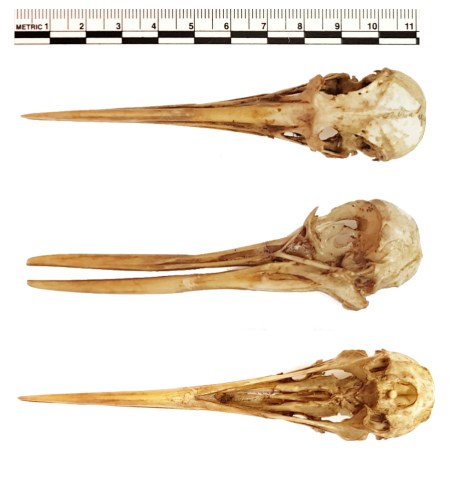
mystery317

It seems that everyone recognised it as being from a charadriiform, and one of the waders at that. The first response was from Chris, who made reference to Lewis Carroll’s poem the Walrus and the Carpenter in which the eponymous characters eat an enormous quantity of oysters – hinting that this is an Oystercatcher.

There were some other suggestions that it could be from one of the birds in the genus Tringa, which includes the ‘shanks’ (Redshank, Greenshank, etc.), but the morphology fits one of the Oystercatchers better – in particular that weird constriction about halfway down the mandible when you look at the skull in profile.

This mandibular ‘waist’ is quite unusual and it doesn’t even seem to occur strongly in all of the Oystercatchers, which helps narrow down the likely species within the genus Haematopus, especially when you factor in things like the relative bill proportions, although you have to be careful doing this as there is some sexual dimorphism in the shape of the bill, with the females’ being longer.

The three closest species are the American Oystercatcher, the Sooty Oystercatcher and the Blackish Oystercatcher, but unfortunately I’ve not been able to find good reference skulls all of these species to be able to look for any distinguishing cranial characters. Based on bill morphology I’m leaning towards this being the skull of the American Oystercatcher, Haematopus palliatus Temminck, 1820.
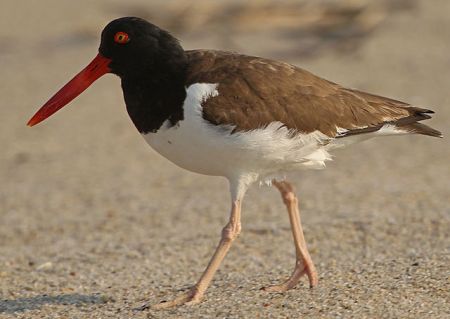
American Oystercatcher by DonaldRMiller, 2010

American Oystercatcher by DonaldRMiller, 2010

My next step will be to check through our collections to see if we have comparative material to check the identification (once I get some time – a sadly rare commodity). If I can’t confirm I’ll just stick with Haematopus sp. on the label.

If you’re not familiar with Oystercatchers, they walk along the tideline either prying or breaking open bivalves. In my experience they seem more fond of mussels than oysters, but what do I know?

Another mystery next week!

Friday mystery object #317

For this week’s mystery object I’ve decided to stick with my favourite subject of skulls. This time it’s a bird from the Dead Zoo’s collection, that was in a drawer labelled “Unidentified” – let’s fix that!

mystery317

Any idea what species this skull belonged to? I have my suspicions, but I’d love to hear what you think.

As always, you can leave your clues, questions and suggestions in the comments section below. Have fun!

Friday mystery object #316 answer

Last week I reverted to my favourite topic of skulls for the mystery object, with this specimen:

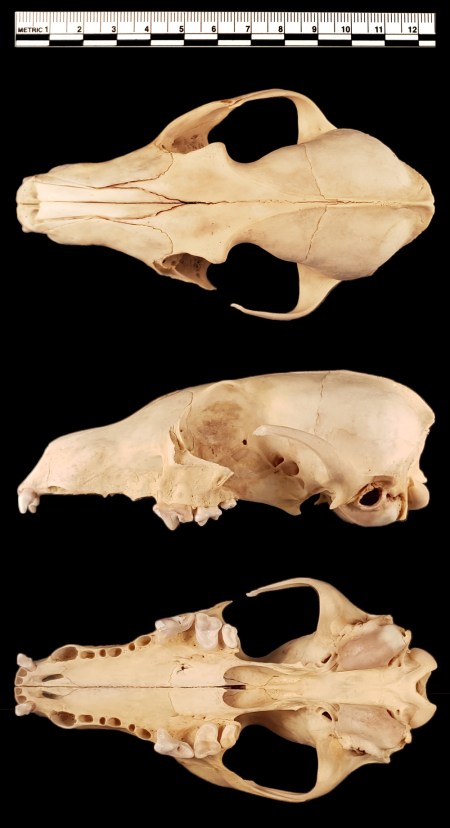
mystery316

Everyone recognised this as a member of the dog family, but surprisingly few of you pursued it much further than dog or maybe fox.

mystery82

A distinctive doggy forehead

The small size and lack of a distinct forehead (don’t mistake that bump at the top of the nasal region the head for a forehead by the way, it’s in the wrong place for a dog – see above) says it’s most likely one of the foxes or ‘weird’ dogs rather than a domestic type. By weird dogs I mean Raccoon Dog or Bush Dog type things.

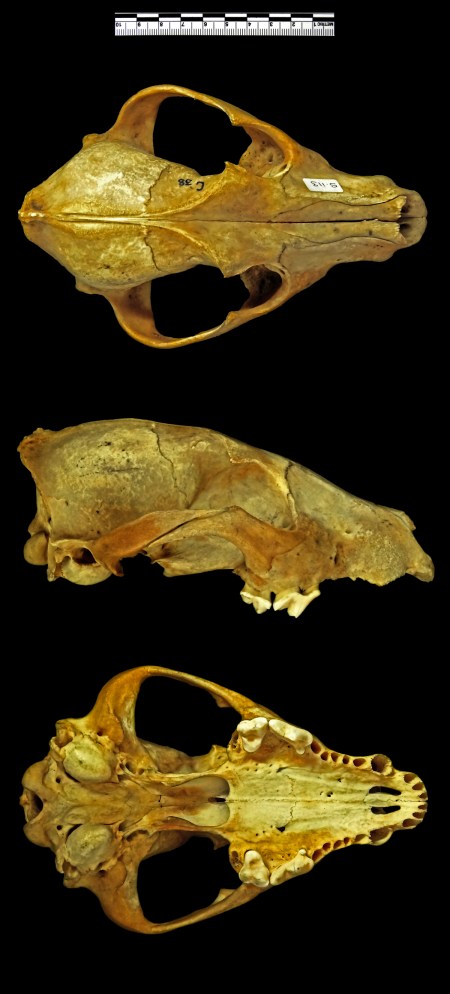
mystery150c

The ‘weird’ Raccoon Dog

In fact, the bump in the area where the frontals and nasals meet in front of the eyes is not too disimilar to the shape of a Dhole skull (see below), but the size and robustness aren’t right.

mystery278

Dhole skull, with its inflated frontal/nasal region

After looking through the various dog skulls I could find it became clear that the mystery specimen is smaller than the smallest of the non-weird canids outside those commonly referred to as foxes (which includes canids other than the ‘true’ foxes in the genus Vulpes).

So that helped me narrow down the options to around 20 species which, after checking a variety of online resources, I was able to trim down on the basis of the profile of the skull (especially that frontal/nasal region), the breadth of the muzzle (rostrum if you prefer) and the dentition (the upper second molar is a little smaller than usual and the protocone on the upper 3rd premolar is quite well developed).

In the end there was just one species left and I was delighted that it matched both my expectation and michiganmeetsnewmexico‘s suggestion of Arctic Fox Vulpes lagopus Linnaeus, 1758.

For me the inflated frontal/nasal region hinted at an animal with large nasal turbinates, which are an adaptation to dry and cold conditions, creating a large area in which to heat air that’s being breathed in (to help prevent water in the lungs from freezing) and trap water that would otherwise be breathed out.

If you’re interested in how I narrowed down the species and the resources I used to do it, take a look at my spreadsheet here, which contains my notes and links to fox skull images.

I hope you enjoyed that challenge – there will be another mystery next week!

Friday mystery object #316

Back to bones this week, with a mystery skull for you to identify. Any idea what species this skull belonged to?

mystery316

I don’t think it will prove too much of a challenge for the bone geeks among you, so please try to be a bit cryptic with your answers to keep it fresh and fun for those who are not so familiar – and that’s a cryptic clue about what it’s not right there 🙂

Have fun!