
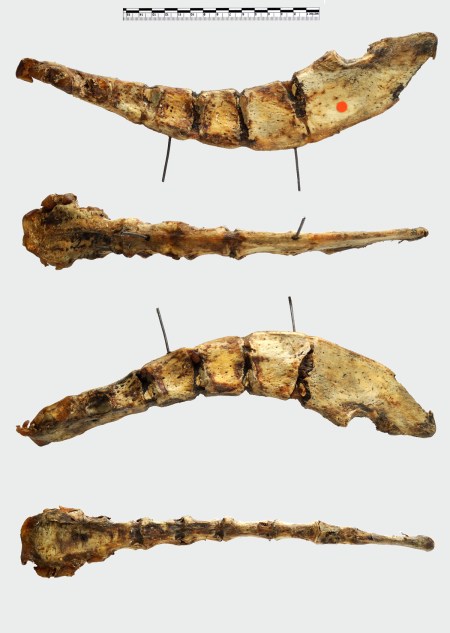
Last Friday I gave you this section of an object that I found in an unmarked box during a reshuffle of the Horniman’s bone room:

The reshuffle is part of a project to make space for temporarily housing specimens while our taxidermy storage space is upgraded. This is a fairly big undertaking, since it means finding enough nooks and crannies to accommodate a full room’s worth of stuffed critters, to allow the room they came from to be fitted out with long span shelving and roller racking – which should double its capacity.
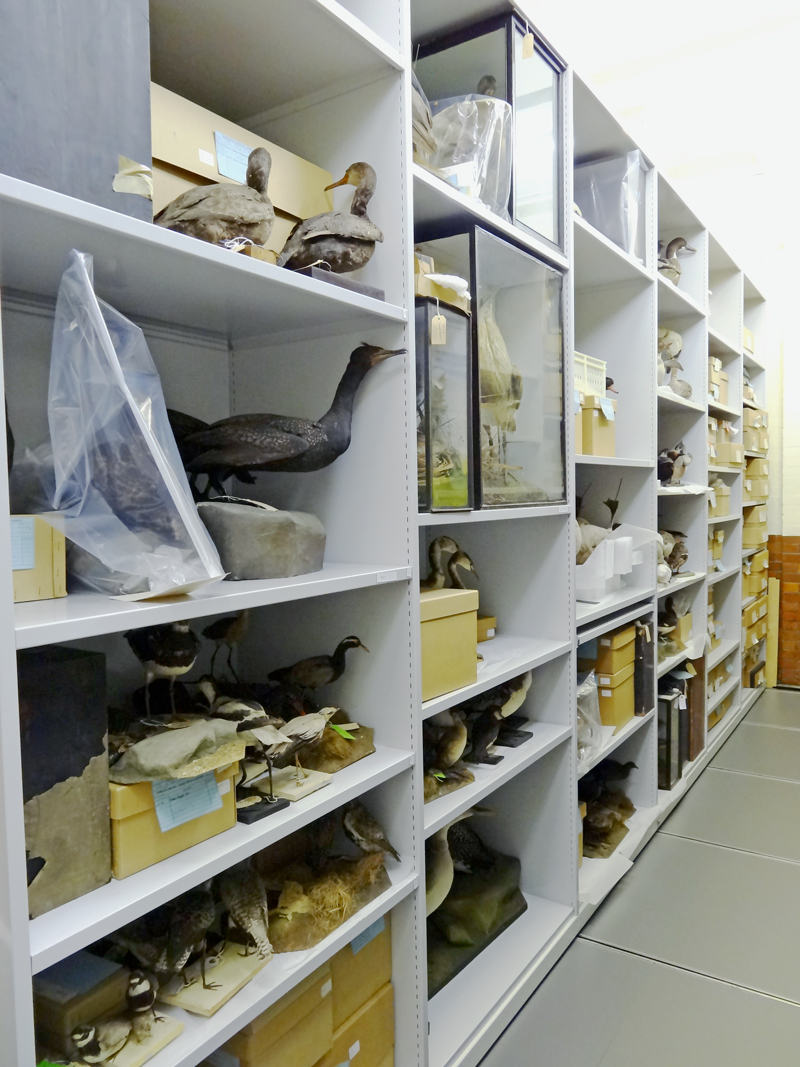
Bone room invaded by taxidermy birds
This reshuffle has also given me the opportunity to dig through the shrinking number of boxes of unidentified fragmentary material to see if any more can be matched back to specimens or rehoused in smaller boxes, thereby saving space. That’s where the mystery object comes in.
It has quite a distinctive shape, with a robust zygomatic arch (cheekbone), inflated tympanic bulla (bony bulb that houses the earbones) and thin squamosal (a bone of the side of the the skull – all of these parts fused together like this can also be called the temporal bone).
The structure of the glenoid fossa (joint where the mandible articulates) suggests it’s a carnivore of some sort, since herbivores tend to have a more open articulation that allows their mandible to move freely in order to grind tough vegetation more effectively. Carnivores need a more precise bite, to cut or clamp their food, which requires a tighter articulation.
However, the thin bone of the squamosal is less usual in a carnivore of this size, since this region normally deals with large bite forces and needs to be reinforced. This suggests an animal that isn’t relying on a powerful bite. The tympanic bulla is also quite open in structure, which I would associate with an animal that dives underwater and needs to be able to equalise differences in internal pressure effectively. These clues suggest that this piece of bone is from a seal of some sort.
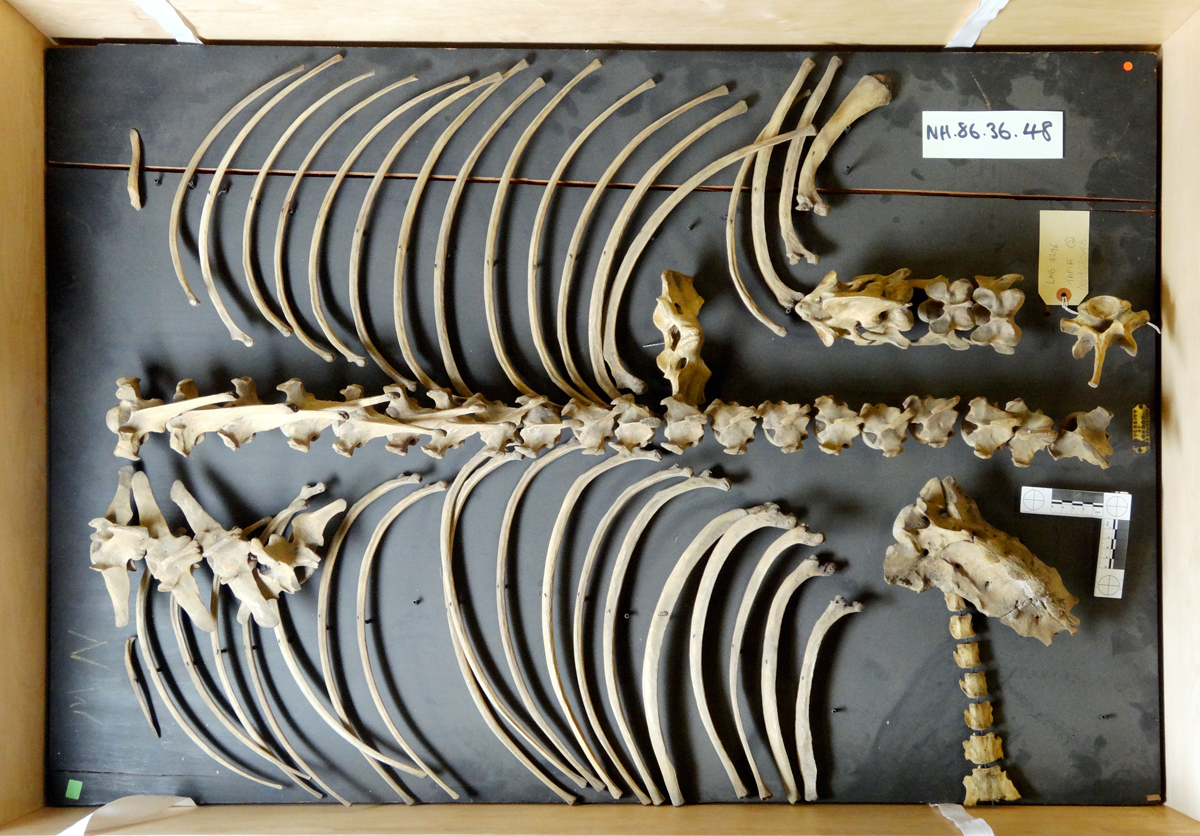
Figuring this out let me compare the mystery object to seal specimens, to see if any were missing the temporal region. As it turns out I did indeed find a fragmentary seal specimen that fit the bill:

This specimen was acquired in 1912 and had been sawn up in order to mount the other half for display on the Natural History Balcony at the Horniman:

In the register it was recorded as “Skull of Seal (Phoca annulata)” which is an out-of-date name for the Ringed Seal Pusa hispida (Schreber, 1775), but I have my doubts about this identification after consulting this useful piece of research on identification of archaeological seal remains by Hodgetts, 1999 [opens as pdf]. The tympanic bulla, mandible and dentition (plus the suture on the zygomatic arch) make me think that this may in fact be a Harp Seal Pagophilus groenlandicus (Erxleben, 1777).
So well done to henstridgesj, Ric Morris, Bobby Boessenecker and Lee Post, who all worked out that the mystery object was from a seal. Please feel free to add more thoughts on whether you agree with my identification of Harp Seal!




 Zygoma