
This Friday I’m giving you a mystery object that’s on display at the Horniman Museum:
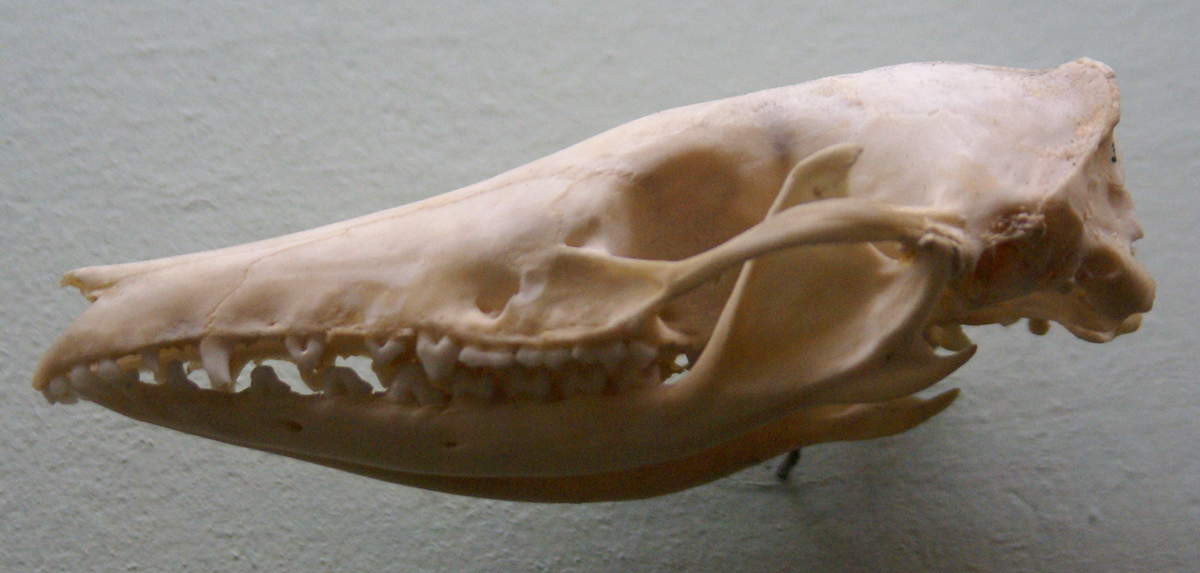
[EDIT length = 8.5cm]
Any idea what this skull is from?
As usual, you can put your suggestions, comments and questions below and I’ll do my best to answer. Good luck!
 Zygoma
An insectivore. Possibly a shrew or a hedgehog. Nothing to compare it to for size.
It’s around 8.5cm long.
Not a shrew or hedgehog, but it does eat insects (amongst other things).
Naughty Paolo – no scale bar. Tsk tsk.
It’s hard to include a scale when the specimen is on display – that’s my excuse! I should’ve included the length above, which I will now do!
A mixture of sharp teeth and grinding molars suggests an insectivore. Visibility of the surface texture of background material suggests the skull is quite small. Not a hedgehog as it has over hanging front teeth – suggest a shrew or mole
Certainly an insect eater (amongst other things) skull is about 8.5cm long and you’re right that it’s not a hedgehog, but it’s not a shrew or mole either…
8.5 cm is bigger than I estimated – I’ll therefore change my id to a moonrat which I think fits the long snout.
Moonrats are awesome, but this isn’t one.
Bandicoot
Bandicoot – that is an interesting thought. At first I dismissed it because my knowledge of bandicoots comes from when I lived in India where they are quite common and my recollection was that they didn’t have a long snout.
But my friend google tells me that there is an australian marsupial species of bandicoot which does appear to have a long snout.
Yes, I thinking of the Australian/Papua New Guinean/West Irian Bandicoots. I guess I could have been a little more verbose. Actually, I don’t think they are found in India. Anyway, dental plan seems to match (5/3, 1/1, 3/3, 4/4).
What a beautiful skull, so elegant!
It’s an insect-eating mammal, but the incisors make it look like insects are not its only diet. Also, the front of the snout (again, not very technical terms!) suggest a wiggly, inquisitive nose…
Sometimes technical terms are less informative than evocative descriptive terms!
Not wanting to stick my lengthy snout in, but I reckon Stephen is on the right lines.
😉
Would Madagascar be close?
Not wanting to give the game away but an insectivore occupying the ecological niche occupied by hedgehogs elsewhere?
The niche bit is pretty close, but you’re a few thousand miles out.
We’ve had tenrecs before… I did think Solenodon, with that size, but I checked and the skulls look quite different. Desmans, too, look rather different. Following Jack’s clue I thought … hmmm … elephant shrew. But it’s not that either. Sticking my long whiffly nose in further, it does look, however, very like a long-nosed bandicoot (Perameles nasuta).
Shhhh….
I’m coming crashing into this remarkably late, for once. Obviously the length of the skull is significant, but the other thing I notice is that it does seem to have rather a lot of incisors, suggesting its a marsupial.
Which one, though? Well, in the tradition of subtle yet somehow quite awful clues, I’ll put this one in the bag beside the badgers, and stare pointedly at the rather long nose.
🙂
Loving the clues!
For those wanting to easily spot a marsupial skull without having to learn dental formulae – the inward pointing flange on the bottom of the back end of the mandible, and the presence of the lacrimal foramen (the tiny hole for nerves and blood vessels near the from of the orbit) OUTSIDE the orbit are marsupial characteristics.
If placental have mandibular flanges they point downwards not inwards, and the lacrimal foramen is INSIDE a placental orbit.
Thanks Jack – useful pointers. Of course it now means that if I do a marsupial people will spot it straight away!
OK, having had three guesses I’ve read the clues and one continent that is ‘thousands’ of miles away from Madagascar is South America home of a load of opossums.
So looking at the wide choice – other clues are 8.5 cm skull, long snout – suggests a Philander opossum?
http://tinyurl.com/44ykczv
I’m a bit too thick to join in, but still enjoy reading the comments.
Maybe next weeks will be about something I know about
Thick seems unlikely, non-specialist seems more reasonable!
Can it be a Numbat skull….
some similar but not numbat
Not too far off – it’s from a Long-nosed Bandicoot: https://paolov.wordpress.com/2011/05/02/friday-mystery-object-93-answer/
is it a bandicoot?
Could be 🙂 the answer is here: https://paoloviscardi.com/2011/05/02/friday-mystery-object-93-answer/