Back to mammals for the mystery object this week. Any idea what this skull is from?
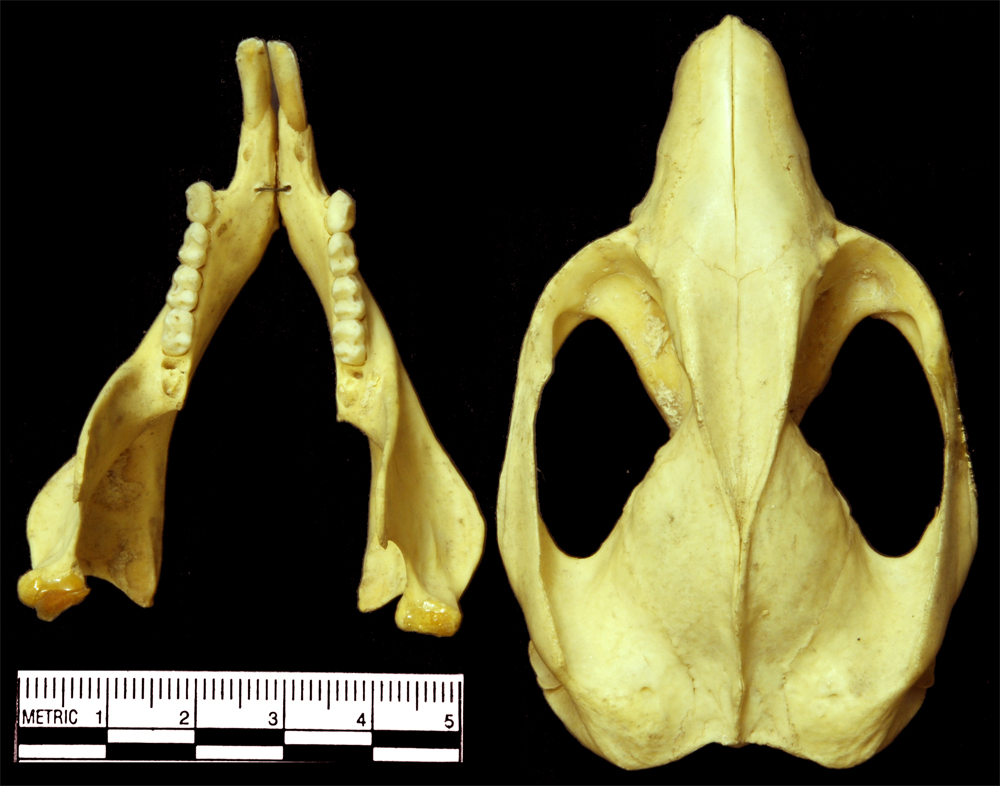
You can put your observations, questions and suggestions in the comments box below – cryptic clues are appreciated if you know what it is!

Back to mammals for the mystery object this week. Any idea what this skull is from?
You can put your observations, questions and suggestions in the comments box below – cryptic clues are appreciated if you know what it is!
On Friday I gave you this small bird skull to identify:
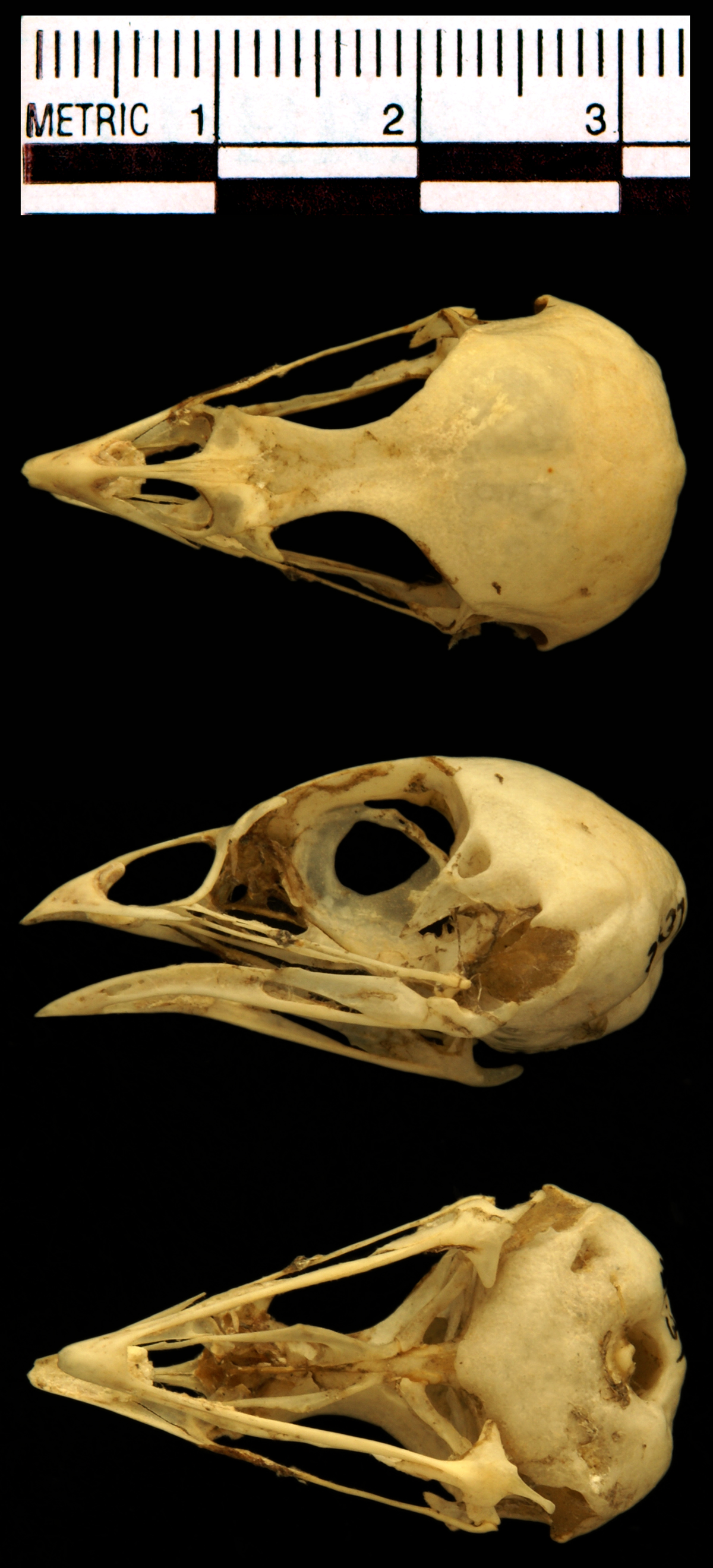
I though that the small size might lead you into thinking it was from a songbird – and there were a couple of you who were caught out by my cheap trick, with suggestions of Meadow Lark and Dunnock.
However, as you’ve probably worked out, it isn’t actually a songbird skull. Rhea misread the scale as being inches rather than centimetres and thought that this was a Chicken skull – which although wrong is in the right family (just a lot bigger!). The distinctive profile than Rhea spotted, combined with the small size meant that Ric Morris, palaeosam and Robin all managed to recognise this as the skull of a Continue reading
I have another bird skull for you to identify this Friday – much smaller than last week’s:
Any idea what it might be from?
I should have access to the internet this week, so I’ll do my best to respond to your questions. Good luck!
Apologies for a late and rather short answer to last week’s mystery object, I was in Scotland for the wedding of a very good friend this weekend and haven’t had much time for writing.
On Friday I gave you this skull to identify:

It’s pretty distinctive and I wasn’t surprised to see the correct identification popping up in short order. The big scars above the eye sockets indicate that this bird had large glands for extracting excess salt, which means it was a marine bird. The shape of the bill, particularly the mandible, is also quite characteristic and the wide triangular pterygoid bones of the palate are a give-away for this group.

Pterygoid bones highlighted
Ian managed to get the correct species identification within the first hour with Barbara Powell and Robin reaching the same conclusion after some comparison at the very useful Seabird Osteology website. This is the skull of a Continue reading
Over the last week or so I’ve been going through some of the bird skulls in the Horniman’s collection. Here’s a nice one that you might enjoy identifying:
As usual you can put your suggestions, comments and questions below and I’ll do my best to answer. Good luck!
On Friday I gave you this mystery object to identify:
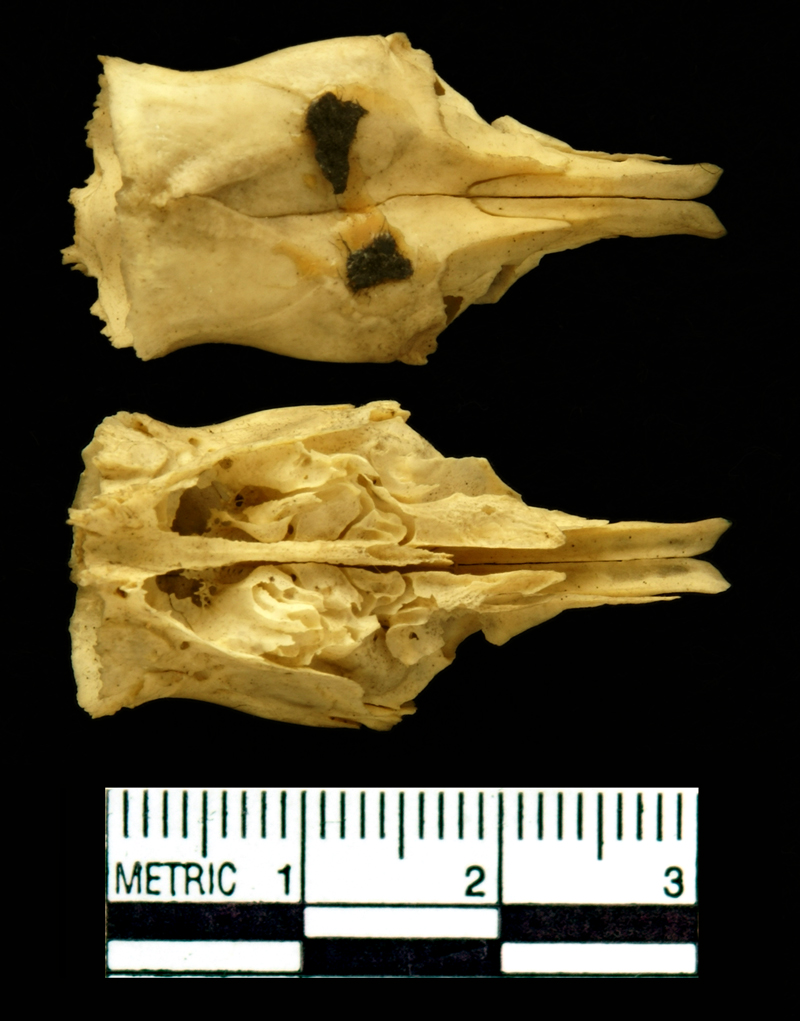
It proved a bit more tricky that I had expected, but given its fragmentary nature I suppose I should’ve expected it to pose a challenge.
As it turns out henstridgesj managed to identify it on the basis of it looking like roadkill – an unusual diagnostic feature, but in this case it was spot on. Robin, biologycurator and Jamie Revell also agreed with the identification of Continue reading
This week I have a fragmentary bit of critter for you to identify:
Any idea what this might be?
You can leave your suggestions, observations and questions below and I’ll do my best to reply. Good luck!
On Friday I gave you this mystery skull to identify:
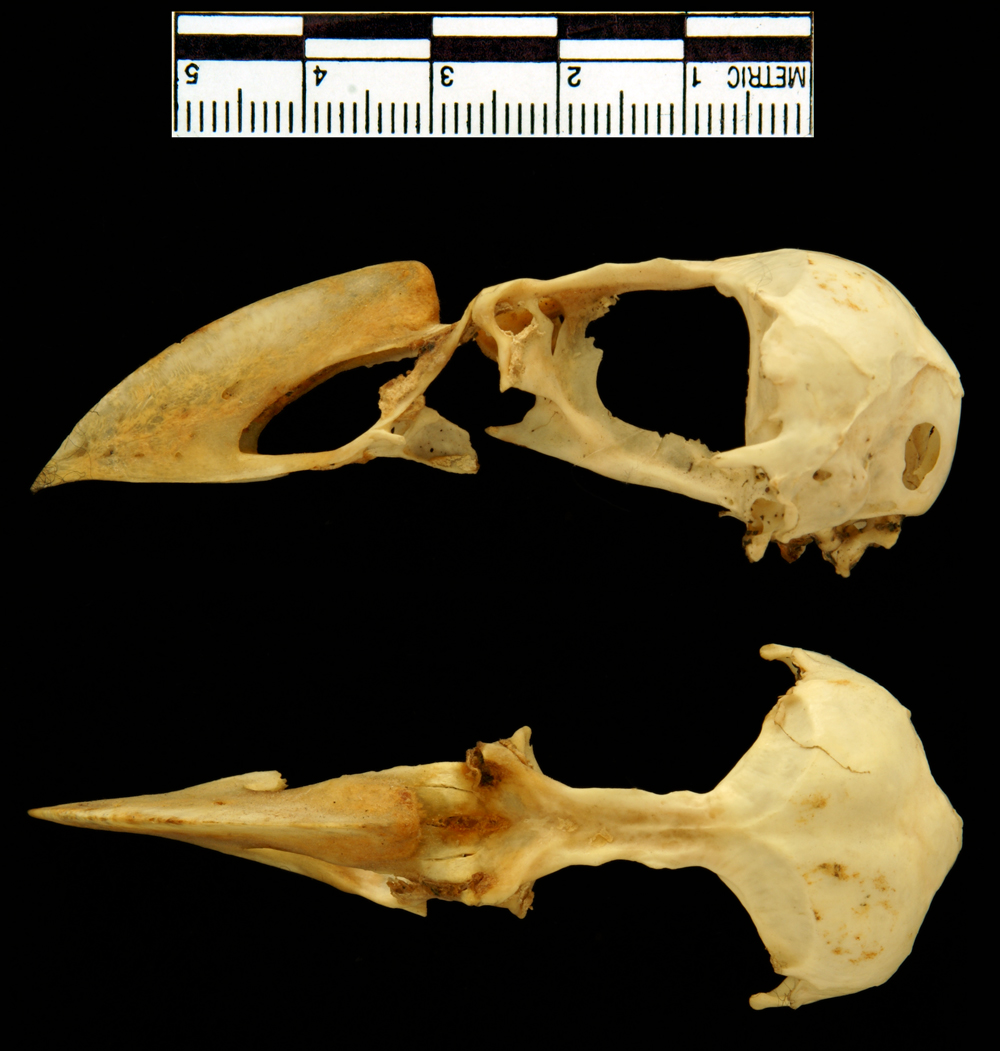
It’s not particularly complete, but the bill is very distinctive so most of you got the correct identification. Well done to Ric Morris, Barbara Powell, Jake, biologycurator, henstridgesj and Robin for spotting that this is the skull of a Continue reading
Today I have this bird skull for you to identify from the Horniman’s collections:
I think it’s a pretty characteristic one, but it’s not very complete, so let’s see how you do.
You can put your suggestions, comments and questions below and I’ll do my best to answer. Good luck!
On Friday I gave you this very distinctive object to identify:
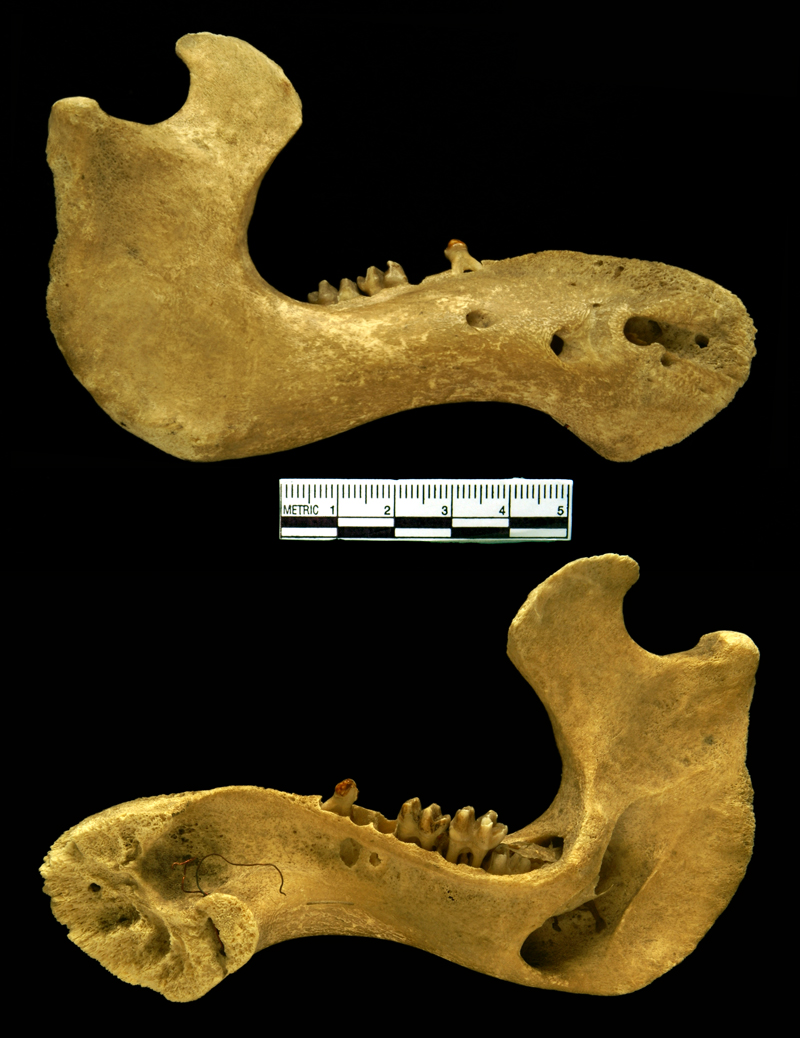
As I suspected, everyone correctly worked out it was a half mandible from a Sirenian – probably a Manatee. So well done to Barbara Powell, henstridgesj, Robin, Ric Morris, Rhea, rachel, Jake, Andrea and Jamie Revell for getting the main identification.
Of course, it got a bit more difficult when it came to making a species level identification, as is often the case. There are three well recognised species of Manatee – the West African, West Indian and Amazonian. There is also the Dwarf Manatee, which is a potential species in its own right or perhaps subspecies of the Amazonian Manatee.
Several people plumped for the Amazonian species or the Dwarf Manatee based on the fact that the jaw doesn’t look robust enough for the other species. However, this mandible is from a juvenile, so that was a bit misleading. Based on the hook of the coronoid process (the highest bit of the lower jaw where the temporalis muscle attaches) and the angle of the mandibular symphyseal region (the bit where the two halves of the lower jaw would have joined together) I think this is most likely to be what Barbara Powell first suggested, the Continue reading
This week I have a specimen that is pretty distinctive for you to have a go at identifying, so it should prove pretty straightforward for anyone who has seen one of these before:
Of course, if you haven’t seen one of these before it may be a bit more of a challenge!
You can put your suggestions, observations and questions below and I’ll do my best to reply. Good luck!
On Friday I gave you this fragment of an object to identify:

Many of the key features we look for when making an identification of a skull are in the facial region. The teeth are the most useful feature, but the relative proportions of the rostrum (muzzle) in the context of the whole skull and the particulars of the various elements that interconnect to make a skull all contain useful information.
It’s rather similar to recognising a person in fact – it’s much easier when you can see their face than it is when all you can see is the back of their head.
So how did everyone do? Well, there were various suggestions as to what it might be, but it was basically a guessing game, relying mainly on scale, gross morphology and the shape of the auditory bullae (aka the bulbous bit containing the ear bones). Most guesses focussed on the carnivores although there were some large rodents suggested.
I thought henstridgesj might have worked it out when he asked ‘Are the bullae double-chambered? Possibly, I can’t really tell, but if they are then it’s in the suborder Feliformia‘ and I answered in the affirmative, but the most obvious answer was somehow missed.
This object is almost certainly the rear part of the skull of a Continue reading
This week I am delving into a box of bits to provide a genuine mystery object. I expect I will be doing a few items from this box in the coming weeks, since I am reaching the end of my curatorial review of the Horniman’s mammal osteology collections and I have been left with just a few boxes of random odds and ends that have been on display or have been cut up and the other part put on display.
These items have no information with them at all, so each is a genuine mystery that I hope to solve – a process that starts with identification. Any idea what this might be?
As usual you can put your thoughts, suggestions and observations below and I’ll do my best to reply. Good luck!
Apologies for the late posting today – I’m on holiday and haven’t had a chance to post until now.
On Friday I gave you this object to identify:

It was immediately recognised as a primate by everyone, which is unsurprising, given the very characteristic enclosed bony orbits and set of four incisors in the premaxilla and mandible. The teeth were also commented upon by henstridgesj, who recognised that this is an Old World Monkey (Cercopithecidae), with two premolars on each side in both the maxilla and mandible.
Some people might argue with the classification of this specimen as a member of the Cercopithecidae, since the lack of a tail suggests that it’s an Ape of some sort, but the Hominoidea form a smaller clade within the wider Cercopithecidae clade, which means that this is both an Ape and an Old World Monkey.
The kind of Ape is a more tricky question, although the shape of the teeth and the size of the braincase in relation to the facial region rules out any adult Great Apes (Hominidae) – it could be a juvenile, but the degree of fusion of the bones says not. That leaves the ‘Lesser Apes’ (Hylobatidae) or Continue reading
This week I’ve got something that will probably be way too easy, but it’s a great specimen from the Horniman Museum:
Any idea what this cheeky looking chap might be?
I probably won’t get a chance to respond to comments today, although I will try. Good luck!
On Friday I gave you this object to identify:

There were fewer comments than usual, but those comments were impressively observant.
Lena got stuck in, identifying the element as a long, thin ungulate humerus and narrowing it down to a camelid. Mikolaj Lisowski noticed the low proximal epiphysis (the end of the bone that is connected to the shoulder) and suggested that it might belong to a Continue reading
This Friday I have a mystery object that may be a bit of a challenge. Any idea what this is, or more to the point, what it’s from?
As usual you can put your questions, comments and suggestions below and I’ll do my best to get back to you. Good luck!
Normally Monday mornings are the time that the answer to the mystery object is posted on my blog, but this weekend I’ve been involved in the Enlightenment Cafe, which has meant I’ve been too busy to write the usual full answer. Here are a couple of images of me doing my bit in the show (photo on stage courtesy of @sillypunk):
But excuses for tardiness aside, here is the mystery object I would have been writing a proper answer for if I wasn’t on a stage talking to a room full of people:

You all spotted that it was a type of canid (dog) straight away, but the species was a little bit more tricky. Many went for a fox of some kind, as it is quite a small specimen, but Barbara Powell, Jamie Revell and Ethan plumped for the correct answer of Continue reading
Apologies for the slight late running of this, my sesquicentennial Friday mystery object – I was giving a talk about mermaids last night that went on until quite late (and which had an exciting special guest), but more about that later.
I’ve been waiting to do this object for a while – it’s a favourite of mine, which is good, since it is part of my own personal collection. Any idea what it is?

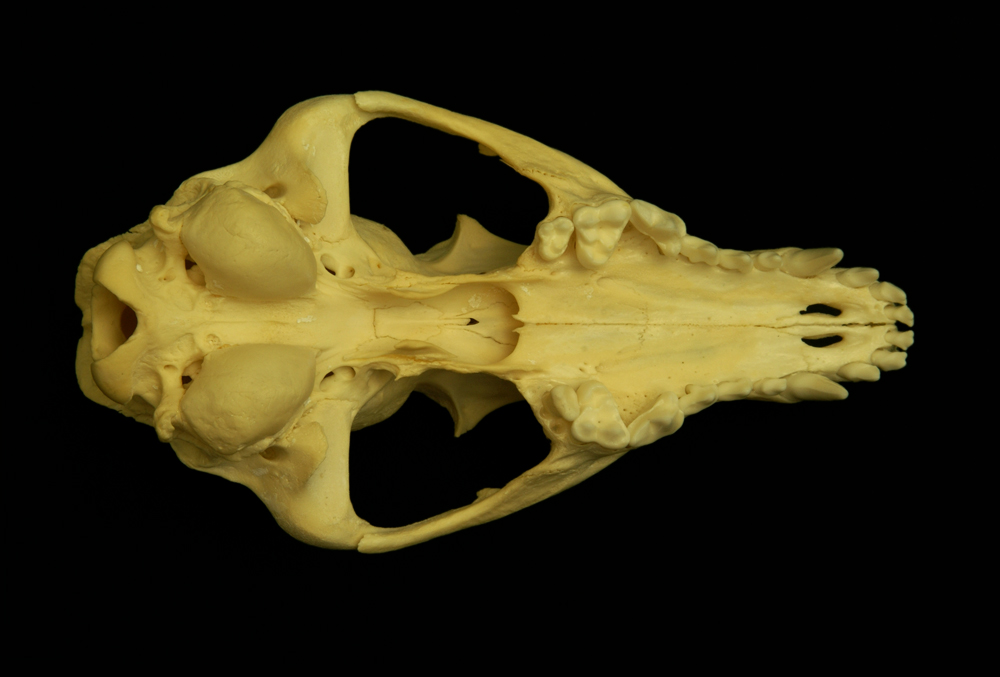
As usual you can put your questions, comments and suggestions below and I’ll do my best to respond. I will also add that I will have this specimen, along with the others in my collection, at the Enlightenment Cafe this Saturday and Sunday at the Old Vic Tunnels. There may also be the special guest who appeared at my talk last night, but that is a story for later… Good luck!
On Friday I gave you a bit of a spot-the-difference with these two skulls, wanting to know if they were two individuals from the same species or if they were from two different species:

I must say that it was a bit of a tricky identification without the added complexity of a between specimen comparison, yet you all did remarkably well.
As usual Jake was the first to comment, correctly identifying that the specimens are both rodents and squirrels at that. He also recognised that both were adult animals, although one was probably older than the other when it died, based on the degree of wear on the teeth (assuming the diet was similar). The squirrel identification was also supported by Will, henstridgesj, Dave Godfrey, Jamie Revell and Barbara Powell.
Barbara also picked up on the feature that made me consider that these specimens may have been from different species – the sutures between the premaxilla, maxilla, nasals and frontal bones that make up the rostrum (the nosey bit). This is something that Lena and Jamie Revell also commented upon.
The position of the sutures (or junctions) between the various bones that make up the rostrum can certainly be useful in diagnosing differences between species – it’s a handy one for distinguishing between Lions and Tigers for example:

However, in this case I don’t think that the differences between the sutures are all that diagnostic, I think the differences may simply be down to either sexual dimorphism (that’s where males and females of the same species develop differently) or differences between the ages of the individuals. In fact, given that the specimen with the more heavily worn teeth is smaller and less robust than the other specimen I wouldn’t be surprised if it was an older female and younger male of the same species that are being compared.
One of the reasons I don’t think the sutures are diagnostic comes down to timing of their fusion. According to Wilson & Sánchez-Villagra, 2009 the pattern of closure of the cranial sutures in rodents follows a fairly standard pattern, with the rostral elements being amongst the last to fuse. This suggests that those sutures are more likely to vary between animals of different ages and between animals with different life histories. That said, there are geographical variations in this species, so these specimens may represent individuals of different subspecies from different parts of the range – something I can’t check because there is no locality information with them (at least not that I’ve found yet).
With the spot-the-difference dealt with, I will leave you with the correct species identification as made by henstridgesj, these are the skulls of Continue reading
 Zygoma