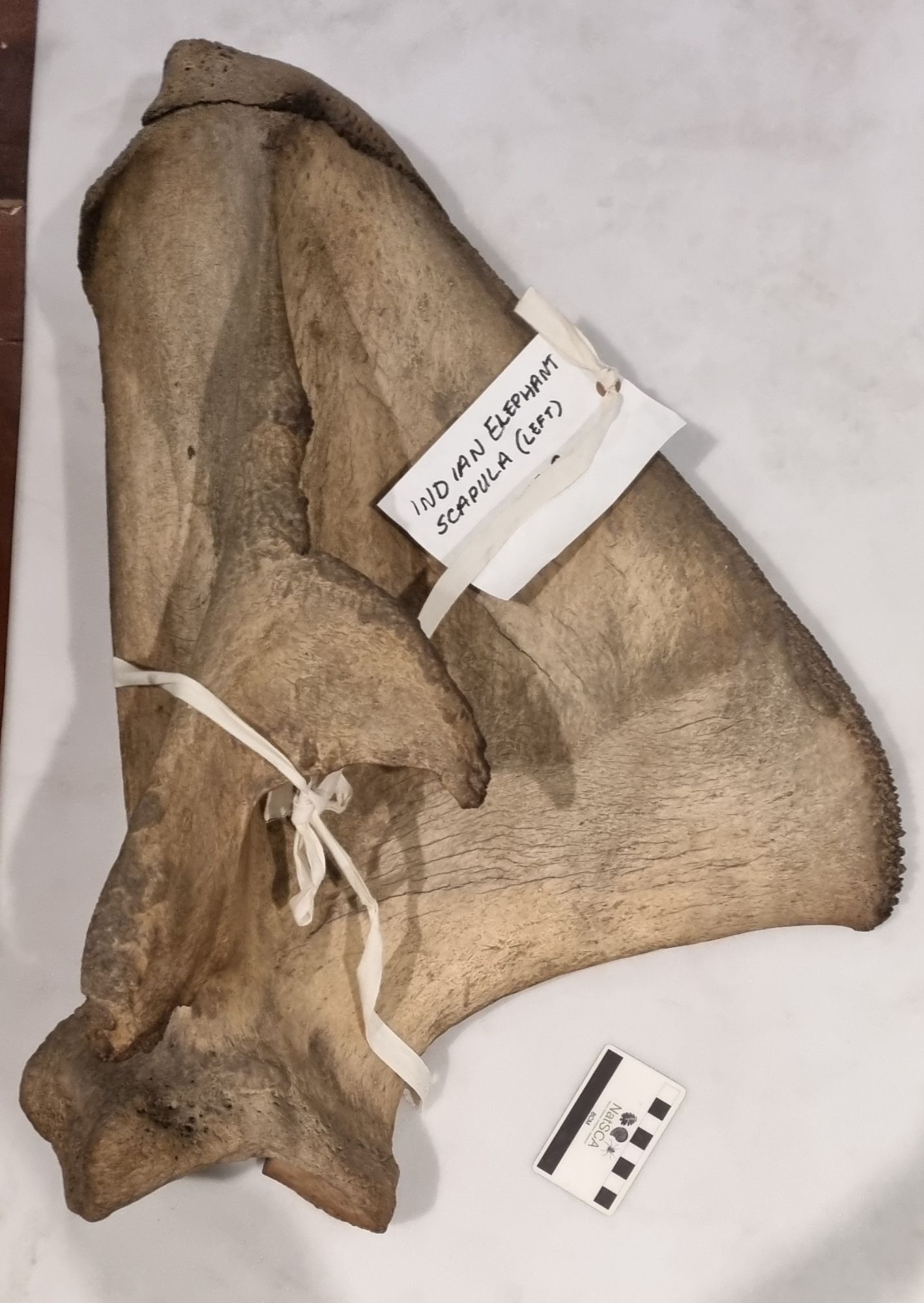
Friday mystery object #488 answer

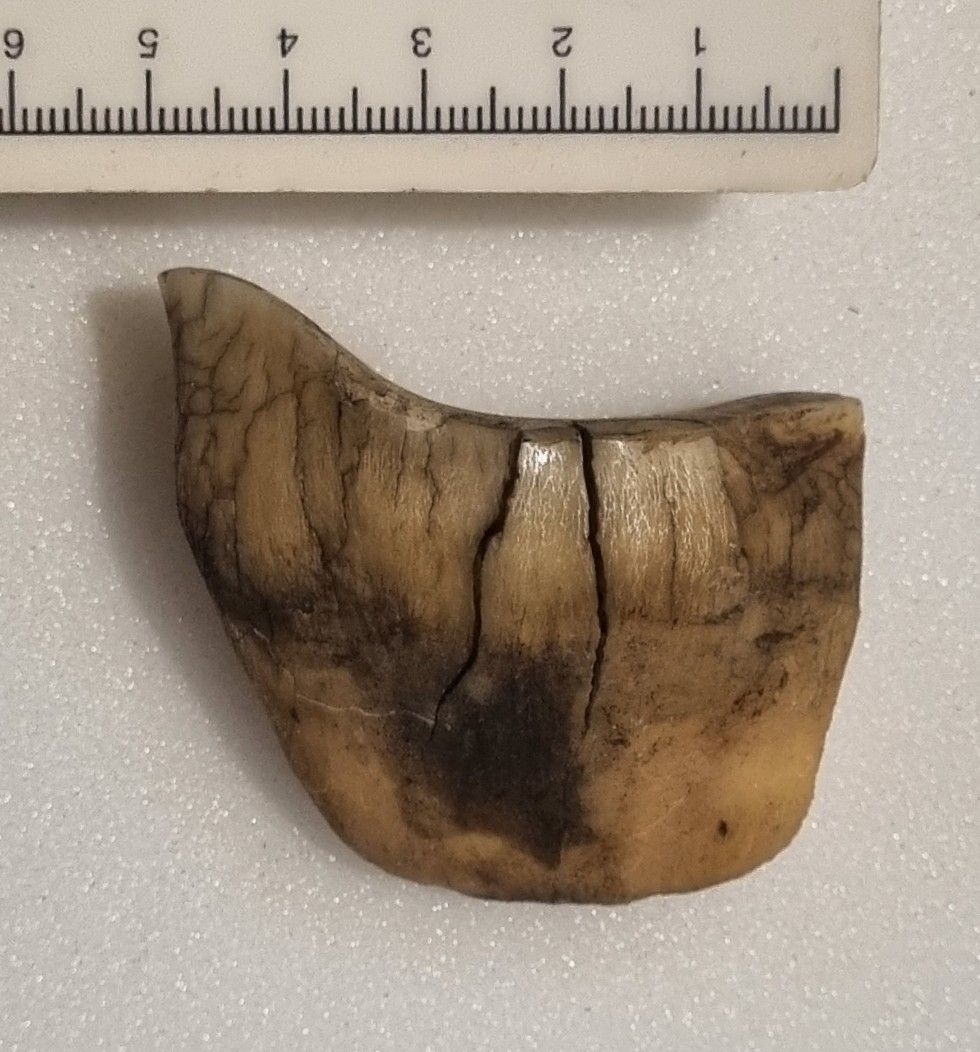
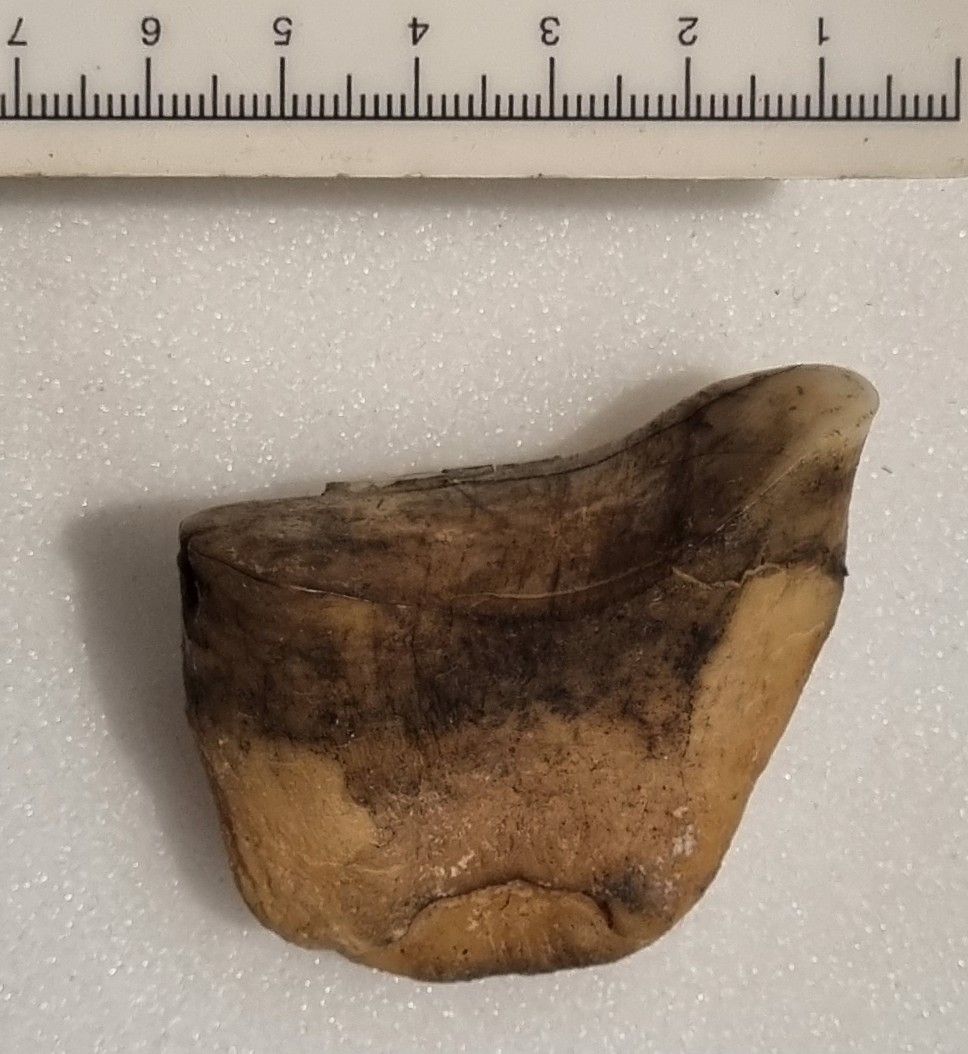
Last week I gave you this specimen to identify, from the collections of the Dead Zoo:

I thought it might prove a little challenging, and I wasn’t mistaken, although some people did manage to get very close. Chris Jervis was the first, but Adam Yates also provided a nice analysis of the specimen:

It is blade shaped without cusps, so the incisor of a large animal seems possible (I’m ruling out a Thylacoleo premolar on the basis of the broad wear facet on the occlusal surface and single root).

The root is really short so I’m guessing its a deciduous incisor.

Horses are large mammals with incisors of this sort of shape. If it were a horse it would be a third incisor because of its less square crown. As the high point (presumed mesial side) is on the left side it is probably a right incisor.

So my guess is a right deciduous incisor three of a horse.

Adam Yates June 7, 2024 at 10:20 am

Adam then followed up with a note about the size being too big for a horse, and leaned in to Chris Jervis’ suggestion – a good decision.

So what is it?

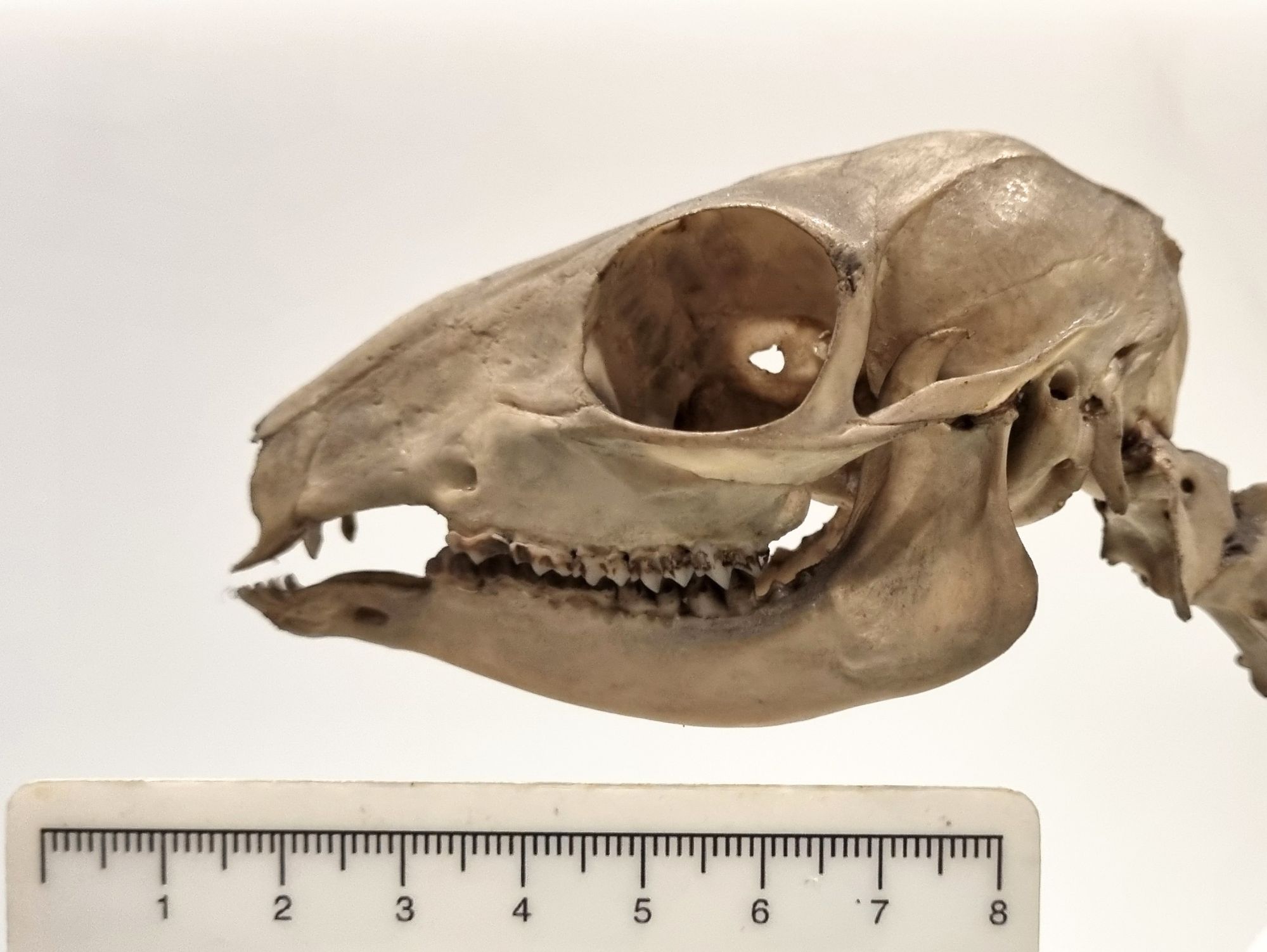
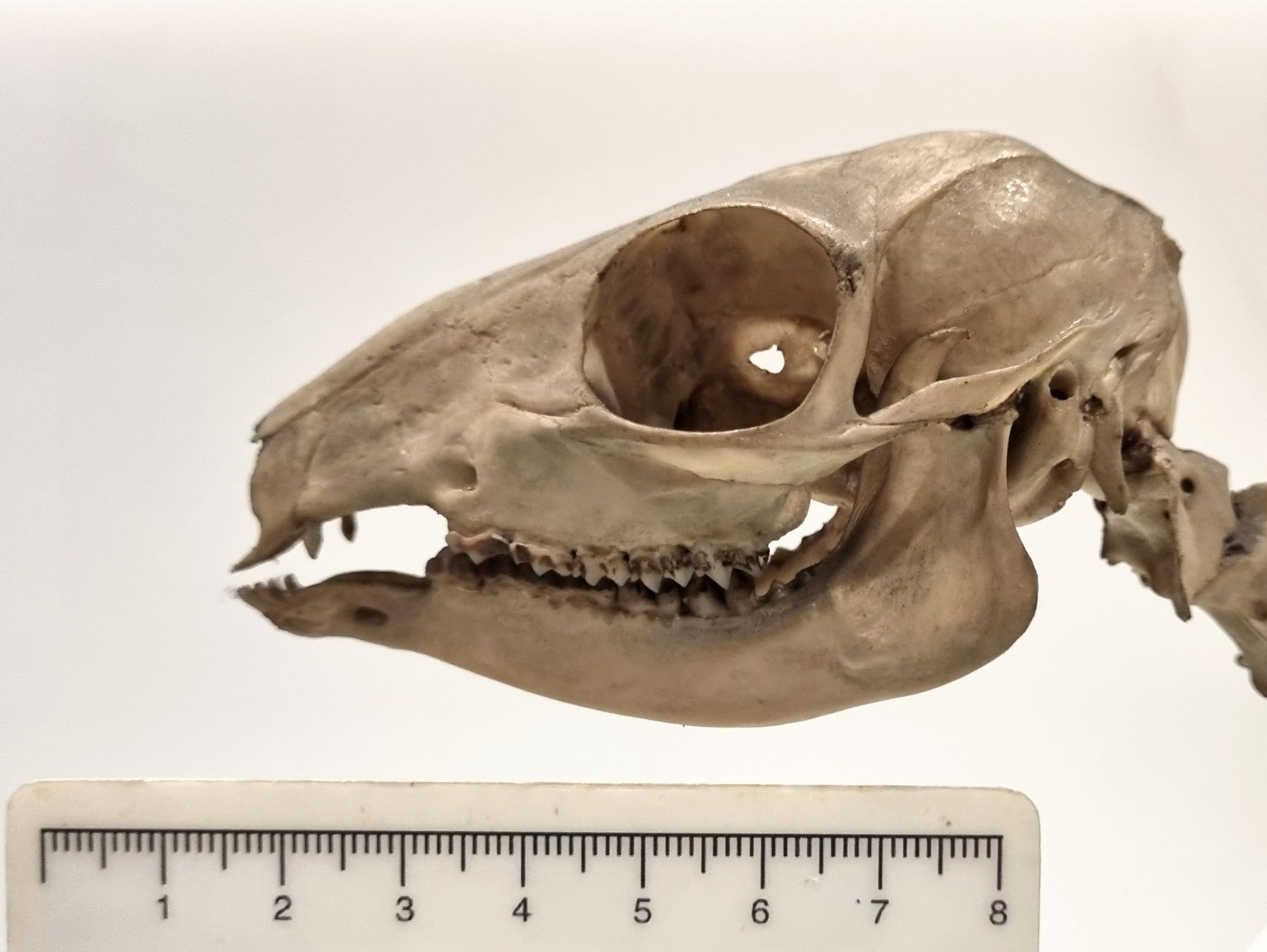
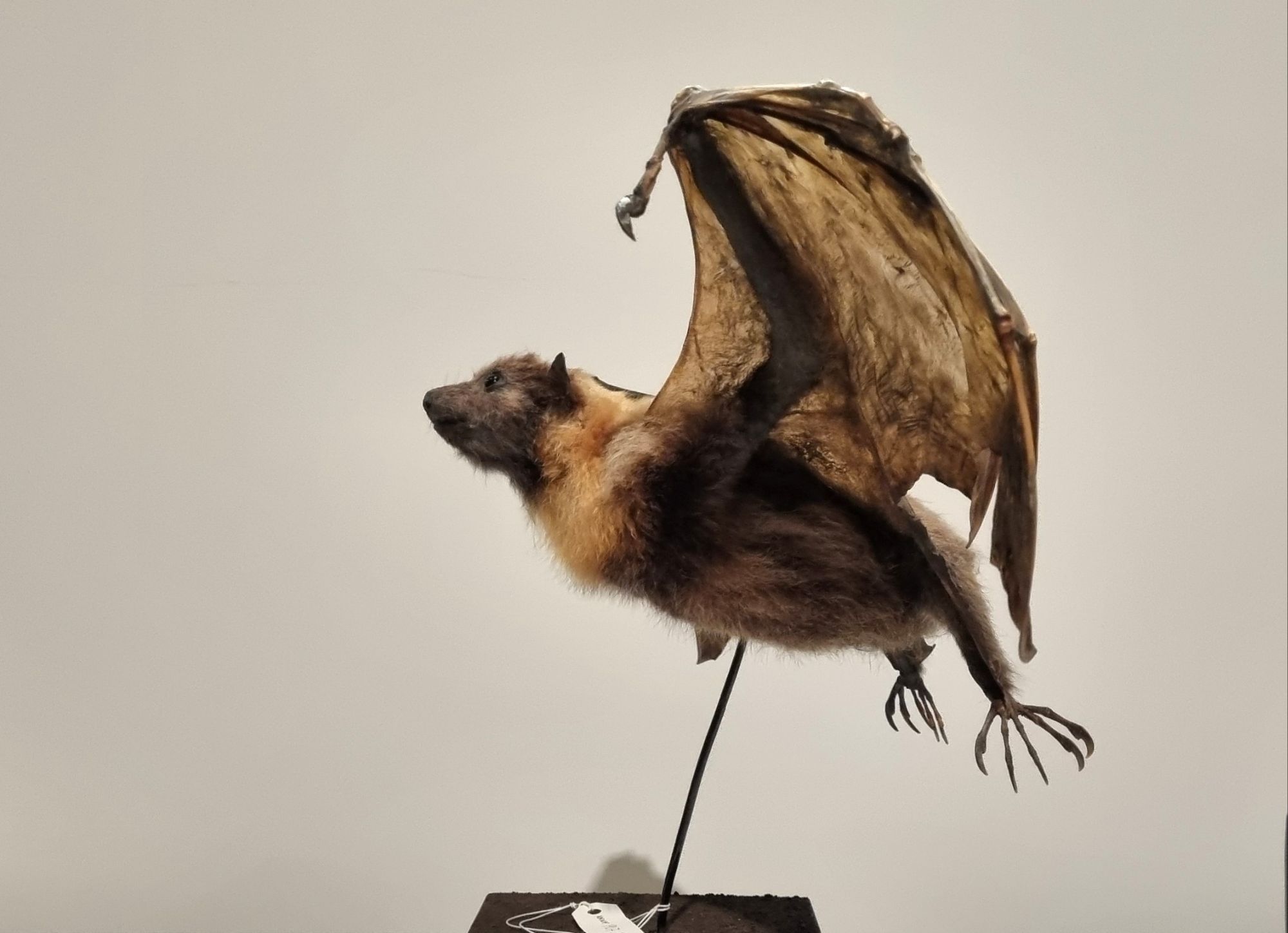
This is in fact the upper right incisor (or tusk) from the skull of an Indian Rhinoceros Rhinoceros unicornis Linnaeus, 1758:

African rhino species have lost their incisors, but the Indian Rhinoceros have incisors that form self-sharpening tusks with open roots, which are used in fighting.

The full specimen that this is from is a mounted skeleton that was on display in the Dead Zoo for a century or so, and the animal clearly had a very tough life, as it shows a variety of pathologies that have healed.

In the mandible there is a huge abscess at the base of the lower right tusk, possibly due to fighting or maybe a bullet wound:

The animal also has a variety of other injuries, including a bullet wound in the ribs:

and a major trauma to the lower front left leg, which has resulted in the humerus and ulna fusing together:

This would undoubtedly have been a very grumpy, very gnarly rhino. I’ve spoken a lot about rhinos in the past (including in a recent documentary series about the problem of rhino poaching and the wildlife trade), as they’re incredible animals that have been horribly exploited in the past, and still being horribly exploited today.

I have these photos of the specimen as over the last couple of weeks we have started the decant of specimens from the Dead Zoo in earnest, as we’re getting moving on a major capital developement project in the Museum, to solve a number of issues with access for the public, problems with the museum environment, and conservation of the 168 year old building.

Stay tuned for more updates on the project, as I suspect it will be keeping me busy for the next few years!

Friday mystery object #487 answer

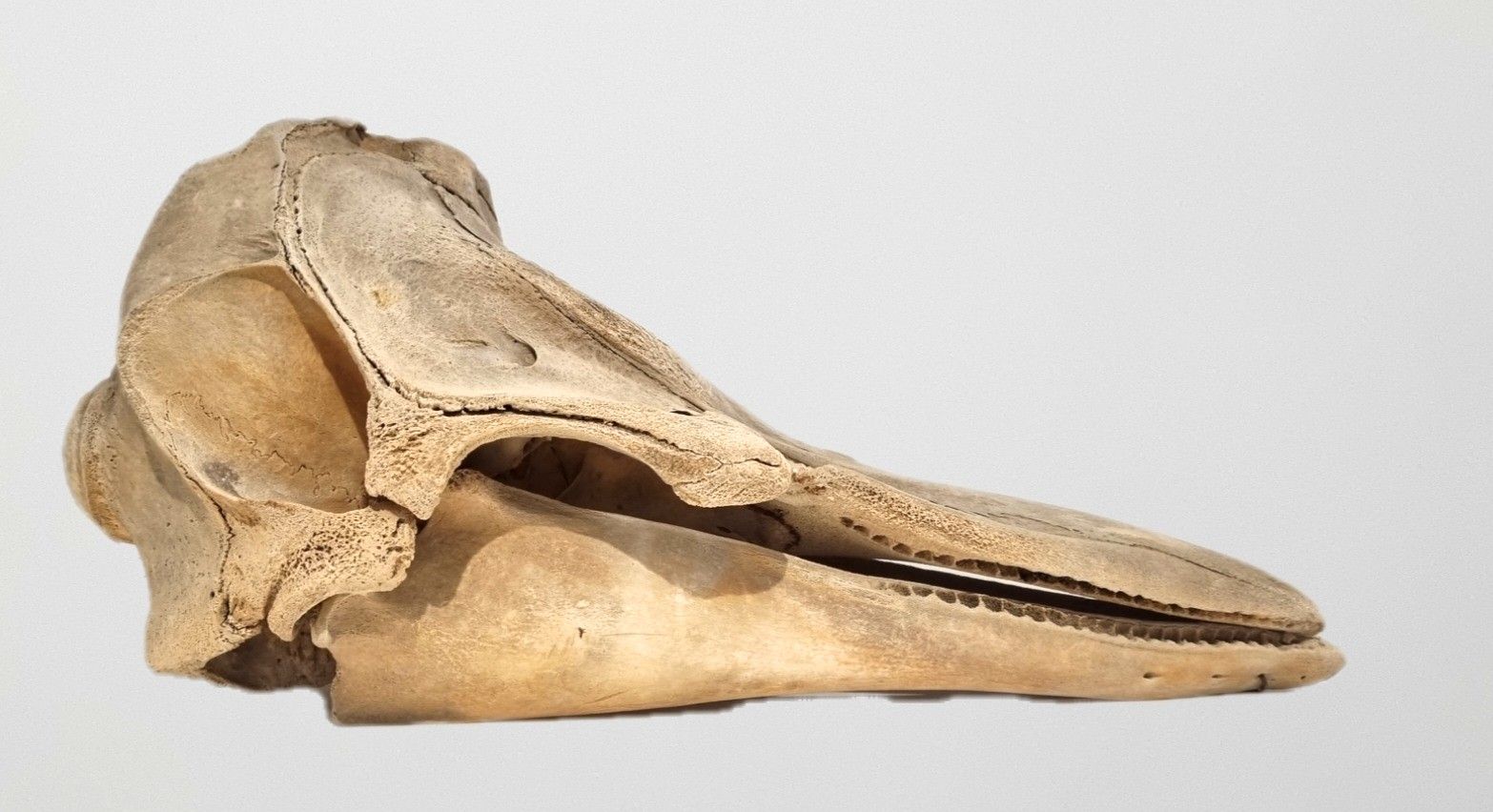
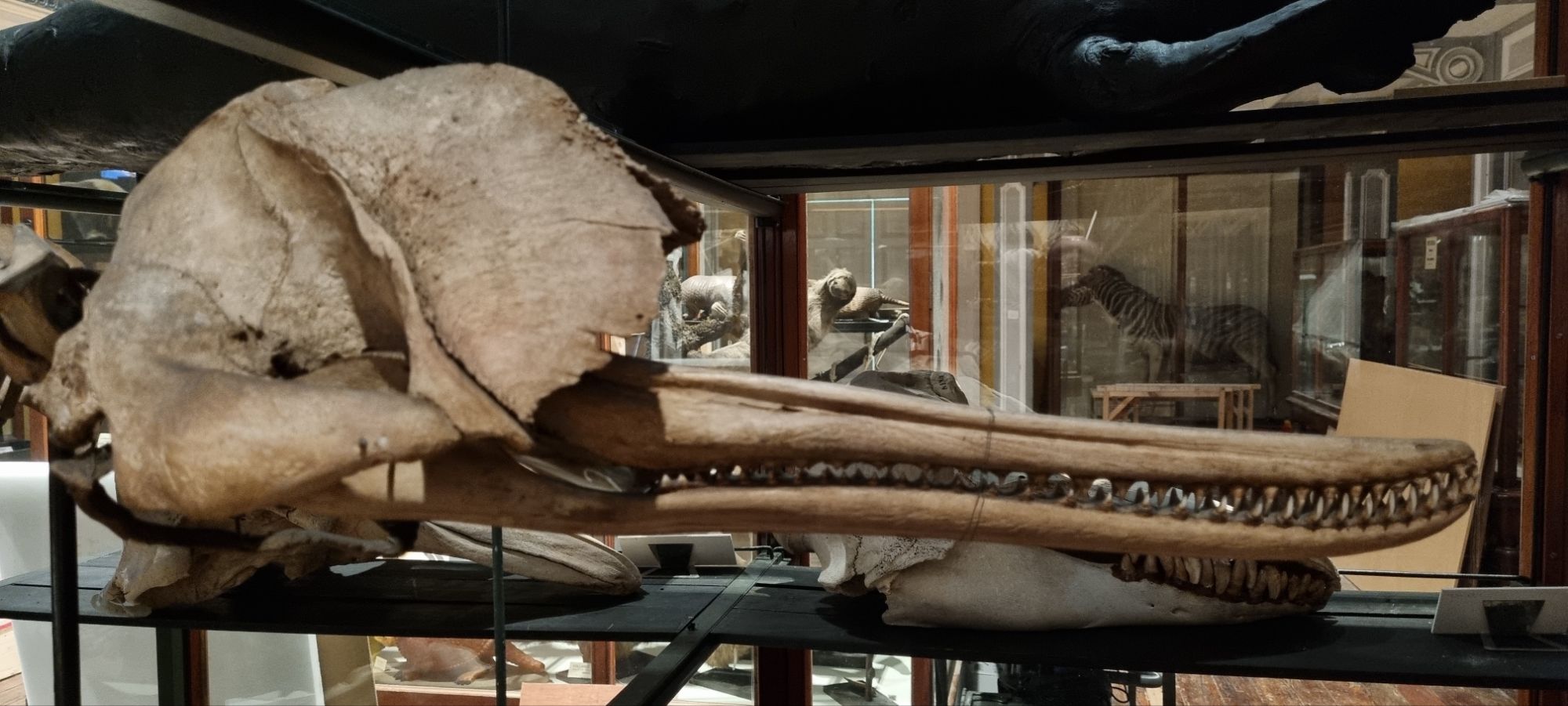
Last week I gave you this incredibly funky skull to have a go at identifying:

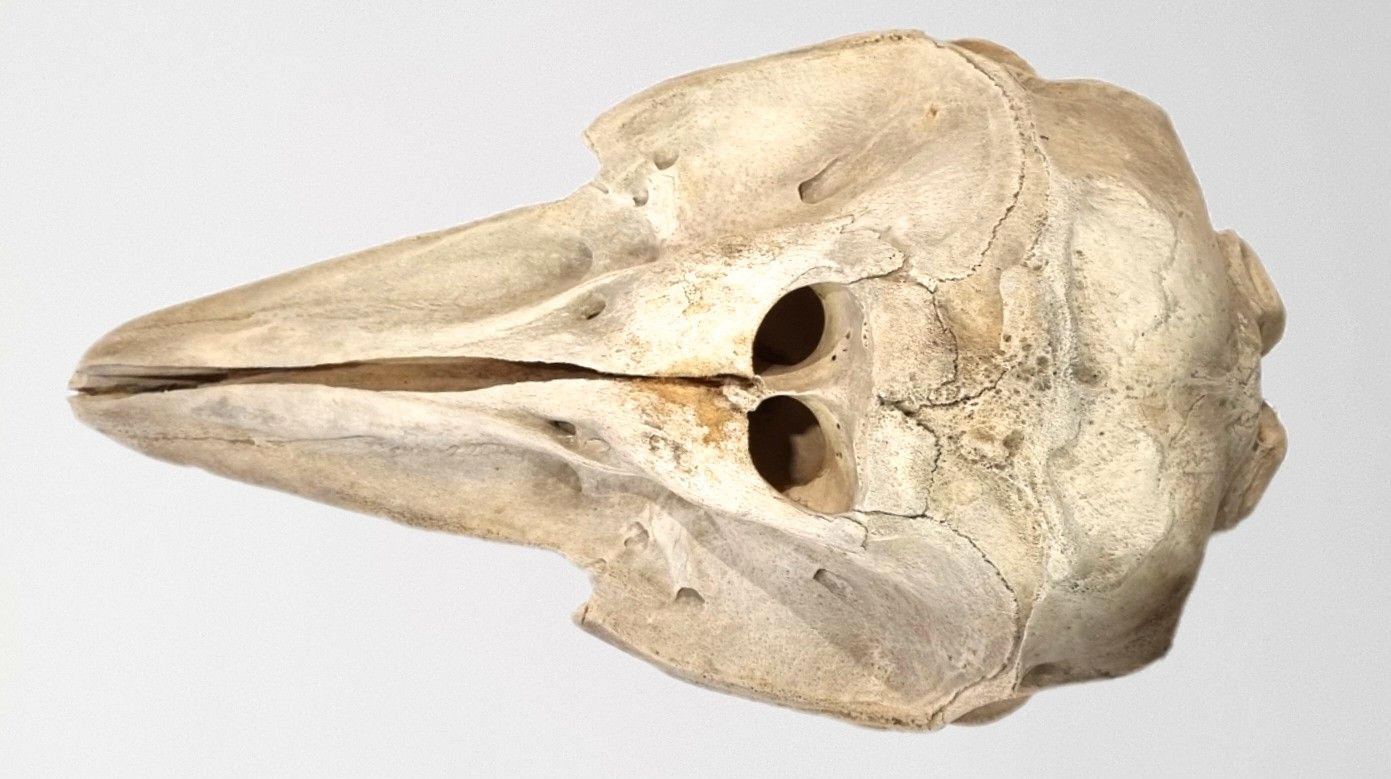
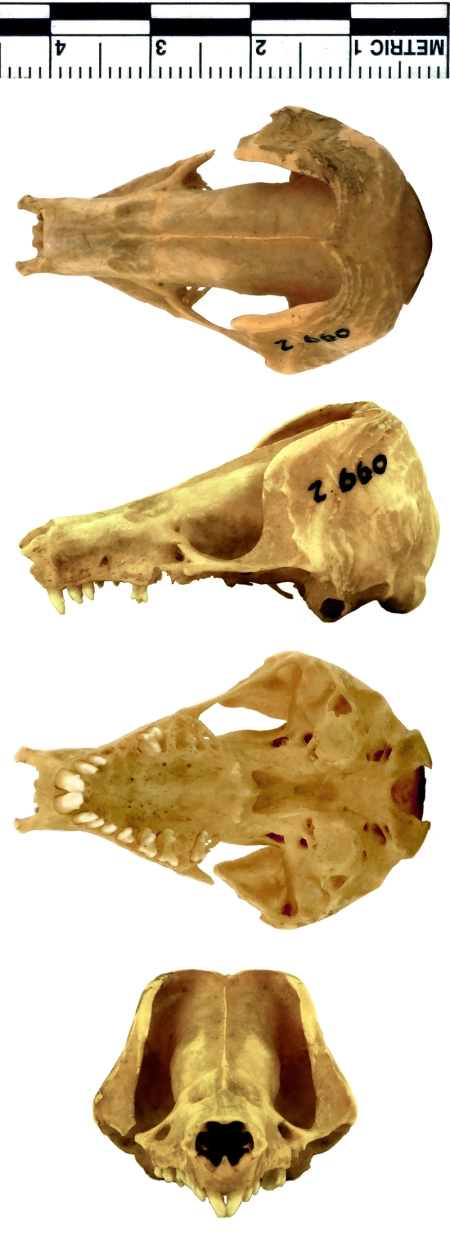
It’s from a very distinctive type of animal, which pretty much everyone figured out, thanks to those huge bony crests on the front of the cranium (actually originating from the maxilla). In life, these would have almost enclosed the animal’s melon (a waxy ball that helps focus sound transmitted through water), helping to improve echolocation.

This is of course the skull of a River Dolphin – which is a term given to a variety of riverine dolphins around the world – although only the Genus from South Asia (Platanista, as Chris Jarvis was the first to identify) has the characteristic bony crests. This is probably an adaptation to their reliance on echolocating in the sediment-laden and murky waters of the Indus and Ganges rivers.

As Adam Yates correctly pointed out in the comments, the tooth count suggests that of the two possible species, this is the Susu, Hihu, Shushuk, or Ganges River Dolphin Platanista gangetica (Lebeck, 1801).

These dolphins have almost lost the use of their eyes, with them being lenseless and merely used for detecting the difference between light and dark. This pushes them to rely on echolocation as their primary method of finding food.

I find it interesting that Giant Golden Moles have a somewhat similar crest structure to their skulls, while sharing this near blind condition (I’ve talked about this a little in a previous post):

As far as I’m aware the Giant Golden Mole has no melon, but it does have (relatively) huge ear bones, no external ear openings, and lives at ground-level rather than underwater, so it may be that the bony structure helps focus sound transmitted through the ground into the auditory region of the skull, in a way similar to that suggested for the South Asian River Dolphin’s crest, albeit in the water.

Speculation about comparative structures aside, the South Asian River Dolphins are incredibly well adapted to their habitat, which means that their populations are increasingly at risk due to changes arising from the climate crisis (such as changing annual rainfall and runoff patterns), farming practices (such as increased pesticide and fertiliser contamination of waterways), hydrological management (such as the installation of dams), plus hunting and accidental fatalities due to river traffic.

Similar pressures have almost certainly already pushed the Baiji or Yangtze River Dolphin into extinction, so let’s hope we can learn from the mistakes of the past, and ensure these strangely wonderful animals survive into the future.

Friday mystery object #487

This week I have a lovely specimen from the Dead Zoo for you to have a go at identifying. It’s very unusual looking, but as a result it’s very distinctive:

Any ideas what it is? If you recognise it, then please have a go at making your answer cryptic, so people who are less familiar have a chance to work it. I look forward to your responses and hope you have fun with them!

Friday mystery object #486 answer

Last week I gave you this specimen to have a go at identifying:

It’s not a specimen from the Dead Zoo for a change – this one is from the displays of Museo Nacional de Ciencias Naturales in Madrid.

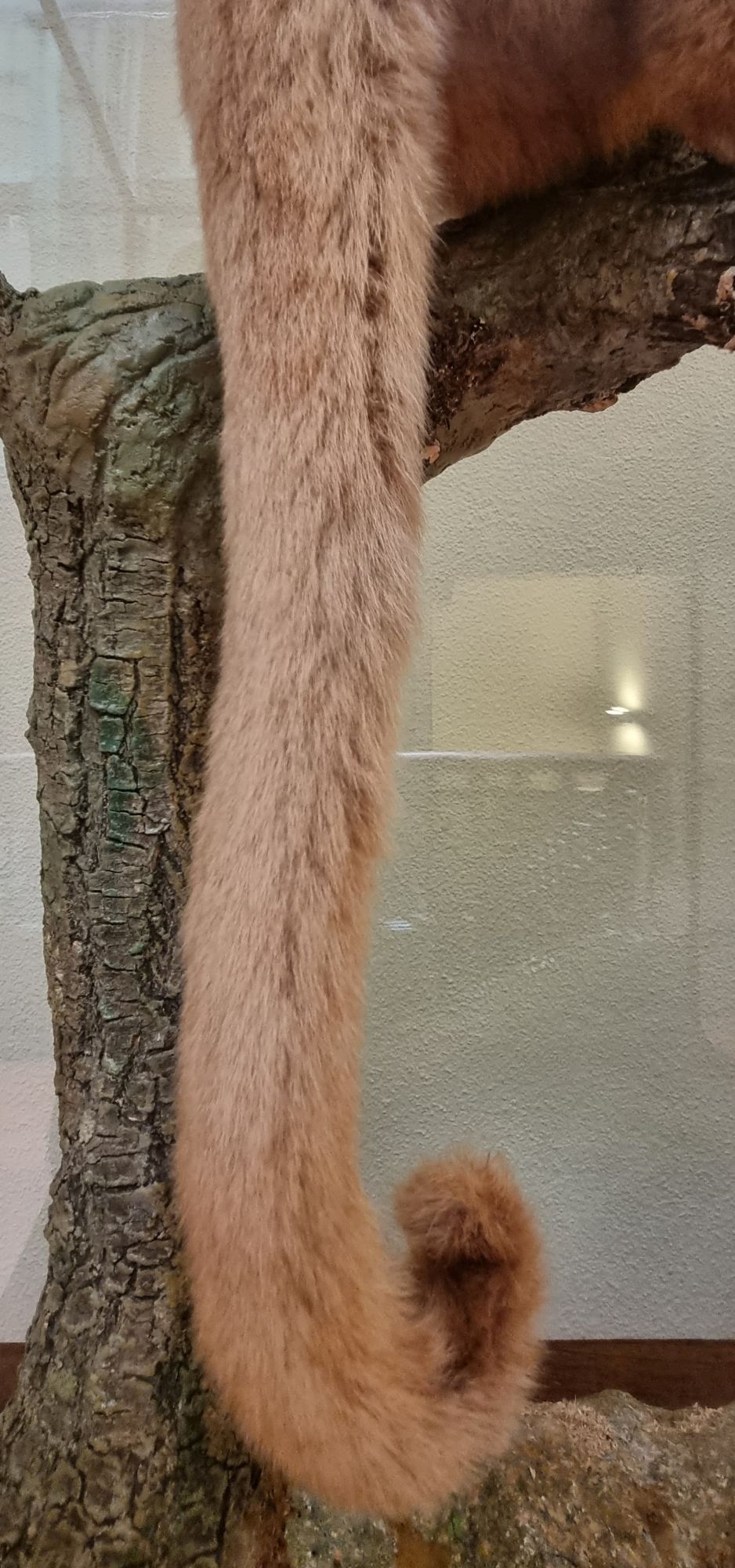
The image is missing the hind quarters and tails of the specimen, which was unfortunate, but also convenient for the purposes of the Mystery Object, since the tail on this specimen is very characteristic and would have made things a bit too easy:

Chris Jarvis came very close, with a nice cryptic hint at an Olingo – which is a member of the same small Subfamily that this species belongs to (the Potosinae), but Sallie Reynolds earned a gold star by asking the all important question about its tail.

The tail is important as a feature, since this specimen is one of just two species in the Carnivora to have a prehensile tail – the Binturong (which it’s not) and the Kinkajou Potus flavus (Schreber, 1774), which it is.

This is a species I’ve spoken about on the blog previously, so I won’t go into detail again here. I hope you enjoyed trying to work this one out – I love the fact that there are these lesser known, yet wonderful critters out there in the world – it reminds me of when I was a kid, just starting to discover the amazing diversity of life.

Friday mystery object #485 answer

Last week I gave you this fantastic skeleton from the Dead Zoo to identify:

I suspected that it wouldn’t prove too much of a challenge for most of the regulars here, as it is fairly distinctive – although possibly not all that familiar. However, there is another species that has some very similar convergent features, which did cause some confusion.

The skull is quite elongated and there is a series of simple teeth that line the upper and lower jaw:

This skull shape – plus the powerfully built body – is reminiscent of the first animal to come to mind for anyone with an alphabetical mindset; the Aardvark:

Aardvark skull LDUCZ-Z144 at the Grant Museum of Zoology, UCL

However, as you can see, despite the similarities, there are several differences between these skulls – particularly in relation to the eye (there’s a postorbital process in the Aardvark), cheekbone and teeth (Aardvark teeth are a lot more robust – I talked about them a bit in a post from 2017 if you’re interested).

In terms of differences from the Aardvark, there’s also quite an important feature presnt in the forelimb:

Aardvarks have four front toes, all of which are fairly uniform in size and all have long and robust claws for tearing into termite mounds, but the mystery object has a very odd toe configuration, with every toe different in size and shape, with one enormous sickle-shaped third claw (also useful for demolishing termite constructions).

This is a feature unique to the Giant or Great Armadillo Priodontes maximus (Kerr, 1792):

Bones of the manus of the Great Armadillo. Frank E. Beddard, 1902

So well done to Chris Jarvis, who was the first to identify the animal – but I must say that the clue he used to share his knowledge came with a parasitic earworm from which I’m still recovering…

Friday mystery object #485

This week I have a mystery object from the Dead Zoo for you to have a go at identifying, that might be a bit on the easy side for some of you:

Despite the fact that I don’t think it will be much of an identification challenge, I just wanted an excuse to feature this specimen, simply because I really like it. Perhaps you can share your thoughts on what it could be using some suitably subtle clue, or perhaps through the medium of rhyme, or even haiku?

Have fun with it!

Friday mystery object #484 answer

Last week I gave you this fantastic specimen from the Dead Zoo to have a go at identifying:

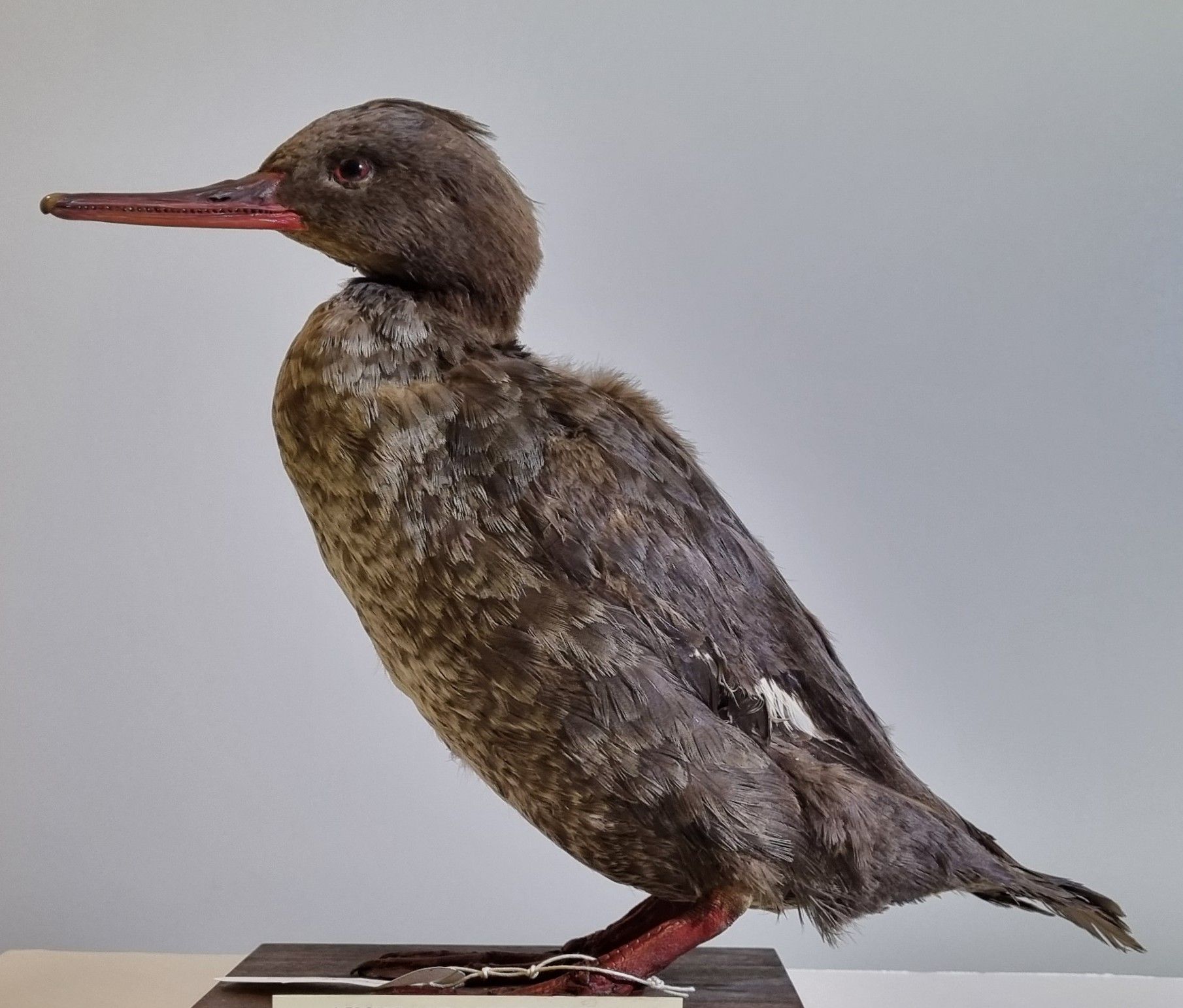
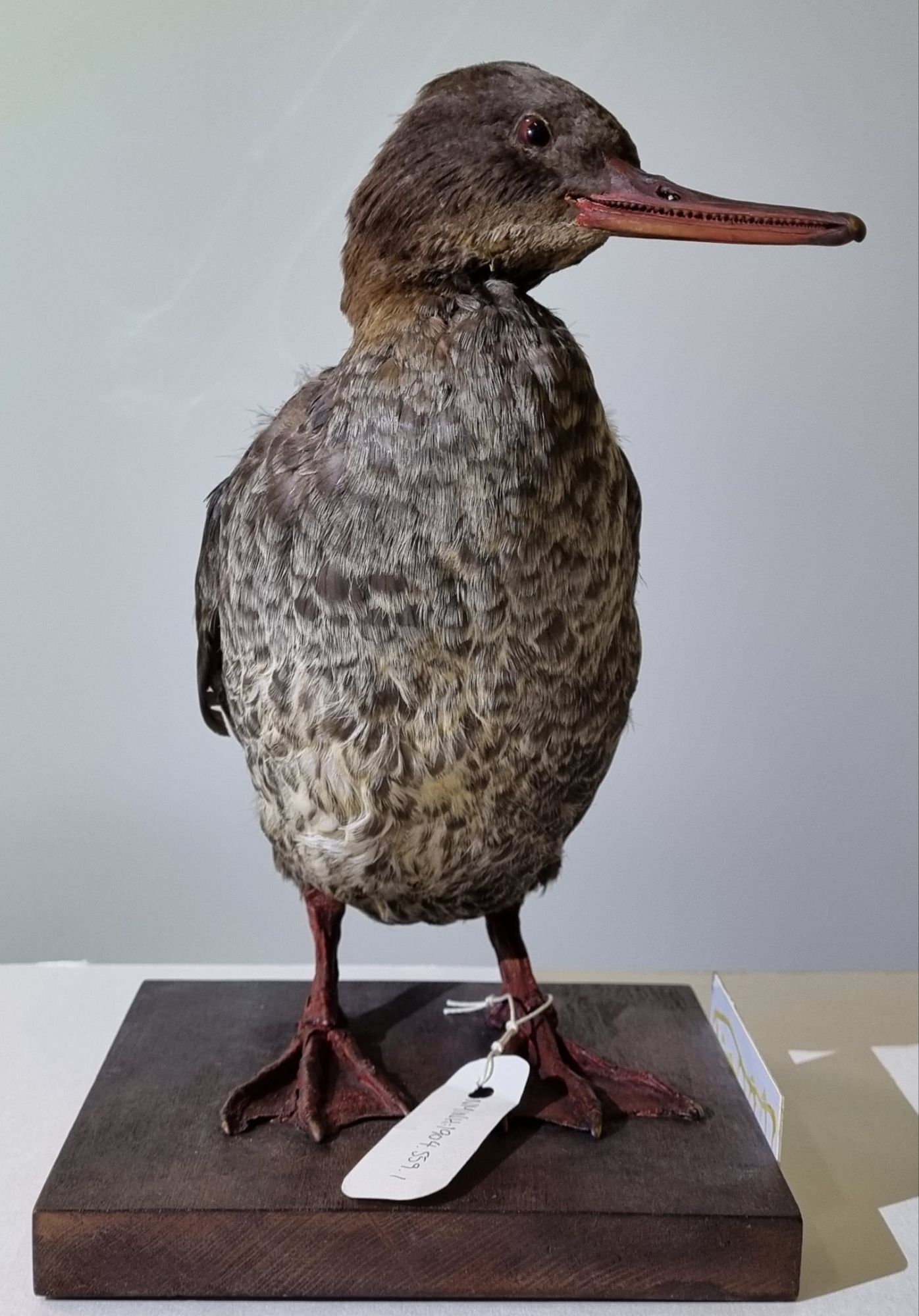
It wasn’t a hugely difficult object to identify, given its distinctive narrow serrated bill on a duck-like body, which are hallmarks of the mergansers – a genus of piscivorous ducks:

There aren’t many species of merganser – just six alive today, so on the face of it, there aren’t many to choose from. This particular specimen looks most like a juvenile Red-breasted Merganser, as several people suggested – but it’s not one of those.

This particular specimen is one of two other known merganser species that survived until historic times, but which are now extinct. The other species has no taxidermy specimens to represent it, and is only known from subfossil material from Chatham Island, off the coast of New Zealand.

Our mystery object is one of the very few taxidermy mounts that can show us what the Auckland Island Merganser (Mergus australis Hombron & Jacquinot, 1841) looked like. There are only 27 existsing specimens of this species in the world, most of which are preserved in fluid, and have lost most of their colour as a result – although ours is no doubt a little faded from the natural light in the galleries.

The Auckland Island Merganser is a good example of a species that did not survive contact with humans. Their original distribution was much more widespread on New Zealand and Chatham Island, but the arrival of Polynesian peoples led to their loss everywhere except on Auckland Island.

The arrival of Europeans and the pigs and cats they brought with them to Auckland Island pushed the population to the brink, and then hunting expeditions around the turn of the 19th to 20th century wiped out the rest. This particular specimen was shot on the 5th January 1901. One year and four days later the last pair were killed by the same man – Lord Ranfurly, the Governor of New Zealand.

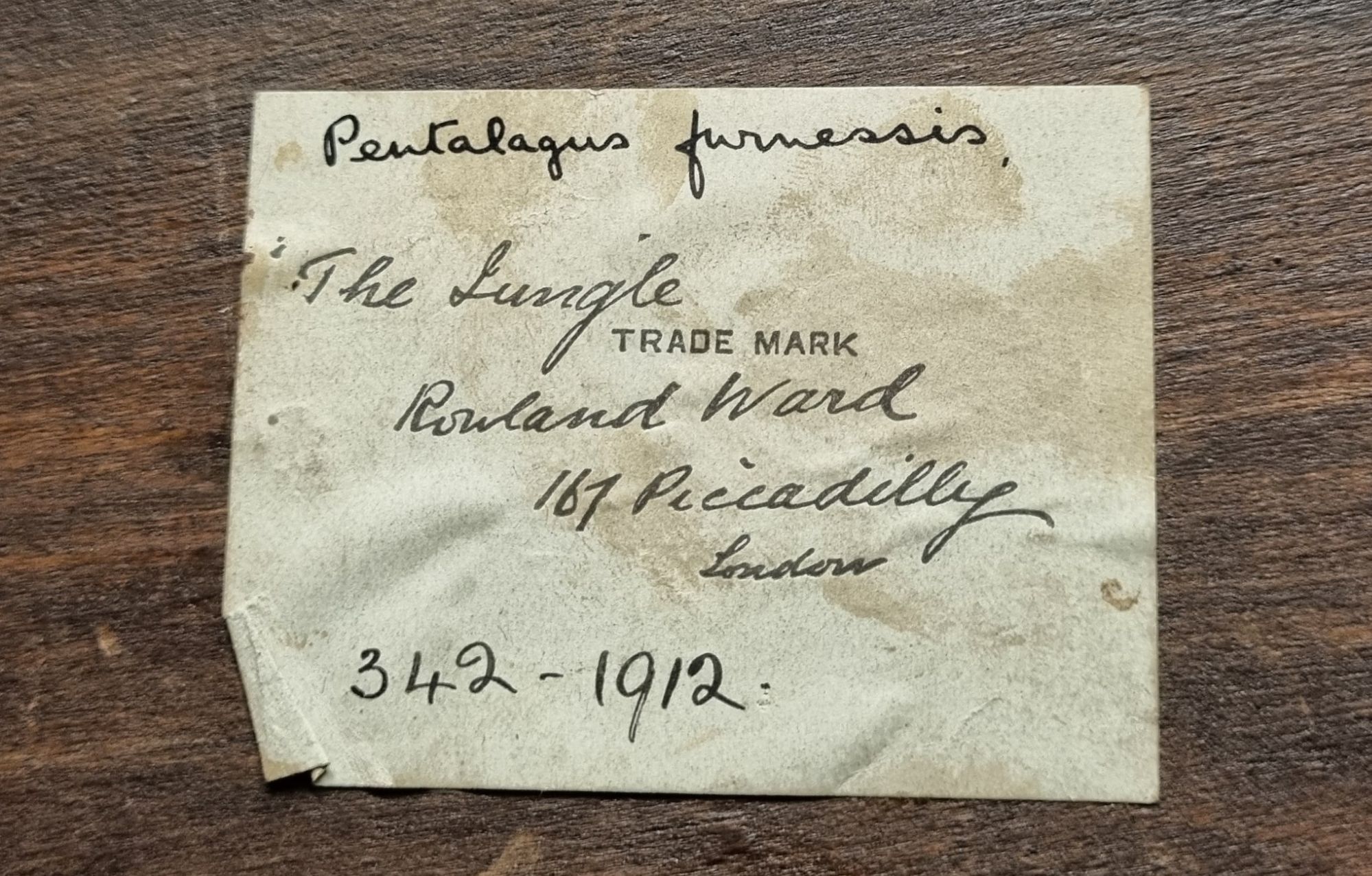
Ranfurly finished his term as Governor in 1904 and it seems likely that some of the skins of the specimens he collected in New Zealand returned with him. Some went to the British Museum (Natural History), while this one was prepared at “The Jungle” – Rowland Ward’s by shop at 167 Piccadilly, London before coming to Dublin.

It’s saddening to think that a species was pushed over the brink of extinction so deliberately, with no effort to preserve or protect it. Around the same time in North America the Passenger Pigeon became extinct in the wild, but at least the decline of the species had spurred efforts to preserve the remaining individuals in an effort to breed them. Meanwhile in New Zealand, it seems that the scarcity of the Auckland Island Merganser increased the demand for specimens, thereby sealing the fate of the species.

If you want to know more about the life and habits of these birds, New Zealand Birds Online is a great resource, with excellent information, so do check it out.

On a final note, I am currently attending the excellent NatSCA conference in Oxford at the moment, so extinct birds are very much on my mind. Later today I am looking forward to seeing the remains of the last fragments of surviving skin from the Dodo. We once shared our planet with these animals, and while it’s remarkable that we still have these specimens that help us understand what has been lost, it would be better if they had never been lost at all.

Friday mystery object #483 answer

Last week, with Easter in the air, I thought this specimen from the Dead Zoo might be appropriate:

Of course, it wasn’t as simple as this being a European Rabbit or ‘Mad March Hare’. Of the 70 or so species of rabbits and hares in the family Leporidae) found around the world, this one is rare and pretty special. In fact, it’s a special national monument in Japan.

As many of you managed to work out, this is an Amami or Ryukyu Rabbit Pentalagus furnessi (Stone, 1900). This species is dark haired (although the fading on this specimen doesn’t make this immediately obvious), they have relatively short ears and their legs are short compared to those of most rabbits. Generally this species is considered to be quite primitive – by which I mean they share a lot of characteristics with their rabbity ancestors who died out in mainland Asia over 2.5 million years ago.

The species is only found on two small islands off the southern end of Japan. This isolation helps explain their primitive status, since they would have been cut off from some of the same pressures that drove their ancestors to extinction. However, now their numbers are in decline and have been for the last century and more.

Where once hunting and trapping were the main threat (and this specimen acquired from taxidermist Rowland Ward in 1912 was likely acquired through that route), the main threats today consist of invasive carnivore species and habitat loss for golf courses.

Rowland Ward label on on the base of the specimen

It’s tragic to think that this species has managed to persist as a ‘living fossil’ for millions of years, only to be pushed towards the brink of extinction for the sake of a good walk spoiled.

Well done to everyone who recognised this unusual and interesting bunny!

Friday mystery object #483

Happy (Good) Friday everyone! It’s that time of year when a lot of people in the temperate zones of the Northern Hemisphere are thinking about the springing of Spring and all that entails in terms of flowers blooming, bees buzzing and cute little bunnies doing what they’re famous for.

To mark the upcoming celebration of the pagan fertility goddess Ēostre and the Christian festival of Easter, I have a suitably seasonal specimen from the Dead Zoo for you to have a go at identifying:

Any idea what species this fuzzball might be? I suspect that this may prove more challenging than you might expect, especially since this specimen is very faded by sunlight, so I’m keen to see if anyone can work it out. Have fun!

Friday mystery object #482 answer

Last week I gave you this specimen to identify, which came to me as an enquiry, after being found in the sea by a fisherman:

I don’t think it posed too much of a challenge, despite some damage, which has left sections looking a bit different to usual for this skeletal element – which is a section of the lower jaw or mandible.

This piece of the mandible includes the ramus (the rear part of the jaw behind the toothline where it rises up), coronoid process (the section of bone that rises up through the inside of the cheekbones, and where the temporalis muscles attach to power part of the action of the jaw) and the mandibular condyle (the hinging articulation point where the lower jaw meets the rest of the skull).

The scale bar shows that it’s fairly large, and the shape of the coronoid process and articular condyle are what I would consider to be quite distinctive to herbivores, since a long ramus isn’t well suited to resisting forces from struggling prey or meat-cutting bites.

From this point I find it’s useful to check an image I prepared earlier (and by earlier, I mean about 10 years ago):

A quick comparison makes it fairly clear that the mystery object is part of the mandible of a Cow Bos taurus Linnaeus, 1758, based mainly on the shape and orientation of the mandibular condyle.

There are of course species that could possibly turn up in Irish waters, that aren’t on my mandibles photo – in particular, Giant Deer, which Ireland seems to have a lot of. However, I have easy access to those specimens in the Dead Zoo and they have a similar mandibular condyle orientation to a Red Deer.

So well done to everyone who worked it out – I hope my explanation of the anatomy of the rear part of the mandible makes sense and maybe offers some pointers for identifications you might be faced with in the future!

Friday mystery object #480 answer

Last week I gave you this doe-eyed specimen from the collections of the Dead Zoo to try your identification skills out on:

I didn’t provide a scalebar as I think it would have made it too easy, but even so, it’s clear that the specimen is a very small species of artiodactyl (the group containing pigs, deer, antelope, bovids and a variety of related herbivores).

There were some suggestions that it could be a Dik-dik, but as Adam Yates pointed out, this specimen lacks the large preorbital glands that are very visible in Dik-diks (and makes them look like they got carried away with the eyeliner):

Dik-diks with their distinctive preorbital glands
The mystery object lacking preorbital glands

The other popular suggestion for the identity of the mystery object was a Java Mouse-deer (or Javan Chevrotain), which is the smallest ungulate alive. However, while that’s exactly what it says it is on the label, the location of collection rings alarm bells for me:

There are two species of chevrotain found in Singapore, and the Javan species is not one of them.

Of the two, one is the Greater Mouse-deer and the other is the Lesser Mouse-deer. The Greater, as you probably guessed, is on the large side for a chevrotain, weighing in between 5 and 8kg. This species also has a dark stripe from its nose to its eye, which is missing from the mystery object.

The Lesser Mouse-deer Tragulus kanchil Raffles, 1821 lacks the dark stripe and is almost as tiny as the Javan Mouse-deer, making it the most likely candidate for the mystery object:

Lesser Mouse-deer alongside some rodents

This specimen not only has that likely identification error on the label (easily done considering the complexities of chevrotain taxonomy across Southeast Asia), but it had somehow also had a completely incorrect label associated with it in the past, which said it was a Siberian Musk Deer – a species that’s on the small side, but by no means as tiny as this.

This specimen was of particular interest at the end of last year, when we had a visit by a group of researchers from Singapore, who are undertaking a fantastic project to digitise specimens collected from Singapore that are held in museum collections all around the world. The project is called SIGNIFY and the team were not only absolutely lovely people, but they achieved a huge amount of research and detailed imaging work in a very short time:

The SIGNIFY portable imaging setup in use on a specimen from the Dead Zoo bird skin collection

The SIGNIFY project has huge value for helping to understand the historic baseline biodiversity of Singapore prior to industrialisation, but it also helps foster links between organisations and allows the inextricably linked social and personal histories of collectors to be explored. I loved getting a chance to spend time with the team, learning more about their project and the collections I care for. It also turns out that we have a wealth of spiders from Singapore that still need to be investigated, so I really look forward to welcoming the team back soon!

The awesome SIGNIFY team with me in the Dead Zoo

Friday mystery object #479 answer

Last week I shared this fuzzy critter as mystery object for you to identify:

It was probably a bit of a mean one, as I didn’t provide a scalebar. It’s also a species from a group of small carnivores that contains over 30 species that can look quite similar, and (perhaps most importantly) the specimen is old and very faded from being on display in a gallery space with lots of light for the last 100 years or more.

Natural light in the Dead Zoo, image taken in May 2020.

Regardless, Chris Jarvis figured it out (after an initial near miss), while I believe that Joe Vans cheated by checking out the 3D tour of the Dead Zoo. Most other comments on social media came close, with a lot of people working out that this is a Mongoose, but then not quite getting the species.

This specimen is a Common Kusimanse Crossarchus obscurus G. Cuvier, 1825. These are also known as the Long-nosed Kusimanse, as their snout is a bit more elongated than that of most other Mongooses (or should that be Mongeese?):

The Common Kusimanse is one of the African Mongooses in the Subfamily Mungotinae. They are a good bit shorter than most of the other species of Mongoose – for comparison here’s this specimen next to a Small Indian Mongoose (well, that’s what the label says, although I have some doubts):

They are normally a dark brown colour, like this example:

Common Kusimanse by LA Dawson, 2006.

However, the Dead Zoo specimen is now bleached blonde, so I’m not surprised that this identification was tricky. Fading leads to all sorts of issues for the accurate representation and identification of species, to the point where the Giant Panda on display in the building had to be dyed black in places a few years ago, because it had ended up looking like a Polar Bear cub due to the sun damage.

At the moment that’s no longer an ongoing issue in the Museum, as a temporary floor has been installed just beneath the old glass ceiling, to allow investigations on the roof space to take place – this blocks almost all of the natural light. This has been great for conditions in the building, as it no longer heats up like a greenhouse on sunny days, and the bleaching of the specimens has been put on hold.

At some point the tempoprary floor will be removed, but I sincerely hope that a more permanent solution to the light issue will have been put in place by then. Still plenty of work to be done to get to that point though!

Dead Zoo with temporary floor installed to allow roof access. This blocks the natural light and keeps the environment more stable.

Friday mystery object #478 answer

Last week, I gave you this shiny blob to have a go at identifying:

There wasn’t much to go on, since it is just a blob that looks like a chunk of hardened tar, but it is in fact a rare and valuable natural material. It’s actually a small piece of ambergris.

Ambergris has always maintained an air of mystery, since it’s formed deep within the bile duct of a Sperm Whale and its function in the animal is still only suggested rather than fully understood. General agreement seems to be that this tarry substance provides protection for the intestines from the sharp beaks of the squid that Sperm Whales prefer to eat.

Evidence for this comes from the fact that squid beaks are often found embedded in ambergris – an observation recorded from as early as 1725:

An essay upon the natural history of Whales, with a particular account of the ambergris found in the Sperma Ceti Whale. In a letter to the publisher, from the Honourable Paul Dudley, Esq; F. R. S
Published:30 April 1725https://doi.org/10.1098/rstl.1724.0053

This letter goes on in some detail about various whale species, offering details of their economic yield in terms of barrels of oil, quantity of whalebone (baleen) and medicinal uses of teeth, as well as some aspects of their biology. When the discussion gets onto ambergris, much of the focus is on its location in the whale and the method of extraction (N.B. it’s not pretty.)

Of course, the suggested function of ambergris as a mechanism to aid the passing of sharp objects through the gastrointestinal tract would indicate that ambergris also might emerge naturally, and doesn’t necessarily need to be ripped from an unwilling victim.

However, evidence for this is quite hard to find, since it’s remarkably difficult to follow a Sperm Whale and keep track of its bowel movements or regurgitations (which have also been suggested as an exit route for these masses of indigestible items). What is known is that ambergris can be found floating at sea and washed up on beaches, sometimes persisting for years (there has even been fossilised ambergris discovered in Italy).

This non-invasive method of harvesting ambergris by beachcombing may not be hugely efficient, but it supplies the majority of the ambergris now used in perfume manufacture. Yes, you heard me right.

Human interest in ambergris may seem surprising given its somewhat revolting source, but as we all know, humans are pretty weird when it comes to making use of the fruits of nature, especially when searching for ingredients for perfume – just think of the African Civet and its anal excretions.

The natural complex aromatic compounds found in waxy substances like ambergris and civet musk provide long-lasting base odours that have played an important role in creating perfumes for centuries. Modern chemical synthesis of similar products has taken over to a large extent, but the naturally occurring compounds are still in use today.

This particular blob of ambergris was photographed when we were getting it out for sampling to inform a rather different line of scientific questioning, since there is still a lot to learn about this very unusual natural material.

Friday mystery object #477 answer

Last week I gave you this mystery object from the Dead Zoo as a way to kickstart 2024:

While it does indeed look a bit like an old Roman shoe (thanks Adam Yates – I will never unsee that now), these are in fact the gill rakers from a Basking Shark Cetorhinus maximus (Gunnerus, 1765).

This was spotted early on by Dennis Nieweg and several other people worked it out, both here and on social media (Mastodon, Bluesky and LinkedIn). However, there were also a lot of suggestions of whale baleen, which is not surprising, since they perform the same function in filter feeding on plankton.

Basking Sharks are the second largest fish on the planet reaching around 8m in length, although they trail behind another far bigger filter feeding cartilaginous fish, the Whale Shark, by quite a margin (the Whale Shark can be twice as long). These two species have little overlap in their ranges – with the Whale Sharks in tropical waters and Basking Sharks in the temperate marine zones:

Range of basking shark (Cetorhinus maximus). Map by TheEmirr, 2012
Range of the whale shark (Rhincodon typus).
Map by TheEmirr, 2011

Basking Sharks occur in the waters around Ireland, where this specimen was collected. The Dead Zoo also has a full taxidermy specimen collected off the coast near Galway in 1870, which has pride of place hanging from the ceiling in the Ground Floor Irish Room:

At the moment this specimen appears to be wearing a nappy – and this isn’t intended to capitalise on the popularity of the “baby shark” earworm, it’s an emergency stabilisation of the specimen. This became necessary after the rudimentary taxidermy (the skin is basically nailed to a barrel-built internal frame along the top of the specimen) failed in last summer’s unusually humid conditions and the skin started to fall off.

A proper repair will eventually be undertaken, but that will require lowering the specimen from the ceiling and transporting it offsite so it can be fully assessed and conserved. This is a big job, and this year we will be kicking off the next stage in a major capital project in the Museum, to deal with lack of physical access and problems with the environment – including the high humidity issue, so it’s just one big job alongside many, many others.

As the project gains momentum I hope to be able to share some of the work that takes place here on Zygoma, as well as through social media channels – so be sure to watch this space for updates. Here’s looking forward to an exciting 2024!