Friday mystery object #503 answer

Last week I gave you this very tricky object to have a go at identifying:

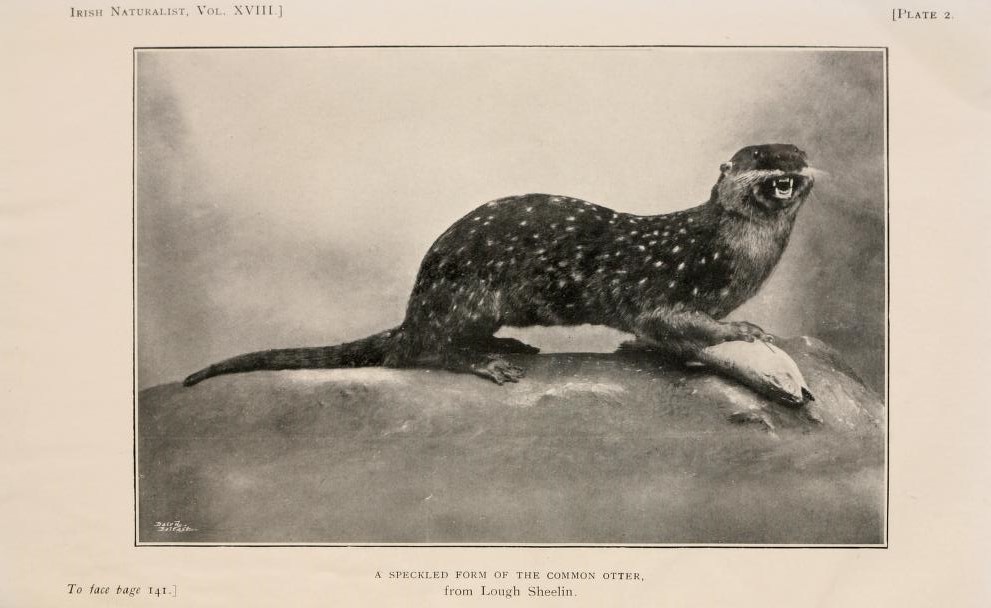
It certainly proved a challenge and I have to admit to feeling a little guilty about setting such a difficult one. The reason it was such a challenge is because this is an abberant form.

I’m not sure if anyone worked it out fully, but katedmonson dropped in the word “Oughter” and Adam Yates spotted that it has a long-slung body that looked like it might belong to a mustelid… which it does.

This is in fact a Eurasian Otter Lutra lutra Linnaeus, 1758 – a particular noteworthy specimen due to its speckles:

And when I say it’s noteworthy, I mean there was a note written about it – published in Volume 18 of The Irish Naturalist in 1909. It’s an interesting note, that draws on the experience and knowledge of Mr Williams, the hugely experienced taxidermist who prepared the specimen – along with many others in the Dead Zoo.

Here’s the note for your perusal, and while we’re talking about notes – it’s worth noting how much darker the fur is in the photo from 1909 – this is the problem we have with fading due to light over time:

Thanks for all your thoughts on what it could be – it was really interesting to see how everyone went about solving this one!

Friday mystery object #497 answer

Last week I gave you this guest mystery object from Andy Taylor FLS (and now) FBNA to identify:

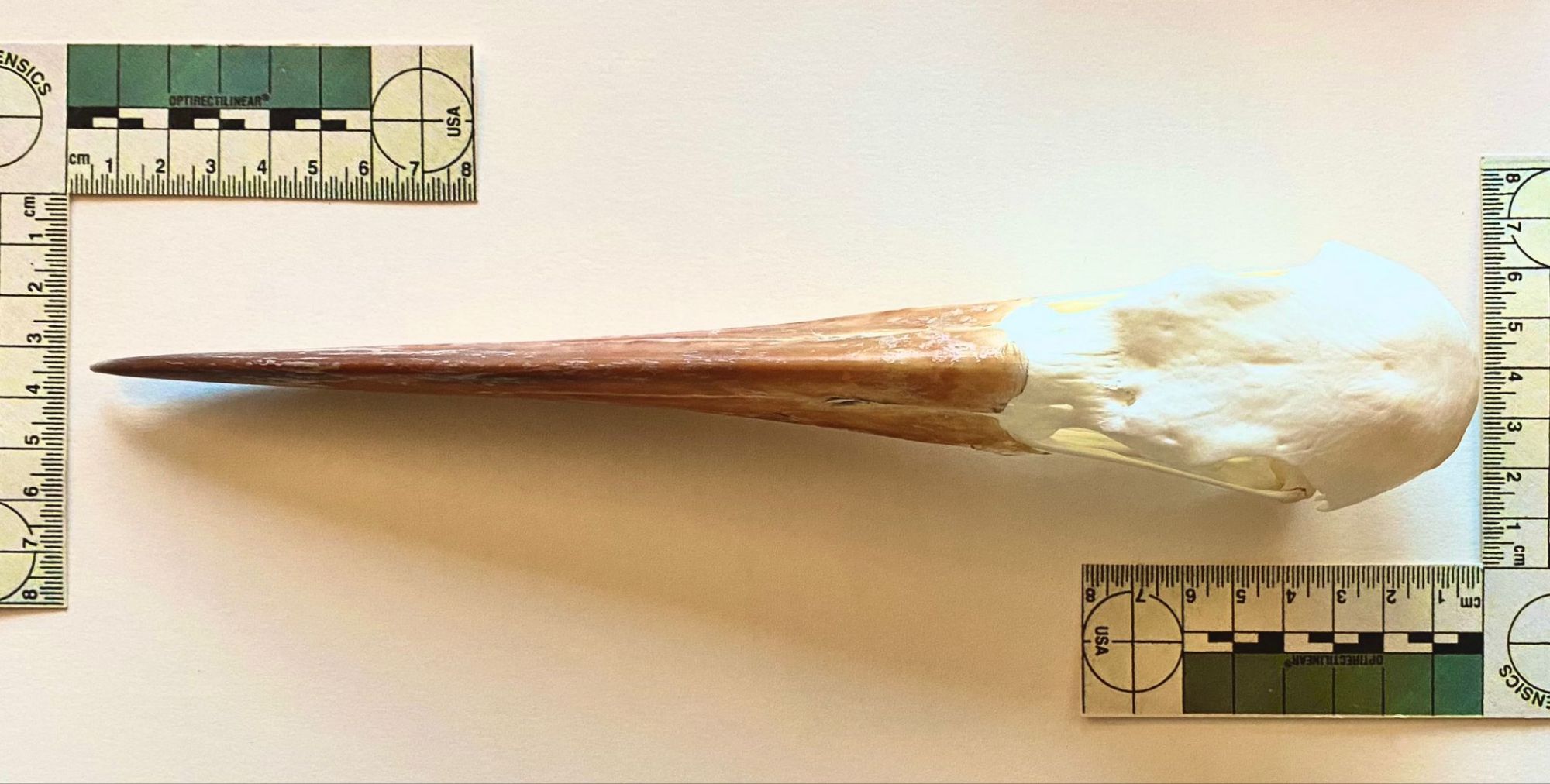
Image by Andy Taylor FLS FBNA, 2024.

It wasn’t a particularly difficult one, since that huge bill immediately narrows down the possibilities.

The spear-like bill shape is reminiscent of a heron’s, but it’s heavier – not quite as massive as something like a Marabou Stork, Adjutant, or Jabiru, but heavy nonetheless.

As Adam Yates noted, this is the skull of a White Stork Ciconia ciconia (Linnaeus, 1758) – the second mystery object in a row with the initials C. c. (the previous one being Crocuta crocuta).

When attempting to identify bird skulls, a hugely useful resource for reference is Skullsite, which is run by regular commentor on the blog, Wouter van Gestel – who referenced the White Stork with a comment relating to their reputation for the delivery of babies.

So well done to everyone who worked out the species, here and on Mastodon, Bluesky and LinkedIn – and my thanks to Andy for sharing another gem from his collection!

Friday mystery object #497

This week I have a guest mystery object for you, from avid naturalist and frequent contributor, Andy Taylor, FLS:

Image by Andy Taylor FLS, 2024.

I suspect that some of you will get this one easily, so it’s time to break out your creativity and let me know what you think it is with a cryptic clue.

I hope you have fun with it!

Friday mystery object #494 answer

Last week I gave you this hansome critter to identify:

I thought that it might prove tricky, since as with most of the Dead Zoo specimens, it’s quite faded. However, Adam Yates recognised it straight off the bat (if you’ll excuse the pun),

This is a Grey-headed Flying Fox Pteropus poliocephalus Temminck, 1825, a species of fruitbat native to Southern Australia.

Normally I’d go through and point out some identification tips, or provide a bit of story about the animal, but after 4 years I have finally succumbed to Covid-19 and I just don’t have the energy or brain power for that today – my apologies!

Hopefully by next week I’ll be a little more with it! Stay safe folks.

Friday mystery object #476

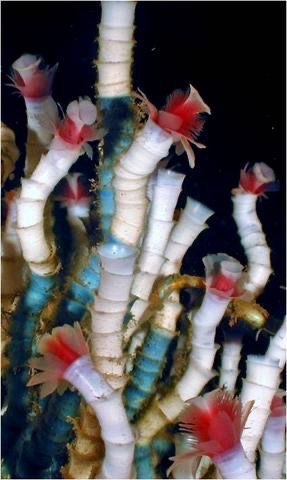
This week’s mystery object is a guest specimen from regular contributor Andy Taylor, FLS, chosen for its seasonal colours:

Any ideas what these living party decorations might be?

As ever, you can pop your questions, thoughts, and suggestions in the comments below – no need for cryptic clues this time around as it’s a tricky one!

With that seasonal conundrum to consider, I wish you all a wonderful holiday weekend!

Friday mystery object #358 answer

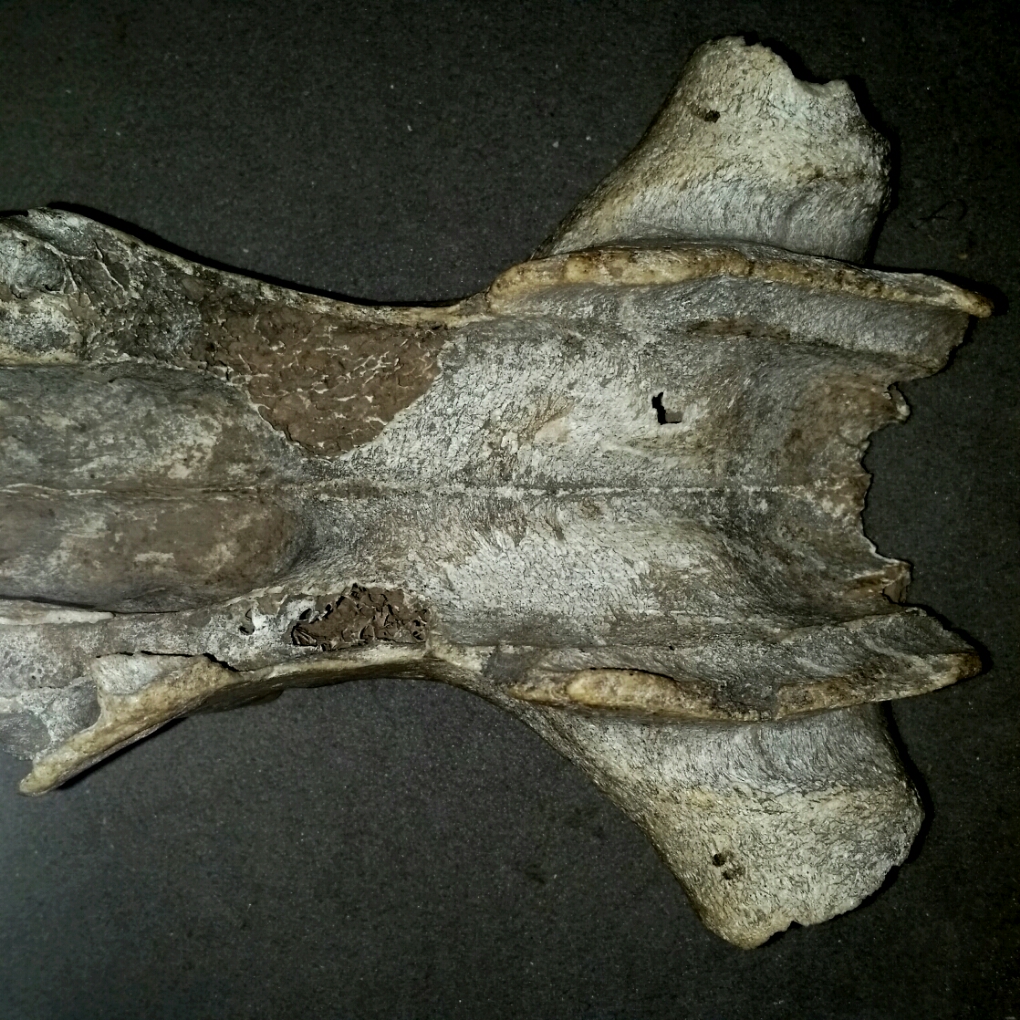
Last week I gave you this skull from customs to have a go at identifying:

Adobe_20190613_200131.png

The long horns rising in line with the plane of the face are a distinctive feature of the genus Oryx, which most of you spotted straight-off.

However, after that it gets a bit more tricky, not least because there are several species of Oryx and within the species there are different subspecies and populations from different parts of the African continent.

The first species that’s easy to rule out is the Scimitar Oryx, O. dammah since they have strongly curved horns which don’t diverge as much as this specimen. This species is currently extinct in the wild and individuals only survive in captivity.


Scimitar Oryx in Werribee Open Range Zoo in Victoria, Australia. Image by Waddey, 2009


Next up is the Arabian Oryx O. leucoryx which used to be extinct in the wild, but which is one of the few species to have become reestablished in the wild by captive breeding and release programmes. This is the smallest Oryx and the mystery specimen’s horns are way too long to be from this species.
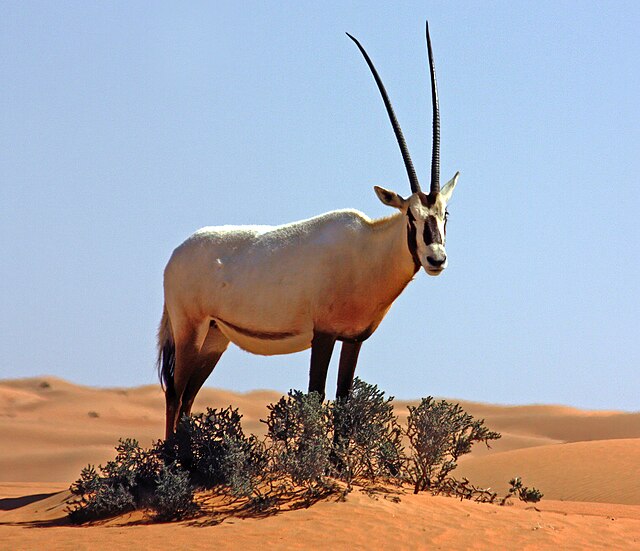
Arabian Oryx in the Dubai Desert Conservation Area. Image by Sharp Photography, 2014 

Getting to the more likely species, there’s the East African Oryxwhich either has a couple of subspecies or is two different species – the Common Beisa O. beisa, which is endangered and the Fringe-eared Oryx O. callotis, which is threatened. The other possibility is that it’s a Gemsbok O. gazella, which is still doing well in the wild.

Common Beisa. Image by Steve Garvie, 2010

Fringe-eared Oryx. Image by Riaan Marais, 2009
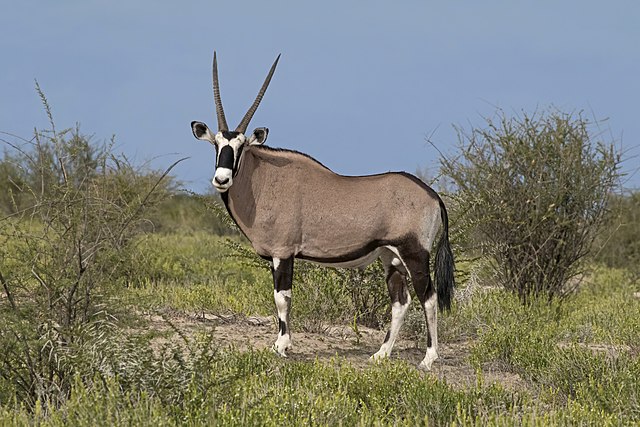
Gemsbok. Image by Sharp Photography, 2018

As you’ve probably worked out, part of why customs are interested in knowing which species this specimen belongs to is knowing what level of protection it has under CITES, should they need to pursue a prosecution. Regardless, the specimen was seized because it wasn’t properly prepared and it entered Ireland without the appropriate information.

Of course, differentiating between the Gemsbok, Beisa and Fringe-eared Oryx using only the skull is tricky (and even harder if you only have photos).

Fortunately, there is literature that can help, with measurement ranges for certain features, like horn length, distance between horn tips and number of rings on the horn. Of course, these are only indicative, but they offer a guide to most likely species. Ungulate Taxonomy by Groves & Grubb, 2011 has a handy table of these, which I used to narrow down the options to just one – a population of Gemsbok Oryx gazella (Linnaeus, 1758) from the Nata River in the northeastern region of Botswana.

Of course, DNA sampling can offer a more certain diagnosis these days, but only if there is a good quality reference sequence to compare against and it assumes there is the equipment and expertise available to do the sampling and analysis. This is why identification from morphology can still play an important role in managing wildlife crime.

Friday mystery object #344

This week I have a specimen that I’ve been considering for display for you to have a go at identifying:

mystery344.jpeg

No scale for this, but it’s probably safe to say it’s bigger than you’d be comfortable with.

For some of you this will be too easy, for others it may pose more of a challenge, so if you do know what it is, please keep your suggestions cryptic to keep things fun for everyone!

Friday mystery object #295 answer

Last week I gave you a bit of detail about a particular collection at the Dead Zoo in Dublin, which we don’t have much information about. In particular I was interested in your opinion on this specimen:

mystery295

The general consensus was that it’s a parrot, which I totally agree with and the there was discussion of Lorikeet and Parakeet based largely on the size. Palfreyman1414 noted that the skull was longer than you normally see in a parrot – which is true, but that length is mainly coming from the bill, and you have to keep in mind that parrots have a weird hinge on the upper part of their bill, which allows more mobility. This specimen has simply been prepared with the bill in a slightly elevated position, creating a misleading sense of a length in the skull.

The morphology of the  mandible is quite useful in distinguishing parrots, and to me this looks like it may belong to a Cobalt Winged Parakeet Brotogeris cyanoptera (Salvadori, 1891) although I’ve not seen a scale or  for any other speciemens, I’m just basing it on the  morphology of that distinctive mandible

So many thanks for all of the suggestions!

Friday mystery object #289 answer

Last week I gave you this object to have a go at identifying from the Grant Museum’s Micrarium:

mystery289

There were all sorts of suggestions, but it turns out that the very first comment by Chris was correct – these are the mouthparts of a Honeybee Apis mellifera Linneaus, 1758.

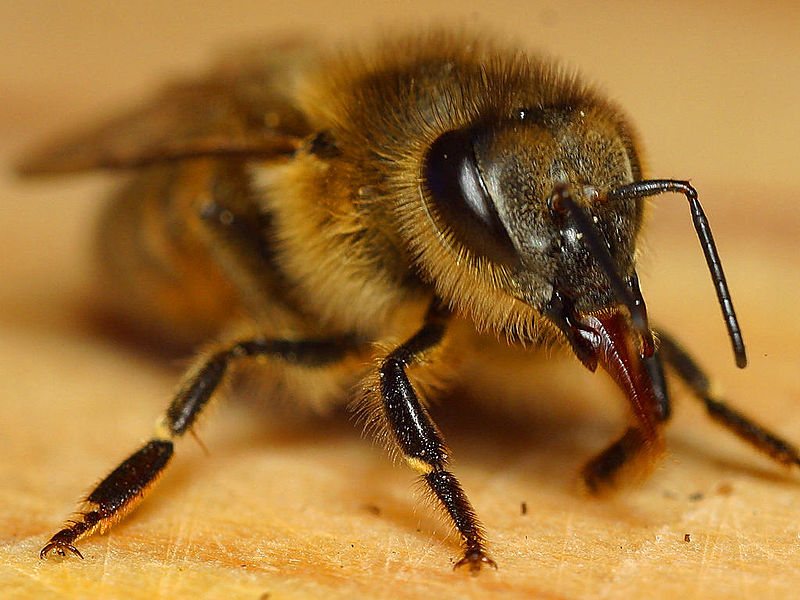
Honey Bee showing its mouthparts in situ. Image by Jon Sullivan

Honeybee showing its mouthparts in situ. Image by Jon Sullivan

These are more than just feeding apparatus for the bee, they also act as radiators to help it cool by evaporating fluids when they get overheated. The mouthparts also play a role in honey production, since honey is formed from nectar that is partially digested and regurgitated through them.

Bees are in the news a lot at the moment, due to their importance as pollinators (Honeybees are estimated to contribute around £165 billion of ecosystem services to global agriculture) combined with problems like colony collapse disorder in the USA and severe population decline of Honeybees and bumblebees in the UK.

There are opportunities to get involved in survey work  to help work out what’s happening, so why not get involved?

Natural Interest: Using Natural Science Collections to Engage Audiences

In a few weeks I’ll be delivering some training in Cyfarthfa Castle, Merthyr Tydfil, which will look at using natural science collections to engage a range of audiences. If you think this might be of interest the details are below.

handling_specimens

Date & time: 11 March 2015 10am for a 10.30 start to 4.30pm

This free course is funded by CyMAL and provided through the Linking Natural Science Collections in Wales partnership project. It is open to staff and volunteers working in museums in Wales and beyond. NB a charge of £10 for catering will be made for those working in museums outside Wales. Any cheques to be payable to ‘Federation of Museums and Art Galleries of Wales’.

It is suitable for anyone who:

  • Wants to think creatively about how to use natural science collections
  • Is already working with natural science collections
  • Is interested in making links to local landscapes/wildlife groups
  • Wants to tackle current issues such as biodiversity and climate change
  • Wants to make links between natural science collections and social/industrial history etc.

Aim: To offer insight into creative ways of using natural science collections to engage key audiences.

By the end of the course participants will have:

  • details of useful resources
  • ideas for using their collections
  • greater confidence in their ability to use natural science collections to engage with key audiences, including schools, communities and specialist groups.

Training Methods: A blend of presentations, practical exercises, informal discussion and one to one consultancy.
Preparation: Please come with an idea of what is in your natural science collections (eg geology, zoology, shells etc.)
Registration Registration requests are limited to 2 per organisation however we are happy to waitlist any others in the event the course is not fully subscribed. Please contact
Sarah.daly@museumwales.ac.uk to book a place.

100 a day in May

I don’t know about you, but my job can be quite sedentary. Lots of time spent in front of the computer or looking at skulls, very little time getting any exercise – obviously not counting my stint as Extreme Curator

Every so often I try to get off my backside and do something approaching exercise, but because I am fundamentally lazy, I can find it hard to get motivated.

Last year I forced myself to do the Push-ups Challenge (100 push-ups a day for 6 weeks) and by the end of the challenge I was feeling far stronger, more toned and significantly more self-satisfied, because I’d stuck to my goals.

One of the things that helped me was to share my progress each day on Twitter as way of keeping track of the challenge. What I hadn’t expected was the support and encouragement that came from people online, which really made me feel like I wanted to complete the challenge.

I’ve decided to do a version of the challenge again this year, during May and I hope to encourage other people to take part. The hashtag on Twitter is #100aDayInMay and if you feel like doing some exercise with some training buddies to offer support and encouragement, why not join in?

The rules are simple:

  1. try to do 100 push-ups a day. Both full and half push-ups are fine, and you can split them into as many sets as you need. 20 sets of 5 are as good as 5 sets of 20 in this challenge. Ideally, by the end of May you’ll be able to do fewer sets of more push-ups, maybe with some harder variations included – like doing full push-ups as well as/instead of half push-ups, or elevating your feet if you want to really challenge yourself.
  2. don’t injure yourself. Use good form on your push-ups and if you have any medical issues please check with your doctor before trying the challenge.
  3. share and support! Anyone can decide to do some push-ups, but it’s more fun and more motivational if you share what you’re doing with the other people taking part (you can find them on this list).  If you want to join in, just send a tweet containing the hashtag #100aDayInMay saying that you’re taking part. Remember that other people like to be encouraged too, so don’t forget to support the others taking part.

Finally, here’s a video explaining good form in both full and half push-ups (although the guy’s bum seems to be raised a little bit too high for perfect form):

I hope you feel like joining in!

WHY I AM NO LONGER A SKEPTIC

No, not me – this is my brief response to a post by Stephen Bond.

There are some valid points in his article for the sceptical skeptic, but as is often the case with polemic writing there is a lot of cherry-picking, generalisation and reliance on ecological fallacy.

He makes the point that most Muslim women don’t wear burkhas, but he then misses the point that any community is shaped by all of its members, not just a handful of highly visible (or visibly invisible) individuals. This applies to skeptics as well – the famous, loud and/or obnoxious are more visible, but they do not represent the whole.

I did toy with the idea of dissociating myself with skepticism a year or so ago, for several of the reasons stated by Stephen. Fortunately I discussed this with my friend and colleague James and we decided to do something a bit more positive, which led to us setting up PubSci and later Hackney Skeptics with Alice. These events are more focussed on science and socialising than bashing people we don’t agree with.

I think it’s a shame that Stephen has embraced the typical polemic style adopted by skeptics for his piece, as I think that style is one of the most damaging tools used in modern skepticism. It lacks nuance and is fundamentally unhelpful when trying to encourage consideration of a different perspective and it can alienate those with more moderate views.

In my opinion, polemic needs to be dropped if skepticism is to avoid becoming an echo chamber populated by a smug and mouthy minority.

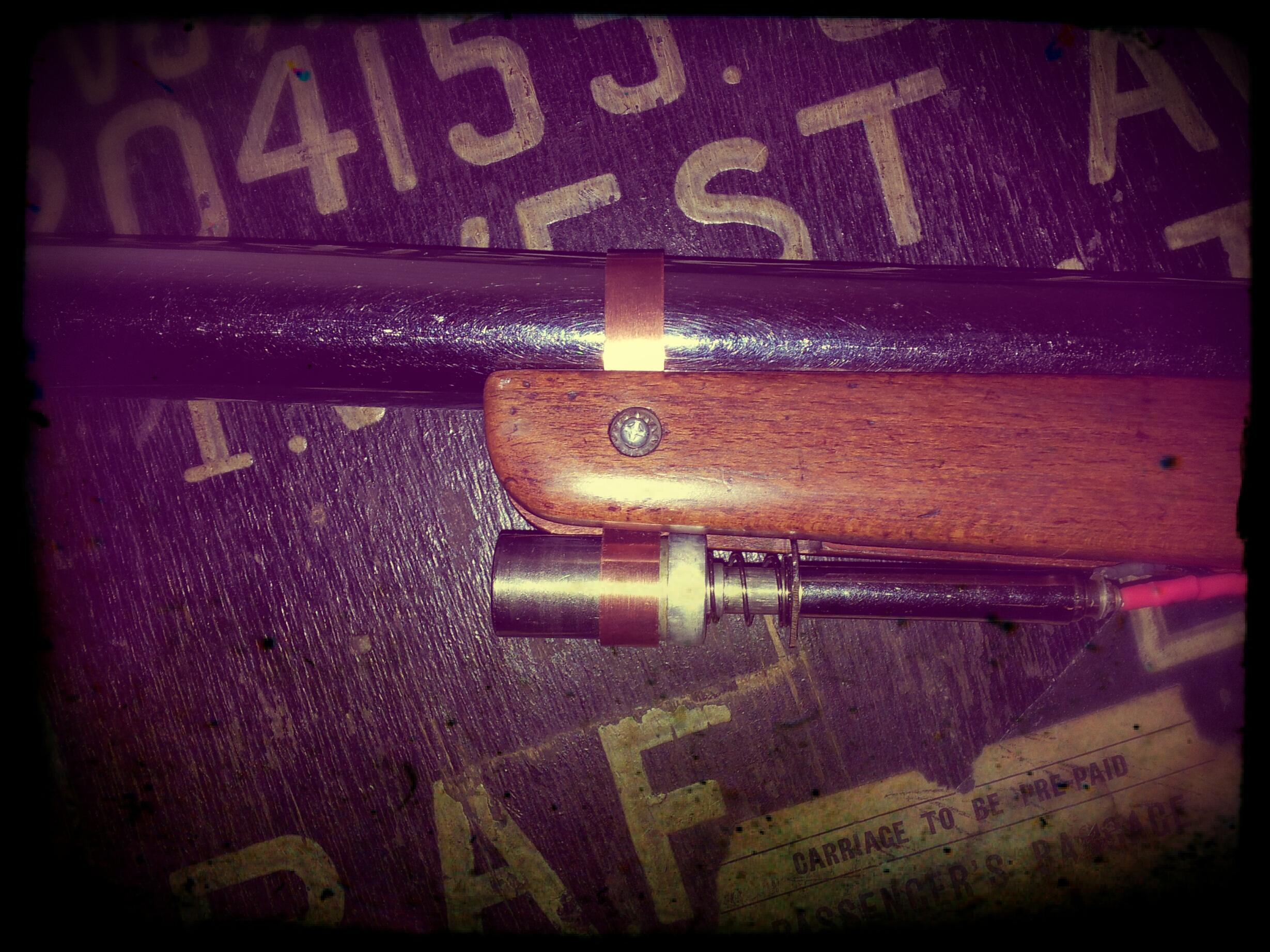
Steampunk confetti gun

You may well have seen some of this already on Youtube, but I thought I’d do a brief post about my new ‘toy’ – a steampunk confetti gun:

I made this with help from my good friend Graham over a couple of weekends and it was remarkably straightforward.

The barrel and mechanism housing are made from some old vacuum-cleaner tubing and a large washer, the stock is from an old air-rifle and the mountings were all hand made from bits of copper roofing strip that I bent into shape and attached with nuts and bolts, plus some old metal decorative plates I picked up in a junk shop.

The working mechanism is fairly simple, it is an electrical circuit powered from a glow-stick power source that runs through a switch (that makes the trigger) and into a glow-plug  normally used for starting model aircraft engines. The earth return runs out through the bolt that attaches the mechanism housing and trigger-guard to the stock.

The attachment between the working section housing and the barrel is simply a push-fitting, which makes the canon a partial breach-loader, allowing the flash cotton charge that propels the confetti to  be loaded in a way that means it will be ignited by the glow-plug. When the cotton catches it burns incredibly quickly, creating a rapid expansion in the base of the barrel, forcing out the wadding and confetti (see video below).

Now I should say that for the purposes of the video I also used flash tissue, which is slower to ignite than the cotton, meaning that it doesn’t flare up until just after it leaves the gun, giving a spectacular flash of orange fire (or green fire if I use my specially treated paper).

I hope to take the gun along to White Mischief at the weekend, so I may need to swap the flash tissue for tinfoil to avoid setting anyone’s hair on fire, but the burst of confetti will hopefully be enough to celebrate Victoria’s Diamond Jubilee in style!

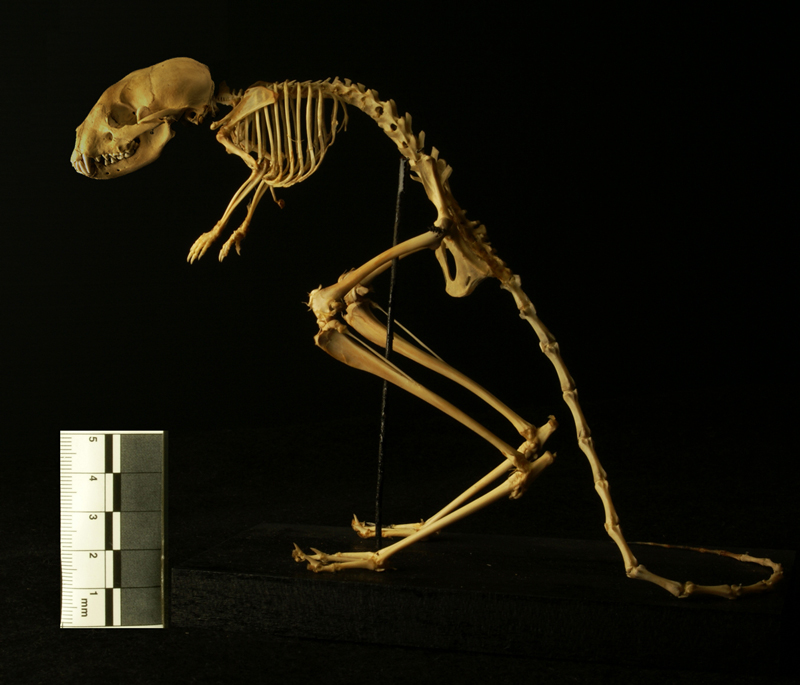
Namibian Jumping-weasel

I thought I’d pen a quick post about an interesting specimen that I discovered the other day:

It’s a species I’d not heard about before and I was intrigued to discover a bit more about it.

It’s a Namibian Jumping-weasel Mustela jocuverus (Primus, 1881) which is a small mustelid native to Namibia and Botswana. It is very similar in habits to other Weasels and Stoats, but it has a very special adaptation – it jumps.

Now other mustelids also jump as part of their hunting technique, as can be seen in this video clip:

But this mustelid hunts in arid desert conditions and it has little cover from vegetation, making it more dependent on high speed bounding to overtake its prey of small rodents, which it quickly overpowers with a bite to the back of the neck from those impressive canines.

Happy April!