Friday mystery object #480 answer

Last week I gave you this doe-eyed specimen from the collections of the Dead Zoo to try your identification skills out on:

I didn’t provide a scalebar as I think it would have made it too easy, but even so, it’s clear that the specimen is a very small species of artiodactyl (the group containing pigs, deer, antelope, bovids and a variety of related herbivores).

There were some suggestions that it could be a Dik-dik, but as Adam Yates pointed out, this specimen lacks the large preorbital glands that are very visible in Dik-diks (and makes them look like they got carried away with the eyeliner):

Dik-diks with their distinctive preorbital glands
The mystery object lacking preorbital glands

The other popular suggestion for the identity of the mystery object was a Java Mouse-deer (or Javan Chevrotain), which is the smallest ungulate alive. However, while that’s exactly what it says it is on the label, the location of collection rings alarm bells for me:

There are two species of chevrotain found in Singapore, and the Javan species is not one of them.

Of the two, one is the Greater Mouse-deer and the other is the Lesser Mouse-deer. The Greater, as you probably guessed, is on the large side for a chevrotain, weighing in between 5 and 8kg. This species also has a dark stripe from its nose to its eye, which is missing from the mystery object.

The Lesser Mouse-deer Tragulus kanchil Raffles, 1821 lacks the dark stripe and is almost as tiny as the Javan Mouse-deer, making it the most likely candidate for the mystery object:

Lesser Mouse-deer alongside some rodents

This specimen not only has that likely identification error on the label (easily done considering the complexities of chevrotain taxonomy across Southeast Asia), but it had somehow also had a completely incorrect label associated with it in the past, which said it was a Siberian Musk Deer – a species that’s on the small side, but by no means as tiny as this.

This specimen was of particular interest at the end of last year, when we had a visit by a group of researchers from Singapore, who are undertaking a fantastic project to digitise specimens collected from Singapore that are held in museum collections all around the world. The project is called SIGNIFY and the team were not only absolutely lovely people, but they achieved a huge amount of research and detailed imaging work in a very short time:

The SIGNIFY portable imaging setup in use on a specimen from the Dead Zoo bird skin collection

The SIGNIFY project has huge value for helping to understand the historic baseline biodiversity of Singapore prior to industrialisation, but it also helps foster links between organisations and allows the inextricably linked social and personal histories of collectors to be explored. I loved getting a chance to spend time with the team, learning more about their project and the collections I care for. It also turns out that we have a wealth of spiders from Singapore that still need to be investigated, so I really look forward to welcoming the team back soon!

The awesome SIGNIFY team with me in the Dead Zoo

Friday mystery object #479 answer

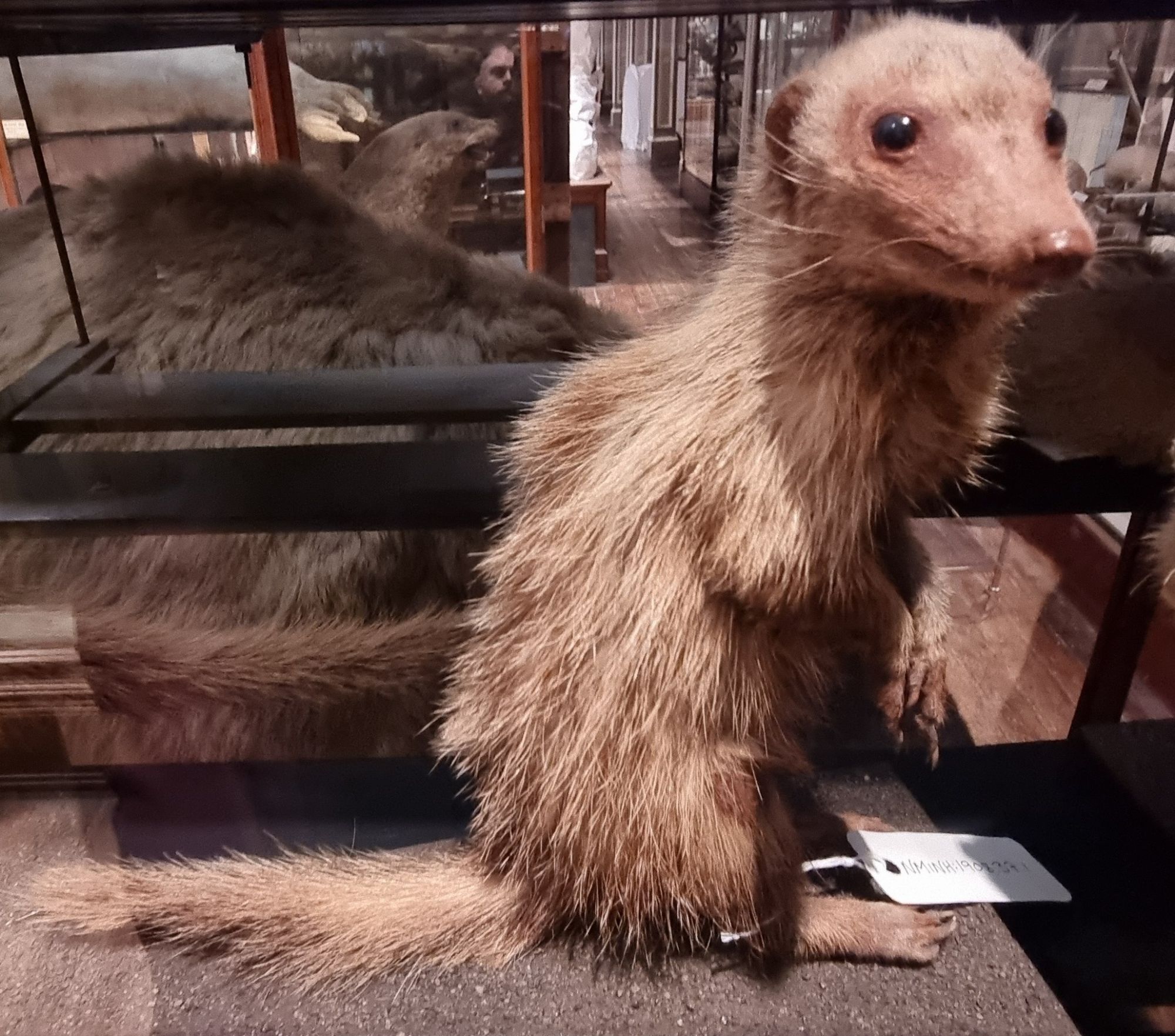
Last week I shared this fuzzy critter as mystery object for you to identify:

It was probably a bit of a mean one, as I didn’t provide a scalebar. It’s also a species from a group of small carnivores that contains over 30 species that can look quite similar, and (perhaps most importantly) the specimen is old and very faded from being on display in a gallery space with lots of light for the last 100 years or more.

Natural light in the Dead Zoo, image taken in May 2020.

Regardless, Chris Jarvis figured it out (after an initial near miss), while I believe that Joe Vans cheated by checking out the 3D tour of the Dead Zoo. Most other comments on social media came close, with a lot of people working out that this is a Mongoose, but then not quite getting the species.

This specimen is a Common Kusimanse Crossarchus obscurus G. Cuvier, 1825. These are also known as the Long-nosed Kusimanse, as their snout is a bit more elongated than that of most other Mongooses (or should that be Mongeese?):

The Common Kusimanse is one of the African Mongooses in the Subfamily Mungotinae. They are a good bit shorter than most of the other species of Mongoose – for comparison here’s this specimen next to a Small Indian Mongoose (well, that’s what the label says, although I have some doubts):

They are normally a dark brown colour, like this example:

Common Kusimanse by LA Dawson, 2006.

However, the Dead Zoo specimen is now bleached blonde, so I’m not surprised that this identification was tricky. Fading leads to all sorts of issues for the accurate representation and identification of species, to the point where the Giant Panda on display in the building had to be dyed black in places a few years ago, because it had ended up looking like a Polar Bear cub due to the sun damage.

At the moment that’s no longer an ongoing issue in the Museum, as a temporary floor has been installed just beneath the old glass ceiling, to allow investigations on the roof space to take place – this blocks almost all of the natural light. This has been great for conditions in the building, as it no longer heats up like a greenhouse on sunny days, and the bleaching of the specimens has been put on hold.

At some point the tempoprary floor will be removed, but I sincerely hope that a more permanent solution to the light issue will have been put in place by then. Still plenty of work to be done to get to that point though!

Dead Zoo with temporary floor installed to allow roof access. This blocks the natural light and keeps the environment more stable.