
Last week we had a second guest mystery object from Rohan Long, who is based at the Harry Brookes Allen Museum of Anatomy and Pathology at the University of Melbourne.

It was a genuine mystery object and it certainly proved quite tricky. There were quite a few suggestions of gibbon, but the proportions of the long bones aren’t right, with gibbon radius and ulna bones proportionally far longer in relation to the humerus or any of the the bones of the legs than what we see above. The skull does look quite gibbony gibbonesque gibbon-like, but generally gibbons have an auditory bulla (the region on the underside of the skull that houses the hearing apparatus) that strongly curves, almost like a boomerang, whereas here the feature is much straigher.

The teeth tell us that the mystery object is from one of the Cercopithecidae (Old World Monkeys) since there are only two premolars instead of the three that you find in the Platyrrhini (New World Monkeys). That helps a bit, but there are still over 150 species in the Cercopithecidae to consider.
Some can be ruled out fairly easily, such as members of the Papionini, like baboons and macaques, which have adults that are more prognathic (their jaws jut forward) that this specimen. This is less true for juveniles (jaws jut more as the animal grows and matures), but we can ignore that here, since the mystery specimen has well-fused sutures and visible wear on the teeth, so we know it’s an adult.

One thing that can be useful to consider when trying to identify primate skulls is the shape and position of the nasal opening. This can vary within species and it can be a feature sensitive to the angle at which a photograph is taken (making it more difficult to assess from images), but overall it can help narrow down possibilities without having to get into too much fine detail early in the identification process.

The Mammalian Crania Picture Archive has well standardised images, including a reasonable variety of primates with males, females and animals of different ages represented. They also provide some measurements for each specimen, that may be useful when making comparisons. The primate page is here in case you’re not familiar with this very valuable resource.
Over the last week I’ve taken a look through a wide variety of skulls from different primate taxa and I’m confident that the mystery specimen is from the Colobinae. I think the position of the nasal opening (especially the top part of the opening in relation to the eyesockets) is helpful in distinguishing possible species within the subfamily. This makes sense when you consider that a third of the genera in the Colobinae are in a group known as the “odd-nosed monkeys”.
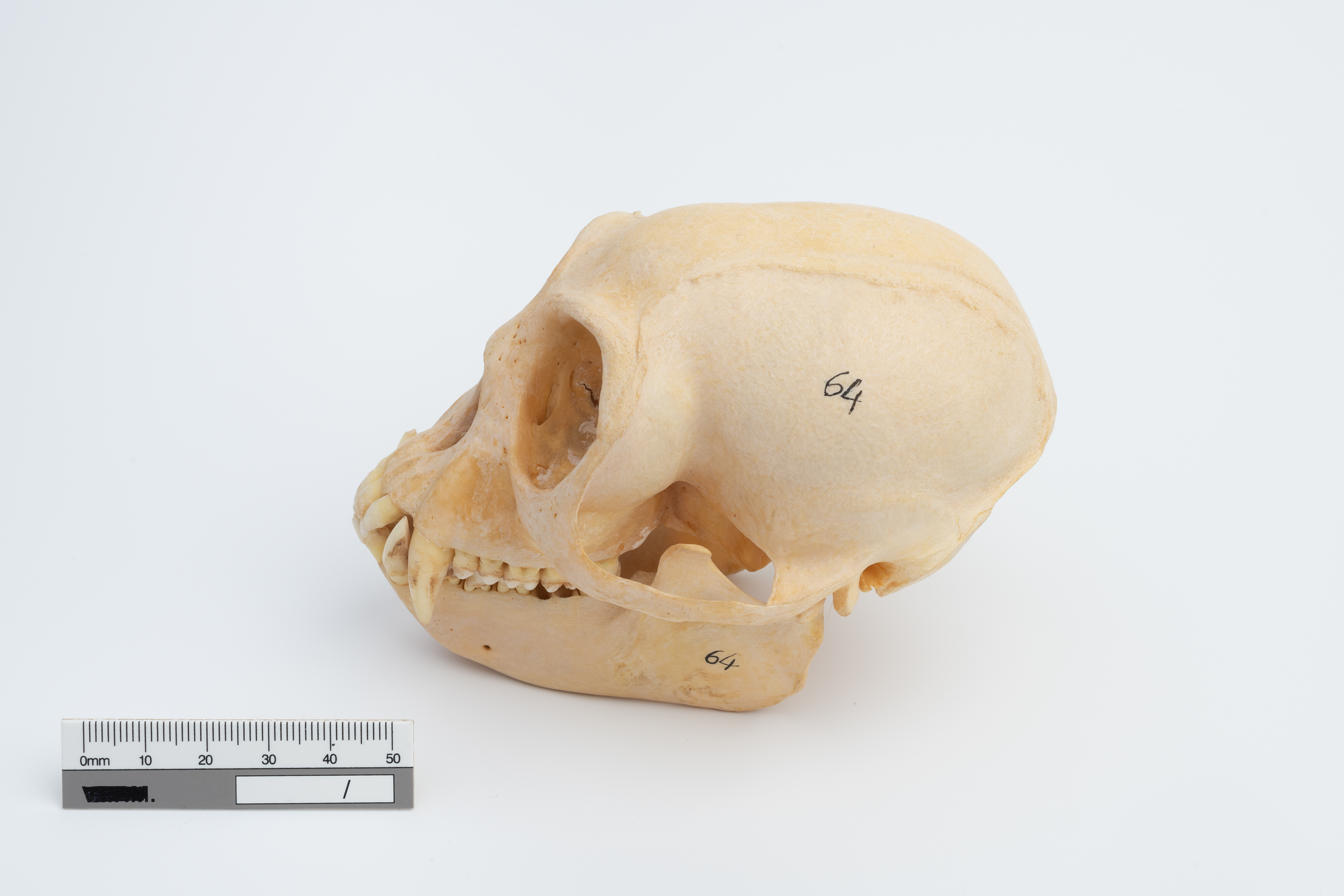
In this specimen the nasal opening forms a shield shaped hole with a flat top that starts quite high in relation to the eye sockets. In most species it starts lower, sometimes well below the line of the bottom margin of the eye socket. The Red Colobus is superficially quite similar, but when you look at other features it doesn’t look right – for example, if you look at the underside of the skull it has several different features, include a differently shaped incisor arcade and the pterygoids (the wing-shaped bits of bone that spread to either side, just behind the palate) are a different shape.
However, I did find a species which matches much better, so I am tentatively suggesting that the mystery object may be a Black-crested Sumatran Langur (AKA Mitred Leaf Monkey or Sumatran Surili) Presbytis melalophos (Raffles, 1821). If not that species I think the mystery specimen will be in the same Genus. There will undoubtedly be additional species with similar skulls that I’ve not seen, but within the limits of the resources at my disposal I don’t think I can do any better than that.
Oddly enough, I have had a skull of this species as a mystery object before, but it appears to be from a much younger individual, so at first glance it looks quite different, but the general features of the nose still remain:

My thanks to everyone for your suggestions and many thanks to Rohan for sharing this mystery object. It’s been an interesting one and has reinforced my conclusion that primate skull identification can be REALLY difficult!


 Zygoma