This week I have an insect for you to have a go at identifying for a change:
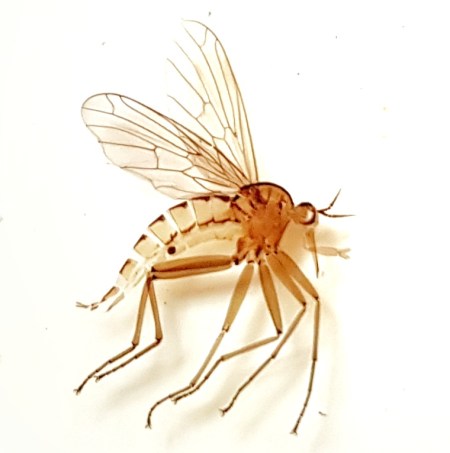
Any idea what this diminutive critter might be? No need to be coy for this one – let me hear what you think in the comments section below. Have fun!

This week I have an insect for you to have a go at identifying for a change:
Any idea what this diminutive critter might be? No need to be coy for this one – let me hear what you think in the comments section below. Have fun!
Last week I gave you this beach-loving little bird to try your hand at identifying:
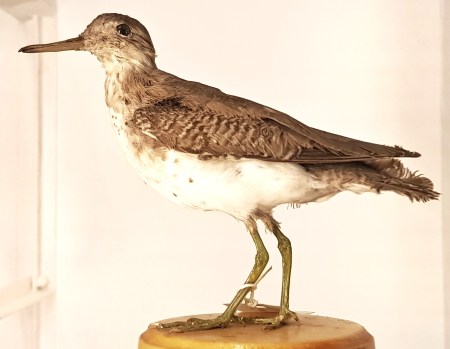
I had a feeling that one or two of you would know exactly what it is, while others would have a pretty good idea of the type of bird, but not the species, since there are quite a few birds on the world’s shorelines that look something like this.
The Waders are a clump of groups of shore birds in the Order Charadriiformes (which also includes non-waders, like Gulls) and the small to medium sized waders, with long straight bills like this one, are mainly in the Family Scolopacidae or Sandpipers (nicely suggested by palfreyman1414 with the cryptic clue “a silicaceous rat enchanter“).
However, there are quite a few species in the sandpiper family – around 80 in total – so there’s still quite a lot to choose from. However, the small size, brown upper parts, white underparts with some spots (only in the breeding season), yellowish legs and bill with a dark tip all point to a widespread wader from North America – the Spotted Sandpiper Actitis macularia (Linnaeus, 1766).

Spotted Sandpiper, at Bluffer’s Park (Toronto, Canada), by Factumquintus, c.2005
Although this species is from North America, the specimen was actually collected in Ireland – in Finnea, County Westmeath to be more precise. As migratory birds they can sometimes crop up quite a long way from where you’d expect to find them, especially following big storms. Without the spotted breeding plumage it would be very hard to distinguish the specimen from the Common Sandpiper that occurs in Europe, as they are very similar looking birds, apart from the spots.
So well done to Wouter van Gestel, jennifermacaire, and palfreyman1414 who managed to recognised the species, despite the taxidermy being a little jaded.
There will be another mystery next week.
This week I’ve been looking at birds, so I thought I’d share the joy with you. Do you have any thoughts about what this might be?
I expect that quite a few of you will have a pretty good idea, so please keep your suggestions cryptic, to let people who are less familiar with avian identification have a chance of improving their skills.
Have fun!
Last week I gave you these skulls from the collections of the Dead Zoo to have a go at identifying:


The reason for picking these was because I had an enquiry challenging the label associated with a specimen that was on display, and on checking there had clearly been some kind of mix-up, because the first mystery object had been identified as a False Killer Whale Pseudorca crassidens Owen, 1846 – which was definitely wrong.
The second mystery specimen is in fact the False Killer Whale (an identification that palfreyman1414 got right, supported by Rémi), whose label had been mixed up. That left the first mystery object still to be solved. Obviously it’s a toothed whale of some sort and the scale suggests it’s not a porpoise (a bit big) and it’s clearly too small to be one of the bigger dolphins (like a Killer Whale or Pilot Whale).
Generally it takes a bit of time looking at dolphin skulls from a few angles before you can start to get your eye in for identification – they just look so weird compared to the skulls of other mammals. They can also photograph quite poorly due to the large size – by which I mean that the height, length and breadth of a specimen can be distorted considerably in an image depending on small changes in the angle it sits at and the distance between the camera and the specimen.
However, the things I always try to look out for are the shape of the rostrum (or snout), the slope of the forehead, the patterns made by sutures between the bones around the nares (nostrils) and sutures between the bones in the ‘cheek’ area.
In this case there’s a very steep forehead, with a small bump midway, an upward deflection of the posterior maxillary margin (it looks like it’s got a bit of a smirk) and the sutures around the nares and the general shape of the nares all adds up to make me think that this is a White-beaked Dolphin Lagenorhynchus albirostris (Gray, 1846).
Imagine how pleased I was when I discovered that there was a label with that name on it, hiding in a different case and missing a specimen!
This week I have couple of specimens for you to have a go at identifying:
I think these have been mislabelled and need their identifications checked to see if it’s a simple label swap or if it’s a deeper problem with the documentation. I won’t make it easier by providing the labels I’m suspect about – let’s see what you think working just from these images…
Have fun!
 Zygoma