
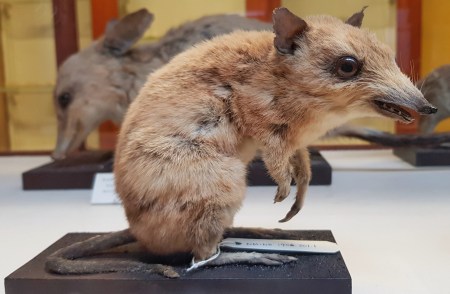
Last week I gave you this cheeky chap to have a go at identifying:
There was some lovely wordplay in the answers, with Chris getting in early with this great one:
I thought I had a shrewed idea until I saw the Bilby in the background which could show this isn’t the elephant in the room. Coot is legs be too Bandi?
This rules out elephant shrews and correctly identifies it as some kind of bandicoot, thanks to its marsupial case companion. Then palfreyman1414 dropped an anagram into the mix with:
Mere ale plus Satan?
which is so nice I wish it was correct, but alas this isn’t a Long-nosed bandicoot Perameles nasuta, although it is in the same genus.
Allen Hazen wondered “How badly does fur fade in preserved specimens?” and that turned out to be the key question, since everyone shied away from the correct identification, because one of the characteristics of this species’ pelage (that’s mammal-fan speak for ‘fur’) is that it’s supposed to have two stripes on its hindquarters or, more accurately, bars. As it turns out, fur fades quite badly in preserved specimens.
This is in fact a Marl or Western barred bandicoot Perameles bougainville Quoy & Gaimard, 1824 (NMINH:1906.301.1).
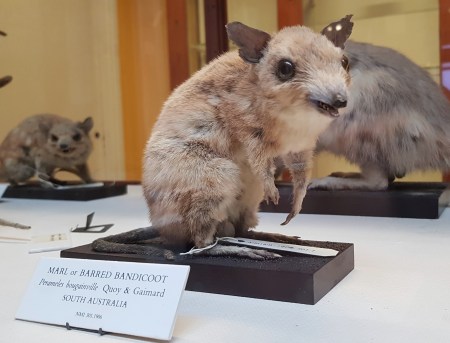
These diminutive Australian marsupial insectivores are vulnerable to introduced predators like cats and foxes, so their wild population only remains on some islands after once being widespread across Western Australia.
Even on the islands where they have some protection from placental predators, they face issues with disease, since their population has shrunk by so much it has impacted on their genetic diversity – reducing resistance to disease at the population level. In particular, a virus that causes tumour growth is affecting the animals on some islands, leaving the species increasingly under pressure.
One island does remain free of the virus, so hopefully with proper management the Marls will be able to hang on in there.




 Zygoma