Friday mystery object #233 answer

Last Friday I gave you a variety of mandibles to have a go at identifying. They lacked a scale bar and represented a range of different species that have similarities in mandible shape.

There were some great cryptic suggestions of identities, but it must be said that Jake came through with a really clear and pretty much spot-on list of suggestions. So here are the answers in a handy form that might be useful for reference:

mystery233b

The Sheep and Cow have a distinctive upward inflexion at the end of the mandible, with the Cow’s being so strong that the incisors start above the level of the top of the molar tooth row – unlike the Sheep’s.

This inflexion is much less marked in the Red Deer, which has a narrower body of the mandible, presumably relating to the less intensive chewing of a browser compared to grazers (grass is tough stuff). The Deer also has a notch along the bottom of the jaw, which Jake pointed out as a useful feature.

The Pig mandible tapers less overall, but is thicker at the end with the articulation – presumably because the omnivorous Pig is chewing differently, using the temporal muscles more than the masseter muscles and therefore needing a different area of the jaw for muscle attachment. The teeth are also pretty distinctive. Like the Pig, the Donkey mandible lacks the long and hooked coronoid process, but is also very triangular in shape with quite squared teeth – features typical of an equid.

So hopefully that gives you some pointers for telling some common herbivore mandibles apart when you don’t have a scale bar – a more common problem for some of us than you might think…

Friday mystery object #233

This Friday I have a challenge for you. Can you work out which five different species these mandibles come from?

mystery233

They are all different sizes and the lack of scale bars is deliberate – this is about trying to find useful features from the shape rather than the size, It’s not easy!

You can put your answers in the comments section below. Good luck!

Friday mystery object #232 answer

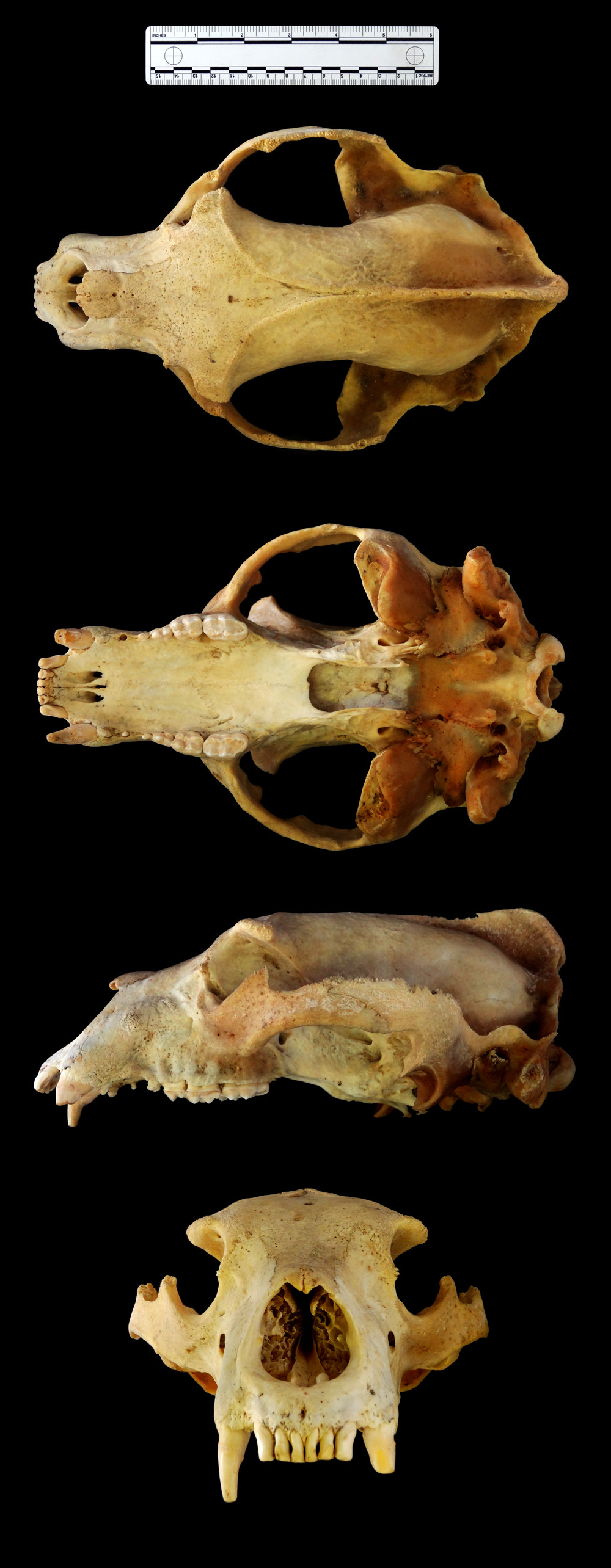
Last Friday I gave you this nice robust skull to identify:

mystery232

There was a healthy discussion about possible identifications, with the importance of scale mentioned more than once (by Jake, palaeosam, Lena and Robin Birrrdegg). Not only is this a robust skull, it’s also quite large, ruling out the British carnivores – and it clearly is a carnivore judging by the canines and the well-defined sagittal crest.

The lack of cutting and puncturing premolars and molars means that cats, dogs, hyaenas and other very carnivorous large carnivores can be ruled out, narrowing down the likely options in the right size range to the bears, as recognised by palaeosam, Ric Morris, Robin Birrrdegg, Will Viscardi, cromercrox, cackhandedkate, Lena, Daniel Calleri, henstridgesj and Carlos.

The species is a bit more difficult to work out, but the big sagittal crest and fused sutures suggests that this is not an juvenile bear, meaning it’s too small for a bear of the Brown  or Polar variety. That still leaves quite a range of other possible bears, but the pronounced forehead and long square muzzle rules out the Giant Panda, Sun Bear, Spectacled Bear and Asiatic Black Bear, while the big robust incisors rule out the Sloth Bear. That leaves the American Black Bear Ursus americanus Pallas, 1780.

Ursus americanus by Mike Bender/U.S. Fish and Wildlife Service, 2008

Ursus americanus by Mike Bender/U.S. Fish and Wildlife Service, 2008

So well done to cromercrox, Carlos and Robin Birdeggg who all got the species correct!

Friday mystery object #231 answer

Last Friday I gave you this distinctive skull to identify:

mystery231

I knew it would be a bit of an easy one, given the highly unusual teeth, but it seemed too interesting a specimen to not use.

As cryptically suggested by many of you (Jamie Revell, Nigel Monaghan, henstridgesj, rachel, cromercrox, Robin Birrrdegg, Allen Hazen and Crispin), this is indeed the skull of a Crabeater Seal Lobodon carcinophaga (Hombron & Jacquinot, 1842).

Jerzy Strzelecki, 2000

These seals are specialised for catching krill, hence the strange shape and tightly fitting nature of their teeth, which act as a filter to strain the tiny crustaceans from ocean water.

Because these seals live in the waters all around the Antarctic, monitoring their population is particularly difficult, so estimates of their numbers vary considerably, from 2 million to 12 million (which is the more likely figure).

As with most abundant animals they have predators, in particular Leopard Seals. Apparently 78% of adult Crabeaters bear scars of Leopard Seal attacks, which can be seen clearly on the live individual in the image above. Most of the attacks happen before the Crabeaters reach a year old and get a bit too big to be easy prey, but in that first year there is apparently a huge mortality rate, with only 20% of seals making it to their first birthday. Good old Mother Nature is never one for sentiment.