
This week I have an unidentified skull that I found in a box of random bits of bone:
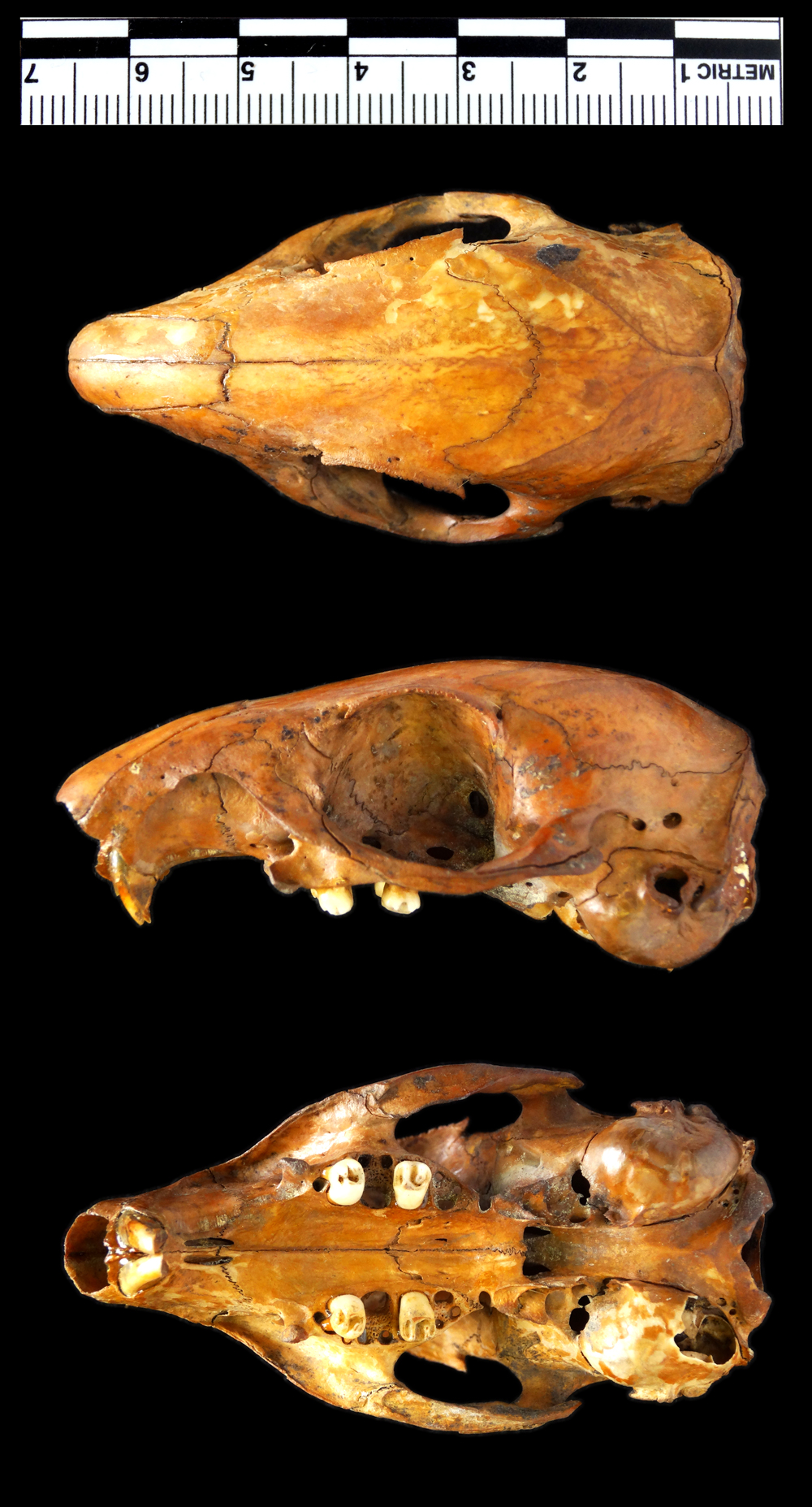
Any idea what it might be from?
As usual you can pop your questions, thoughts and suggestions in the comments section below and I’ll do my best to respond.
Happy identifying!
 Zygoma
Well let’s kick this off by suggesting that it might be some sort of squirrel?
That’s what I was thinking of.
There are so many squirrel species, and this could be almost any of them. Is there anything else you could tell us about the provenance of this specimen that might help to narrow it down?
This is all I have to work with – it was in a box of random bits of bone with no data…
Fair enough. I’ll give this some more thought.
I think it’s a Sciurus, but it doesn’t quite match any of the species I’ve been able to find pictures of.
Scratch that! On closer inspection of a wider range of possibilities Spermophilus seems more likely; S. franklinii looks like a good match. I see that some authorities place this in a monotypic genus of it’s own, Poliocitellus.
Doormouse
Isn’t it a bit too big for that?
It is a bit. Also, the auditory bullae are too small.
Reblogged this on hocuspocus13.
The measurements we calculated on the given skull match up perfectly to the average skull size of a Tree Squirrel.
Ah, but which kind?
The proportion of the eye sockets, the way in which the top part of the skull protrudes, and the measurements of the skull coincide with that of the Mountain Beaver skull.
But the teeth and zygomatic arches are quite different. Shame, I’d love a Mountain Beaver skull!
We found by the proportions of the Cephalic index, eye socket width, and teeth configuration that the friday mystery object #219 might be a Sciurus carolinensis, more commonly known as the Eastern Grey Squirrel.
That’s what I thought at first, but when I compared it to another Grey Squirrel skull it was considerably different in its proportions and the teeth were somewhat different. Most confusing!
The bit that makes the species obvious to me is the spike at the top of the orbit, so that gets it to the two different colour options. If I found it (in the UK) I would say the duller of the two colours, and it’s up at the top end of the size so it might be from a foreign species. The spike is slightly smaller than mine as well. I’ve tried not to give it away so not to spoil the fun for others.
You’re definitely in the right family, but I think this might be from further afield 😉
Poliocitellus franklinii is a north American species…and quite a good match as well!
Looking at the super-orbital arch, it protrudes out from the skull similarly to the skull of the Southern flying squirrel, and we believe the measurements are very similar.
Tamias sp?
Pretty good match, but something looks a little awry, I need to check some more species…
Based on the measurements, number of teeth and the size of the zygomatic arches, we would suggest that it is the skull of a Siberian chipmunk.
Hmm, not bad. Not a perfect match from the specimens I’ve managed to find, but I haven’t ruled it out…
Our measurments have also shown to us that the skull shown is closest to an Eastern Gray Squirrel. We measured the amount of teeth, the size of the orbit, and the brain cage. All of these measurements were proportionate to the skull above. Our only concern is that the bullae shown on the skull above was much larger than the Eastern Gray Squirrel.
You can’t rely on measurements and proportions alone, the squirrel family is pretty big and there are a lot of very similar skulls that are hard to tell apart…
After thorough comparisons made between the mystery skull and other rodent skulls both around our Biology classroom and in online databases (digimorph.org proved quite useful), we were able to narrow the search down to a specific genus of squirrel. We surmise that the genus is Spermophilus after comparing Cephalic Indices, ratios regarding the auditory bullae, head and teeth shape, as well as a few other measurements of the distance between the zygomatic arches and other major features on the skull.
This is a pretty good match – there are some other possibilities, but this is a strong contender!
After first her research specifically among the species of the genus Spermophilus, one species that matched the mystery skull extremely well, and more so than the others of the genus. We conclude that the mystery skull is a very close match to the skull of Franklin’s Ground Squirrel, originally classified in the Spermophilus genus, but re-classified in its own genus as Poliocitellus franklinii.
We think that the image is one of the skull of an Eastern Grey Squirrel, (Sciurus carolinensis).
Based upon measurements (entire skull length;6.1 cm entire skull width;3.1cm, eye socket diameter 1.8cm, etc.) of a skull of the Eastern Gray Squirrel, I agree with the numerous others that the nearest match is the Eastern Gray Squirrel.
The size and proportions are similar, but lots of other little factors suggest that it’s not a Grey Squirrel…
such as what other little factors?
Molar size, palatal length, auditory bulla size, shape of the anterior portion of the zygomatic arch, that sort of thing…
okay
Based on the placement of the deep-set eye sockets, the protrusion of the molars from the tooth bed and the size of the jaw, we surmise that the skull belongs to a Rice Field Rat (Rattus Argentiventer).
Ah, but you’re missing the nature of the infraorbital foramina and the fact that there is a postorbital process rather than a supraorbital ridge. Remember to look at ALL the characters, not just a few.
After looking at many species in the Spermophilus genus we thought that Spermophilus franklini is most similar in terms of proportions and features.
Based on the structure of the skull and teeth, it is a rodent. In further research I think it is close to the squirrel family. My closest guess is a Fox Squirrel (Sciurus Niger).
Loads of comments! And despite spending far too long looking at various squirrelly skulls this evening, I’m still not sure what it is!
I agree that S. franklinii looks pretty close, as does Otospermophilus (to me), although the examples of these that I can find on the web seem to have rather more flared zygomatic arches than the specimen above. I don’t know if that’s just variation or being on the wrong track. To be honest, the only thing I can say for sure is that they all look very very similar!
If those suggestions are on the right track, there’s quite a useful open access paper with lots of good photographs of for comparison here:
http://www.asmjournals.org/doi/pdf/10.1644/07-MAMM-A-309.1
Fantastic paper – thanks for that reference!