Friday mystery object #201

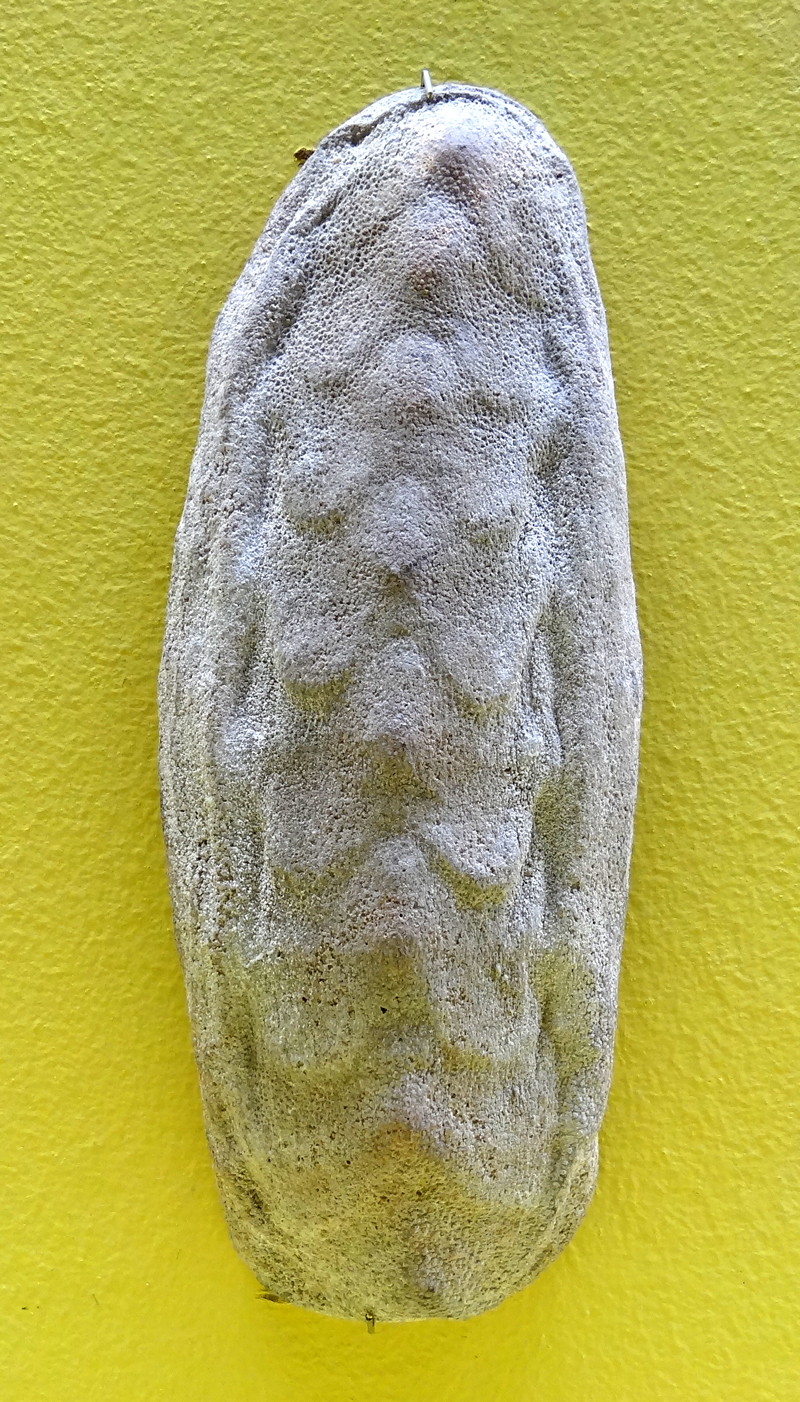
This week I have a mystery object that’s a bit dusty and not much to look at, but which is one of my favourite historic specimens at the Horniman Museum.

I have the feeling that it might stump everyone this time, but let’s see how you do. Any idea what this is?

mystery201

Scale = 10mm

As usual you can put your comments, questions and suggestions below and I’ll give you some clues if you need them. Good luck!

Oddjects No.6

Next week we’ll be reviewing our mineral collections at the Horniman, which means that I’ve been trying to track down the various minerals in the collection. Amongst them I found this rather lovely sample of bismuth – a non-toxic, silvery, heavy metal that can naturally grow into an intricate step-structure crystal.

Bismuth crystal

As the outer surface of the bismuth crystal oxidises it becomes iridescent, creating a beautiful and multifaceted structure that is really quite gorgeous. Hope you like it!

Friday mystery object #200 answer

Last week I gave you this object to identify:

mystery200

It was a bit of a mean one, since it had no scale bar and the specimen is quite old and dried out, so it doesn’t look much like the living animal.

I had hoped that this would mean that nobody would manage to identify it, but I wasn’t at all surprised when correct suggestions started coming in.

Dave Hone was the first to get the correct kind of animal, although he was a bit thrown by the outer surface – vannabarber was also on the right track, but thrown by the texture. In fact the texture led to some interesting suggestions, including pumice, fossil, bezoar and Pompeian pinecone.

In the end, henstridgesj made the right connection and identified the species, with Anna Pike, rachel and Crispin Wiles all coming to the same conclusion. This is the dried and shrivelled remnant of a Gumboot (or Giant Western Fiery) Chiton Cryptochiton stelleri (Middendorff, 1847). Also known as the ‘Wandering Meatloaf’ for obvious reasons!

Cryptochiton stelleri (Gum Boot Chiton) by Jerry Kirkhart

Chitons are an ancient class of mollusc called the Polyplacophora – a name that means “bearing many (or several) tablets (or plates)”. They get this name from the eight plates (also known as valves) that they have on their backs.

Most chitons have these valves visible (see below), but the huge Gumboot Chiton has the valves hidden underneath their rubbery girdle.

Tonicella lineata

Tonicella lineata showing the eight valves characteristic of chitons

Chitons are remarkably conservative animals, having changed little since the group arose around half a billion years ago. They have few predators and manage to live a blameless and slow-paced life feeding on algae and detritus on rocks in the world’s oceans, that they rasp off with a fairly simple rasping radula.

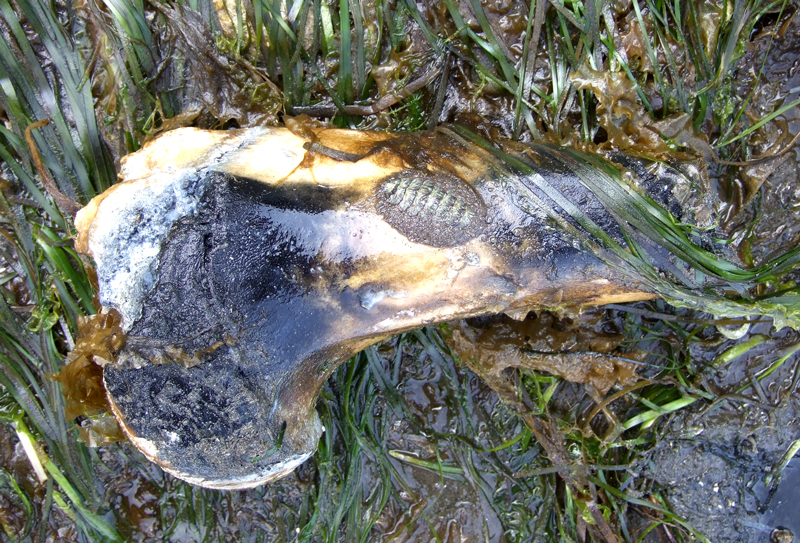
There are few ways of spending time on the sea shore that are more enjoyable than turning over rocks in the quest for chitons. Except maybe finding washed-up bones. Or maybe finding both together!

chiton-bone

Friday mystery object #200

I’m not quite sure how I’ve managed it, but this is my 200th mystery object. 100 objects ago I said that I was running out of ideas for new objects and time for writing answers, but clearly that problem hasn’t stopped me.

However, once again I feel as though I’m in a similar situation, especially with regard to the time I have available for writing answers. Therefore, I have decided to have a go at making the mystery object fortnightly, the answers being published a full week after the mystery object.

This longer turn-around for the answer will let me open the mystery object up for more guest contributions (since getting the answer over a weekend is usually a struggle) and hopefully that will make it more fun for everyone!

On to the object:

mystery200

Do you have any idea what this might be?

Leave your questions, comments and suggestions below – preferably in a cryptic format so others can have a go.

And don’t forget, the answer will be posted next Friday. Enjoy!

Friday mystery object #199 answer

On Friday I gave you this rather beautiful object to identify,which came to light during our mollusc Bioblitz last week:

mystery199

It turns out that it didn’t prove much of a challenge and was identified to species level in no time. So well done to Kevin, Anna Pike, @benharvey1 and Carlos Grau!

In fact, Carlos went a step further than identifying the specimen and told the very story I was planning to tell in this post. It’s great to hear stories like this about specimens or species, so I’ll share it with you in Carlos’ words:

This picture immediately brought back memories of my old seashell-collecting guide I had when I was about 12 and haven’t looked at for years and years (I will look for it next time I’m at my parent’s). The book said that this species was considered so valuable that fakes were made in rice paste by Chinese artisans, and that the counterfeits are now more rare and valuable than the actual shell! I remember finding that bit of information amazing.

It’s been so long I had to Google the book, it’s “Guide to Seashells of the World” by R. Tucker Abbott.

The animal is… Continue reading

Aquatic Ape – the body fat observation

Recently I wrote about the Aquatic Ape Hypotheses, inspired by a conference being held on the subject.

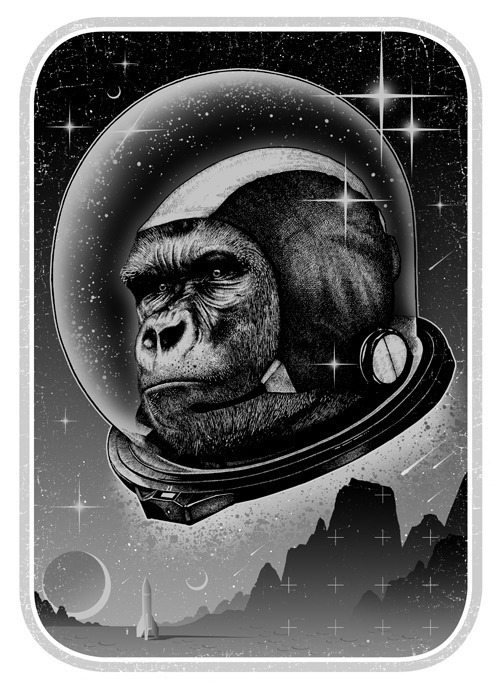
Unsurprisingly, other people have also been busy discussing the topic and there has been a fun pseudoscientific parody called the “Space Ape Theory” which took off rather nicely on Twitter and is doing a good job of highlighting problems with the AAH.

Space Ape

This post will only be short, because other people have been dealing with this issue perfectly well without the need for my input, but I thought it might be useful to make visible the outcome of an extended conversation I had with AAH proponent Marcel F. Williams, in the comments section of my earlier post.

I decided to check some independent evidence about an inference made by Alister Hardy that led to the development of the AAH in the first place – the idea that having layers of subcutaneous fat was a trait unique to humans and aquatic mammals. This idea is still regularly cited by AAH proponents (especially Elaine Morgan) as a line of evidence for evolutionary convergence between humans and marine mammals due to the sharing of an aquatic habitat.

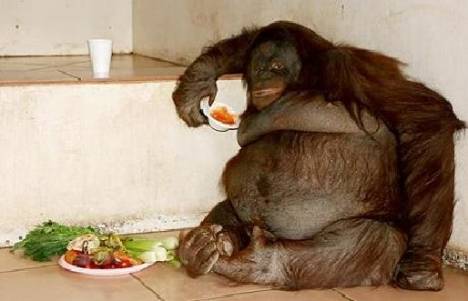
However, on checking the literature on primate husbandry it turns out that other primates have levels of subcutaneous fat that are directly comparable to humans if the animals have a ready supply of food, suggesting that humans are no different to other primates except in having a more stable food supply and leading a more sedentary life. This is supported by data from modern hunter-gatherer groups, who exhibit far lower fat levels than either farming or Western populations. Here’s a summary of the data with a link to the research:

Body fat – man vs monkey
Rhesus macaques in labs that are identified as being in the ‘optimal’ weight range have an average body fat content of 25% with individuals in the obese range averaging 42.7% [link opens pdf]

Autopsies of male orangutans show body fat levels range from 15% to 45% [link opens pdf]

Average body fat in Hadza hunter-gatherers averages 13.5% for men and 20% for women. In Western populations men average 22.5% and women average 37.9% [link opens pdf]

In short, humans are by no means unique in the primates with regard to their proportion of subcutaneous fat, so if any AAH proponent pulls out that old chestnut in conversation, be sure to put them right.

Oshine the morbidly obese Orangutan

Oshine the morbidly obese orangutan

Friday mystery object #198 answer

On Friday I gave you these two objects (with a third photo to show the end) to identify.

mystery198

The specimens had me a bit stumped. They are keratinous (keratin is the protein that makes up fingernail, hair and horn amongst other things) and perhaps unsurprisingly they had been labelled as “Artiodactyla horns” given their overall shape. Of course, if they were artiodactyl horns they would be from a bovid (antelope, sheep, cow, etc.), since the other artiodactyls don’t have unbranching horns.

There are nearly 150 bovid species, ranging from the gigantic Gaur to the miniature Royal Antelope, and so far I’ve not been able to find any with horns quite like this. Moreover, the very small size, pattern of growth and relatively shallow depth of the inside chamber of the sheath, don’t really agree with the identification.

My next thought was the spur of a galliform bird, like a Chicken. I compared these specimens to the spur of a male Chicken skeleton in the Horniman’s collection and they looked quite different and much too long, so I gave up on that idea.

Finally I started to consider claws of all sorts of animals, but this didn’t make much sense to me as claws aren’t usually round in cross-section and they have wear facets from being used to walk, climb or dig. You don’t have claws this big if you’re not going to use them and I couldn’t think of much use for a claw like this.

So that left me stumped.

Fortunately, Mieke Roth came to my rescue and made me reassess the Chicken spur identification. It turns out that the Chicken I compared the spur to much have had his spur sheaths  removed and they’d hardly grown back.

As you can see, the spur identification fits perfectly!

Many thanks to everyone for their suggestions on this mystery object. It really helps to have fresh eyes looking at a problem and suggesting something you’ve discarded in error!

The inevitability of change

I’ve been running this blog for over four years now and it’s been some time since I really engaged with it beyond posting my mystery object on Friday and the answer on Monday.

I finally forced myself out of bed extra early on a Saturday morning to give the old blog a bit of a spring clean. What I found was both distressing and heartening.

The links I had to other sites were so out of date that half of them had moved or had simply stopped being updated over a year ago.

With others I found that the content had moved on, from blogs about being a hopeful museum newbie to blogs about being a capable museum professional (see Wunderkammer and Museological Meanderings as examples). In the case of Jake’s bones the blog had changed from being a 9-year-old talking about his bone collection, to an eleven-year-old talking about his forthcoming book on bones.

This sort of progression is wonderful to see and it led me to consider how my blog has changed over the years.
Self reflection

An opportunity for self reflection

The photos now are generally of better quality than they were at the outset, so that’s good. However, I feel that the detail and quality of the answers to the mystery objects have deteriorated, as the time I have available to research and write about them has decreased.

The mystery objects themselves have also become a bit less inspiring, perhaps because the number of striking specimens in the Horniman’s collections that need identification has decreased.

One thing is certain however, after nearly 4 years of running the mystery object I have built up a fantastic community of people who come to Zygoma to have a go at identifying the Friday mystery object, which is something worthwhile.

So now I am left with a quandary – how do I rethink  Zygoma to make better use of my increasingly limited time, while maintaining the sense of community on the site?

I may try reducing the number of mystery objects so they’re not a weekly feature, but if I do that I can fill the gap with photos of interesting specimens I’ve come across at work and perhaps specimens that people request.

If you have any ideas about what you’d like to see on Zygoma please leave a comment below – I’d also appreciate links to other related blogs that I may have missed when tidying up my list, so please feel free to suggest away!