Friday mystery object #499 answer

Last week I gave you this mystery object from the Dead Zoo to try your hand at identifying:
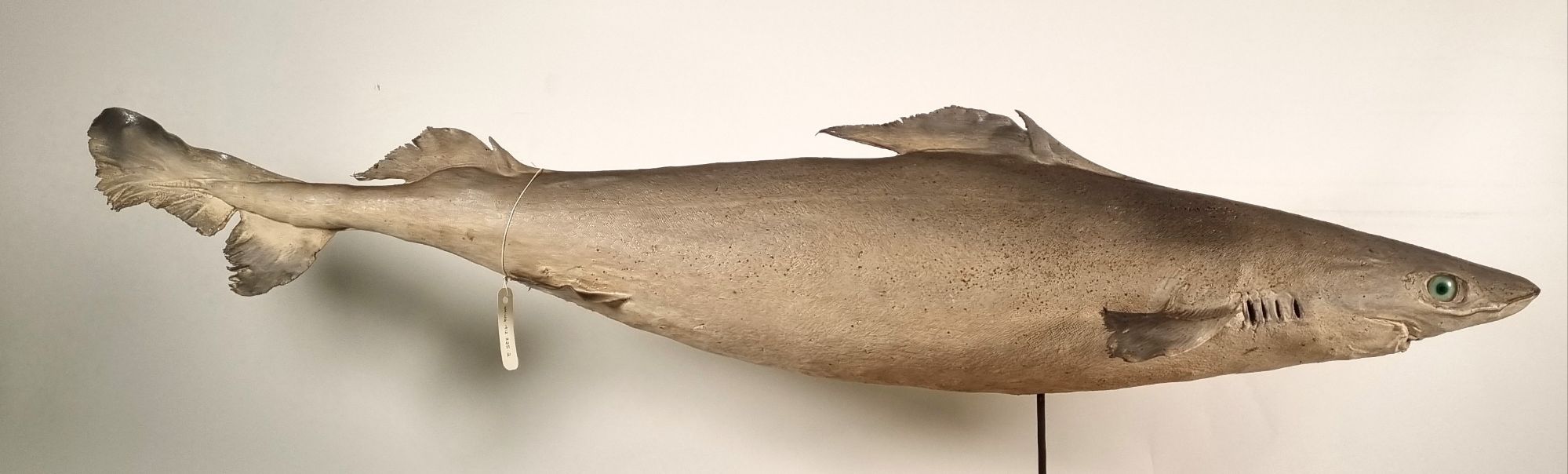
There were some muttering about this being a squalid in the comments and on social media (I left Twitter some time ago, but I’m on Bluesky, Mastodon, and LinkedIn), and those mutterings were of course correct, since this is a shark in the Order Squaliformes. A useful point for identification of this Genus is the lack of an anal fin.

There are a lot of Squaliformes, but this one has a profile that best fits the form of either the Squalidae (the Dogfish) or the Centrophoridae (the Gulper sharks). The tail offers a clue to distinguish though, as it has a full tail notch and a secondary partial notch that gives a squared off section of the tail tip that isn’t seen in the Squalidae (although some do have a squared off tail tip, but with just a single partial notch).

Within the family Centrophoridae you could spend a bit of time going through about 20 species to rule some out, or you can take a shortcut and guess that this specimen is from the waters around Ireland and start searching for likely candidates there. This approach helped Adam Yates get the identification.

I think the taxidermy of our specimen may have made this harder, since I don’t think the taxidermist had a big enough eye for the species (if you look at the specimen’s head you can see how hollow the orbit appears around the eye):

The large eyes are one of the features of this deep sea species that does indeed occur in Irish waters, but the scales are probably the most useful feature, although unfortunately they aren’t easy to see clearly on the specimen (although if you click the photo you do get a bigger version).

As Adam recognised, this is a Leafscale Gulper Centrophorus squamosus Bonnaterre, 1788.

This particular specimen was collected in May 1906, 70 miles off Bull Rock in County Kerry, in a trawl at 110 fathoms. It came to the Dead Zoo via Irish Fisheries, along with many other specimens that have helped lay the foundations of our understanding of the marine life found in Irish waters.

We still receive new specimens from trawlers around the island, with new records of species and interesting variations within species being donated quite frequently. With the dizzying rate of technological developments, it’s easy to assume that we already know everything about the life on our planet, but in reality we’re still discovering new things all the time, and our knowledge is very incomplete.

So thanks to everyone who joins in the mystery object – it gives me a chance to learn new things from you, and I hope it helps you to test your skills, and maybe learn some new things about the animals we share the planet with!

Friday mystery object #423 answer

Last week I gave you this fishy looking critter to identify:

It wasn’t an overly difficult one for most of you, since it is a very distinctive and somewhat unusual animal with some immediately recognisable features. Most obvious are the gills.

Bony fish only have one visible external opening on either side of their head where water exits after it’s flowed over the gills, and this is well hidden when the gill flap (or operculum) is closed. So this is clearly not a bony fish.

Most modern sharks have 5 external visible gill slits, but this one has six. That makes it a bit of an evolutionary anachronism. There are only seven species of shark with more than 5 gills and they are all in the Order Hexanchiformes, which narrows down the possibilities considerably. Of those, two have seven gills, leaving just five possible species.

Those five species sit in just two families – the Cow Sharks and the Frilled Sharks. These can be separated based on a variety of features, but the most obvious is that the Cow Sharks have fusiform (or spindle-like) body shapes with a very pointed nose to help them move efficiently through the water by minimising drag. The Frilled Sharks have more anguilliform (eel-like) bodies with a blunter head and mouth set further forward in relation to the eyes – a feature about the mystery object picked up on by Allen Hazen.

There are only two species of Frilled Shark to choose between and I’m not sure I could tell the difference between them based on the photo provided. However, one species is only found off the coast of South Africa, and in last week’s post I dropped a (hopefully) helpful clue – this specimen was caught off the coast of Ireland.

That means this can only be the Frilled Shark Chlamydoselachus anguineus Garman, 1884. Well done to Adam Yates for being the first to get it spot on. This specimen was caught off the coast of County Donegal at a depth of 390 fathoms (or 713 metres in standard units) just over 21 years ago. A special mention to Pete Liptrot on Twitter who managed to identify this mystery object to the actual specimen – not just the species!

Friday mystery object #263 answer

Last Friday I gave you this mystery object that came up at a natural materials identification course that I delivered at the Royal Albert Memorial Museum in Exeter last week:

mystery263

There were a variety of suggestions as to what it might be, but everyone (correctly) discounted the information on the label that it was a tooth.

There were some suggestions of wood and ivory, but there were two suggestions which were definitely in the right ball-park. Daniel Calleri suggested it might be something fishy, while Krista got it pretty much spot on when she suggested a dorsal barb from a skate or ray.

I’m pretty sure that it’s the spine from the leading edge of the first or second dorsal fin of a Spurdog shark in the genus Squalus Linnaeus, 1758.

Spiny Dogfish (Squalus acanthias) by Dornhai

Spiny Dogfish (Squalus acanthias) by Dornhai

These turn up every so often in collections, sometimes as decoration, sometimes as items found in Native American middens. Presumably they’re composed of keratin, which is a commonly occurring structural protein in vertebrate skin that can also form hair, horn, scales and claw.

Thanks for all your comments and well done to Krista!

Friday mystery object #110 answer

On Friday I gave you these objects to identify:

Apart from their superficial similarity to chocolate pralines or denuded molluscs several of you managed to identify that these are in fact teeth.

In particular Dave Godfrey, David and Styracosaurus Rider pwned this object with a definitive genus identification of   Continue reading