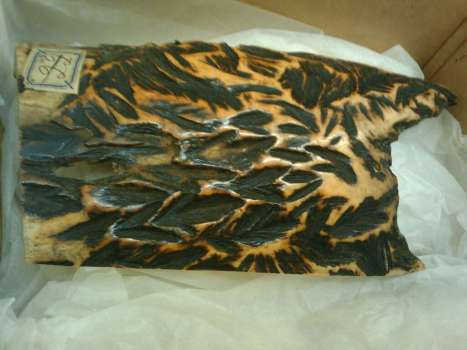
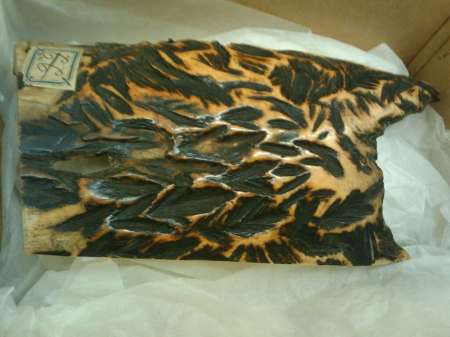
More poorly labelled stuff I’ve found at work this week – do you know what this is and where it came from?
Dorsal view (total width ~5cm)
Ventral view (total width ~5cm)
I’ve decided to trial multiple choice answers for this one, so please vote on what you think it is! [N.B. don’t forget to hit the “vote” button after making your selection!] Continue reading →
The mystery object I showed you on Friday was this:
Despite a range of inventive and highly plausible(?) proposed identifications, ranging from lunch to Mike Tyson’s ear, Lifelinking earns a plethora of kudos for the correct identification that this is Continue reading →
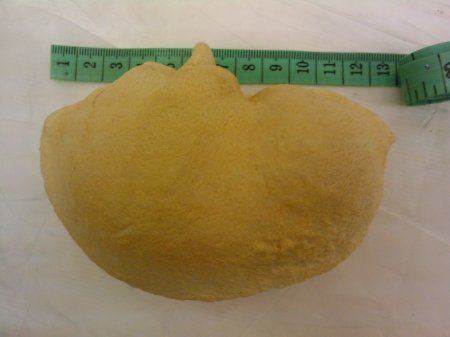
Delving deeper into the world of natural history this week, with the second of my Friday Mystery Objects!
This should be much easier than last week’s object since you only need to work out what it is and I have provided two views (scale is in cm BTW). If it proves too simple I will up the difficulty next week!
As before, put you thoughts in the comments section below. Answer will follow on Monday in a seperate post and I may drop in some extra clues if they’re needed.
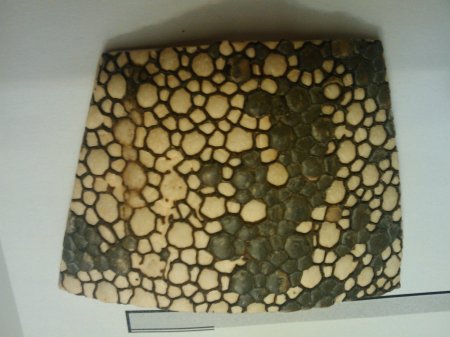
I’ve decided to share my world with others – at work I get to see some amazing stuff and often I have to work out what it is, because the label has gone missing. So here is the first of my Friday Mystery Objects!
So, what is it and why does it look like that?
Put you thoughts in the comments section below. Answer will follow on Monday in a seperate post.
It has only been in the last year or so that I have paid much attention to the comments sections at the bottom of online science articles. It strikes me that everyone feels the need to comment, regardless of whether they understood the article or not – in fact, those who have not understood it tend to be the ones who comment most vociferously. Unsurprisingly perhaps, this tends to include a substantial proportion of creationists. Every article that touches upon my fields of interest (biology and palaeontology) seems to be followed by an irritating and distracting cloud of creationist comments, akin to the swarms of biting flies that pester large mammals. Here’s an example. Continue reading →
Having spent years studying the bones of animals long dead, I have been fortunate enough to see – on a daily basis – evidence of the relationship between humans and other animals. For me, our kinship with the rest of life on Earth is a vivid reality. Evolution is change and that change is the result of an ongoing struggle for life – where those that are best suited for the struggle are rewarded by the continuation of their lineage. This means that we are each an end link in an unbroken chain of life, stretching back over two billion years. For all that time, each one of our ancestors must have been amongst the best of their kind. In the words of Charles Darwin, “There is grandeur in this view of life”. Continue reading →
Science communication is something I consider to be important, because I consider science to be important.
Our understanding of reality may be shaped by many things, but to me there seems to be no justification in basing our understanding on something that is not observably and demonstrably real. Science provides a framework within which we can test ideas of reality against one another and, more importantly against real evidence, to find which ideas are the most robust.
I work at the Horniman Museum in South East London, where we are dedicated to providing the public with access to objects that provide evidence to inform their understanding of the world in which they live. Part of my role as a curator is to provide interpretation of what we can be learned from natural history objects.
I never really thought about my role in this light until Alom Shaha asked me to answer the question “Why is science important?”. My answer can be seen below (apologies for the low volume).
I should probably make it explicitly clear that this blog is personal and in no way represents the views and opinions of the Horniman Museum.



 Zygoma