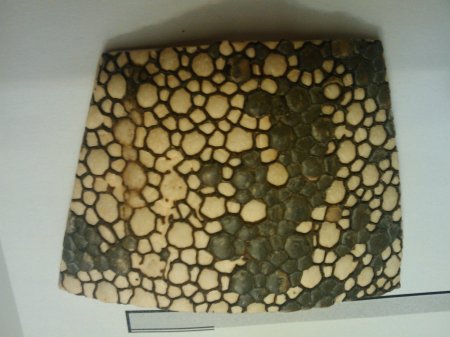
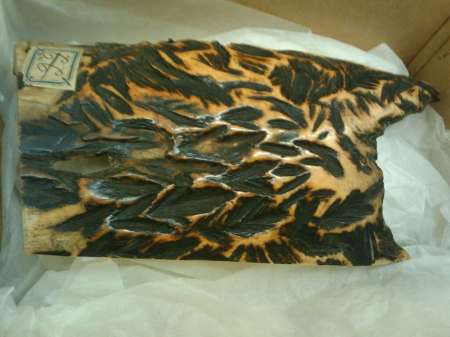
More poorly labelled stuff I’ve found at work this week – do you know what this is and where it came from?
Dorsal view (total width ~5cm)
Ventral view (total width ~5cm)
I’ve decided to trial multiple choice answers for this one, so please vote on what you think it is! [N.B. don’t forget to hit the “vote” button after making your selection!] Continue reading →
The mystery object I showed you on Friday was this:
Despite a range of inventive and highly plausible(?) proposed identifications, ranging from lunch to Mike Tyson’s ear, Lifelinking earns a plethora of kudos for the correct identification that this is Continue reading →
I’ve decided to share my world with others – at work I get to see some amazing stuff and often I have to work out what it is, because the label has gone missing. So here is the first of my Friday Mystery Objects!
So, what is it and why does it look like that?
Put you thoughts in the comments section below. Answer will follow on Monday in a seperate post.
We just had our first taste of the ego that is David Starkey. My wife and I are museum professionals – we just watched Starkey’s series on Henry VIII and are both still reeling from the experience. The content relied on the normal soap-operatics one has come to expect from TV programmes featuring historical figures – in many ways it was actually pretty good, but the whole effect was somewhat spoiled by Starkey’s ham-fisted attempts at theatrics and his utter disregard for the historical evidence he insisted on over-handling – and by that we mean physically handling with the same ham-fistedness as demonstrated in his theatrics. Continue reading →
Science communication is something I consider to be important, because I consider science to be important.
Our understanding of reality may be shaped by many things, but to me there seems to be no justification in basing our understanding on something that is not observably and demonstrably real. Science provides a framework within which we can test ideas of reality against one another and, more importantly against real evidence, to find which ideas are the most robust.
I work at the Horniman Museum in South East London, where we are dedicated to providing the public with access to objects that provide evidence to inform their understanding of the world in which they live. Part of my role as a curator is to provide interpretation of what we can be learned from natural history objects.
I never really thought about my role in this light until Alom Shaha asked me to answer the question “Why is science important?”. My answer can be seen below (apologies for the low volume).
I should probably make it explicitly clear that this blog is personal and in no way represents the views and opinions of the Horniman Museum.



 Zygoma