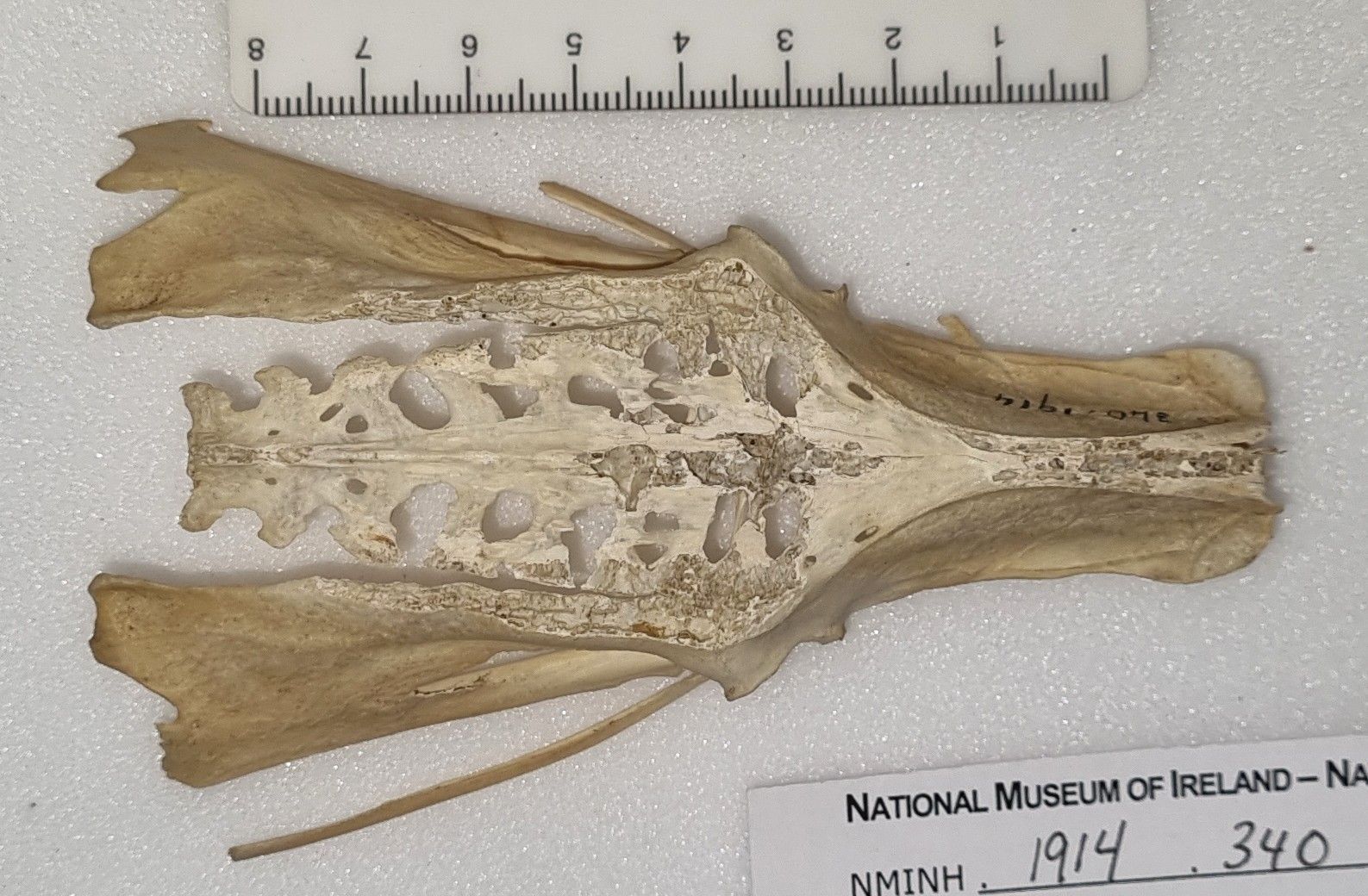
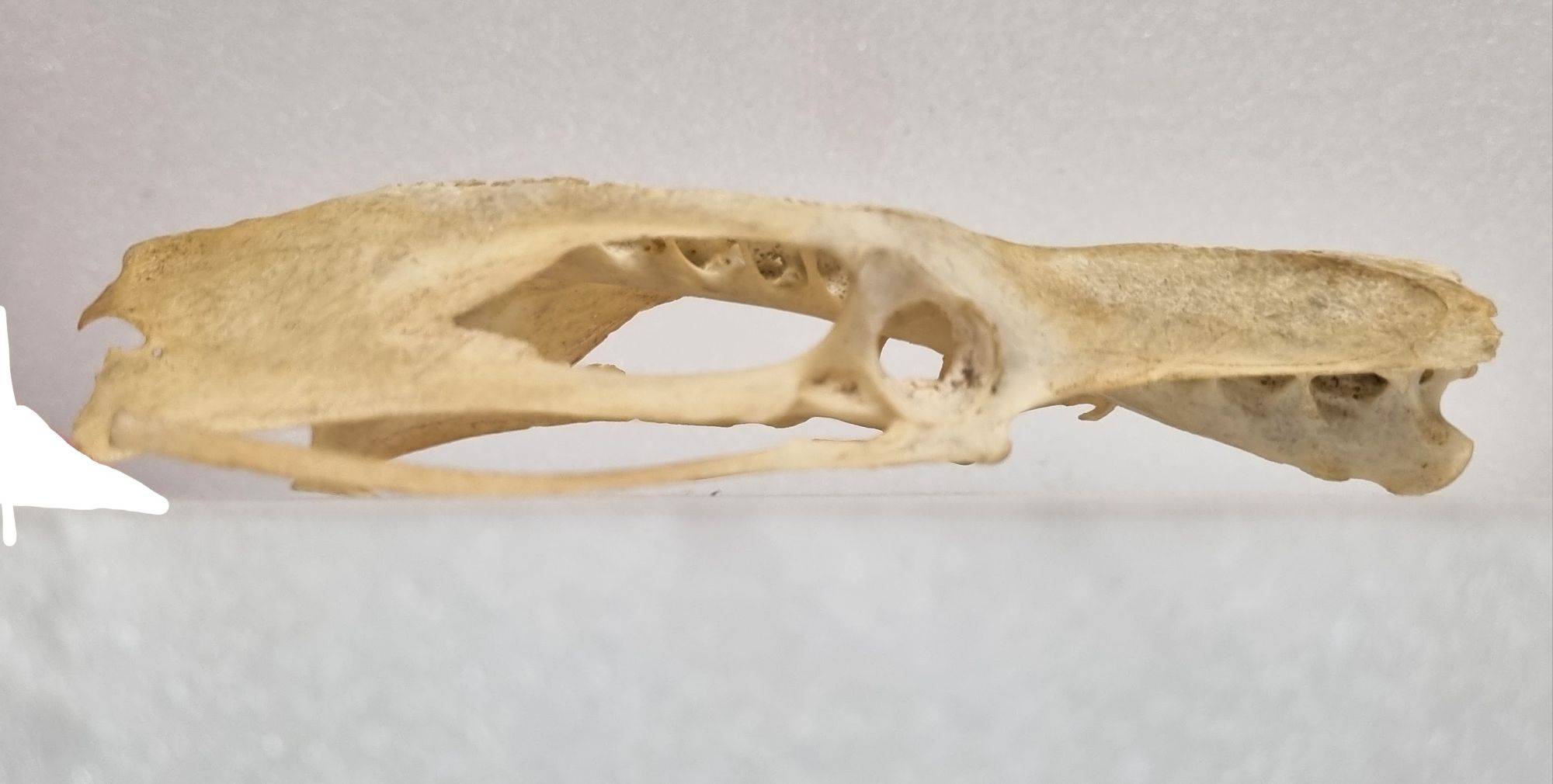
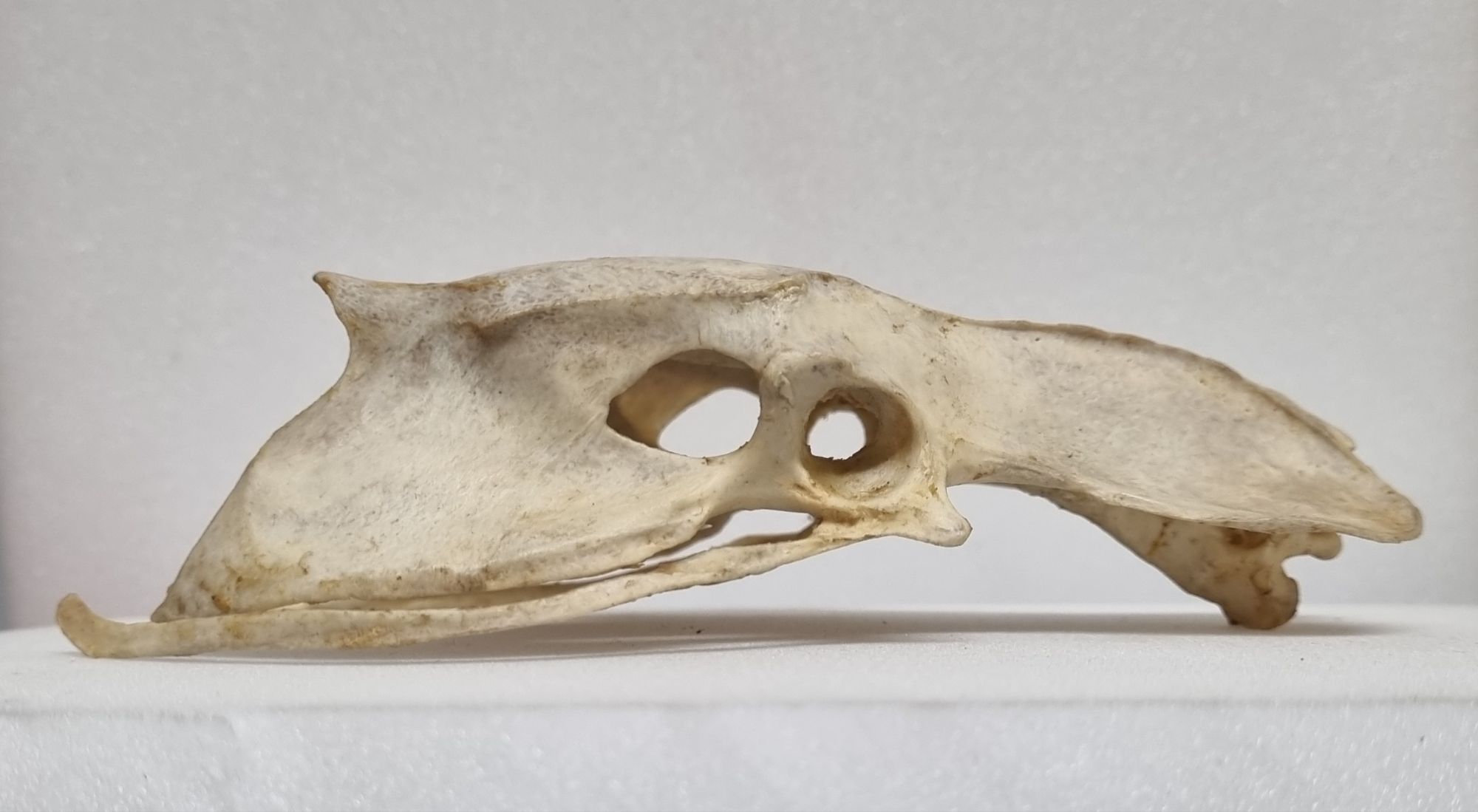
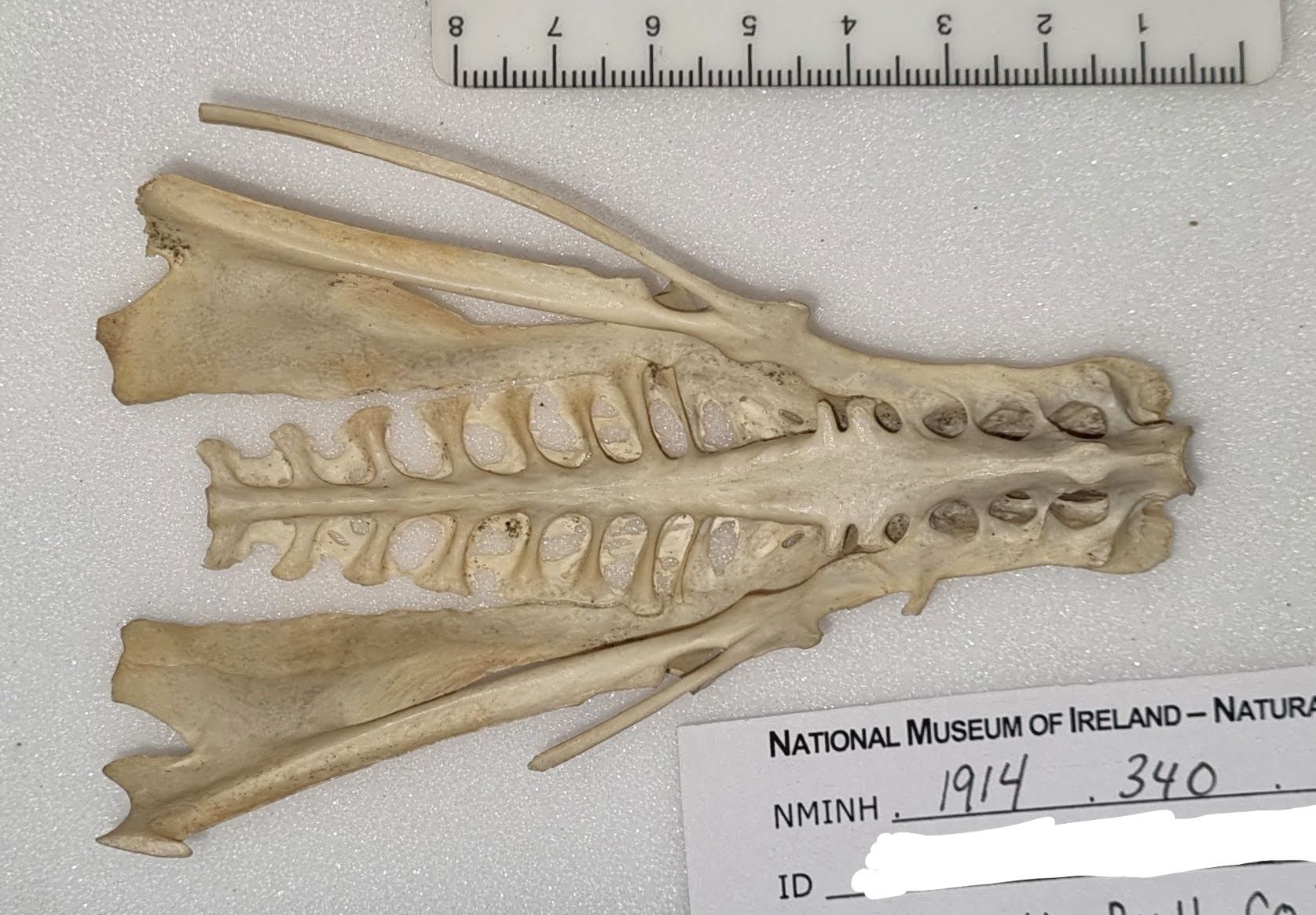
Friday mystery object #510 answer

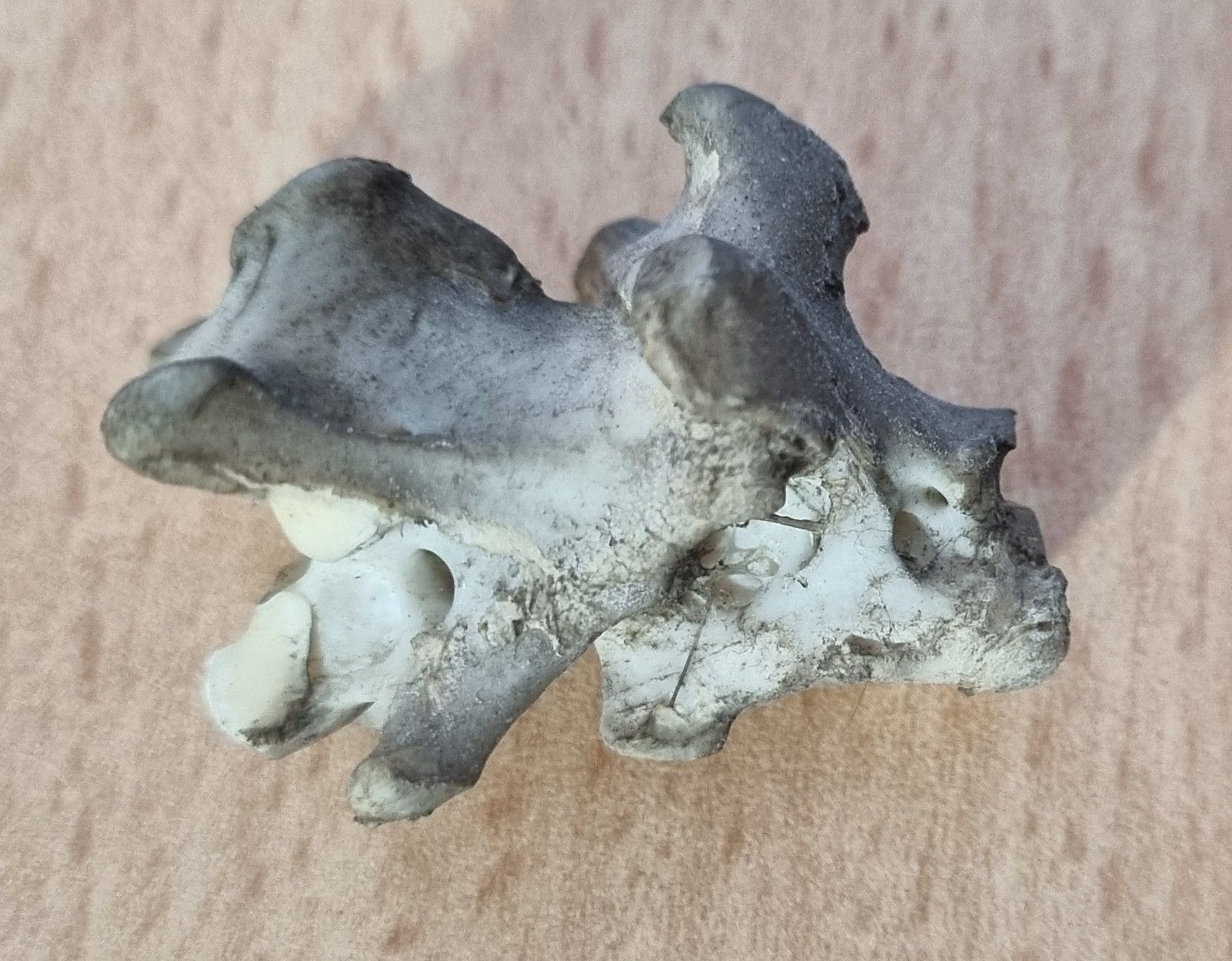
Last week I gave you this genuine mystery object to have a go at identifying:

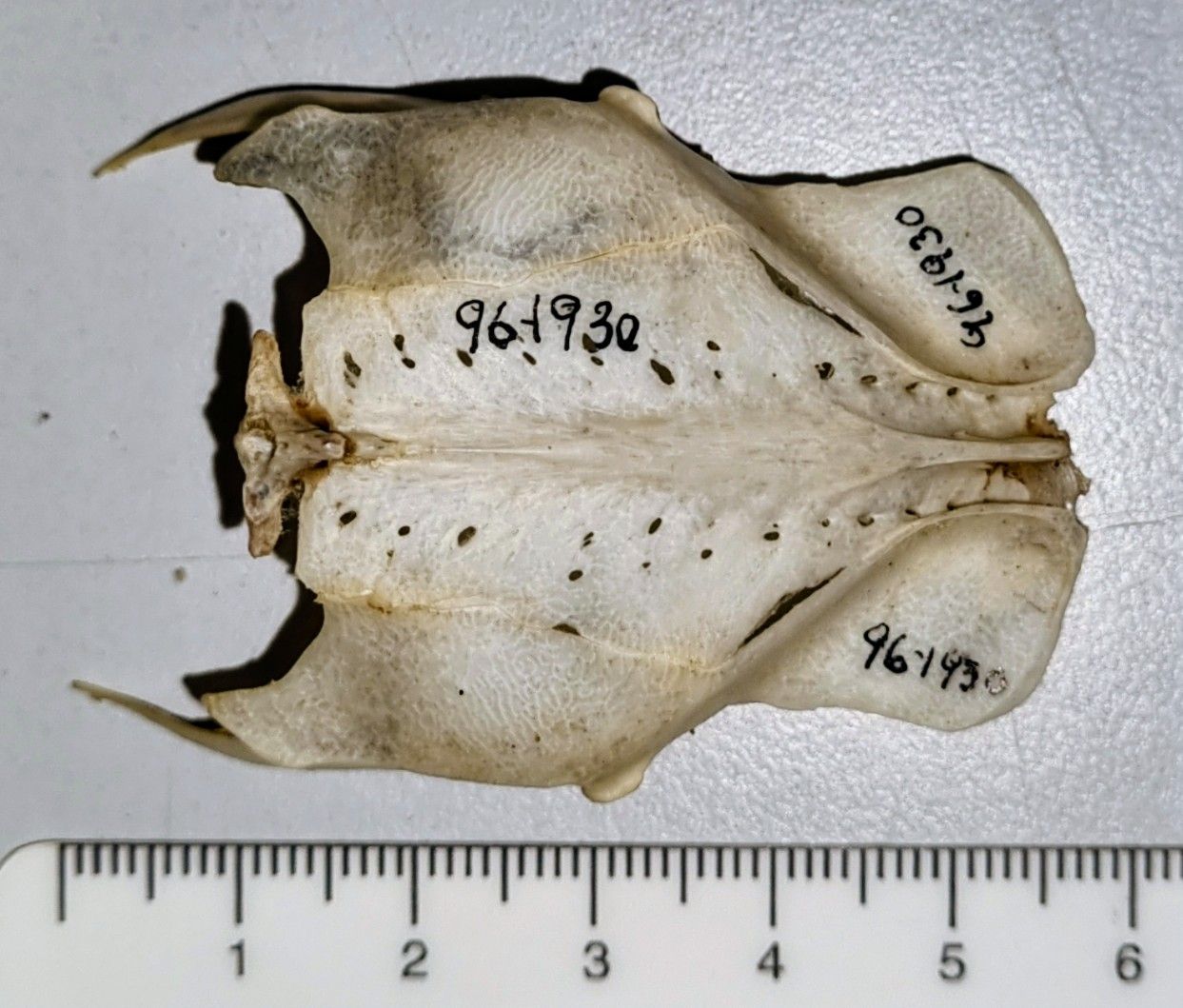
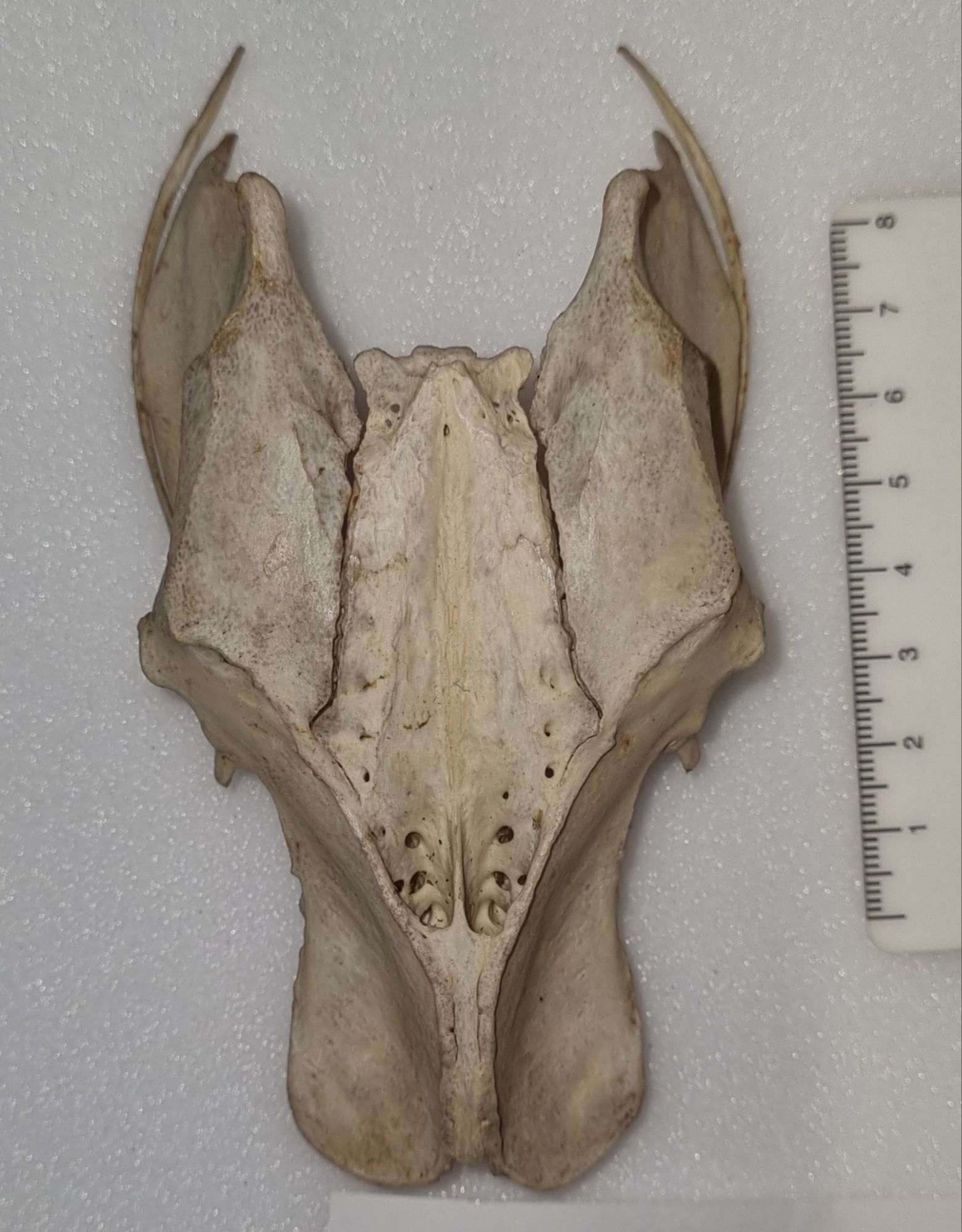
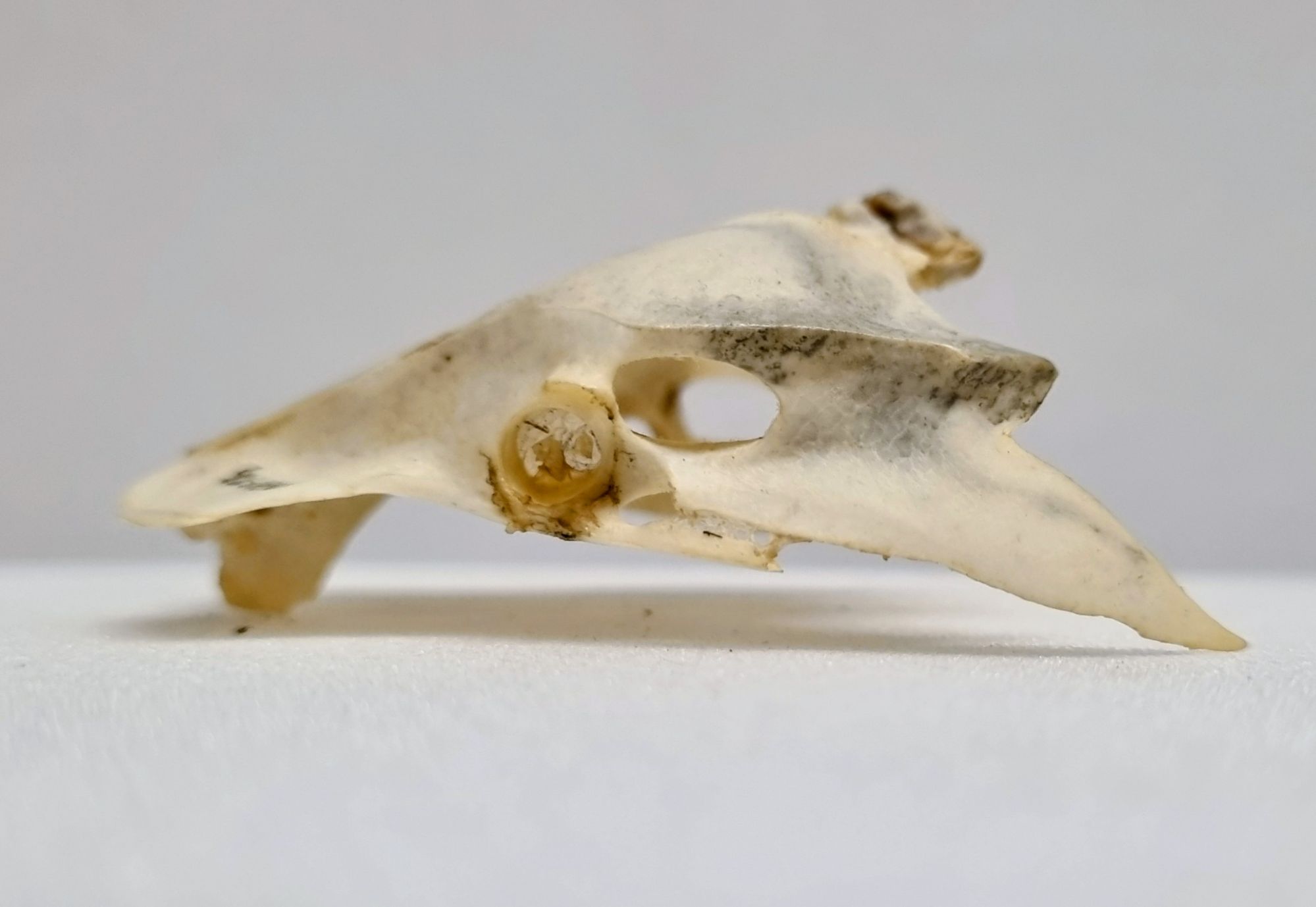
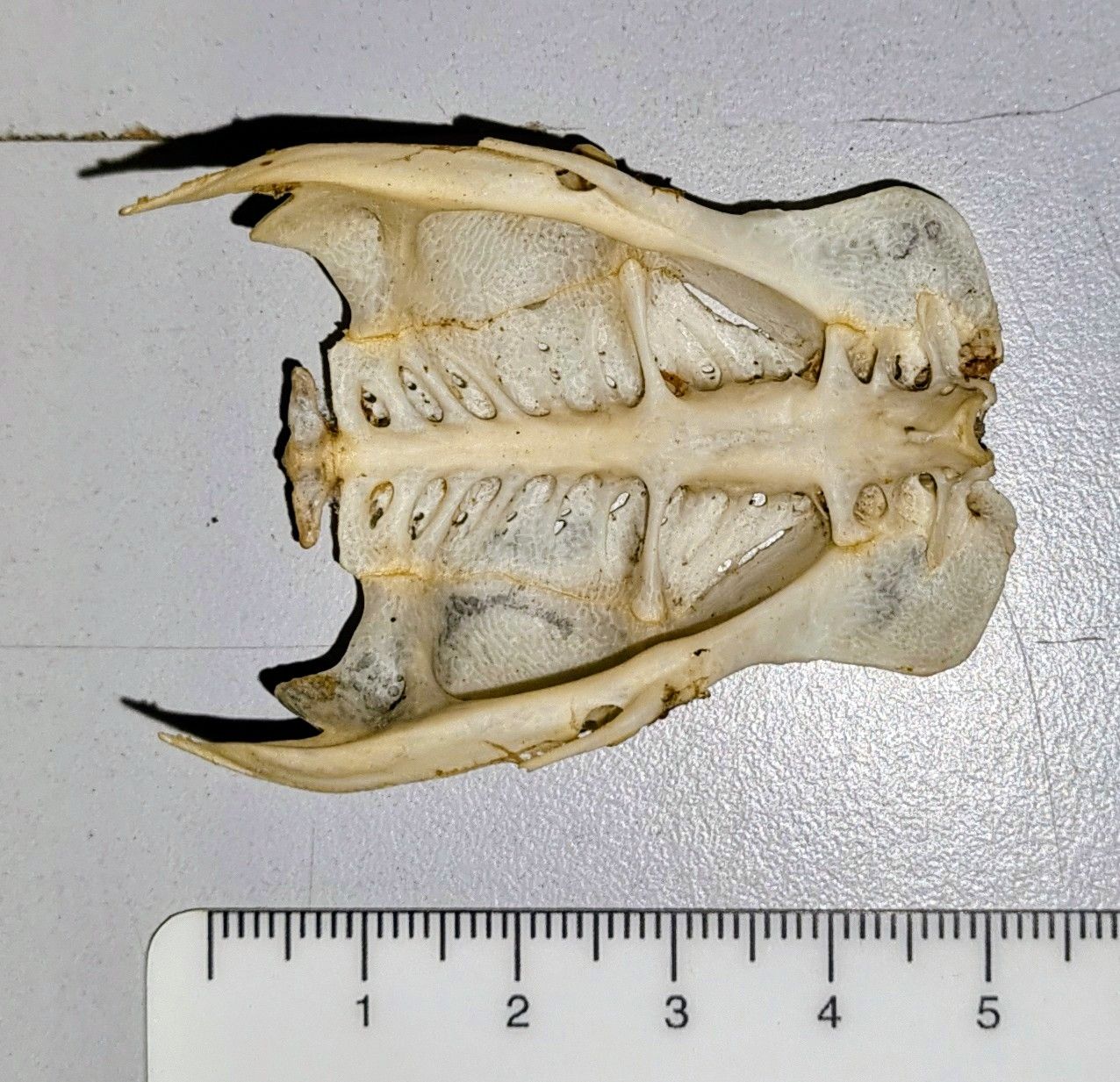
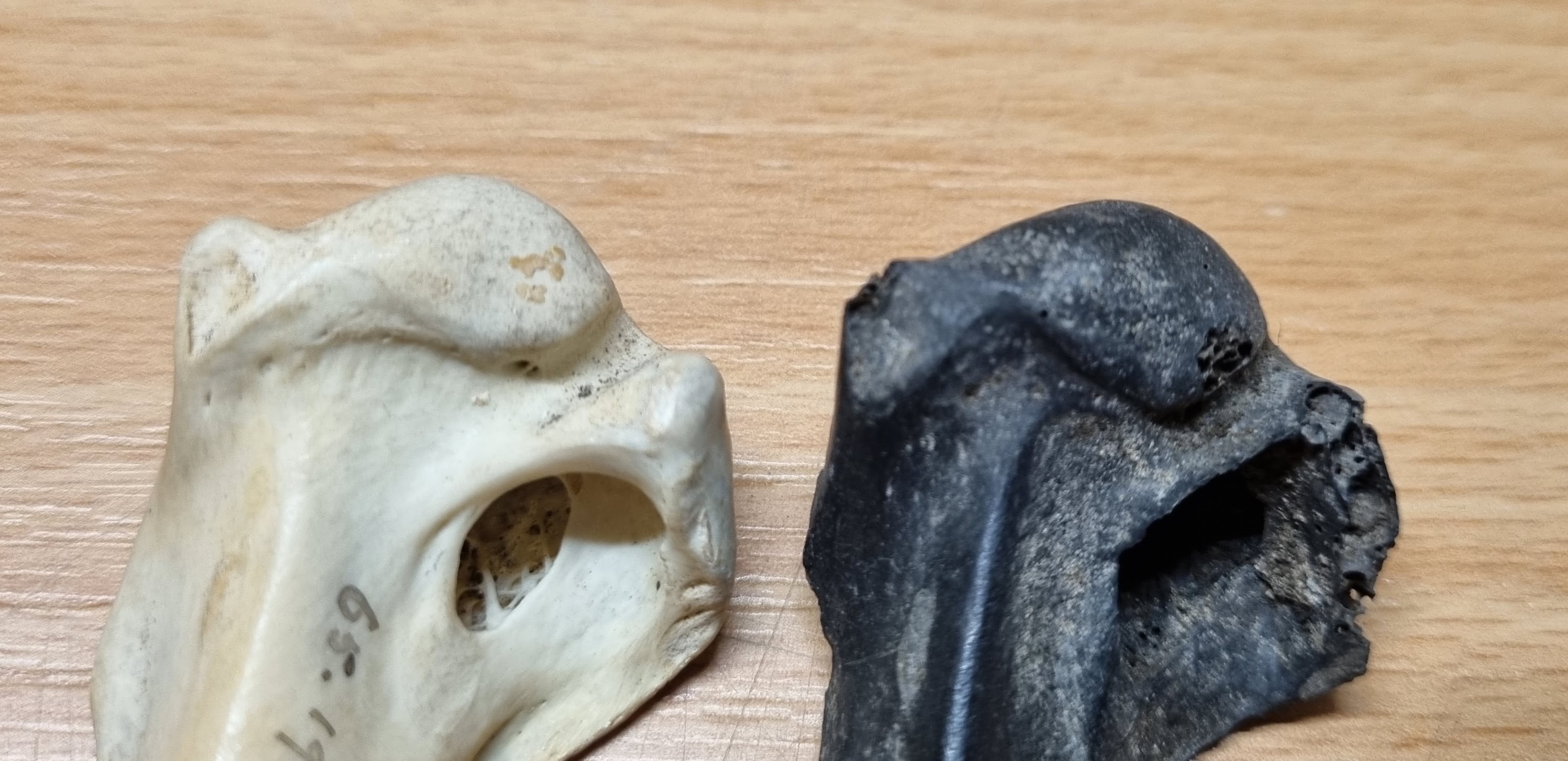
This came to light when we were clearing out cupboards in the Dead Zoo, and it may have been an ill-considered option, considering how tricky vertebrae can be to narrow down to species and how little time I’ve had to research this particular specimen.

I was hoping that someone in the comments might spot something I’d missed, and Adam Yates certainly spotted everything I’d noted from my inspection of the specimen:

Clearly birdy (pneumatic foramina and saddle-shaped posterior centrum face). The odd short anterior of the pair is probably the axis, and the one behind, Ce 3. I can’t do better than that right now, but will return to this puzzle later…

He also added a useful comment about size which I hadn’t really considered fully:

…The first few cervical vertebrae of birds are surprisingly small and I judge this axis to be about 25 – 30 mm across the postzygapophyses, using Paolo’s thumbnail as scale. That would suggest a raft of large species. I’m going to guess this one rhymes with “he knew”.

I’m assuming that’s a reference to Emu, and the size of the vertebrae certainly seem to be in the right size range (at least according to this paper by Baranowski et al, from 2018). However, I’m not entirely convinced that the shape is quite right, Rheas might be a little more similar, and there was a hint at a pouched animal by katedmonson, which I suspect is a reference to a Pelican.

I think these are a little bit too short for a Pelican, but I’ll certainly keep that identification in mind as I try to find where these came from. However, without spending a good bit more time trying to find comparative specimens, it’s going to be a challenge. It may be that the easiest way to work out what this is will be to search for a large mounted bird skeleton that’s missing these vertebrae, since there are not too many such specimens in the Dead Zoo.

But before I start a wider search, I have a hunch that I want to check out. There is a King Vulture specimen that I’ve blogged about previously (way back in 2018) that is large and consists of a partially dismounted skeleton. I think I’ll make that my first port of call, as (if memory serves) it has similar levels of soot build up on the bones, and I suspect it’s in the right sort of size range, as vultures have fairly large and robust cervical vertebrae for their size.

So my thanks to everyone for their suggestions and observations – if I eventually discover the identity of these bones I’ll be sure to update this post, and if you think you know what it is, I’d love to hear your thoughts!

Oh, and if you celebrate Easter, I hope you have a great one!

Friday mystery object #509 answer

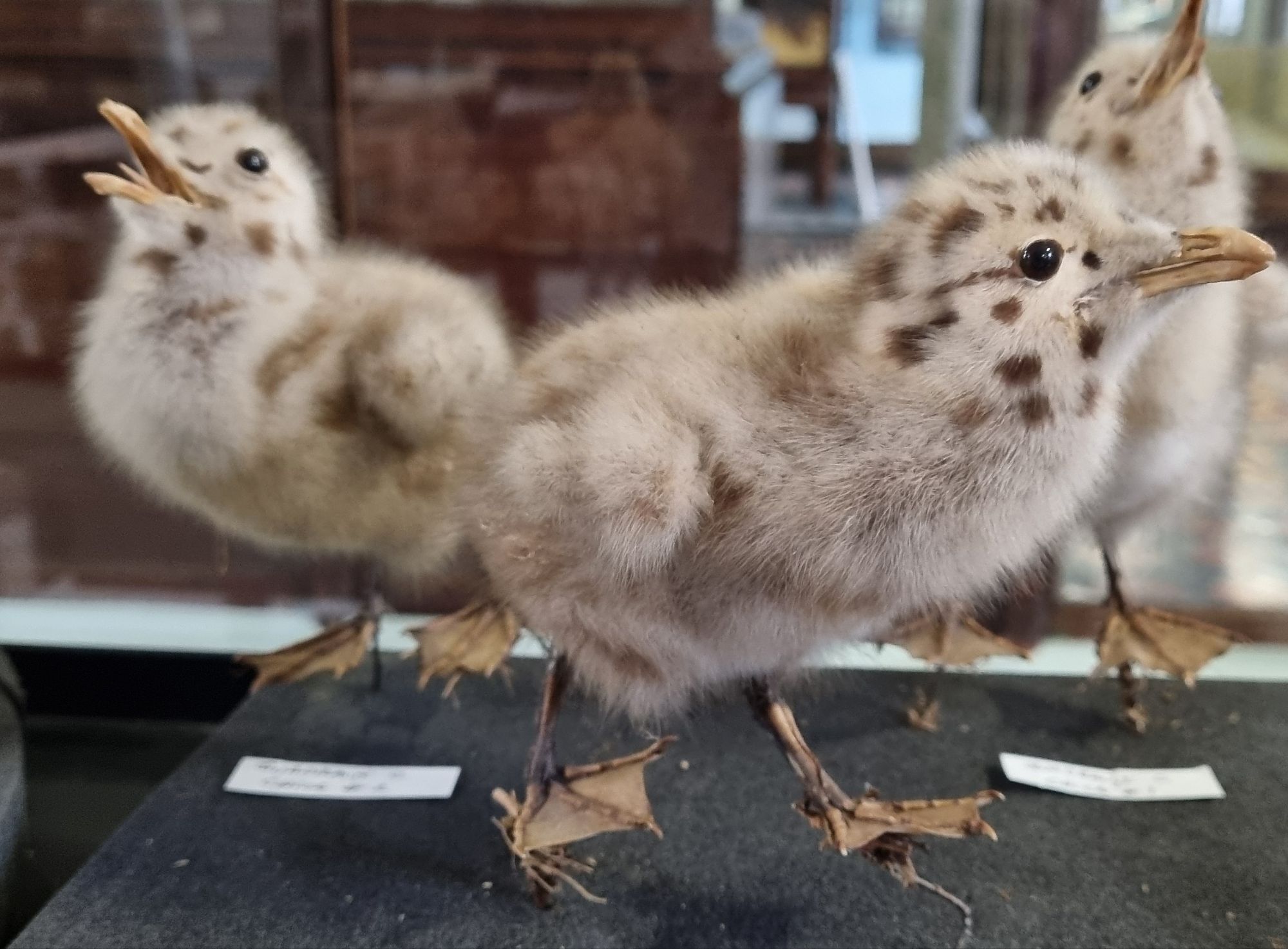
Last week I gave you these fuzzy chicks to try your hand at identifying:

Their speckled camouflage is perfect for pebbly beaches and it’s just what you’d expect from a member of the Gull Family (the Laridae). This is something that everyone picked up on, with a variety of excellent clues.

pleasantly78f070d606 was first in the door, with a great clue identifying the correct species in three words:

Silvery chip thief

The chip stealing (both in the UK and USA meaning of chips) encapsulates one of the more familiar and frustrating behaviours of this commonly kleptoparasitic species:

The “silvery” references the species name argentatus (which in tern references the silvery shade on back of these cheeky birds). So this is the chick of a Herring Gull Larus argentatus Pontoppidan, 1763.

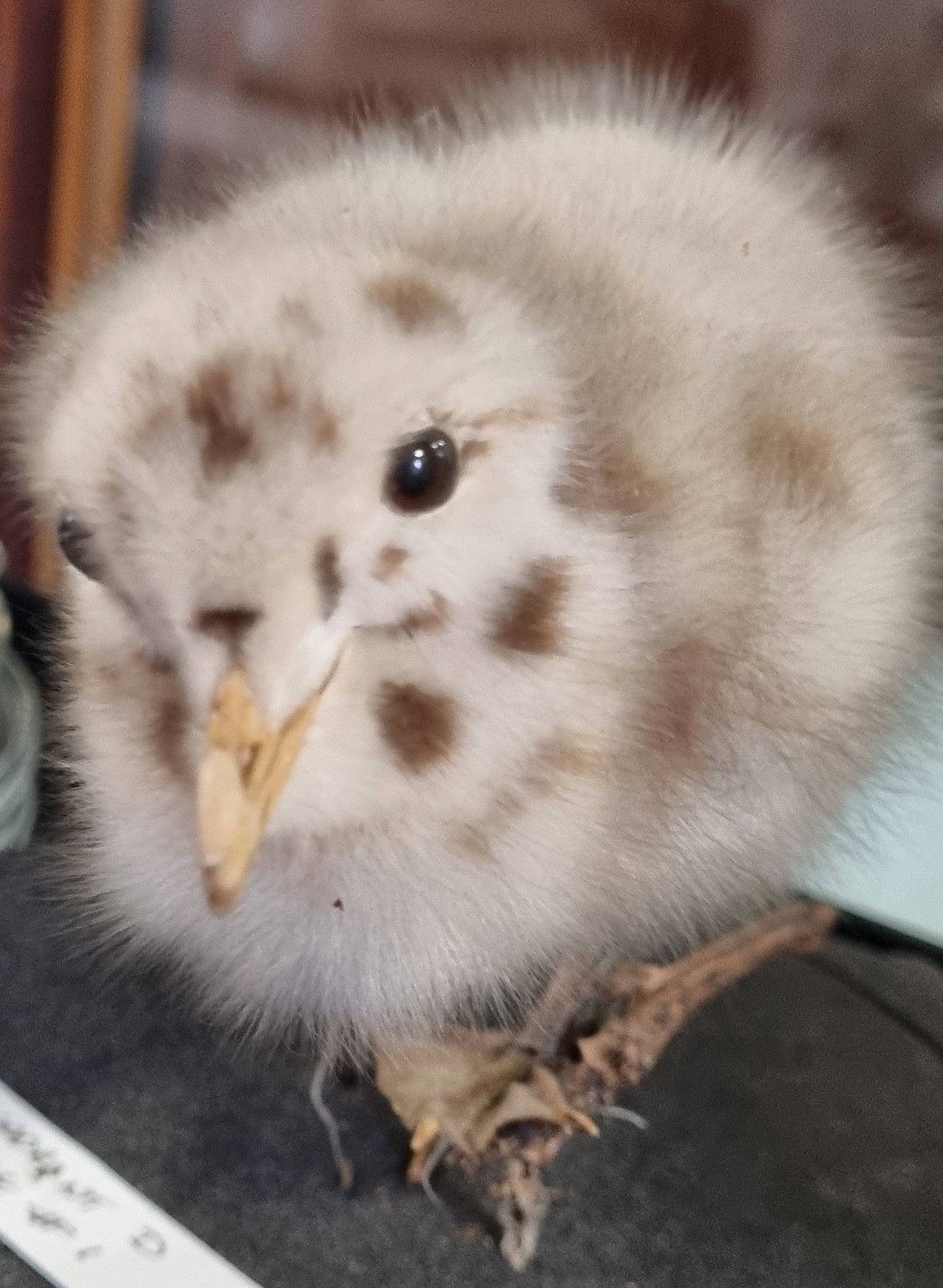
It can be tricky to distinguish between the chicks of various different gull species, but you may notice that these look a bit like they’ve gone for, what I can probably best describe as an eyeliner flick. This bar behind the eye is variable, but occurs frequently in Herring Gull chicks, but less so in the similar looking chicks of other closely related species.

These chicks are from a particularly nicely done diorama in the Dead Zoo, which we’ve been in the process of preparing for transport out of the building. We’ll be sharing some of the progress on the project on some social media platforms (Bluesky and Instagram) soon – so I’ll be sure to share some of those stories from our hard-working team here as well.

Friday mystery object #497 answer

Last week I gave you this guest mystery object from Andy Taylor FLS (and now) FBNA to identify:

Image by Andy Taylor FLS FBNA, 2024.

It wasn’t a particularly difficult one, since that huge bill immediately narrows down the possibilities.

The spear-like bill shape is reminiscent of a heron’s, but it’s heavier – not quite as massive as something like a Marabou Stork, Adjutant, or Jabiru, but heavy nonetheless.

As Adam Yates noted, this is the skull of a White Stork Ciconia ciconia (Linnaeus, 1758) – the second mystery object in a row with the initials C. c. (the previous one being Crocuta crocuta).

When attempting to identify bird skulls, a hugely useful resource for reference is Skullsite, which is run by regular commentor on the blog, Wouter van Gestel – who referenced the White Stork with a comment relating to their reputation for the delivery of babies.

So well done to everyone who worked out the species, here and on Mastodon, Bluesky and LinkedIn – and my thanks to Andy for sharing another gem from his collection!

Friday mystery object #484 answer

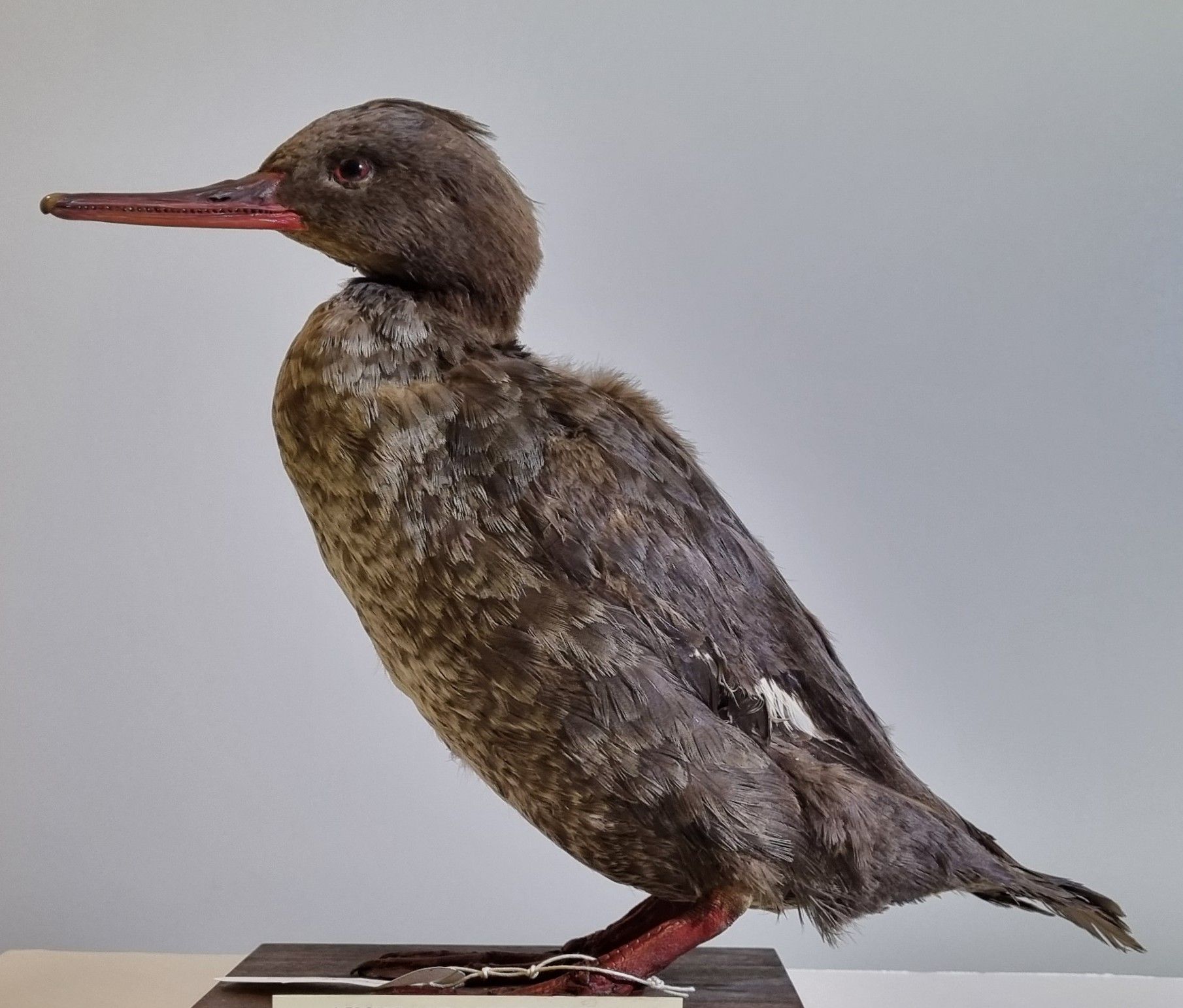
Last week I gave you this fantastic specimen from the Dead Zoo to have a go at identifying:

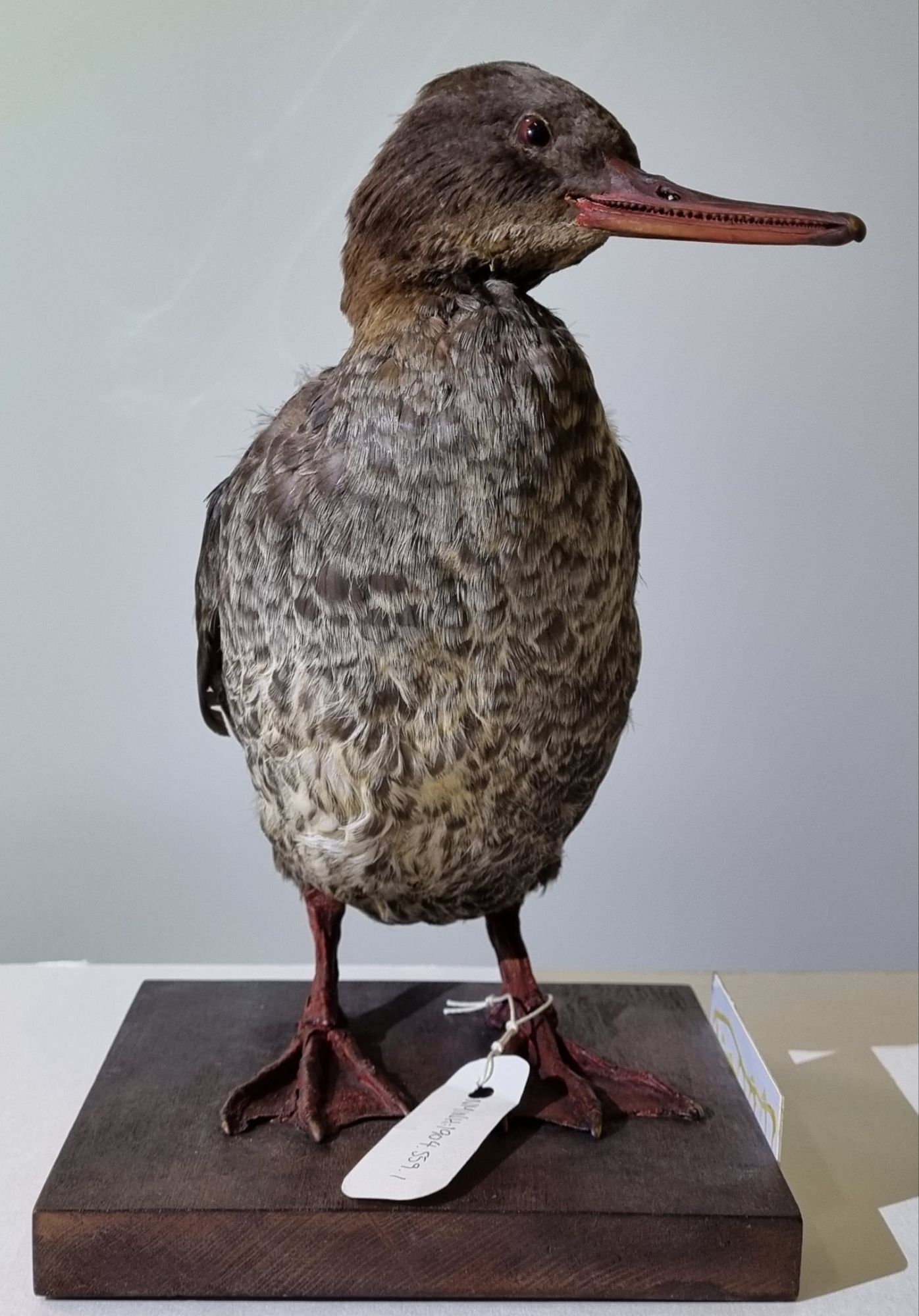
It wasn’t a hugely difficult object to identify, given its distinctive narrow serrated bill on a duck-like body, which are hallmarks of the mergansers – a genus of piscivorous ducks:

There aren’t many species of merganser – just six alive today, so on the face of it, there aren’t many to choose from. This particular specimen looks most like a juvenile Red-breasted Merganser, as several people suggested – but it’s not one of those.

This particular specimen is one of two other known merganser species that survived until historic times, but which are now extinct. The other species has no taxidermy specimens to represent it, and is only known from subfossil material from Chatham Island, off the coast of New Zealand.

Our mystery object is one of the very few taxidermy mounts that can show us what the Auckland Island Merganser (Mergus australis Hombron & Jacquinot, 1841) looked like. There are only 27 existsing specimens of this species in the world, most of which are preserved in fluid, and have lost most of their colour as a result – although ours is no doubt a little faded from the natural light in the galleries.

The Auckland Island Merganser is a good example of a species that did not survive contact with humans. Their original distribution was much more widespread on New Zealand and Chatham Island, but the arrival of Polynesian peoples led to their loss everywhere except on Auckland Island.

The arrival of Europeans and the pigs and cats they brought with them to Auckland Island pushed the population to the brink, and then hunting expeditions around the turn of the 19th to 20th century wiped out the rest. This particular specimen was shot on the 5th January 1901. One year and four days later the last pair were killed by the same man – Lord Ranfurly, the Governor of New Zealand.

Ranfurly finished his term as Governor in 1904 and it seems likely that some of the skins of the specimens he collected in New Zealand returned with him. Some went to the British Museum (Natural History), while this one was prepared at “The Jungle” – Rowland Ward’s by shop at 167 Piccadilly, London before coming to Dublin.

It’s saddening to think that a species was pushed over the brink of extinction so deliberately, with no effort to preserve or protect it. Around the same time in North America the Passenger Pigeon became extinct in the wild, but at least the decline of the species had spurred efforts to preserve the remaining individuals in an effort to breed them. Meanwhile in New Zealand, it seems that the scarcity of the Auckland Island Merganser increased the demand for specimens, thereby sealing the fate of the species.

If you want to know more about the life and habits of these birds, New Zealand Birds Online is a great resource, with excellent information, so do check it out.

On a final note, I am currently attending the excellent NatSCA conference in Oxford at the moment, so extinct birds are very much on my mind. Later today I am looking forward to seeing the remains of the last fragments of surviving skin from the Dodo. We once shared our planet with these animals, and while it’s remarkable that we still have these specimens that help us understand what has been lost, it would be better if they had never been lost at all.

Friday mystery object #473 answer

Last week I gave you this specimen from the Dead Zoo to have a go at identifying:

Evidently it was a bit too easy, since everyone who commented not only worked it out, but took the time to come up with clever cryptic clues to reveal the identity. The first was Tony Irwin with:

I suppose that a pencil sketch of this would qualify as a labradoodle?

Tony Irwin November 10, 2023 at 9:34 am

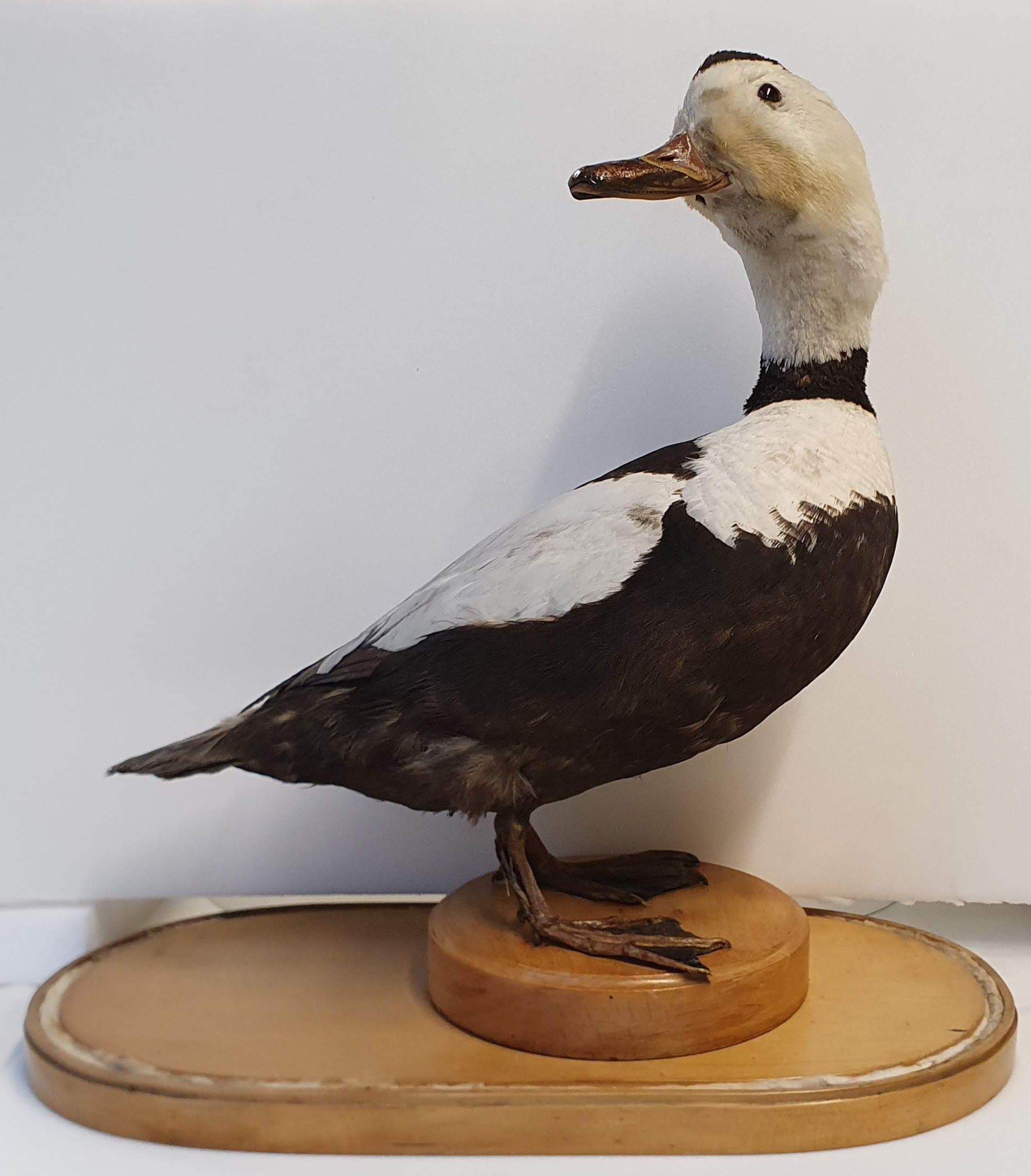
This is a specimen of Labrador Duck Camptorhynchus labradorius (Gmelin, JF, 1789), an endemic North American duck that has the dubious honour of being the first American species to be pushed into extinction following the European invasion of the continent. The exact reasons for the extinction are unsure, but between the adult birds being shot or caught on fishing lines, their eggs being over-exploited as a food source by settlers, and competition with humans for mussels and other marine molluscs, the already small populations were quickly reduced to nothing.

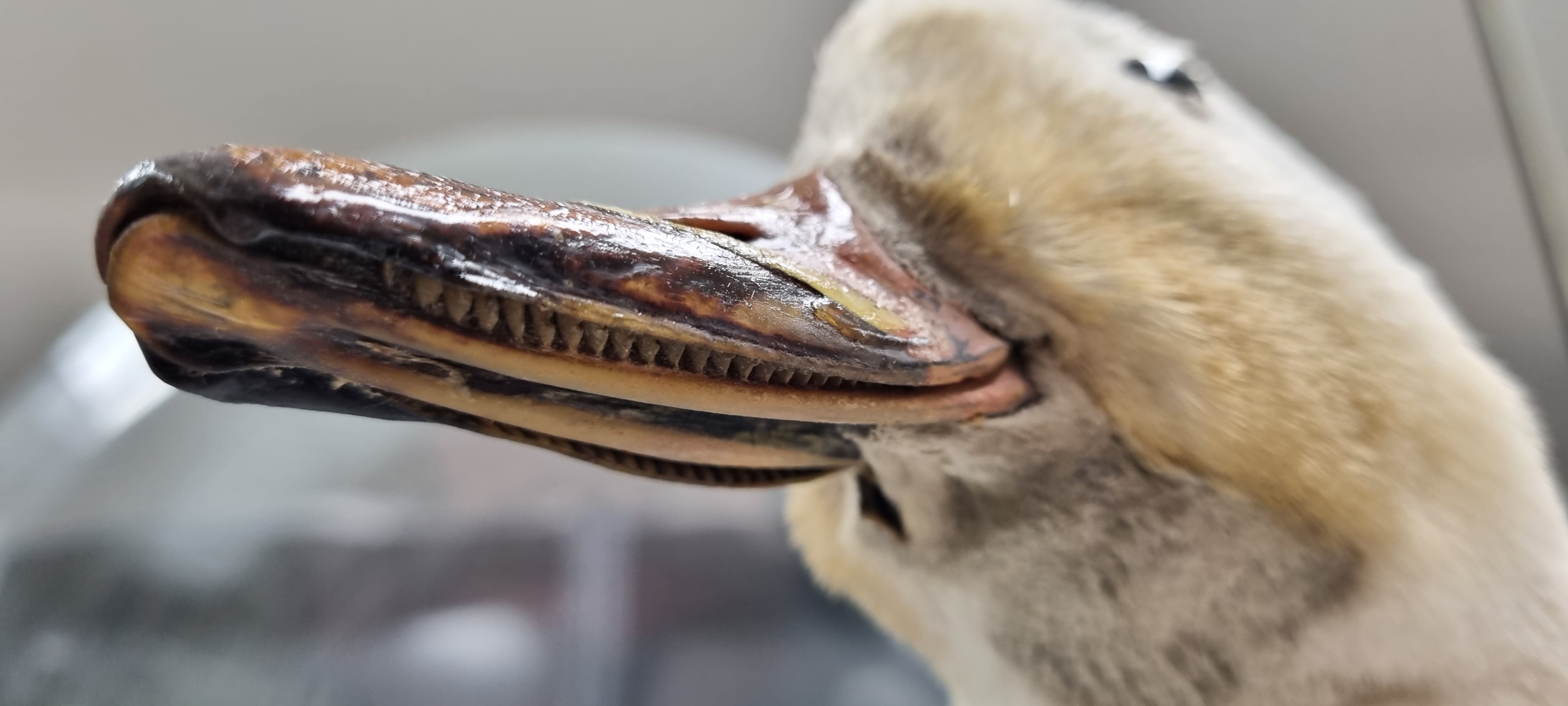
Lamellae in the bill of the Labrador Duck.

The last sighting was in 1878, but the museum bought this specimen in 1892 for the princely sum of £30-0-0 (that’s the equivalent of about €5,376 in today’s money). It had passed through a few pairs of hands before the Museum got hold of it, but we’re fortunate in knowing that the specimen was brought to Ireland in August 1838 from New York by Lt. W. Swainson R.N. who was in command of The Royal William, a paddle steamer in the service of the City of Dublin Steam Packet Co.

Only 55 specimens of Labrador Duck are known from museums around the world, so all information about them is valuable, especially when you consider how scarce and irreplacable they are. Specimens like this really hammer home the responsibility we have as museum professionals who are responsible for their care.

Friday mystery object #471 answer

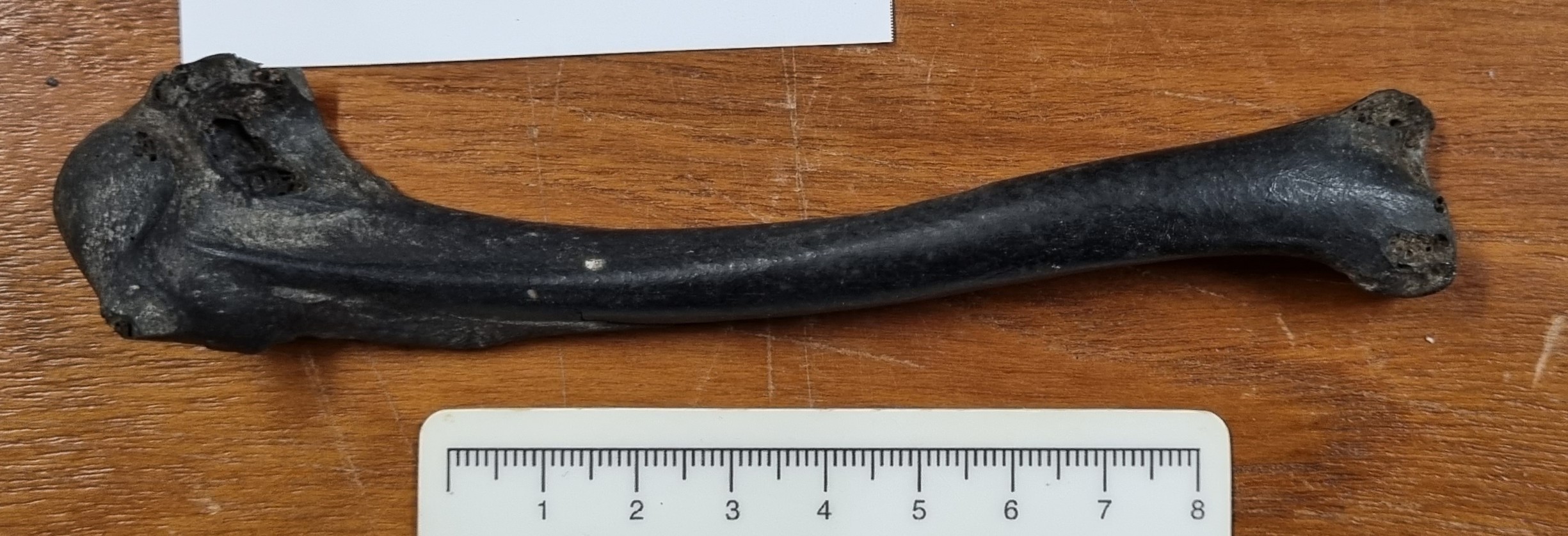
Last week I gave you this genuine mystery object to identify, from the collections of the Dead Zoo:

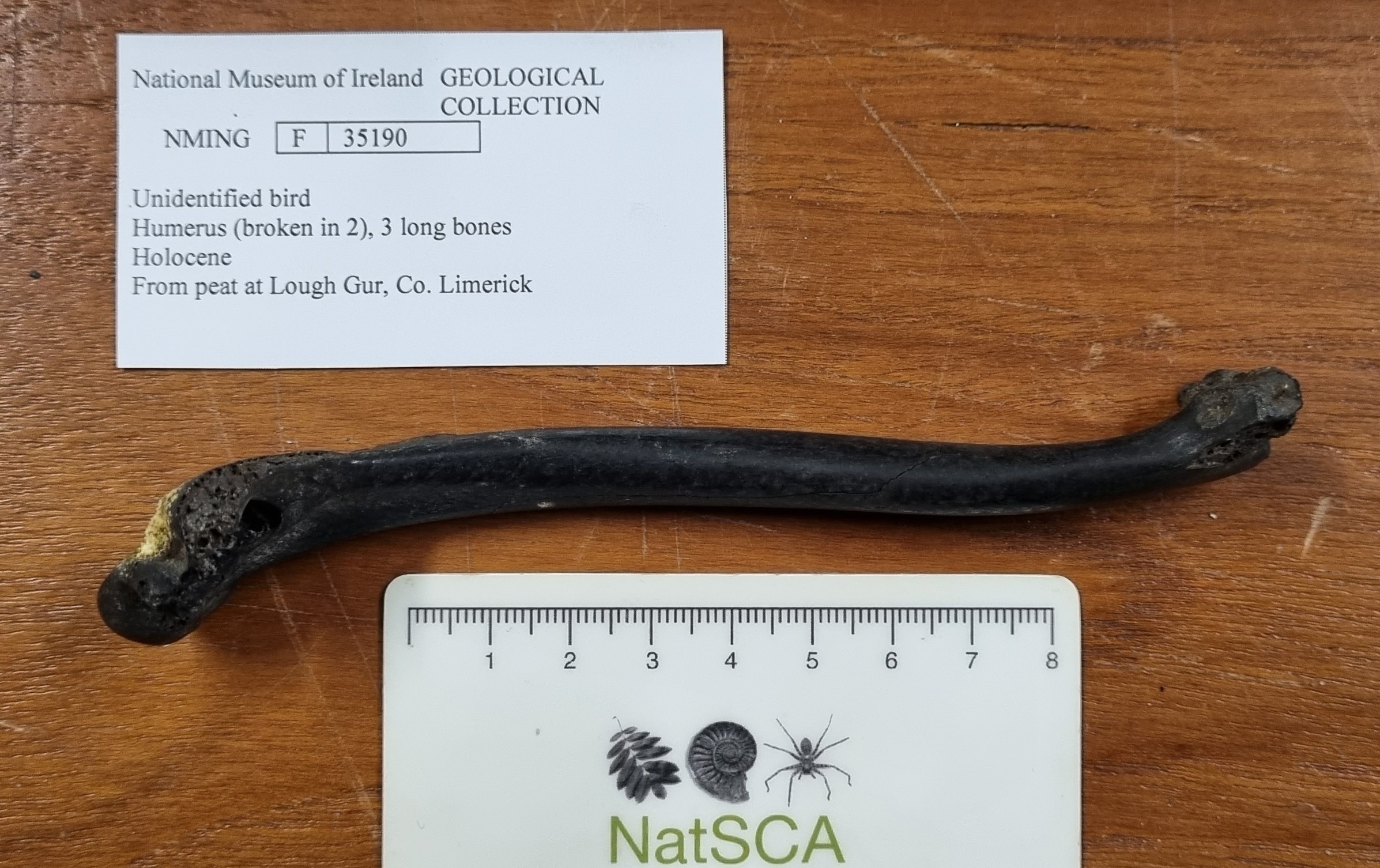
As you may have noticed, there is a preliminary identification with the specimen, that lists it as being an unidentified bird humerus from peat at Lough Gur in County Limerick. It’s dated to the Holocene, so nothing that you wouldn’t expect to find around today, at least within the wider European context.

I always maintain that identifications on labels should never be assumed to be accurate – although I’m happy to say that this one is correct.

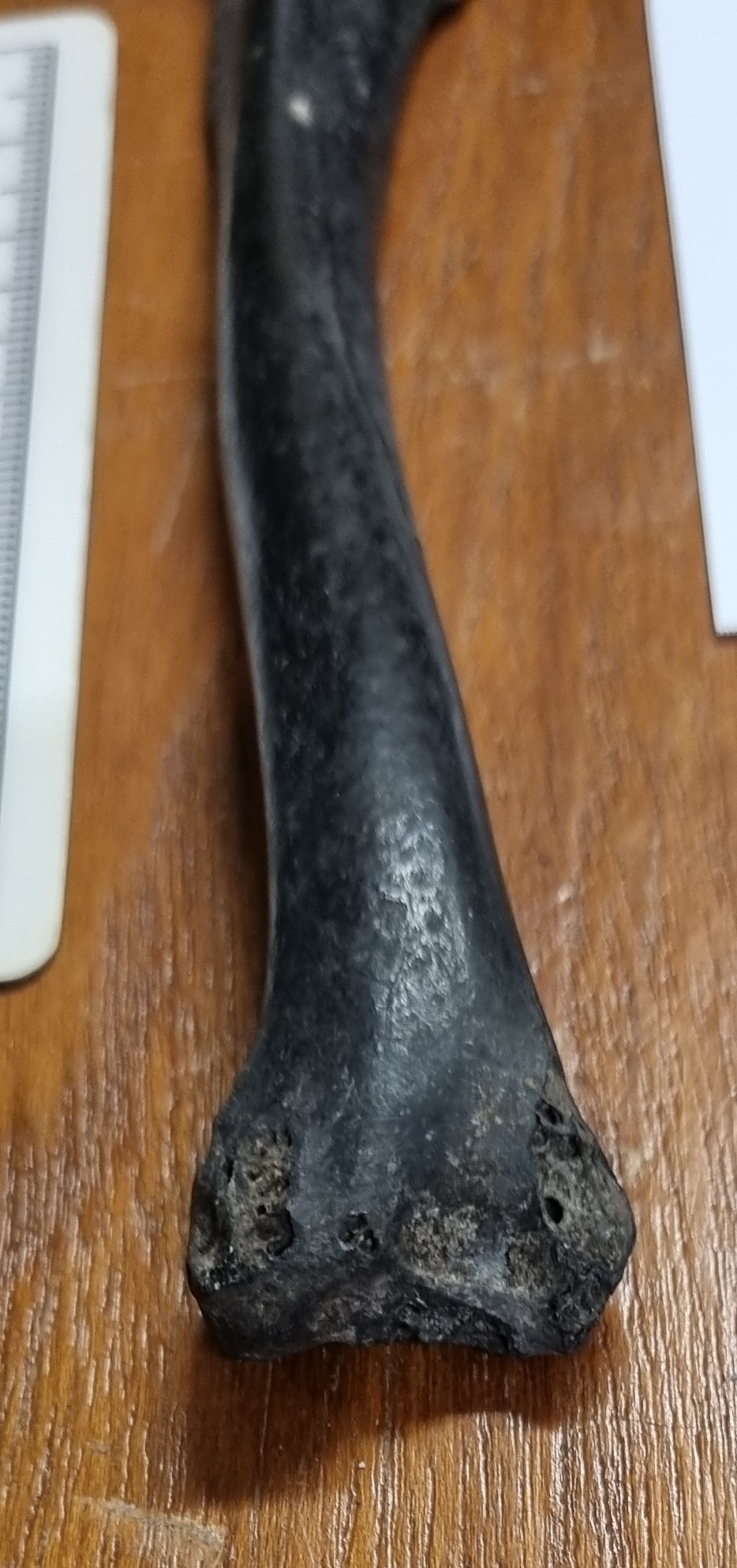
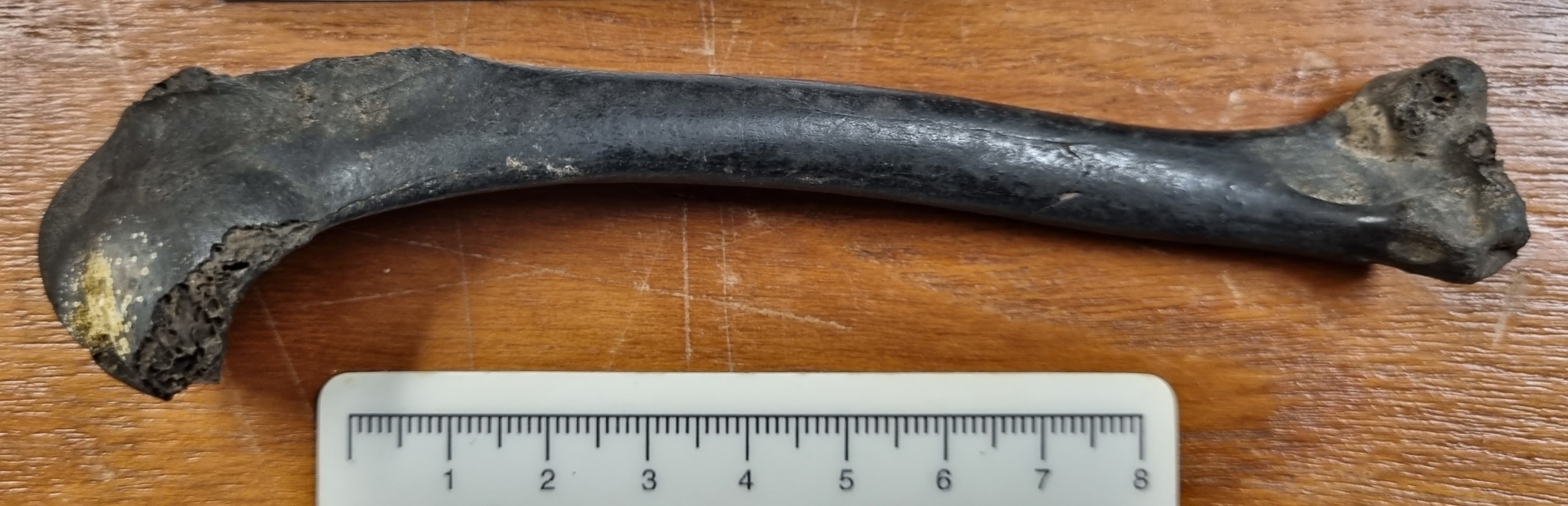
The humerus is fairly large, which helps narrow down possibilities, but there are areas of damage on the articulations, where some useful features of the bone have been worn away, revealing the honeycomb texture inside the bone:

This sort of damage can often make identifications much more difficult, as it can remove diagnostic features and even change the profile of the bone, making it appear substantially different to the original form – especially where parts of elongated crests of bone have been lost:

When you attempt to identify a bone with this kind of damage, you have to keep in mind that something is missing, which can be very misleading when working from the overall shape. I think this is why many of you went down the route of a bird of prey, such as an eagle species or Osprey.

Generally in terms of an identification, the best option is to rule out the most likely species first – which means anything with a high population density or regular occurence, that frequents the habitat in which the bone was found. In this case my first thought went to waterfowl rather than raptor.

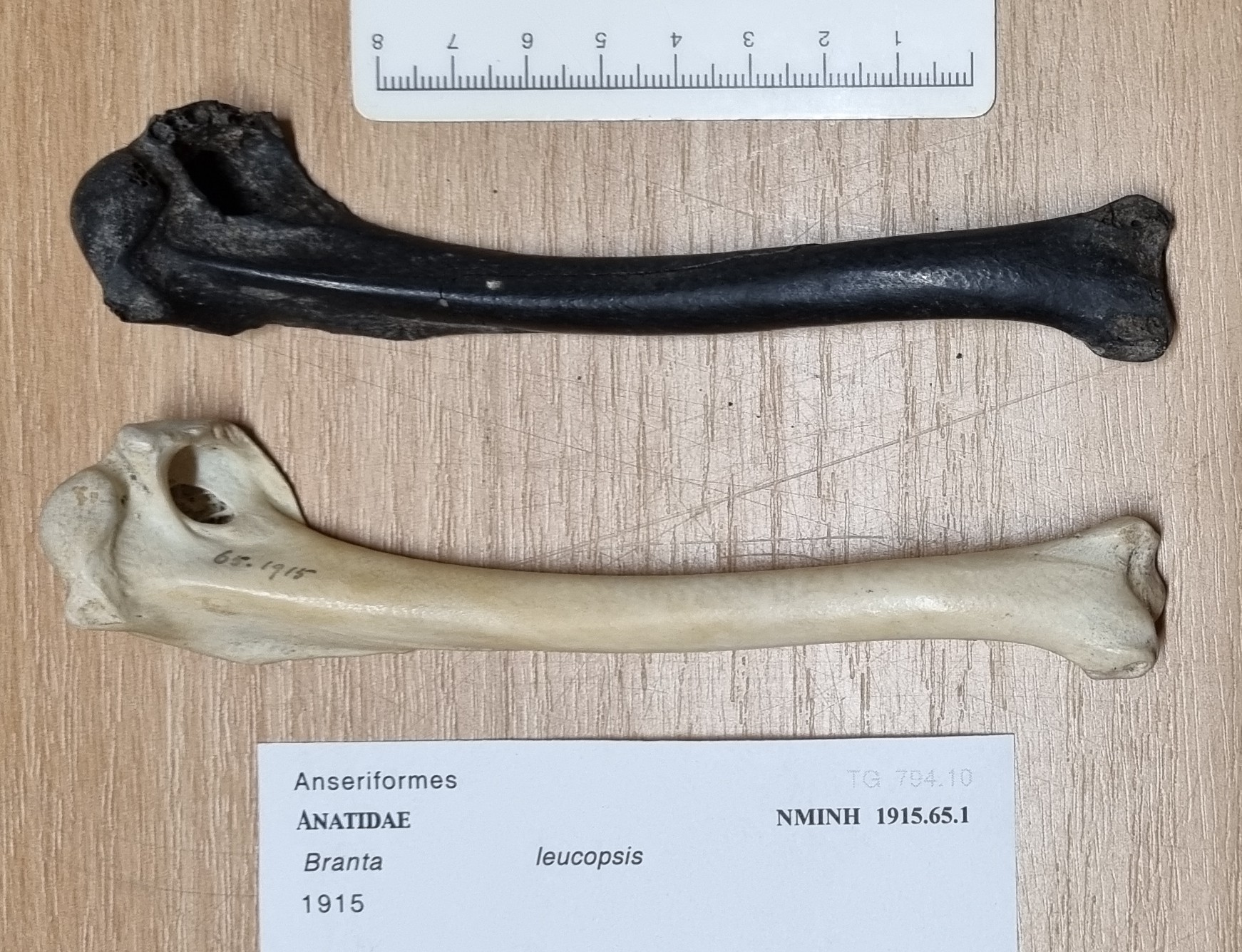
This humerus is too small for something like a swan or large species of goose, and too large for one of the ducks. However, it’s right in the range for one of the smaller goose species, so I took a look through some reference specimens from the genera Anser and Branta.

Of all comparisons, the Barnacle Goose Branta leucopsis (Bechstein, 1803) was very close in size and shape, and where the shape differed it was where there was damage visible to the bone, making it likely that some of the features that seem to be missing were actually there originally but have been abraded away:

I’m still not 100% certain the mystery object is from a Barnacle Goose, but I’m quite confident that if it’s not, it’s from a close relative. I would love to hear your thoughts!

Friday mystery object #453 answer

Last week I gave you this LBJ (Little Brown Job) to have a go at identifying:

This is one of those birds that can be hard to identify in the field when it’s alive, but it can be even harder after spending over 100 years on display in a Museum.

I’ve mentioned this before – when dealing with taxidermy, damage to the pigments in fur and feathers caused by light exposure can significantly alter the colour of a specimen. This it will often happen preferentially – so you might find that black and red is affected more noticeably than brown for example, creating misleading colour combinations. This fading also happens on bills and claws, sometimes changing them to a light brown or yellow.

Another common issue with specimens is that on death the colour of skin can rapidly fade. This means that some common colour features that may be used in identification (e.g. yellow legs) may cease to be reliable. Some taxidermists paint these colour features back in, but some don’t.

All of this adds to the challenge, but when you have an inkling that you’re dealing with a faded specimen you can make some mental adjustments about how to interpret the appearance. This usually means putting greater emphasis on size, shape and pattern of features rather than on colour.

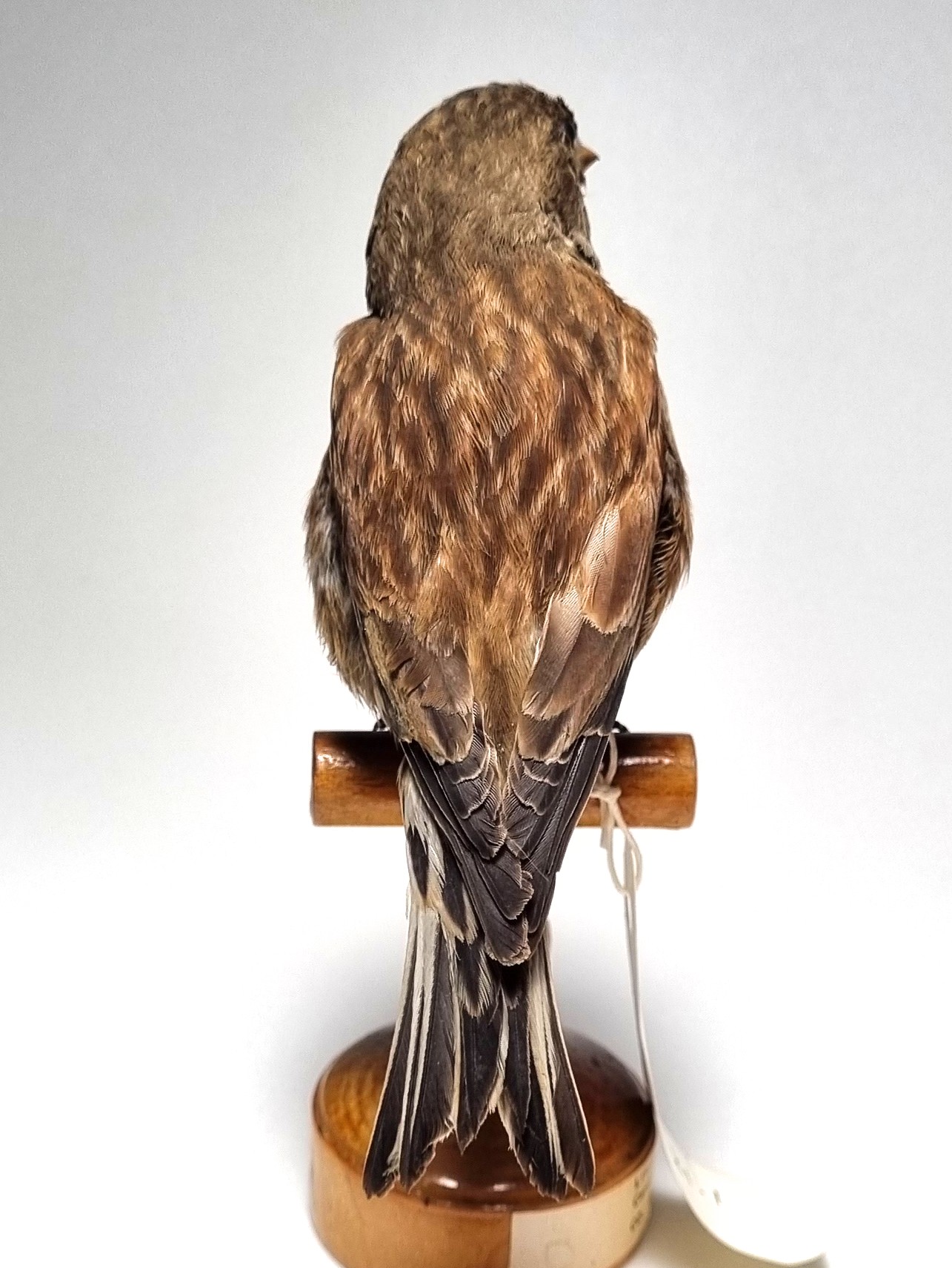
In the case of this specimen, most people narrowed it down to a member of the genus Linaria, but the issue with fading meant that the species that almost everyone opted for was the Twite, whereas the specimen is actually a male Common Linnet Linaria cannabina (Linnaeus, 1758), which I assume is in its winter plumage, unless the fading is REALLY bad (in the summer the males have quite a lot of red on the head and breast). The specimen was collected in Dublin and given to the Dead Zoo in 1915.

A useful feature for distinguishing between the species without relying on colour is the bill, which in the Twite is relatively small. Twites also have heavy streaking of the plumage, which should be somewhat apparent even in a faded specimen. Neither of these are apparent in this specimen.

There is a useful video guide made by the British Trust for Ornithology for distinguishing between Linnets and Twites in the field. It doesn’t extend to museum specimens, but it’s an excellent place to start!

Friday mystery object #451 answer

Last week I gave you this bird specimen to have a go at identifying:

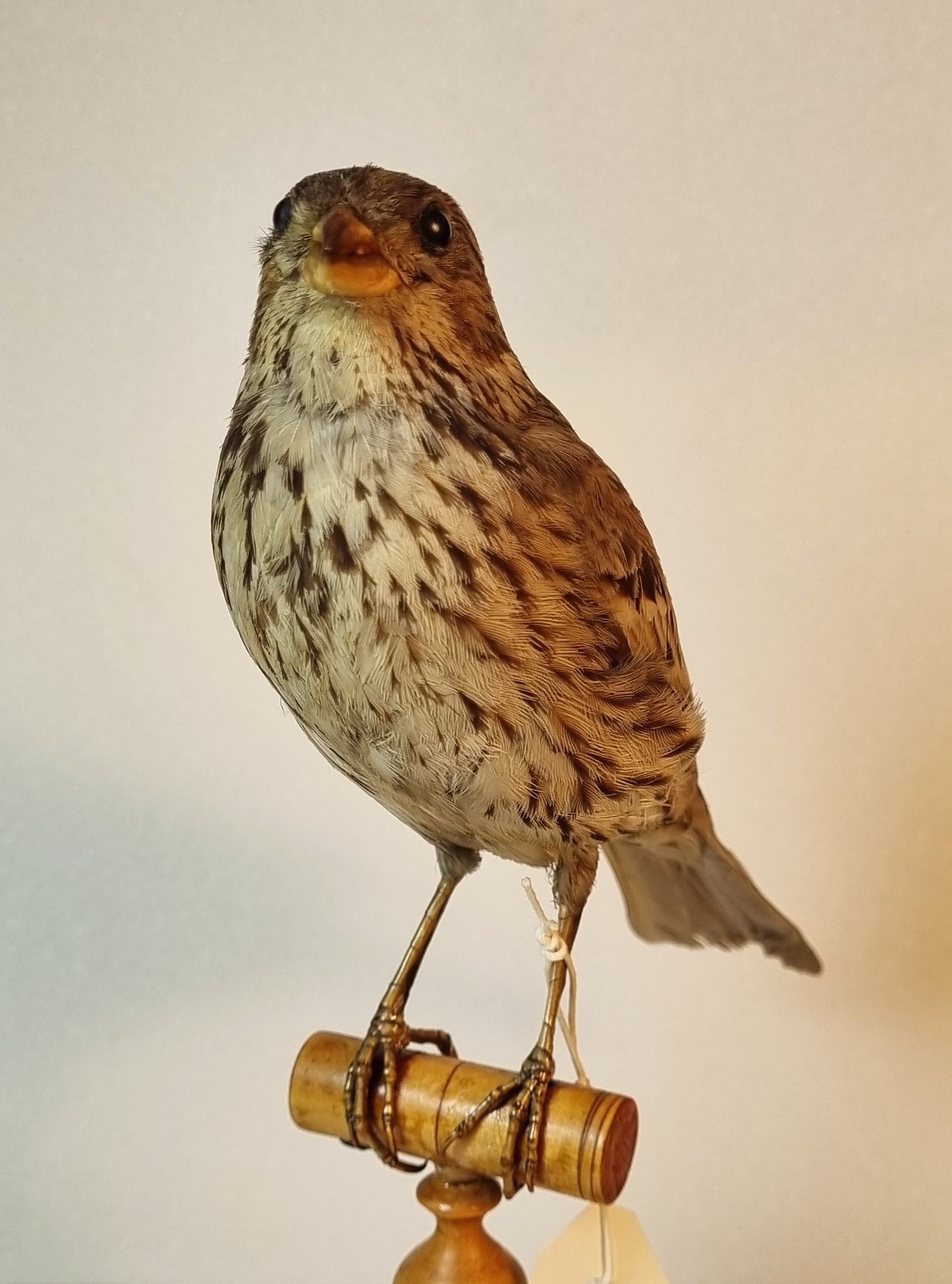
In the ornithological community, birds like this are sometimes referred to as an LBB / LBJ (Little Brown Bird / Job), because they are small, brown and hard to identify (especially in the field) due to the large number of similar looking species.

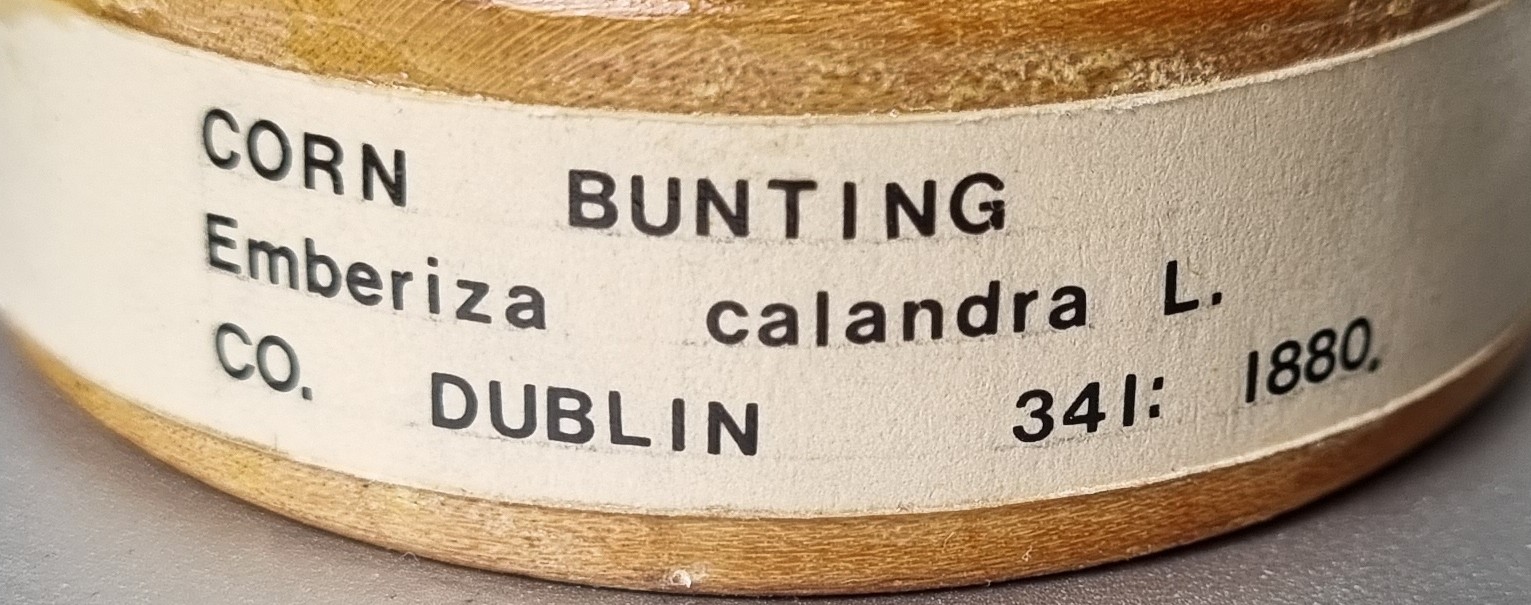
This specimen has a robust, conical bill and grey-streaked breast, which led some of you to think it could be a juvenile Crossbill or perhaps a female Grosbeak. However, as indicated by Wouter van Gestel in an excellent cryptic clue (and by Tim Dixon in a rather rude one), this is a Corn Bunting Emberiza calandra Linnaeus, 1758. It was collected in County Dublin and donated to the Dead Zoo in 1880.

These seed-eating passerines were widespread in arable farmland across Ireland in the 19th and early 20th centuries. However, changing land use practices reduced the available habitat until they became locally extinct as a breeding species in the late 1990s – well within living memory for many people.

The Irish name for the Corn Bunting is Gealóg bhuachair and an interesting fact about these birds is that their populations are remarkably sedentary, allowing them to develop unique dialects in their breeding area. This means that even if this species is reintroduced to Ireland – assuming farming practices become better suited to their survival – the landscape will never again ring with quite the same song that these birds would have sung in the past.

Friday mystery object #451

Happy New Year!

2023 has started off with a bit of a bang. The Dead Zoo has been given the go-ahead for the next phase of a major redevelopment project, and yesterday I signed an employment contract accepting the position of Keeper of Natural History at the National Museum of Ireland, so it looks like I have a busy few years ahead!

But that has nothing much to do with the mystery object, so here’s the specimen I have for you to identify:

It’s probably a bit on the easy side for anyone with an interest in ornithology, so if you know what this is, please keep your answer cryptic to give everyone else a chance. If not, I hope you enjoy the challenge!

Friday mystery object #435 answer

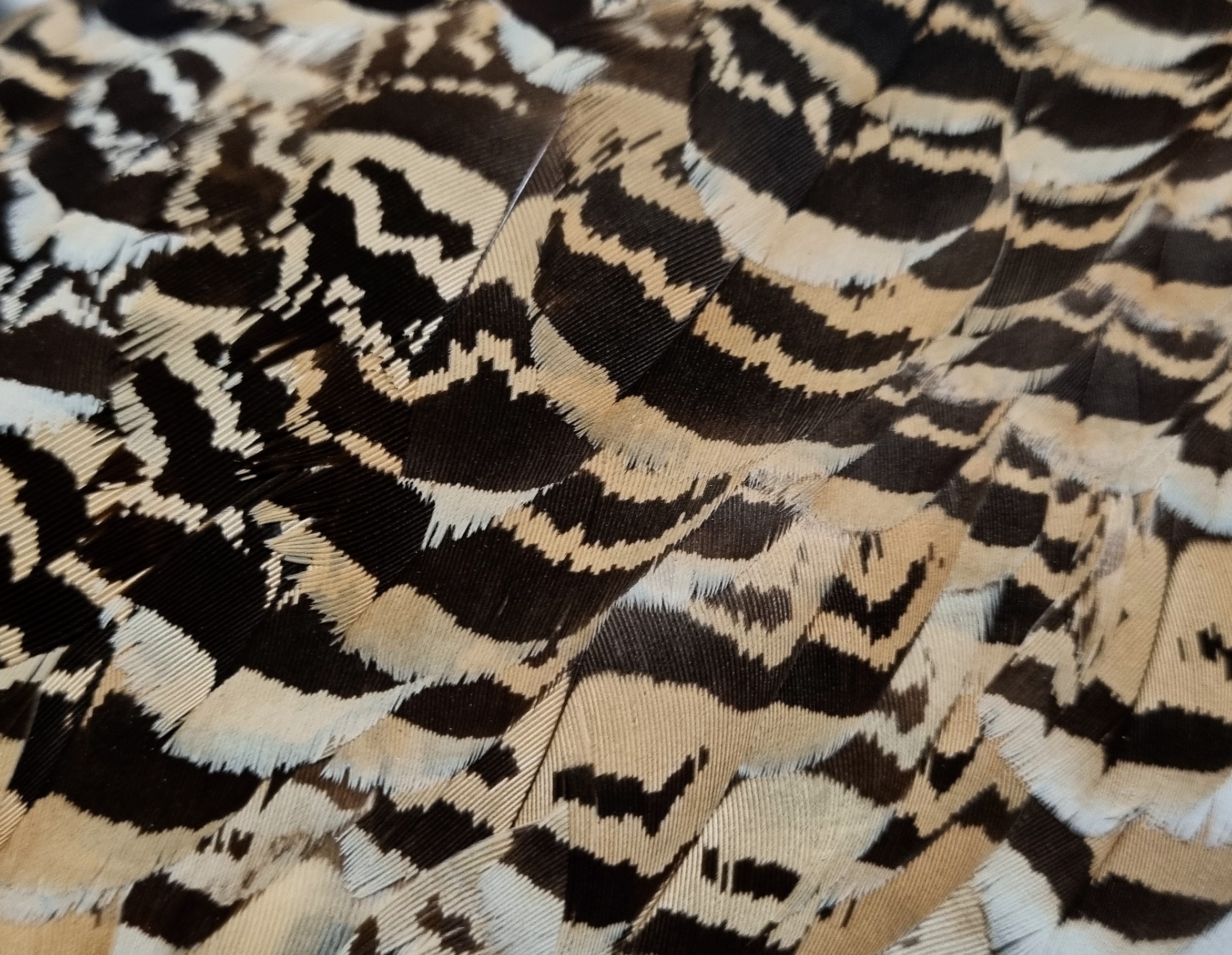
Last week I tried something a bit different for the Friday mystery object. Instead of giving you a few different views of a skull or whole animal, I offered just a small detail:

I hope the challenge proved fun for everyone who tried to figure this out. There were quite a few correct answers, although I think it was quite a challenge.

In fact, it was a challenge issued to the 5th class of St. Laurence’s National School by the Sallins Biodiversity Group in their excellent #MapOfLife2022 project.

Here’s what Gavin Brangan has to say about it:

For many children, the Dead Zoo is their first experience of being struck by the wonder of nature up close and in person.

In #MapOfLife2022 wanted to bring as many facets of that experience to the school and local community. On Wednesday, 5th Class in St Laurence’s had a video tour and workshop given by the education department of National Museum of Ireland – Go Extinct!

Joanne Murray, a local artist, based her art workshops with Senior Infants and 3rd class in the school on the specimen drawers containing insects. To cap it all, we’ve invited the children to find Paolo’s mystery object on the ground floor of the virtual tour of the museum.

If you’ve been following this blog for any length of time, you’ll know that one of the reasons I’ve kept it going for so long (this is its 13th year!) is the community that has developed here and the opportunities the blog offers to help people engage with objects from the natural world and the stories they can tell.

In this case, I thought sharing this beautiful feather pattern would help me tell the story of an extremely rare visitor to Ireland – the Great Bustard Otis tarda Linnaeus, 1758.

This particular bird is a female that somehow ended up in Castletown, Berehaven, Co. Cork in the winter of 1925. At this point in time the Great Bustard had been extinct in Britain for over 90 years and was not to be seen again until they were reintroduced to Salisbury Plain around 2007, so it couldn’t have come from Ireland’s closest neighbour.

It’s more likely to have come from France, Spain or Portugal, meaning it was off course by over 1,000km. I haven’t found any records of particularly big storms in the winter of 1925, but often it will be something like that which brings a migrating bird so far off track.

These birds like dry open grassland, with plenty of insects to feed on. Ireland is probably too wet for them to become established, although with a changing world climate that could possibly change in the future.

This is the interesting thing about nature – it changes constantly. What we think of as being normal is actually just what we’re used to seeing in the span of our lives. This is why it is so important to understand biodiversity over time – to see how it’s changing and to work out why it’s changing.

Museums like the Dead Zoo have specimens collected by people over the last 250 years and the activities of community groups doing projects like #MapOfLife2022 can help feed into that preserved knowledge and add a new level of understanding of the natural world today.

I think it’s especially important for young people to have an opportunity to get involved with this sort of thing, since they will be our future naturalists, life scientists and museum curators. This is why the efforts of people like Gavin, and teachers like Ms Hennessy and Ms Scott are incredibly important and deserve recognition.

To wrap up, I recommend taking a look at the photo journal of the #MapOfLife2022 events to see the young and old of Sallins getting involved in Biodiversity and natural history.

Friday mystery object #426 answer

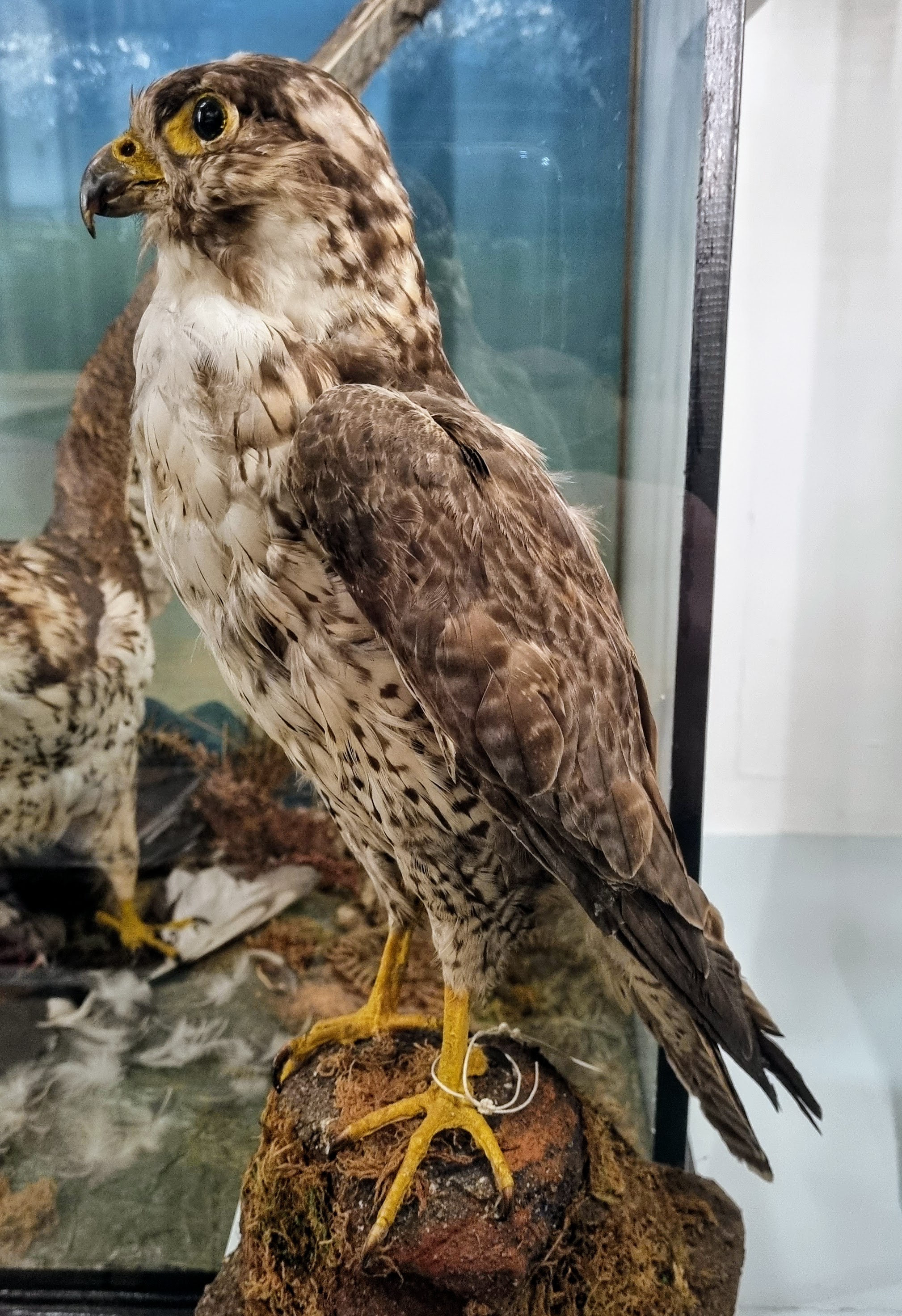
Last week I gave you this beautiful, but rather enigmatic bird of prey as a mystery object:

It was a bit of mean one, because it’s not a natural species, which meant almost everyone was driven to distraction by the subtle differences from anything readily recognisable. I say almost everyone, because Pete Liptrot got it spot-on:

This is indeed a hybrid falcon, that was hatched in Co. Galway to a Saker Falcon Falco cherrug Gray, 1834 mother (called Farah) and Peregrine Falcon Falco peregrinus Tunstall, 1771 father back in 1971, marking the first example of this cross.

The specimen was donated to the Dead Zoo in 1976 by the Rt. Hon. Johnny Morris – who by all accounts was as interesting and unique as the bird he reared. Sadly, I heard that Johnny passed away recently, which will doubtless be a blow to the many people he met.

But Johnny has left a legacy, and as he once said donating to the museum “is a way of making yourself immortal”. In this case his donation has been seen by millions of people and the unexpected cross-breeding he enabled helped inform the captive breeding of birds of prey for conservation.

Friday mystery object #424 answer

I hope that you had a very merry festive season and that you didn’t spend too much time contemplating last week’s mystery object from a dig by Irish Archaeological Consultancy that’s been taking place in Dublin:

Because the object is still partly in the soil and I was unable to get images from every angle and I think that there are some helpful features still buried, so I apologise for that. Still, we can take a look at what we know and start narrowing down possibilities.

First of all, we know that this is the lower part of the hind limb of a bird. That much is clear due to the shape of the articulations, in particular the lobed shape of the distal end of the tarsometatarsus (or TMT, which is the long bone in the image that is intact apart from a hole in the midshaft).

Considering that based on the scale bar the total length of the TMT must be around 380mm, this is clearly from a VERY big bird. The largest bird species occurring in Ireland would be the Great Bustard, which has a TMT length of between 138 and 176mm in the males (which are significantly larger than the females). So that’s not even close.

There are birds common to Ireland which are smaller, but with longer legs, such as the Grey Heron. However, their TMT would seldom be greater than 210mm. Even the Common Crane, which has historcially be reported in Ireland, only has a TMT in the 200-250mm range – about the same as a Greater Flamingo, which is the kind of exotic bird that may have been brought to Ireland by humans as an ornamental in the last few hundred years. We need to look further afield.

The next obvious stop has to be the largest bird, to at least get a sense of just how big the TMT is likely to get. Ostriches have a TMT in the region of 448mm, so we’re not quite up to that size, but we’re also not all that far away. On a side note, as we mentioned earlier, the mystery object probably still has part of the distal articulation buried in the soil – but if it didn’t then it would be a good contender for a small Ostrich, since they only have two toes and their TMT would be missing the section of articulation that is likely buried here.

The next largest bird to consider would be the Emu, which has a TMT around 400mm. This is getting into the right sort or size range, but we should consider the other possible candidates. Staying with Antipodean species, the Southern Cassowary has a TMT in the region of 325mm long and the Northern Cassowary is around the same size. Then we jump over to South America and the rheas. The largest is the Greater Rhea, for which I could only find a measurement of 320mm, which was taken from one male specimen.

Based on size alone this suggests that Emu is the most likely option, but we all know how size can be a bit unreliable. The next thing to look at is probably the shape of the unguals (those are the ends of the digits where the claws would attach):

In most ratites the ungual on the middle digit seems to have quite a flat profile, but from the images I’ve seen of skeletons, the Emu appears to be the only one with a similarly curved middle ungual.

On balance (and I’d be happy to reconsider if I can get my hands on the fully excavated specimen) I think this is most likely to be the leg of an Emu Dromaius novaehollandiae (Latham, 1790) – an opinion shared by Adam Yates.

I realise there are some other extinct large ratites (various moas and the elephant birds) that may have found their way to Ireland as fairly complete fossils, but the lack of holes for wiring, and with the bones still in their correct orientation suggests that this specimen went into the ground with its skin still more or less intact.

I’d like to thank everyone for their suggestions – I’m not sure I’d call this a cut-and-dried answer, but hopefully I’ll get a chance to take a closer look at the specimen in 2022 and confirm the identity with more certainty.

Happy New Year to everyone!

Friday mystery object #424

This week I thought it would be nice to have something seasonal and festive for Christmas Eve, but I couldn’t think of anything that I haven’t done before, so you’re getting a genuine mystery object that came to light on an archaeological dig in Dublin by Irish Archaeological Consultancy:

I’ve been thinking about a possible identification for this specimen (and I’ve ruled out a LOT of possibilities), but I’ve not had much time to check on comparative material, so I’d be keen to hear your suggestions about what you think this leg might have come from in the comments below.

Have a Merry Christmas and try not to spend too much time thinking about this 😉

Friday mystery object #402 answer

Last week I gave you this awesome skull to have a go at identifying:

Skull length approx. 170mm

Of course, you’d only recognise this as being awesome if you knew what it’s from, since apart from bit of a weird shape to the top of the skull, it looks like it could be from a chunky galliform or perhaps a Screamer. However, this skull is from a type of pigeon.

Of course, it’s not from one of your boring standard sorts of pigeon, this skull is from a very special pigeon. Adam Yates pipped everyone to the post in the comments, identifying that this is the skull of a Rodrigues Solitaire Pezophaps solitaria (Gmelin, 1789).

If you’re not familiar with the Solitaire, it’s the closest known relative of the Dodo and, like its cousin, it was large, flightless and it’s now extinct. The similarity doesn’t stop there, as both were endemic to a small, unpopulated island in the Indian Ocean, hundreds of miles east of Madagascar and both were driven to extinction not long after humans first visited the island and dropped off goats, pigs and (inadvertantly) rats.

The closest living relative of both of these extinct birds is the Nicobar Pigeon, found in a string of islands in the Bay of Bengal. While the Nicobar Pigeon is colourful with iridescent feathers that shift colour in changing light, the Solitaire was reported to be a a grey and brown bird about the size of a swan.

The colourful Nicobar Pigeon

A handful of reports are the only real source of information about the plumage and general appearance of a live Rodrigues Solitatire, with just one illustration ever being made by someone who has seen the bird. That was François Leguat, a French naturalist who arrived in Rodrigues in 1691. His artistic skills were more stylistic than descriptive, but he did describe the Solitatire’s plumage as beautiful.

Le Solitaire by François Leguat, 1708

Fortunately, we know a lot more about the bones of Solitaires than we do their plumage, thanks to large fossil deposits of the bird uncovered during the Transit of Venus observations from Rodrigues in 1874. The Dead Zoo specimen is a composite skeleton made up of bones brought back from that expedition and presented to the Museum on behalf of the Royal Society.

My favourite bit of the skeleton is probably the fighting knobs on their wrist bones. They’re a little hard to see here, but apparently the Solitatire’s could be quite aggressive and attack with their wings, which had presumably become repurposed for competition (and perhaps defense) since they were no longer needed for flight:

There will be more mysteries next week, but before you go I wanted to drop in a reminder that I’ll be doing a talk about Dismantling the Dead Zoo this evening at 7pm GMT. If you’re interested in finding out more about how to take apart whales and wrangle hippo heads, why not sign up and join in for free?