
Last week I presented you with this bird skull to have a go at identifying:
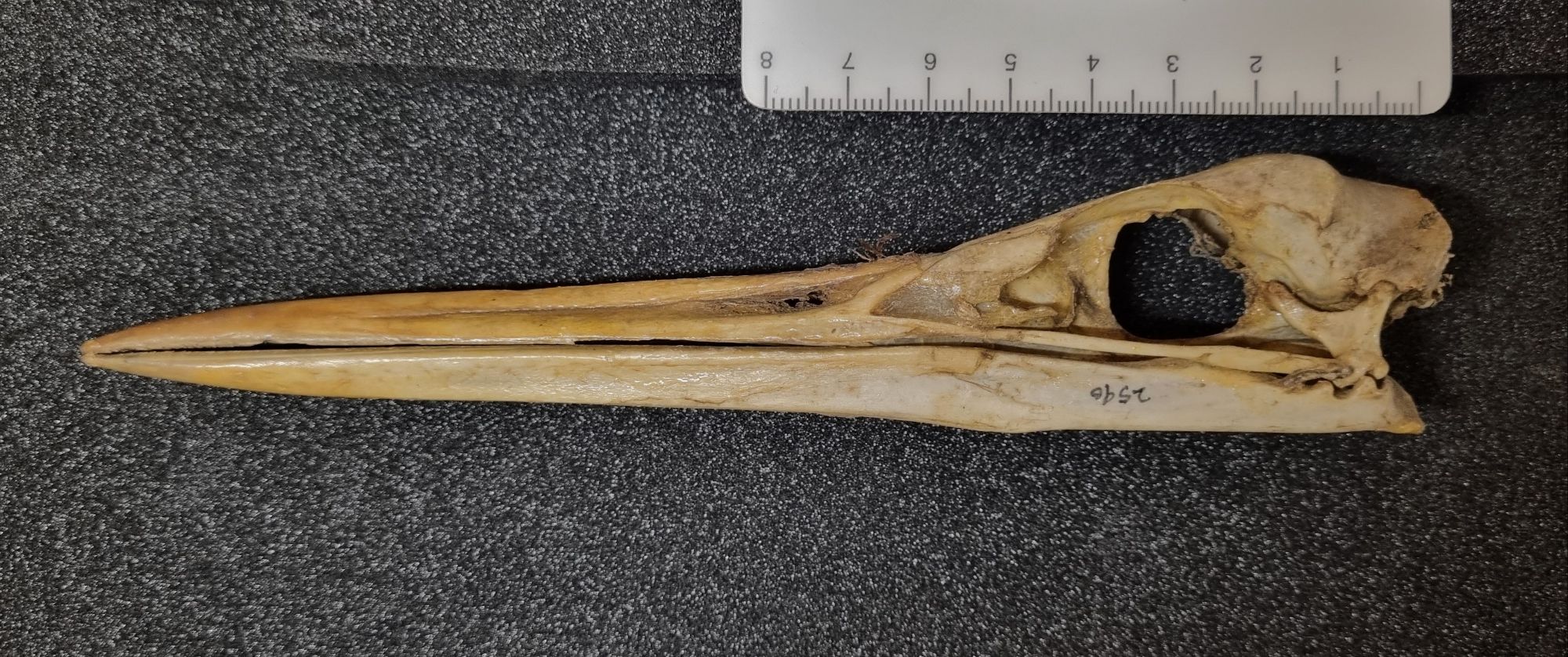
The long dagger-like bill offers up an immediate clue – it really shouts “Heron”. This is reinforced by the narrow profile of the skull:
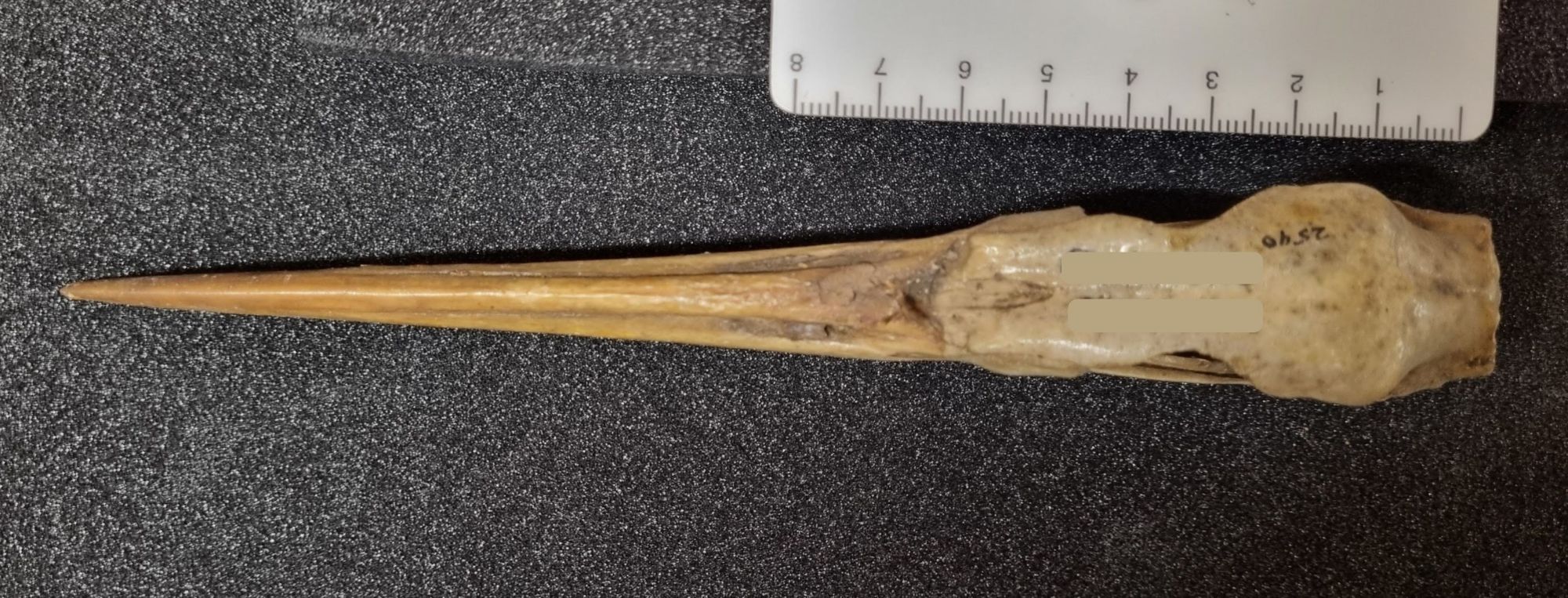
However, the Heron family (the Ardeidae) has 75 species, so there’s a bit of work still to do.
The size of the specimen offers up another clue. At around 170mm it’s actually on the small size something like a Grey or Blue Heron and a little big for one of the smaller species, like the Black Heron or Squacco Heron.
Of course the Ardeidae contains more than just the Herons – there are also the Bitterns and Egrets.
This is where our mystery object takes a turn, as this skull actually has the species it was identified as written on it (you may have noticed my efforts to cover that up in the image above). Here it is unedited:
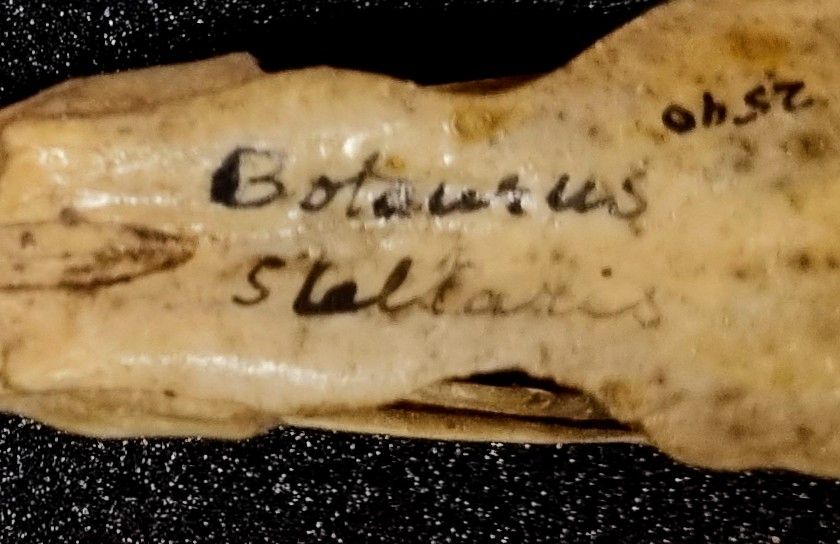
So according to the historic identification on the specimen, this is the skull of a Eurasian Bittern, but in the comments there was a convergence on this actually being something else.
In my experience, it’s always worth checking the identification of specimens in collections, since our predecessors were as prone to imperfection as we are, and they wouldn’t have necessarily had access to the same resources to check identifications as we have today (Skullsite is a great example that I regularly mention).
Comparing this mystery skull to a Eurasian Bittern immediately sounds alarm bells – the bill in the mystery object is distinctly longer, and thinner at the base, than the more chunky Bittern:

Mrjohncummings, 2013.
A much better match for this specimen is actually the Great Egret Egretta alba Linnaeus, 1758 – something that was picked up on by Wouter van Gestel and Adam Yates (and possibly by salliereynolds, although I read her comment as referring to a Little Egret based on the size reference in her clue).
I’m not sure of the source of the identification is a little uncertain – the handwriting may offer a clue, but there’s no guarantee that what’s written wasn’t taken from another source of determination. The specimen itself seems to have to come to the Dead Zoo as part of an acquisition from van Lidth de Jeude, which is noteworthy considering I have written before about misidentifed specimens from that same collection and we know that other specimens from the same collection have lost their labels and numbers in the past:
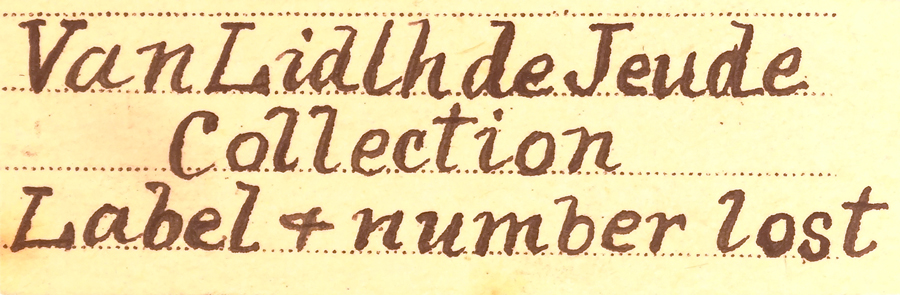
These sorts of issues are not uncommon in collections, which is why researching objects remains important. If we are to provide good comparative material for researchers to use, we need to be sure our specimens are correctly identifed.
So my thanks to everyone for their thoughts on the identification of this specimen – it looks like our database needs updating to reflect an improved determination!


I can’t claim the fame. I did intend Little Egret!
Glad we agree on the ID of this skull, and good to know that misidentifications happen in the Dead Zoo. I have some doubts about the woodpecker tongue you posted a few weeks ago and which clearly differs from the one I prepared myself, but I can’t post pictures in a comment
I had the skulls of great egret and grey heron side by side in my hand, but although they look clearly different, it was surprisingly difficult to put into words what exactly is the difference. Nice this one had its rampotheca, as the differences with purple heron are even more subtile.
Be careful with size differences within herons, they can differ a lot within a species, possibly related to sex. I’ll look into that.
One more thing: If your bittern skull is on display, it would be good to move the skull a bit forward on the lower jaw, as the quadrate is placed behind the joint, what gives the skull the suggestion of an underbite