
Last week I gave you this skull from the collections of the Dead Zoo to have a go at identifying:
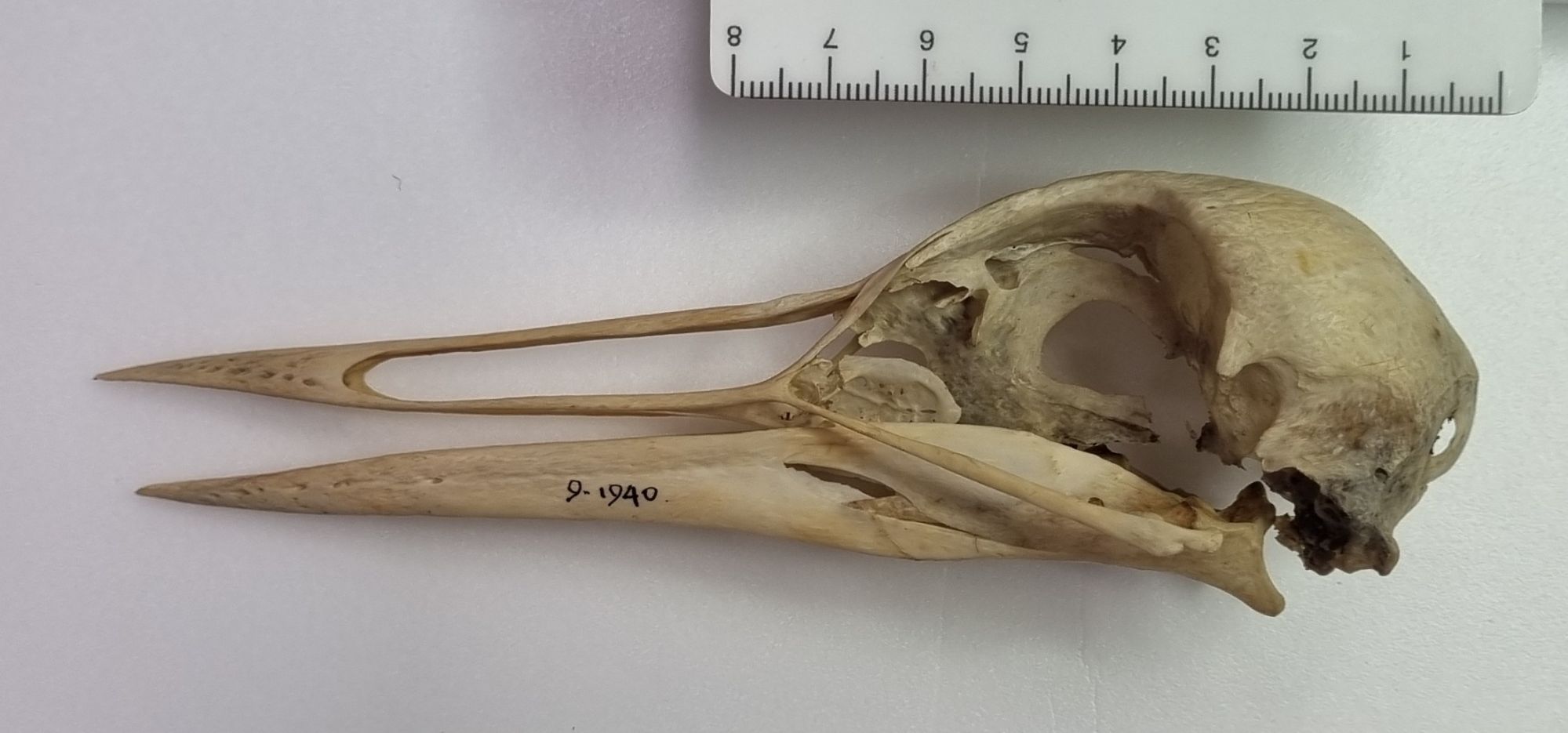
Bird skull identification can take a bit of work, until you get your eye in on things like the bill morphology (especially without the clues provided by the keratin sheath). Resources like the excellent Skullsite.com certainly help a lot, by providing a huge range of images of different species for comparison, and with tools to help narrow down options based on skull size and bill morphology.
As it turns out, Adam Yates certainly had his eye in, and he was first to comment with a correct identification for this specimen. It’s a Common or European Crane Grus grus (Linnaeus, 1758).
I chose this specimen as it’s one that we recently put on display in the Dead Zoo Lab as part of a community curated project called Our Irish Natural History. Eight community groups involved with iCAN (the Irish Community Archive Network) contributed to the work, which was coordinated by Adriana Ballinger – a fantastic postgraduate humanities researcher who has been working with us for the past year on a project with a focus on the wider cultural context surrounding natural history collections. The community groups involved each explored a different areas of interest, illustrating and exploring some of the connections between objects and local communities.
The Common Crane offered a fascinating topic explored by the Woodlawn Heritage Group and Galway Community Archaeology, who delved into the past history of the Crane in Ireland, and its importance to Bronze Age people, also touching on their recent return, with a pair of these fantastic birds recently recorded nesting in rewetted boglands. There’s too much information for me to cover it all here, so I recommend taking a look at the work for yourself on the Galway Community Archaeology web resource about the project.
These sorts of projects, that connect our ostensibly scientific objects back into local communities through a cultural link are a fantastic way to broaden the relevance and interest in our collections. As a scientist it can be easy to focus on one aspect of an object – but every item we look after can be viewed from multiple perspectives – all of which add value and relevance.
I look forward to working on similar projects in the future, while hopefully taking the opportunity to share more of the collection here, for those of you with an interest in identification!
 Zygoma
JUST A COMMENT ON THE CRANE . MY FATHER ,WHO WAS A KEEN FISHERMAN,OFTEN TOLD ME THAT A CRANE’S STAB TO CATCH A FISH IS POWERFUL ENOUGH TO PENETRATE A PERSONS SKULL AND TO BE AWARE NEAR THEIR NESTS. CRANES WERE CONSIDERED A PEST SPECIES AND I RECALL GETTING A BOUNTY BY TAKING ONES HEAD TO THE LOCAL POLICE BARRACKS IN THE 1950’S
CRANES WERE USED FOR WEATHER FORECASTING AS WHEN SEEN LEAVING THE LOWLANDS AND HEADING TOWARDS THE MOUNTAINS AND BOGLAND IT INDICATED DRY WEATHER APPROACHING
DONIE O SULLIVAN