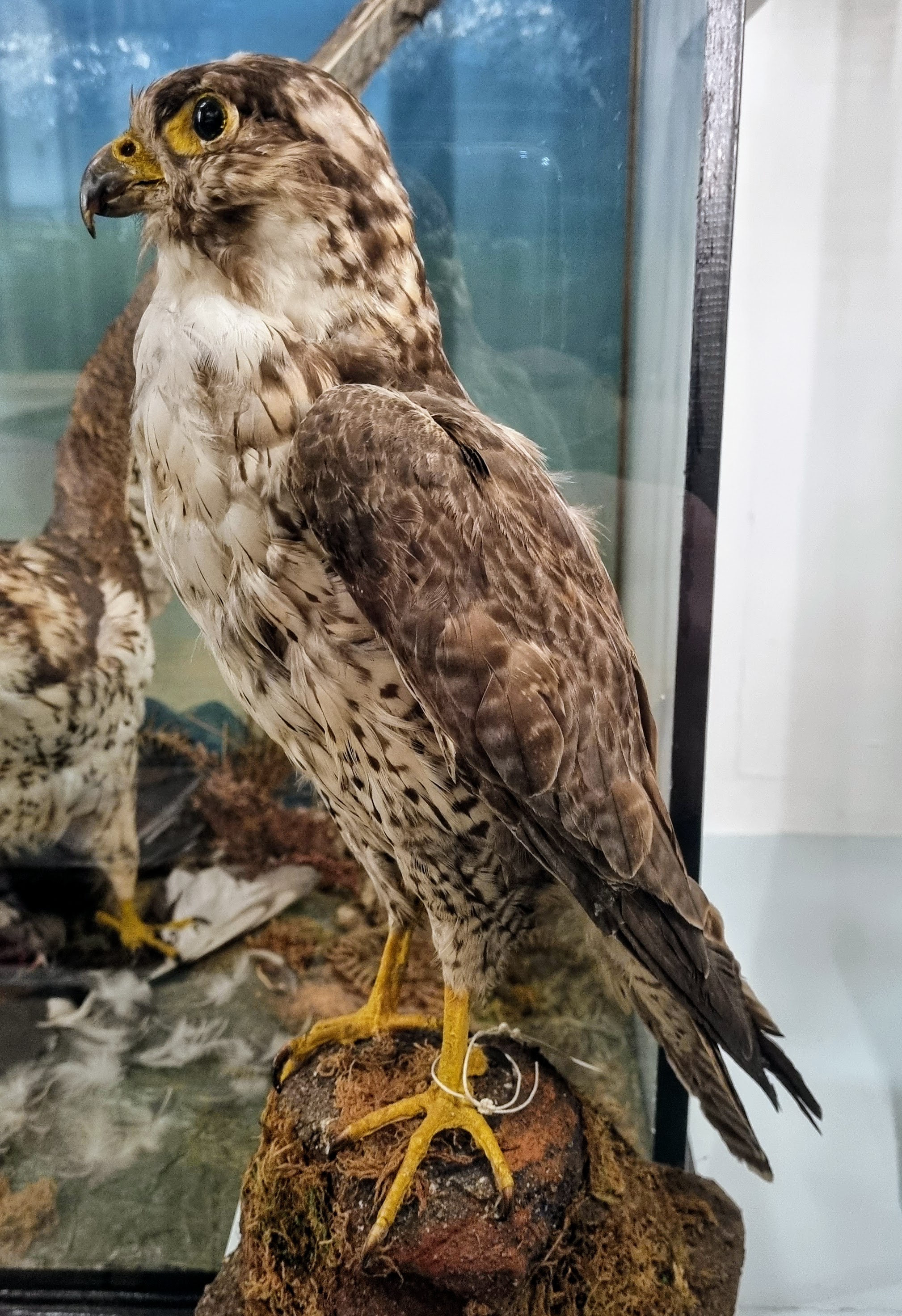
Last week I gave you this beautiful, but rather enigmatic bird of prey as a mystery object:
It was a bit of mean one, because it’s not a natural species, which meant almost everyone was driven to distraction by the subtle differences from anything readily recognisable. I say almost everyone, because Pete Liptrot got it spot-on:
This is indeed a hybrid falcon, that was hatched in Co. Galway to a Saker Falcon Falco cherrug Gray, 1834 mother (called Farah) and Peregrine Falcon Falco peregrinus Tunstall, 1771 father back in 1971, marking the first example of this cross.
The specimen was donated to the Dead Zoo in 1976 by the Rt. Hon. Johnny Morris – who by all accounts was as interesting and unique as the bird he reared. Sadly, I heard that Johnny passed away recently, which will doubtless be a blow to the many people he met.
But Johnny has left a legacy, and as he once said donating to the museum “is a way of making yourself immortal”. In this case his donation has been seen by millions of people and the unexpected cross-breeding he enabled helped inform the captive breeding of birds of prey for conservation.
Last week I decided to give you a taste of the kind of identification I often get asked to do. One bone with no scale and a photo from just one angle that doesn’t quite show what you’re looking at very clearly:
I must admit that I was suitably impressed with the responses though, since the very first response by Chris was cryptic yet absolutely spot-on.
As you probably figured out, this is the upper front section of jaw (or premaxilla if you’re feeling fancy) from a fish.
The more difficult bit is working out which fish, since there are plenty to choose from – over 28,000 species.
This is where knowing where the specimen came from can be helpful, since it can help narrow down the likely possible options. However, morphology is always the most important thing to consider and I find that locality is more useful for figuring out species than the higher taxonomic group – and higher taxonomy is really helpful for narrowing down options.
Of course, to do this you need good comparative morphological specimens to help steer you in the right direction. This can be difficult when working with fish, since there are so many species and they have skeletons that tend to be poorly fused, so there are many separate bony elements for each animal.
The premaxilla isn’t always the easiest element to differentiate, but there are a few things to look for:
The teeth. You do need to be careful with these as a feature, since they can break off and look quite different between individuals. Check out the teeth in this specimen and notice there is a line partway down each tooth. This is a weak point that the teeth can break along quite easily and I’ve seen examples of premaxillae from this species that have mainly squarish, blunt looking teeth because the sharp cusps have come off.
General shape. Some Orders of fish have premaxillae that are almost solid triangles (like the Tetraodontiformes), others are long, thin and quite straight – looking almost like just a shard of bone (like some Beloniformes). It’s worth taking a good look at the shape and trying to spot processes and articulation points, since these provide clues to the taxonomy.
Processes on the rear of the premaxilla. These can be present or absent, well defined, poorly defined, high, low, long, short, simple, complex etc. The thing to remember about this mystery specimen is that the rear of the premaxilla curves downward with no processes on the upper surface – so its close relatives are also unlikely to have processes, or if they have them they are unlikely to be well-developed.
Processes in the middle of the premaxilla. Some groups have a process like a fin in the middle of the premaxilla (e.g. Esociformes and Osmeriformes). The mystery has no process here.
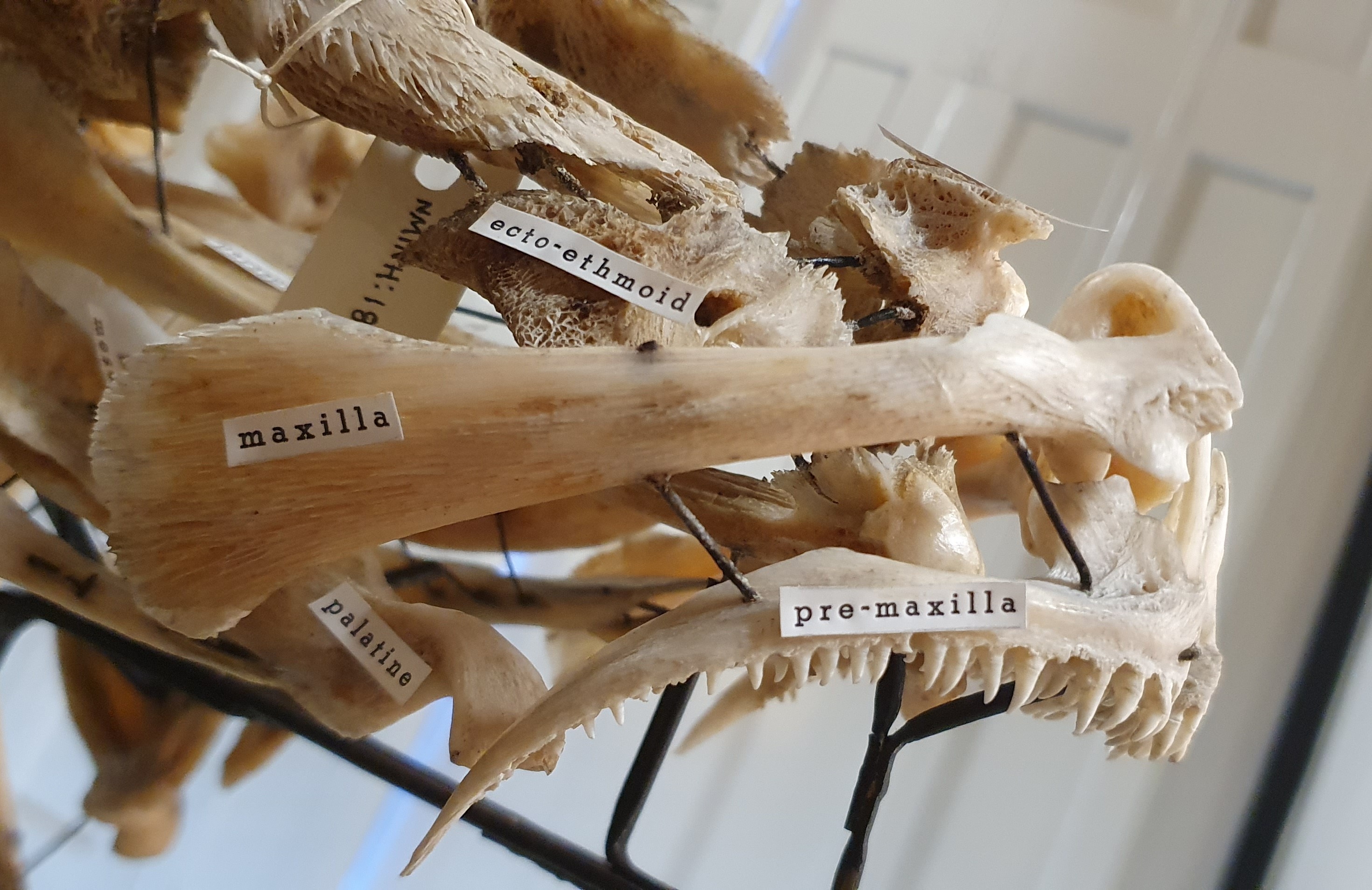
Processes on the front of the premaxilla. Many groups do have at least one process on the upper surface at the front of the premaxilla, but the number and shape are important for identification. The mystery specimen has two – the first is tall and shaped a bit like a bat-ear the second is not fully separate from the first and it is lower and quite squared off:
When you start to put all of these features together it becomes easier to narrow down possibilities. If you use Osteobase to scan through images of premaxilla you’ll find that the premaxillae that are closest (although none are identical) are from the Pleuronectiformes – or the Flatfish.
Knowing this one is from Irish waters (which I admitted in the comments) helps narrow down options to 22 species (things like Turbot and flounders) and with a bit of searching online and especially checking specimens in the Archaeological Fish Resource at the University of Nottingham you can narrow down the possible species to one good option.
This is the premaxilla of a Halibut Hippoglossus hippoglossus (Linnaeus, 1758). These large flatfish undergo a strange developmental distortion of the head that allows them to lie on their side on the seabed without having their left eye sitting in the sand.
Illustration of Atlantic Halibut Hippoglossus hippoglossus by Marcus Elieser Bloch (1723–1799), via rawpixel.com.
This asymmetry is far more obvious in the whole animal than it is when just looking at the skull.
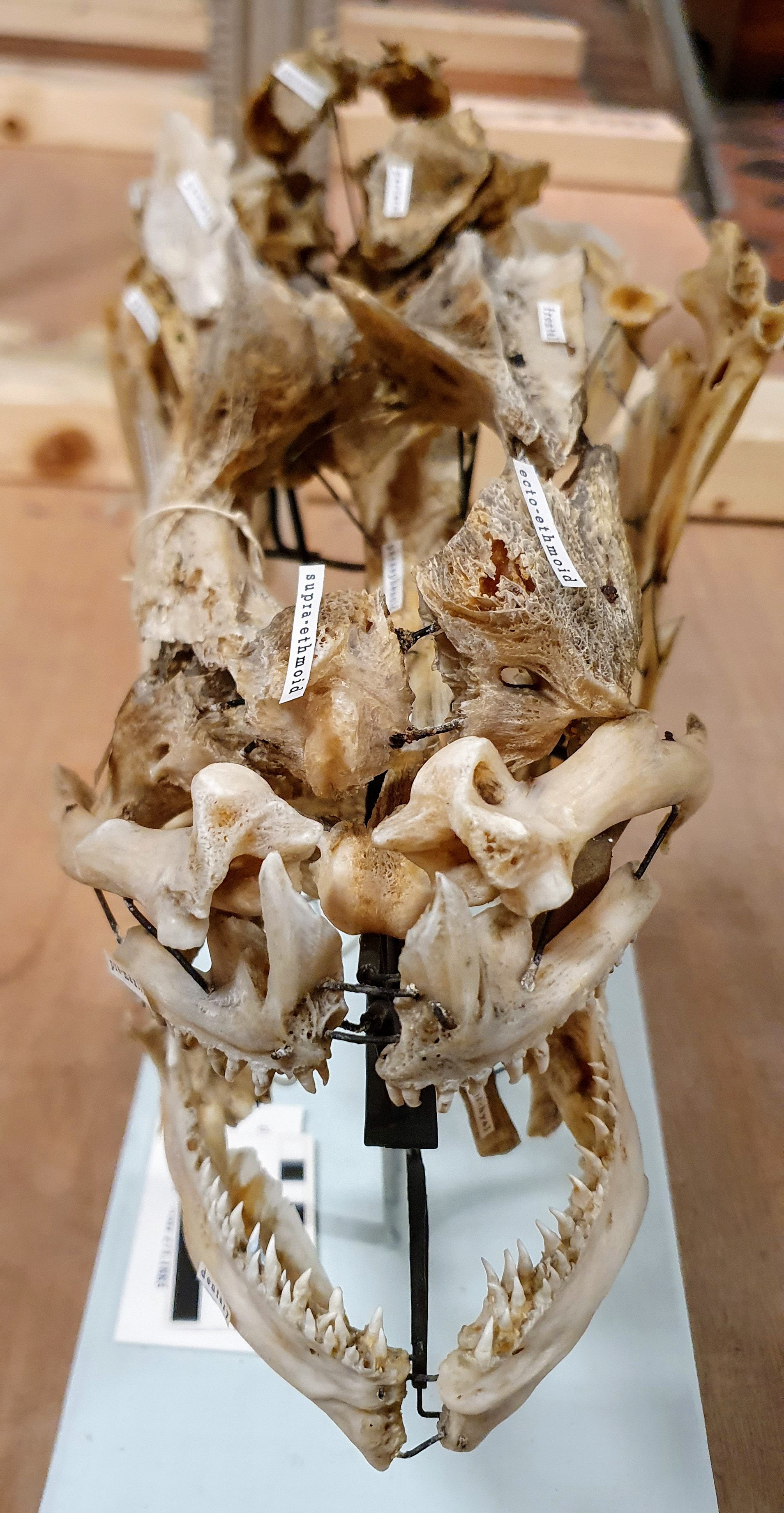
As you can hopefully make out, the jaws are reasonably symmetrical and the distortion is mostly in the area of the frontals and ethmoid bones, which have shifted to allow the eye to move. Here’s a more complete view of the right side of the Halibut skull to finish up with:
One of the things I get asked to identify a lot in my job are bits of bone that people have found on the beach. I’ve decided to give you an idea of what that’s often like, with this small section from a skull as this week’s mystery object:
I hope you have some fun figuring out what this bone belongs to – I usually find it to be quite a rewarding experience.
As ever you can pop your thoughts in the comments box below. Enjoy!





 Zygoma