
Last week I gave you a nice skull to have a go at identifying:

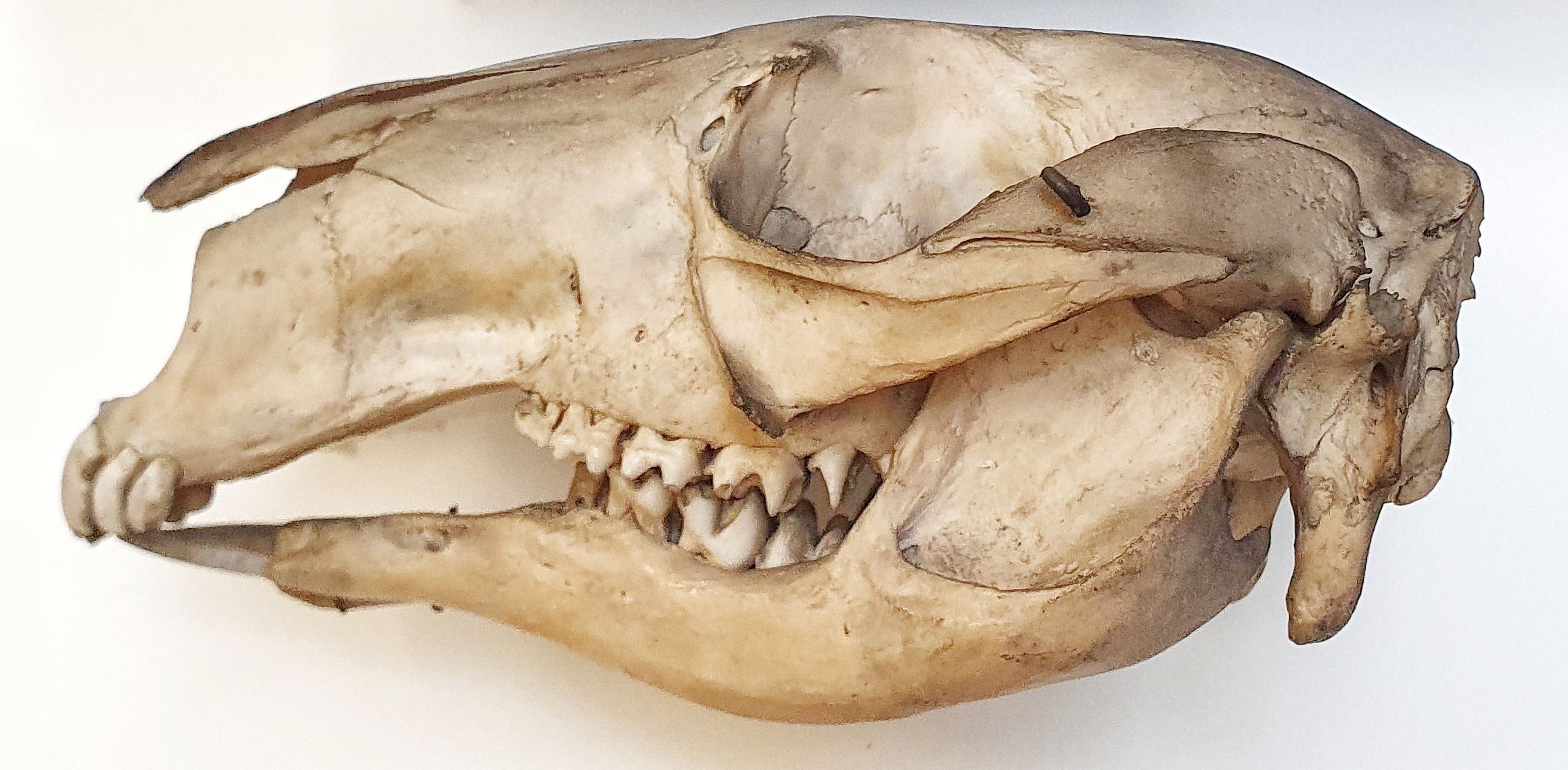

Pretty much everyone recognised it as a marsupial, thanks to the palatal vacuities and inflected angular of the mandible (as Allen Hazen alluded to).
The size, general shape of the skull and tooth shape narrows down possible species very quickly, as it’s quite large (at around 17cm) and quite kangeroo-shaped. That leaves the likely options as Eastern-grey, Western-grey or Red kangaroos.
Red Kangaroo skulls tend to average around 205mm long, Greys tend to average in the region of 145mm, so this falls between the two – either a small Red or a large Grey.
The sutures of the skull seem well-fused and there are quite robust muscle scars, suggesting a well-developed adult animal. For me this hints that it would probably be in the large end of the size range of its species, rather than at the small end of the size range – hinting at it being a Grey.
Another feature that hints at Grey Kangaroo is the crown of the third upper incisor, which in Red Kangaroos tends to be slightly broader than it is long, whereas in Greys it tends to be longer than wide.
Unfortunately, I’ve so far failed to find good enough verified images or specimens of Western Grey Kangaroo skulls to differentiate from the Eastern Grey.
I do know that this mystery specimen is identified as an Eastern Grey Macropus giganteus Shaw, 1790, but I am also aware that the taxonomy of these animals has been complex and confusing, especially since their ranges overlap so I don’t fully trust that identification. Sometimes a dose of scepticism is important when dealing with historic collections, so I think I’ll just leave it there after the tough week I’ve had.


 Zygoma