Friday mystery object #415 answer

Last week I gave you this Blaschka glass model of a marine invertebrate to have a go at identifying:

It was a bit of a mean one, since it’s from a very poorly known group of animals – and I mean that in more than one way. The taxonomic group is poorly known and the model represents a group of animals, not just a single individual.

So while this looks a bit like a jellyfish, it’s actually a siphonophore, which is a type of colonial organism that has discrete cloned zooids which fulfil specialised functions, similar to organs that cooperative to create a metaorganism.

Generally in siphonophores, these zooids are arranged on a stem in an organised pattern, with either two or three main zones of specialised zooids, depending on the taxonomic Suborder.

The zooid zone common to all siphonophores is the siphosome made up of feeding zooids with stinging cells, reproductive zooids and sometimes zooids with defensive functions. The two other zooid zones are the nectosome, which is comprised of zooids that act like tiny jet engines for swimming and the pneumatophore, which is a gas-filled zooid at the top of the stalk that acts as a float:

The presence or absence of particular zones is indicative of the particular Suborder of siphonophore, where the Physonectae have all three zones, the Cystonectae lack the swimming zooid zone and the Calycophorae lack the float.

I’m telling you all of this because it helps in narrowing down the mystery object. As you can see, there is no single zooid at the top acting as a float, so it must be one of the Calycophorae.

Within the Calycophorae most families only have one or two swimming bells and although the nectosome in the mystery object is not quite up to the Blaschka’s usual level of detail, it clearly contains more than two zooids, which is a feature of the Hippopodiidae.

The Hippopodiidae only contains two genera, Vogtia and Hippopodius and the two can be distinguished by the shape of the nectophores – in Vogtia they’re pentagonal whereas in Hippopodius they’re a more simple crescent shape – as we see here.

Back when the Blaschkas were making their models, there were a few species included in the genus Hippopodius, but they only made one that’s mentioned in their catalogues:

“209. Hippopodius gleba, Leuckart (Hippopoda lutea, Qu. & G.)”.

These days all the various species have been synonymised to just one – Hippopodius hippopus (ForsskÃ¥l, 1776).

So well done to everyone who recognised that this was a siphonophore, even better if you spotted it was one of the Calycophorae and bravo if you got the genus (and therefore species).

Next week I plan to have a change from Blaschkas, much to everyone’s relief I’m sure 😉

Friday mystery object #415

This week I was hoping to give you some skulls to try identifying from the Royal College of Surgeons in Ireland, but unfortunately all my well-laid plans were scuppered and I was unable to get away from the Dead Zoo. As a result I’ll afraid that I have yet another one of those ghastly Blaschka glass models for you to have a go at identifying:

The usual Blaschka rules apply – full points for the name and order catalogue number used by the Blaschkas (the catalogue can be found here) and bonus points for the current name for whatever this model depicts (if the taxonomy has changed).

I hope you enjoy this week’s challenge!

Friday mystery object #414 answer

Last week I gave you this Blaschka glass model from the Dead Zoo to have a go at identifying:

It seems as though you’ve all managed to get your eye in with the Blaschka identifications, since there was a flurry of correct answers both in the comments on the blog and on Twitter.

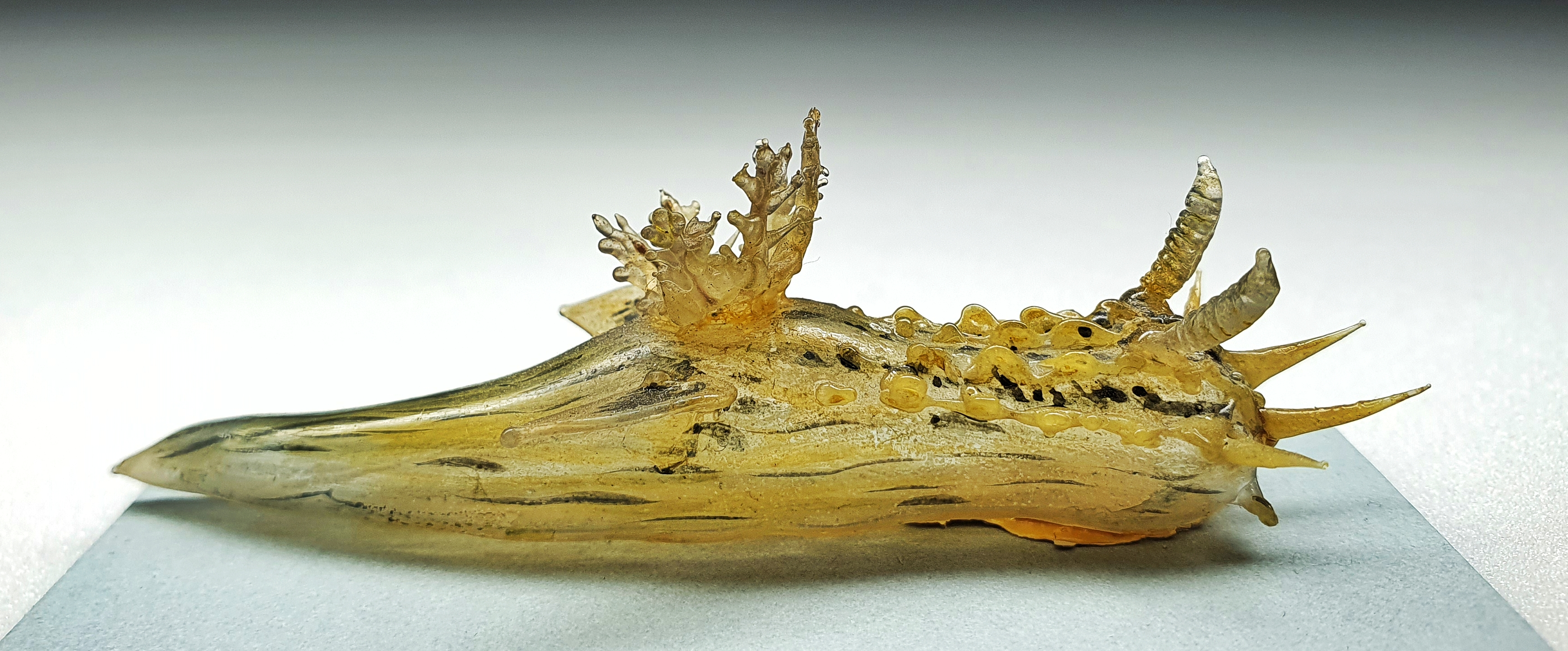
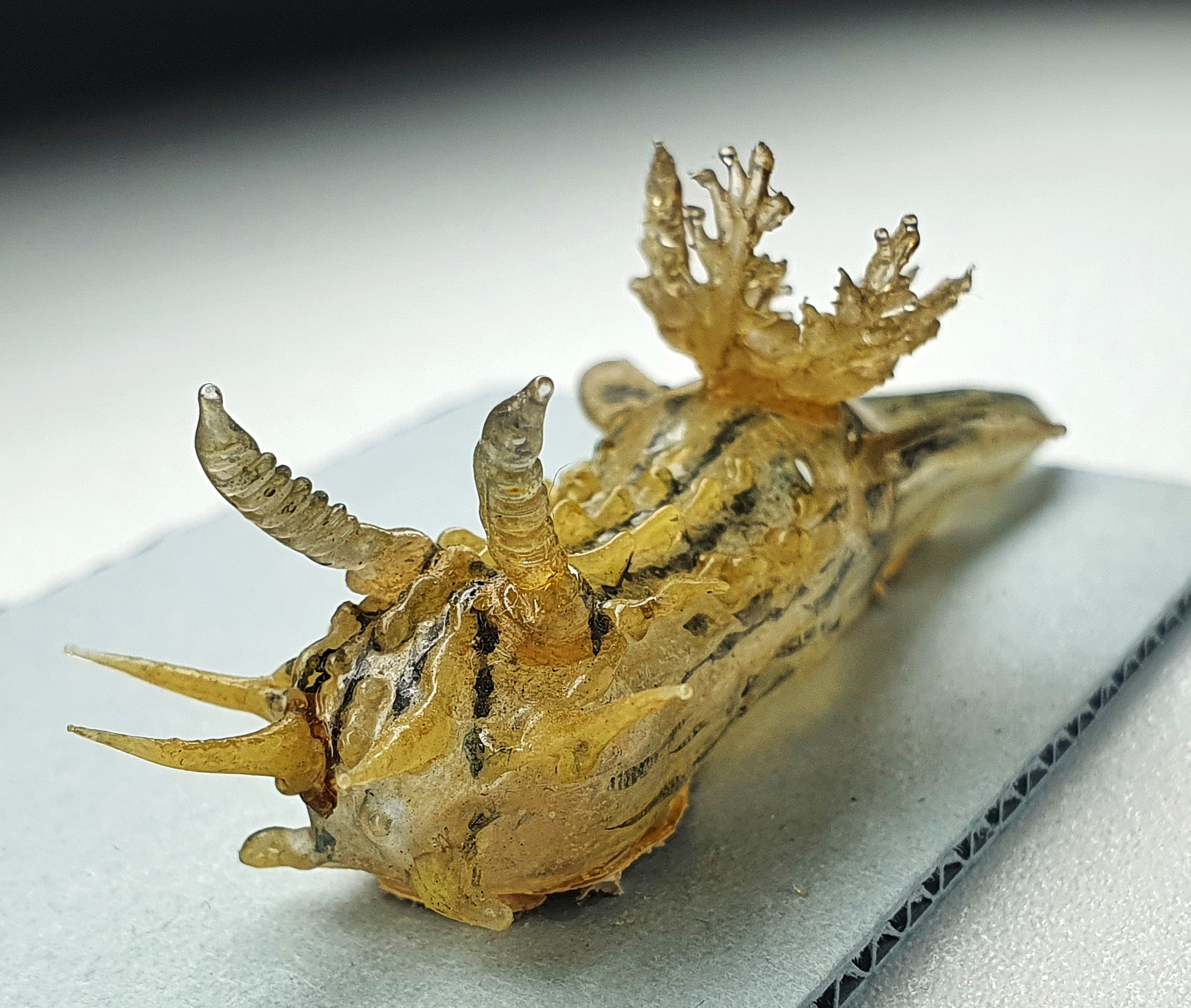
Those exposed gills immediately let us know that this is a nudibranch sea slug. From there I thought it might prove more of a challenge, but by looking at the physical characteristics shown it quickly became obvious what we were looking at – at least when there is a handy catalogue to look at and provide clues.

In this case, the clue lay in the scientific name of the species: Polycera quadrilineata (O. F. Müller, 1776). As you might expect, it has many (poly-) horns (-cera) and four (quadri-) lines (-lineata), making the name helpfully descriptive. At least in this instance. The problem is that the name could be much less helpful if this model depicted the same species with a different morphotype.

In fact, it seems that there has been a separate species of Polycera hiding in plain sight until very recently. The wide variety of different colours and patterns associated with P. quadrilineata has meant that the new species Polycera norvegica Sørensen, Rauch, Pola & Malaquias, 2020 was only identified in last year, because it was lumped together with its more lineated cousin (that often lacks its stripes).

Separating these species relies on finer details than just overall appearance of course – the team that identified this cryptic critter did so on the basis of detailed morphological and genetic work that you can read about here.

It does help illustrate an ongoing problem faced when dealing with historic collections though. There have been a lot of species that have been similarly split, especially since molecular methods have become so much more accessibble. When working with old specimens it’s not unusual for these little bits of scientific progress to have been missed.

I’ve grumbled about this before, but it is a particular problem that can make dealing with Blaschkas so much more complicated. Fortunately there has been some work done on trying to match some of the more distinctly fishy taxonomy used by the Blaschkas to more modern versions, but there are still some impossible examples where the Blaschkas reproduced something from a source that had little bearing on real species. I promise I won’t set one of those as a mystery object.

Probably.

Friday mystery object #414

The last mystery object I gave you was one of the Dead Zoo’s Blaschka glass models and it proved to be a nice challenge. So here’s another one of them that’s become dissociated from its data in the mists of time for you investigate:

Same rules as last time – let’s see if you can figure out the species and the catalogue number (here’s a link to the catalogue to help with that). Have fun!