
Last week I offered up a fossil specimen from the collections of the Horniman Museum & Gardens for you to have a go at identifying:
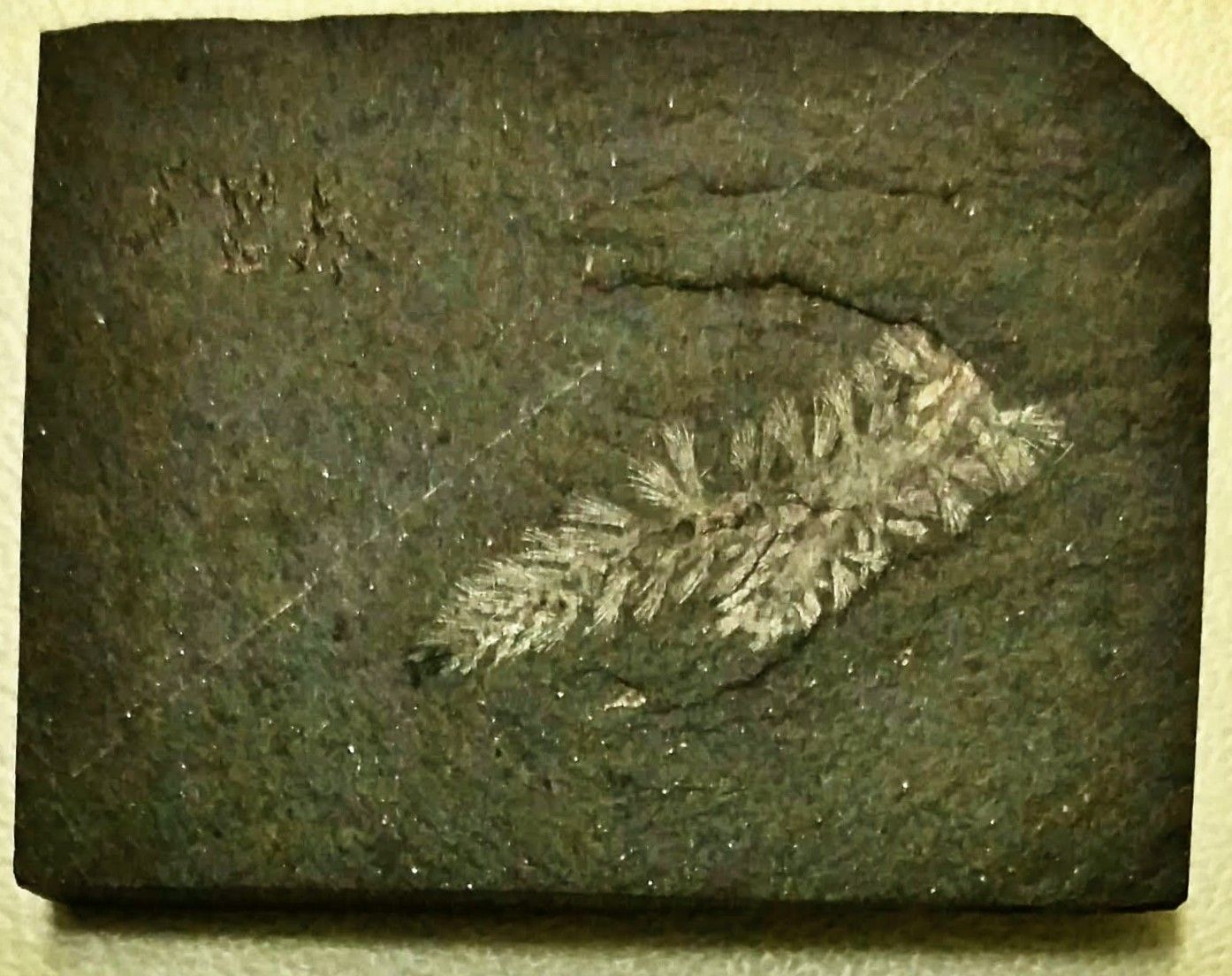
The type of preservation here is quite distinctive for those familiar with fossil Lagerstätten (sites of exceptional fossil preservation or concentration). This silvery sheen on a piece of dark slate is immediately recognisable as the type of soft-bodied preservation I expect to see in specimens from the Burgess Shale.
The Burgess Shale is an incredible fossil locality in the Canadian Rock Mountains, that preserves animals from marine ecosystem that was rapidly buried around half a billion years ago. The rapid burial and some factor that created a hostile environment (low O2 or perhaps a hypersaline seep) prevented the decay of the soft tissues of the animals that were buried and created conditions that preserved soft parts of the animals present, rather that just preserving hard parts,
This unusual set of conditions means that rather than just seeing shells of animals like brachiopods and carapaces of trilobites, we get a much more accurate snapshot of marine life at the time, including a variety of bizarre worm-like animals and creatures with forms that aren’t recognisable as being from types of animal alive today.
This particular specimen is not all that strange in comparison to some of those organisms that diversified in the Cambrian explosion (a name we use to describe the apparently sudden diversification of multicellular life around 540 million years ago).

Used in Pates S, Lerosey-Aubril R, Daley AC, Kier C, Bonino E, Ortega-Hernández J. 2021. The diverse radiodont fauna from the Marjum Formation of Utah, USA (Cambrian: Drumian) PeerJ 9:e10509 https://doi.org/10.7717/peerj.10509
The mystery object actually doesn’t look too much different from some of the living Polychaetes, such as the pelagic Gossamer Worm:

However, there are several different Polychaete worms recognised from the Burgess Shale, so it does take a bit of close investigation to work out which it’s likely to be.
Adam Yates took a good look and while his first response of Canadia spinosa Wallcott, 1911 matches the label with the specimen, he updated his answer. Looking at the setae structure, I think that Adam is right in rethinking this. In Canadia spinose the setae appear more flight-feather-like, with longer leading bristles and a more swept-back appearance:

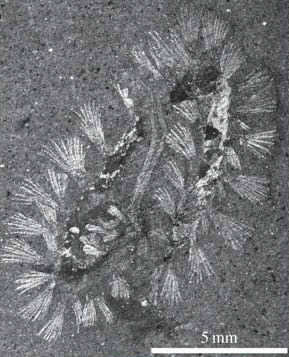
The setae of the mystery specimen appears a bit different, with bristles of a more similar length that stick out in more separated tufts. This makes me concur with Adam, in that we may be looking a Burgessochaeta setigera (Walcott, 1911):
I hope you enjoyed that little journey into the distant past as much as I did. Learning about the Burgess Shale was a highlight of my undergraduate days, as it offered a glimpse at both the lost diversity of the past, and a hint at the unfathomable depth of time through which life has persisted, adapted and evolved.


