
This week I have a fragment of jaw for you to have a go at identifying:
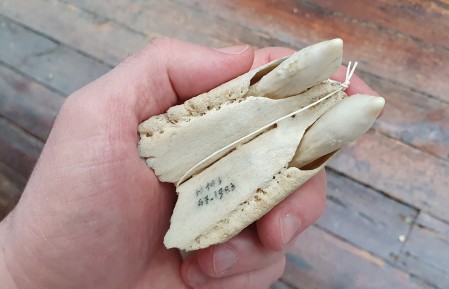
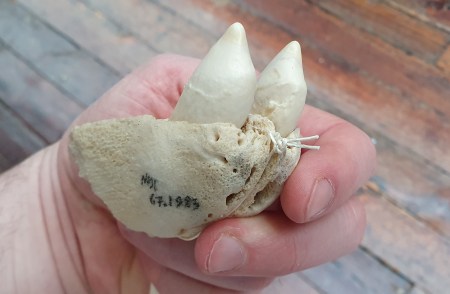
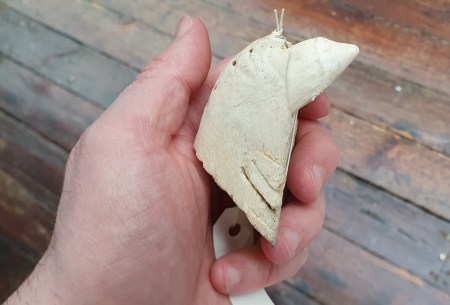
Any idea what these tusky teeth might belong to?
Usual rules apply – if you think it’s easy then please drop your thoughts in cryptic form or, even better, perhaps as a ditty or snippet of verse in the comments section below. Have fun!
 Zygoma
Could this true pecker be all at sea?
Nicely done 🙂
A scan of truly epic sites brought me to this…spoiler alert! Don’t click if you prefer to search yourself but do look at the site at a later date-a fascinating resource! https://phenome10k.org/mesoplodon-mirus
Hi Chris – I have used this site for other research, and it’s a good one. It was this site that had me mostly rule out M.m because the teeth are just too far apart. I thought. Now I am not so sure. But since we had a location hint…. it bears that both M. m. and Z.C. are still in the running. Except that Feb. stranding in 1983. Oh geeze… what’s written on the specimen? Could it be? Is it True?
And this one – with the same warning for those that want to do more searching on their own..
I agree with Chris. This is a really rare specimen, what a shame they only saved the tip of the lower jaw. I know several collectors of mammal skulls willing to invest non-essential body parts to get one of these
and it is also possible that this would have belonged to a species named after an 19th century French biologist. Which would be a great find as well
I keep pondering this post. I’m an advid collector, but I am still trying to figure out what body parts would be non-essential.
avid
I’ll admit to being baffled. If those are incisors, then it’s probably a herbivore? Is that a mandible, all fukked in like that?
ZZZZZZZzzzzzzzzzz … No, I’m not bored, just trying to guess a family name. Narrowness of the front end of the mandible suggests a sort of… you might say “beak”, or maybe “bottle”….
Allen – Your statements are not True but I think they are correct! I think what I am saying may be “hollow”, and I am agreeing with you.
Well, I’m not sure if this is the TRUth or not, but I followed what I took to be Chris Jarvis’s suggestion and looked at the Wikipedia article on the species and found
“The two distinctive teeth on the males are small and set on the very end of the beak”.
Hmmm… To tell the truth… The species I think this represents is one of fifteen in a genus, and the genus name seems to refer to the placement of teeth in the middle, rather than the extreme front, of the lower jaw: haven’t found a good, usable, key to species, but several species of this genus seem to have their teeth closer to the advertised position than this one does. For the moment I’m going out on a limb and claiming a species identification (though, given the general obscurity of members of thizz family, I’m not confident that there aren’t other “teloplodont” types out there).
I am thinking the Baron would be happy to know this species is still not extinct.
And it looks like they tried 4 times with a saw before they successfully cut it off. I am thinking this is not sharp enough to be female. I will have to narrow this down – but I am thinking only size will tell the truth between the two I have narrowed it down to.
Hmmm…. Right family, but… Following what I thought was a veritable hint, I looked at M.m., the only (?) species of its genus with teeth at the end of the mandible. But Katedmonson seems to be suggesting Z.c.
Wikipedia has skeletal photos of both. But the M.m photo seems to show an unfused mandibular symphysis, whereas the skull of Z.c. shown has an extensively fused chin: on THAT basis, Z.c. seems the better bet.
I saw the same unfused mandibular symphysis too – also.. the M.m. seems to have slightly more space between the teeth than our mystery, or the Z.c. Our Z also has more of a squared-off snout. And the M.m. has a rounded one. As far as I can tell. What do you think?
Katedmonson–
With only a fragment of lower jaw, and no flesh, I don’t want to even try to guess what shape the snout was when the animal was alive.
… I’m pretty confident we have the family, but there are a lot of species to choose from. Somewhere out there there is bound to be a “key”: a list of spotting features for all known species of Z-idae! So far I haven’t found it. Wikipedia on the genus M. has a clickable list of links to articles on the 15 or so species of THAT genus, some but not all of which have understandable descriptions of dentition. Right now, however, I think one of the other genera — like Z. — is a better bet. Over the next few days I will try to look up as many as I can (on Wikipedia and elsewhere!). The two teeth on this one, in addition to being fairly close together, look fairly robust, and a bit worn: do Z-ids use their teeth for anything other than scratching conspecific rivals?
I am also using the size descriptions for species determination – the snout end just fits in the hand. Which seem to narrow it down to the two genus M. or Z. Other species are just too big. Since it is usually the males in all the beaked species that have the two lower teeth, (the descriptions say that in several species the female dentition doesn’t erupt through the gums) it must be something not directly related to survival in general.
Could this be the stuff of Dürer’s southeast asian visions? Really seems like it…
What a goof. Wrong face part…back to the drawing board.
Not sure exactly what the shape of a flensing spade is, but I doubt it is cylindrical with a conical tip! So we can (tentatively) cross off THAT species. 21 to go.
Can’t seem to find a mandible for B. minimus – might be the right size… but I keep going back to our French Baron.
The photos conceal the tag. If we knew where the specimen was from, it might help with identification. The description of Indopacetus Pacific’s I was able to find says that it apparently has two teeth toward the end of the snout (without specifying which jaw!), for example, but if this specimen was from Atlantic waters we could rule that species out.
Ok, it’s clue time. This specimen was from a stranding in Ireland.
Awww geeze – say it isn’t true…. That narrowed it down to,… to… the same two I have been pondering for 5 days.
The lower jaw of the Indo pacetus Pacific’s looks very close – but the size of the animal looks too large for our mystery…