
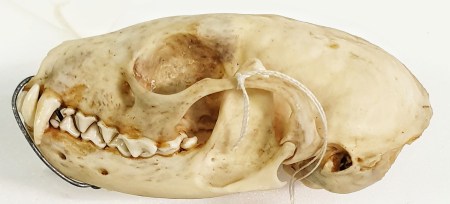
Last week I gave you this specimen from the Dead Zoo to have a go at identifying:


It was a bit of a tricky one, since the specimen has been sectioned down the midline and the bone of the maxilla has been removed to show the roots of the teeth.
However, many of you were stuck at home and had a chance to get into detail in the comments. There were some fantastic answers where the features were discussed, so I think it’s well worth sharing some of them:
Rémi said:
We are confined at home, so we searched together with my 5 years old daughter. Here are our thoughts :
– foramen magnum in a downward position, low-crown teeth, bony part behind orbite, orbites facing toward the front, so we are dealing with a primate
– but a special primate because the orbites are open to the temporal fossa. And also it has a long snout with the orbites below the nasal bone. The orbites are not big enough for a nocturnal monkey. And also the very special lower incisors in horizontal position, also know as teeth-comb. We think it is a lemur-like animal.
The brain case is not round enough for a Lorisidae. We could not find pictures of all the lemur and sportive lemur species. But we saw the picture of a skull of the cat-ish one and it fits very well.
Then
steveryder said:
Second thoughts: we cannot quite see this but in my own notes on lemur;
Canine often incisiform and procumbent, arranged laterally with incisors in toothcomb, creating array of 3.
Ist mandibular premolar often caniniformThis would then be 3 premolar, 3 molar and therefore not Varecia but more probably Eulemur….
and…
katedmonson said:
While some lemurs don’t have upper incisors, this one has small peg-like ones. A Ruffed lemur (Varecia variegate), while having the same dentition, has more of an orbital thickness.
Since the skull has been dremeled out, I am not sure how much of a diastema was between the canine and upper premolars. If there was one there, I will vote for a Ring tailed lemur (Lemur catta), female, because of the smoother occipital and more slender lower mandible. The size fits as well.
These comments all highlight features of the skull that belong to lemurs, but there is a little confusion caused by the bone removed from around the teeth.
Ring-tailed Lemur was the most popular answer, but the diastema (or gap) between the upper canine tooth and the first upper premolar that katedmonson mentioned would not be present on this specimen, even if the bone was still there. Also, that lower first premolar has a fairly simple conical/triangular shape with just one cusp – which makes it caniniform, as mentioned by steveryder.
Rather than the Ring-tailed Lemur, this is the skull of a Ruffed Lemur Varecia variegata Kerr, 1792. I think it’s probably from a female or young animal (or both) as it’s more gracile than some other specimens I’ve seen. This accounts for the reduced orbital thickness, slender mandible and smoother occipital mentioned by katedmonson.
.jpg)
Black and white ruffed lemur by Charles J Sharpe, 2018
I should say, on Twitter Michael English and Gabriella Κογντογριδη also recognised this as a Ruffed Lemur. Worth mentioning that if you use Twitter and you like identifying skulls (well OBVIOUSLY you like skulls if you’re reading this) then it’s well worth checking out the #GuessTheSkull hashtag started by Yara Haridy.
A new mystery object next week – stay safe and healthy!




 Zygoma