Happy New Year everyone!
Last week I gave you this skull to identify from the collections of the Dead Zoo in Dublin :
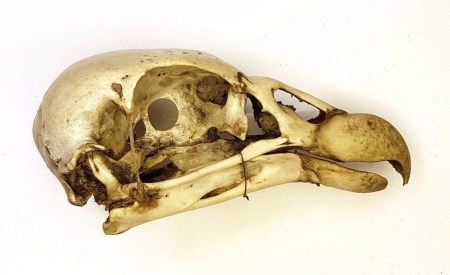
I also included the label, since it offers an interesting taxonomic twist.
If there’s one principle that I hope I’ve managed to convey over the last eight and half years of doing the Friday mystery object, is that you should never fully trust the label.
For starters, the number NMINH:2006.12.1698 could be misleading, as it reflects the year the specimen was catalogued rather than the year it was acquired. To explain, the NMI uses a very sensible numbering system that starts with the collection (NMINH = National Museum of Ireland Natural History) the year of registration (usually the year of acquisition) which allows you to know which register to look in, followed by the lot number (a sequential number reflecting how many acquisitions have come in that year), followed by the individual object number (the sequential number of that individual item in a particular lot). This system can have additional numbers added if necessary, such as if a piece of an individual object is removed for sampling.
However, some older objects were not registered when they entered the collection and as such they get a number that reflects the year they were documented rather than the year they were acquired. In this case the specimen was registered in 2006, but purchased from an auction of the collections of van Lidth de Jeude who died in 1863, as Nigel (the Dead Zoo Keeper) helpfully pointed out in the comments.
If the specimen had been accessioned and numbered on entering the collection back in the 1860’s then issues with the name would be expected since taxonomy constantly changes and old names are often wrong, but because of the new label and the 2006 date, you’d generally expect the name to be more up-to-date. However, it appears that the information on an old label was directly transcribed without being updated.
This is relevant because the name Orogyps auricularis is what we call a junior synonym, which means it has been used to describe a species that already has an older valid name. When this happens the older name takes precedence. In this case, Orogyps auricularis is a name applied in 1867 by Degland and Gerbe to a species that had already been named Vultur tracheliotos by J.R. Forster in 1796 and which is now placed in a different genus, giving the name Torgos tracheliotos (Forster, 1796) – where the parentheses around the author name indicate that the scientific name has changed from the original version that was published by Forster.
These taxonomic and documentation twists are however rendered redundant as soon as you realise that this specimen is from a totally different species. In fact it’s not really anything like Torgos tracheliotos the Lappet-faced Vulture:
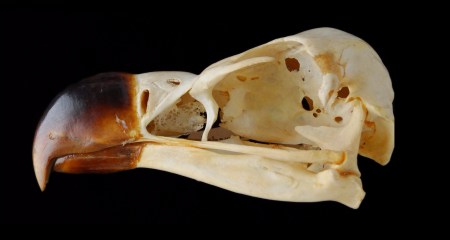
Lappet-faced vulture
In fact, the only real similarity lies in the tip of the beak, which is a functional feature for tearing meat and which is convergent between the Old World Vultures and the New World Vultures. The Lappet-faced Vulture is an African species, while the mystery object has the distinctive deflection of the bill in the nasal region that indicates it’s a species from the Americas. This discrepancy in region was noted by palfreyman1414 and Gerard van den Brink.
Once you focus on the New World Vultures it becomes quite easy to make an identification, since there are only seven species and at 121mm this specimen is the third largest species after the condors – something easy to check on Skullsite. So well done to everyone who recognised the skull as belonging to the King Vulture Sarcoramphus papa (Linnaeus, 1758), especially palfreyman1414 who got there first.

King Vulture by Eric Kilby, 2008
As you can see, not only was the taxonomy very out of date for this specimen, it was also completely wrong, because it was misidentified 150 years ago. This is why you should never fully trust labels – they will often be wrong and if you base research on misidentified specimens, that will be wrong too.
Another mystery specimen next week!




 Zygoma