Friday mystery object #285 answer

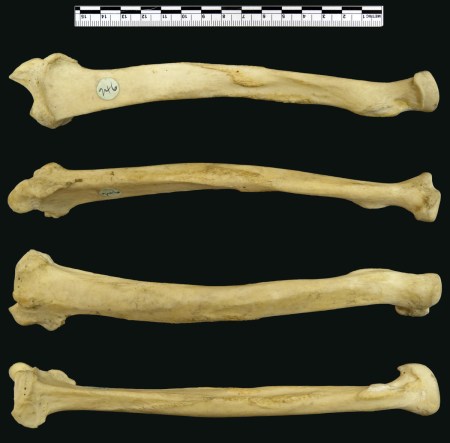
Last week I gave you this unassuming bit of bone, that I found with no identification in the Grant Museum of Zoology stores:
mystery285

Daniel Jones and Daniel Calleri identified the element as a radius, but beyond that there was a general feeling that identification of species was a bit on the tricky side. Palfreyman1414 pointed out that it’s something approximately human sized, with Lena ruling out an ungulate, suggesting that it could be from a carnivore or possibly a marsupial.

I must admit that my mind immediately went to carnivores and I initially thought it could be from a Black Bear, since it’s fairly robust and about the right length. However, after checking the ever helpful Adams & Crabtree book I realised that bears are even more chunky than this.

It didn’t look right for a dog since they are straighter, have a flatter profile and a narrower distal end. However, it did look right for a big cat and I’m fairly certain that it’s from a Leopard Panther pardus (Linnaeus, 1758). If you want to compare a Leopard with a Dog radius you can see them compared in this paper, along with a good description of the bones of the Leopard forearm.

A bit of a tricky challenge – so next time I may try to do something a bit more distinctive!

Friday mystery object #284 answer

Last week I gave you this part of a skull to have a go at identifying:

mystery284

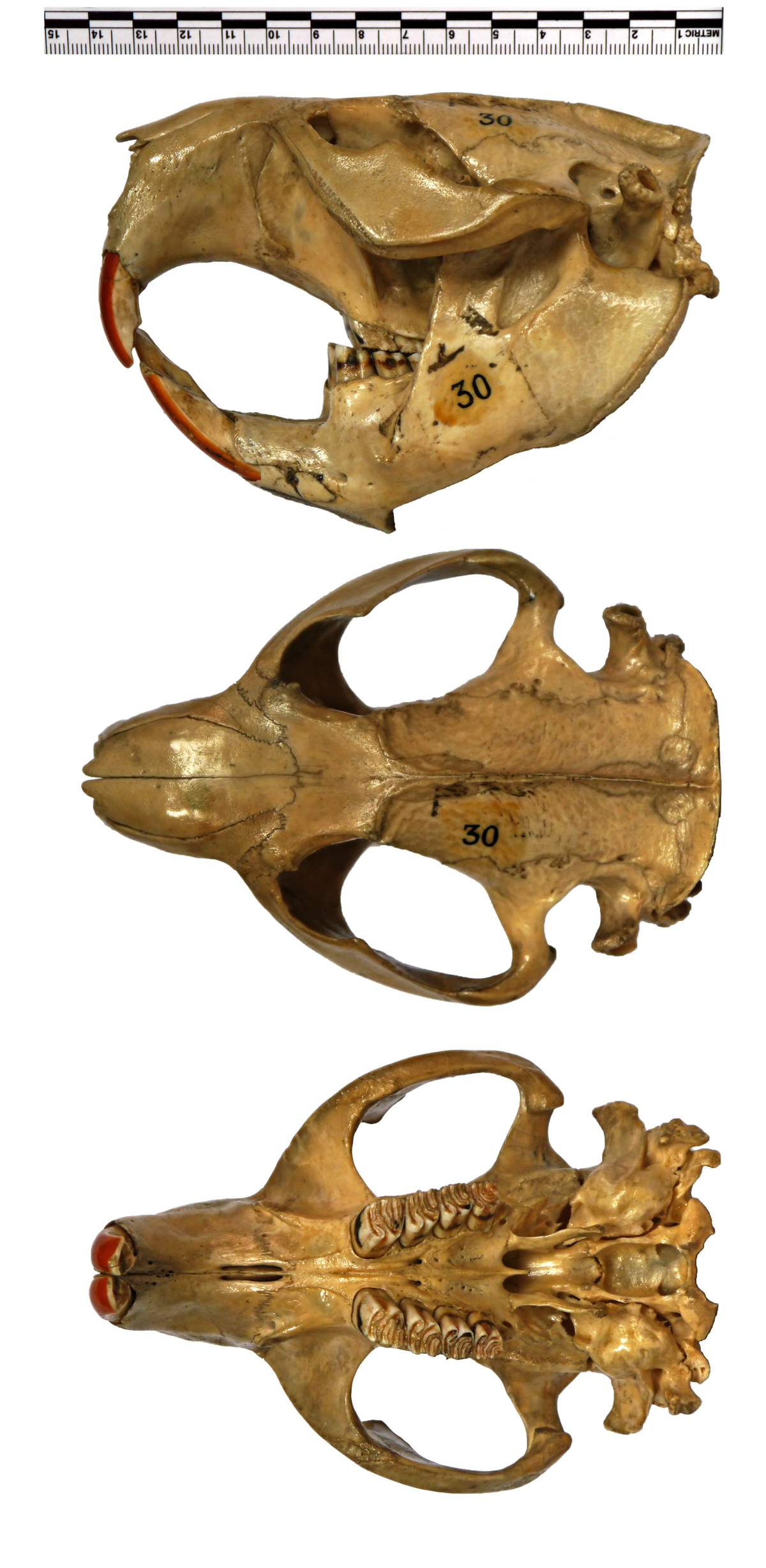
It’s quite a distinctive structure and very particular to one particular group of mammals. It is of course an external auditory meatus (or ear hole as it’s more commonly known), but instead of opening directly into the auditory bulla (the inflated bony bulb that holds the ear bones) it has a long and robust tube.

Lee Post, Daniel Calleri & Dan Jones and Allen Hazen recognised this characteristic feature as belonging to a Beaver and Richard Lawrence went one better and narrowed it down to Castor canadensis Kuhl, 1820 – an identification that I agree with having seen the whole skull:

beaver_skull

I’m not sure if there’s any real functional reason for the ear tube, but it looks to me like it might be a “spandrel” a feature that’s an artefact of another adaptive feature – in this case the articulation of the mandible.

beaver_jaw

Gnawing through a tree trunk is no easy task, so it’s not surprising that the Beaver has some serious adaptations to deal with the work involved. Unlike carnivores, which have a fixed lateral mandibular articulation powered mainly by the temporalis muscles, rodents have a dorso-ventral articulation usually powered by the masseter muscles, which allows the jaw to move backward and forward. In the Beaver the sagittal crest suggests that the temporal muscles are more involved than usual which, with the orientation of the articulation, may necessitate the ear tubes as lateral braces against which the mandible can secondarily articulate. That’s my guess…

Great work on identifying this specimen using very limited information!