Friday mystery object #490 answer

Last week I gave you this sturdy shoulder from a specimen in the Dead Zoo to try your hand at identifying:

It’s big, chunky and definitely not something you’re likely to find while digging in your garden.

The size might suggest something like a horse or cow, but it’s far too broad for either. The shape is a little more like a pig scapula, but as Sallie Reynolds pointed out, pigs have a more strongly curved scapular spine (the ridge of bone that sticks up along the middle). Plus pigs are a good bit smaller – this is a big scapula.

Rhinos have scapulae that are quite long and narrow – similar to a horse’s, and elephants have a very differently shaped shoulder:
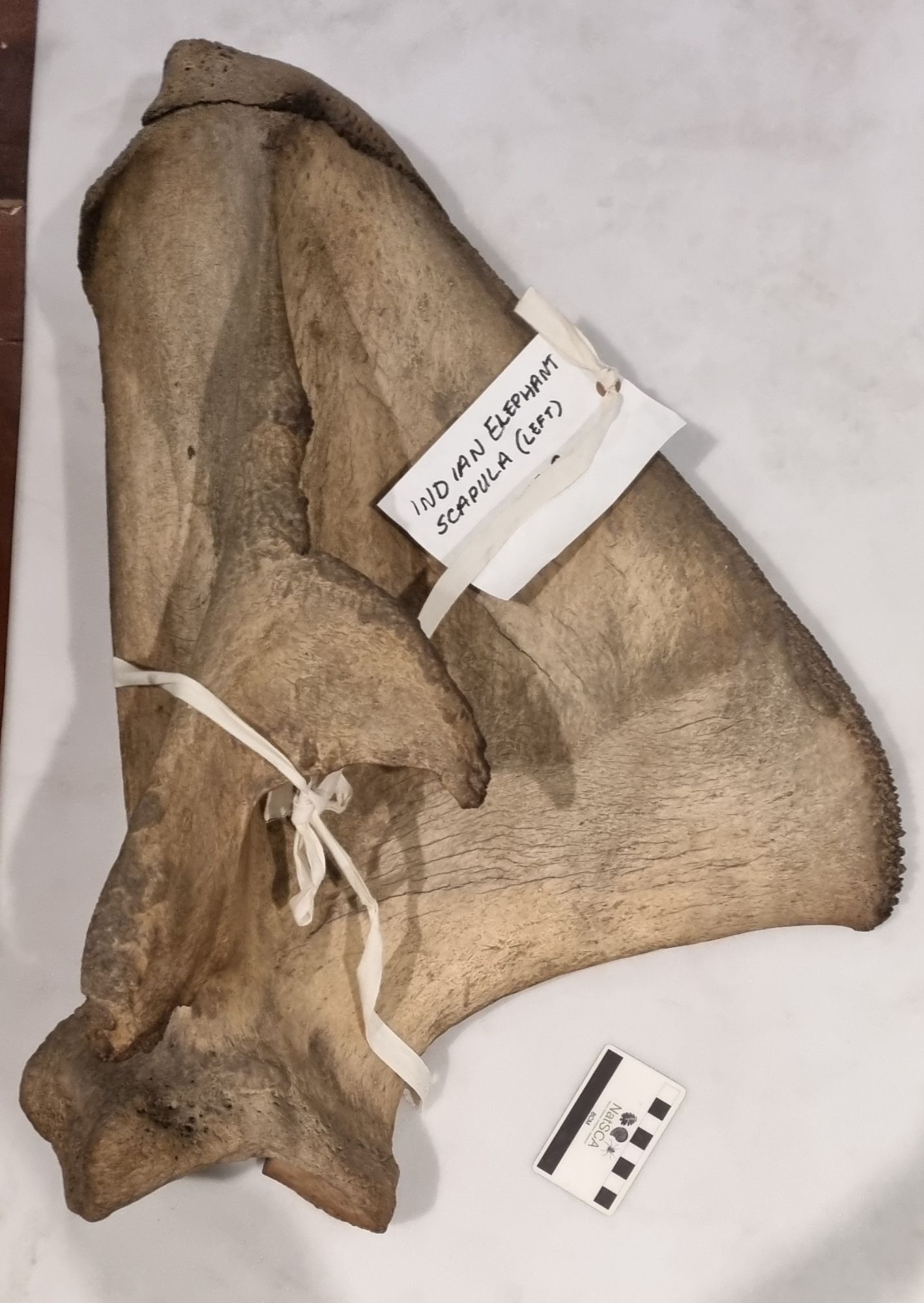
Cetacean shoulders tend to be much more flattened and usually more circular, so it’s not one of them either. It is, however, from a distant cousin.

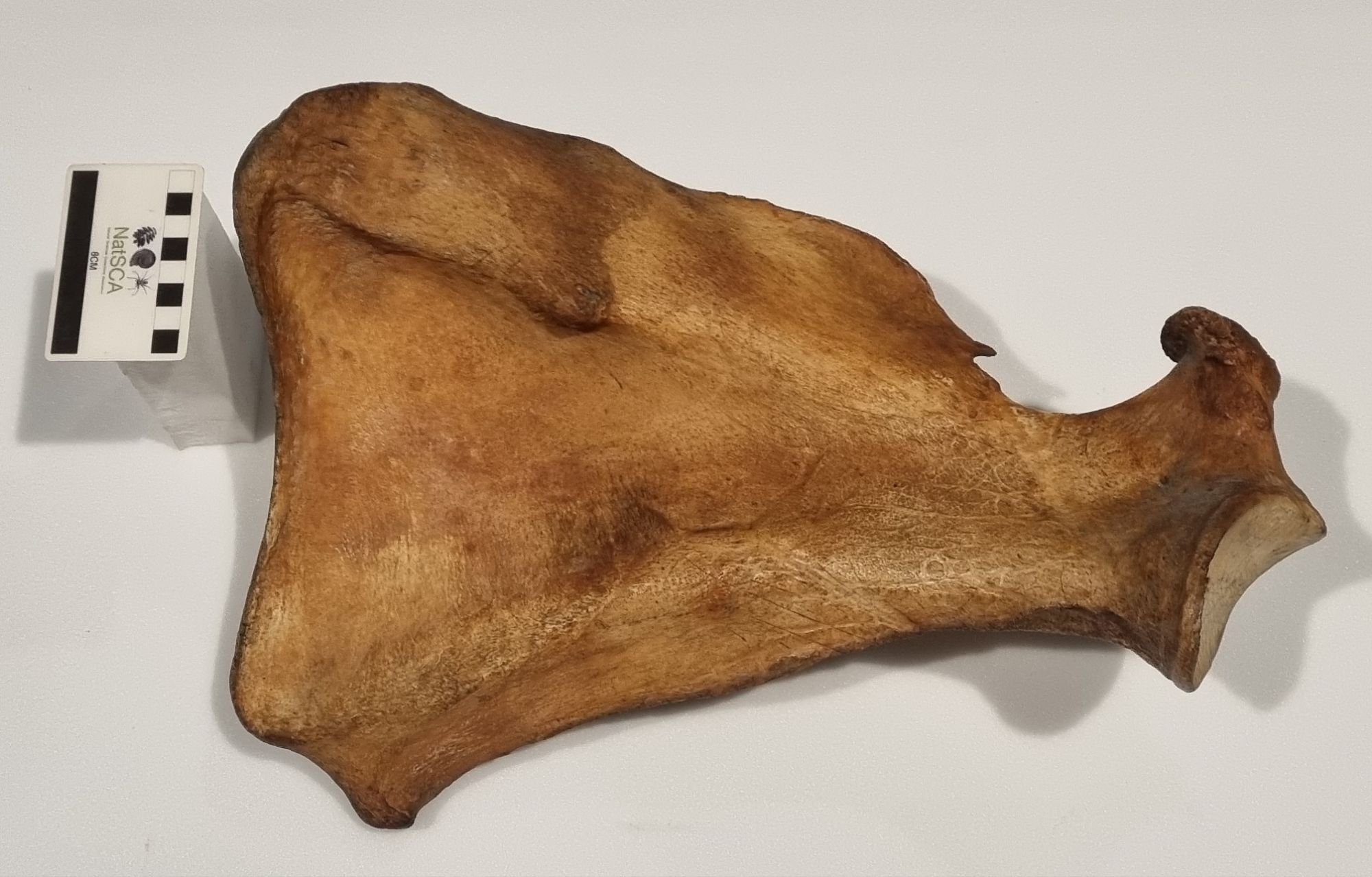
This is the scapula of a Hippo Hippopotamus amphibius Linnaeus, 1758.

Hippos used to be considered closer relatives of pigs and members of the Suborder Suina, but the discovery of the fossil whale Pakicetus in 1981 and various genetic studies over the last couple of decades have revealed that whales and hippos share a common ancestor and they have been grouped together in the Suborder Whippomorpha.

So well done to Adam Yates who dropped an equine hint about the source of this shoulderblade – since Hippopotamus does of course translate to “river horse”. I hope you enjoyed the challenge – there will be another next Friday!
Friday mystery object #203 answer

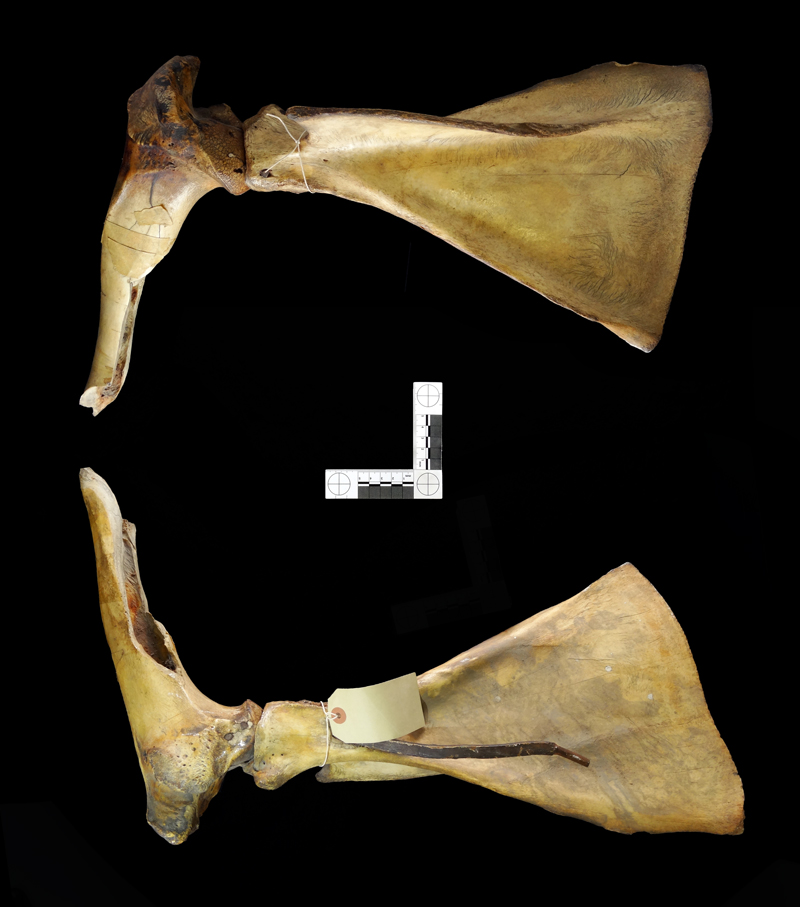
Last Friday I gave you this rather large scapula that I discovered in a crate in the Horniman’s stores to identify:

mystery203

It wasn’t an easy one, since there are relatively few distinctive features on a scapula compared to something like a skull.

Jake has talked about scapulae on his blog before and that provides a good place to see that this specimen is most likely from an ungulate – but an ungulate much bigger than a Red Deer. This led to suggestions for Cow, Horse, Aurochs and one of the larger species of deer. 

Outside the comments section on Zygoma there were also suggestions of Giraffe and Giant Irish Deer and I wondered about Camel.

All in all, there were a lot of suggestions, but none of these looked quite right when I searched for comparative material – although finding good images of scapulae online wasn’t easy. I did, however, find a useful video explaining the differences between Horse, Cow (or Ox) and Camel scapulae:

This was enough for me to rule out each of those animals, although the closest was the Cow – in particular the relative sizes of the two faces (called fossae) on either side of the raised ridge called the spine. However, the shape of the acromion (the hooked bit of the raised spine that points towards the shoulder joint) didn’t seem blunt enough for a Cow.

The size differences in the fossae turn out to be about the same in Sheep and deer as in Cow, which led me back in the direction of Jake’s deer scapulae, which seemed to most closely match the shape, if not the absolute size.

Taking the size into account I realised that this animal must stand almost twice the height of a Red Deer, which narrows it down to just one modern species – the Moose or Eurasian Elk Alces alces (Linnaeus, 1758), which can stand at over 2m at the shoulder compared to the Scottish Red Deer’s (still imposing) 1.22m.

Bull Chukotka Moose by Beloki

I still need to double-check my identification against a confirmed Moose scapula, but from looking at some images of Moose skeletons online it seems that the shape of both the fossae and the acromion fit well.

So a big thanks to everyone for their help in identifying this and special props to newcomer Jeanie who seems to have been spot-on about this being from a cervid. Thanks!