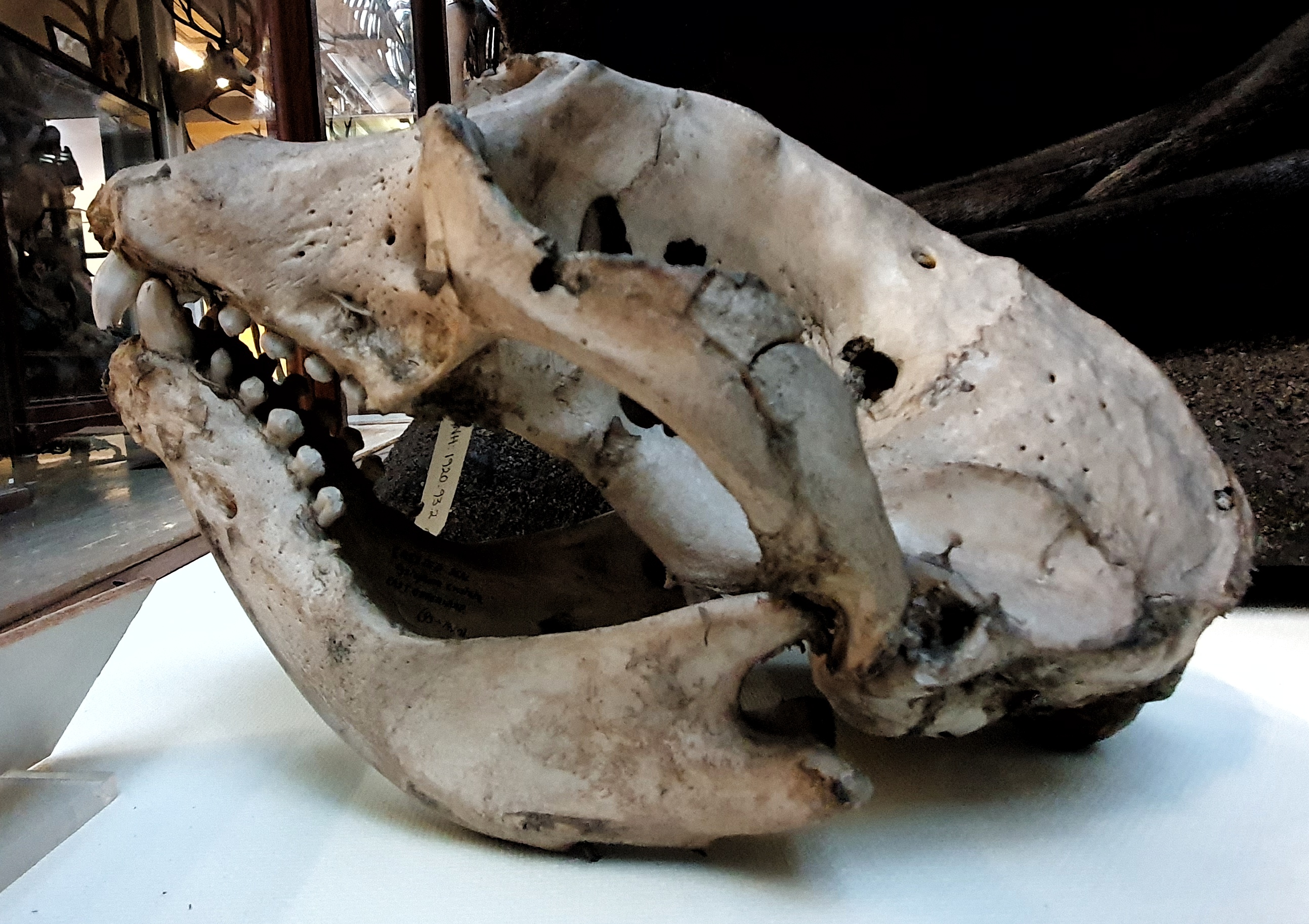
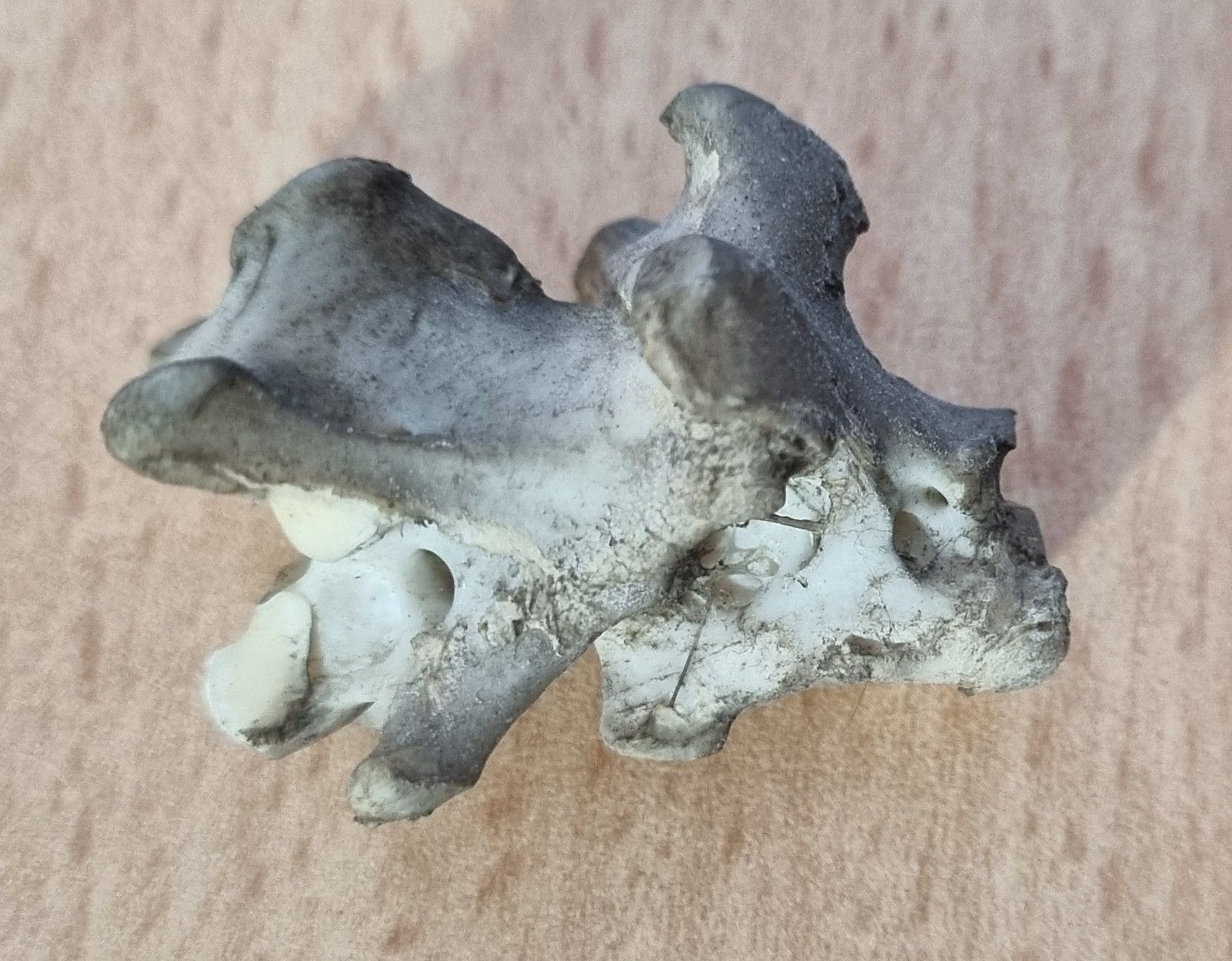
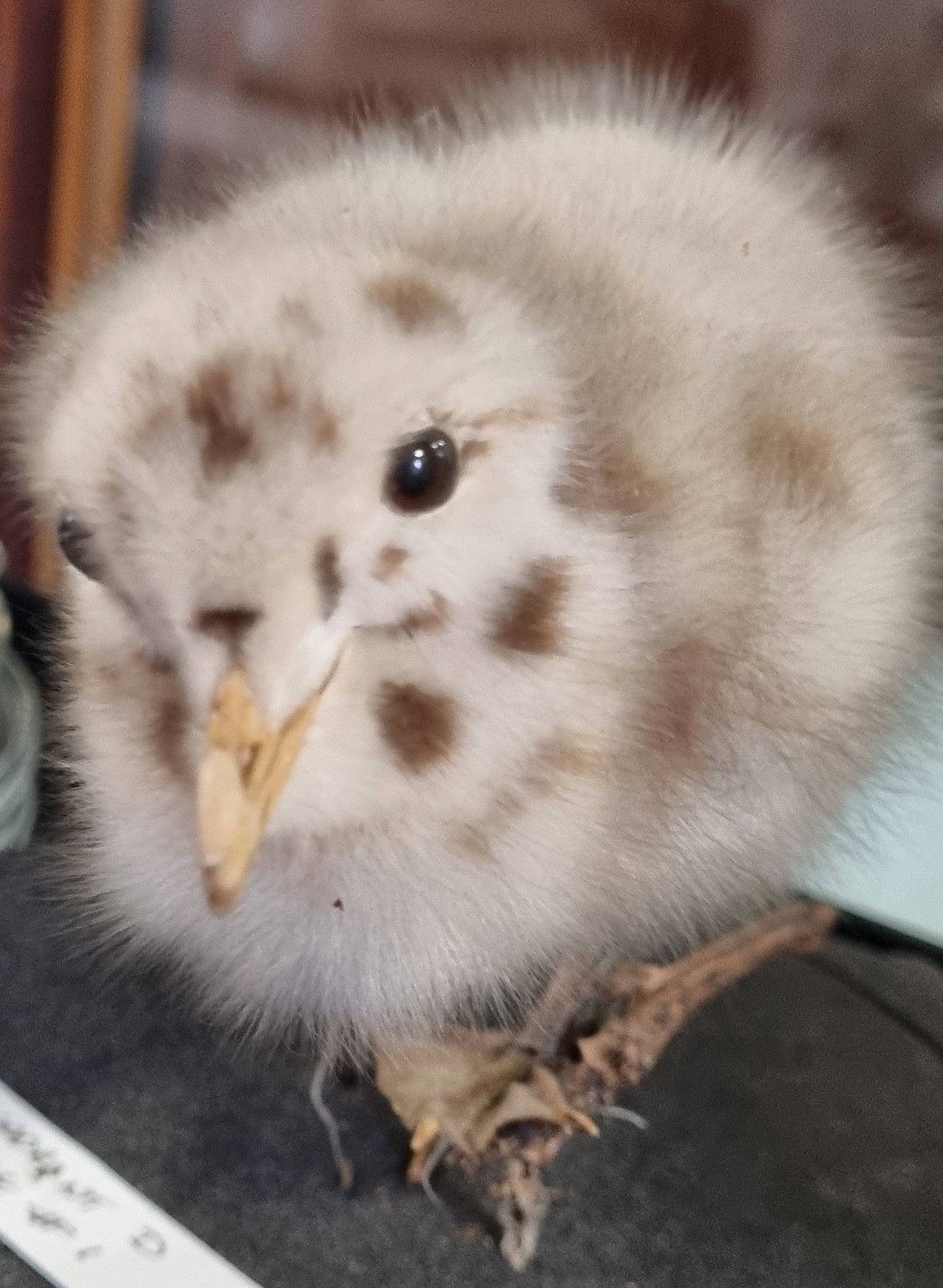
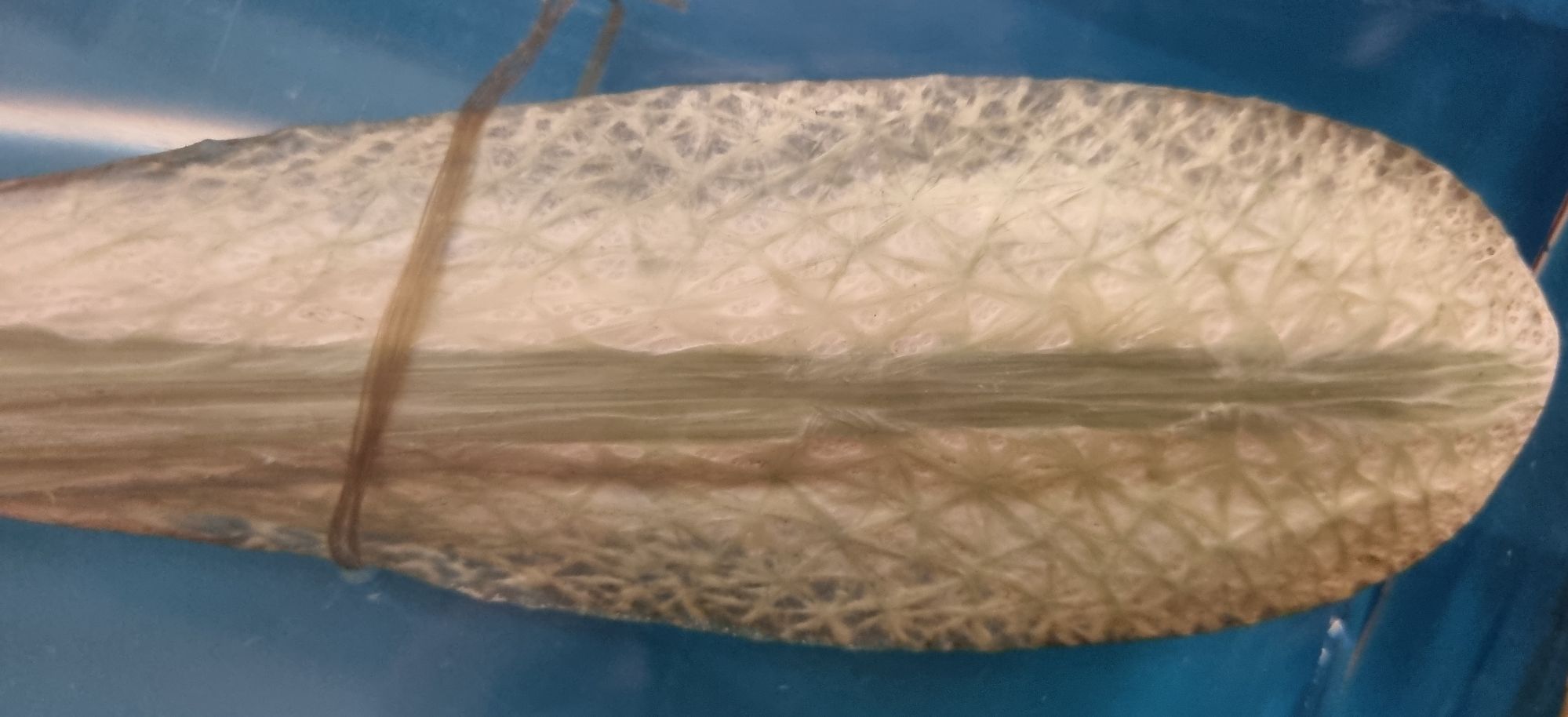
Last week I gave you this extreme close-up of a specimen from the Dead Zoo to have a go at identifying:
Only providing this would probably have been unforgivably mean, so I also provided an image with less detail and little bit more context:
Clearly this provided plenty of information, since several of you managed to work out what this spatula-shaped appendage was from. In fact, the spatulate shape is so distinct it’s incorporated into the animal’s name.
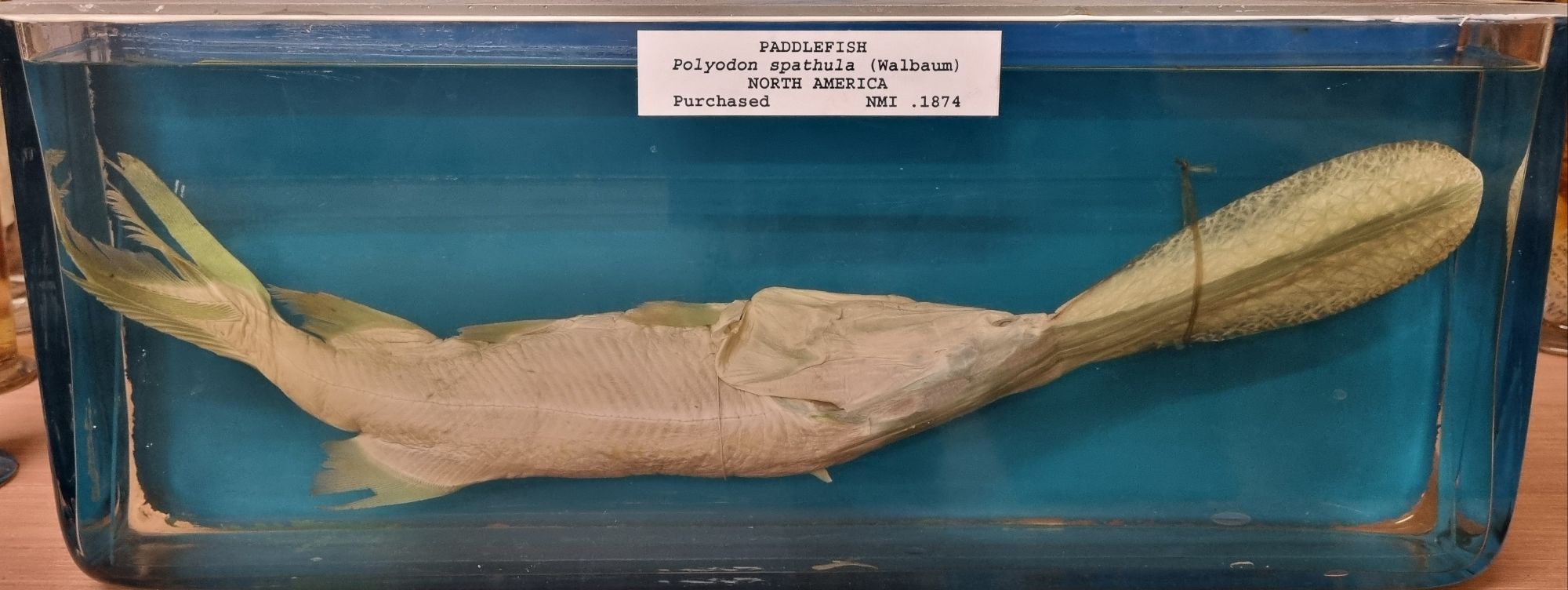
Adam Yates was the first to comment correctly, identifying that this is the rostrum of the American Paddlefish Polyodon spathula (Walbaum, 1792). Here’s a photo of the complete specimen:
It’s a fairly small example of this wonderfully unusual fish, as on average they weigh in at 60lb (27kg) and measure 5ft long (about 1.5m). I call them unusual because they do things differently to most other fish.
For starters, they’re from a very small family of fish that contains just themselves and a handful of sturgeon species. This family have heterocercal tails like sharks, and cartilaginous skeletons like sharks, but they’re actually bony fish that have become less bony.
They also have that distinctive spatulate rostrum (presumably constructed from little interlocking rays of cartilage based on the detailed photo), which looks more like the bill of a Spoonbill bird or a dabbling duck than the slashing blade that other fish species with an extended rostrum tend to have. However, the rostrum isn’t part of the jaw, and it can’t function in the same way as similar shaped structures in birds. Instead it serves a function in electroreception – picking up the tiny electrical signals from the muscle movements of clouds of planktonic crustaceans. Oh, did I mention that they’re freshwater filter feeders?
The name Polydon suggests to me that the species should have many teeth, and while this may be true for the tiny juvenile stages, the adults have no teeth at all – although the name probably relates to the large number of gill-rakers that are used to capture prey.
Another odd thing is that it’s only the American Paddlefish that filter feeds – the Chinese Paddlefish (which was recently declared extinct) fed on things like fish and crabs and had a totally different feeding mechanism that was much more similar to a Sturgeon.
Sadly, the American Paddlefish is at risk of going the way of its Chinese cousin due to overfishing and exploitation of their eggs for caviar. This would be a real loss, as they represent a fascinating example of how evolution is happy to play fast and loose with our expectations based on nearest relatives and shared ancestry.
This week I have a nice mystery object for you from the Dead Zoo to have a go at identifying:
It may not be the most festive looking object, but it is embedded in a piece of pine, and that’s about as festive as I can manage. Any idea what it is?
Last week I hit the 500th mystery object milestone, with this skeleton from the collections of the Dead Zoo to identify:
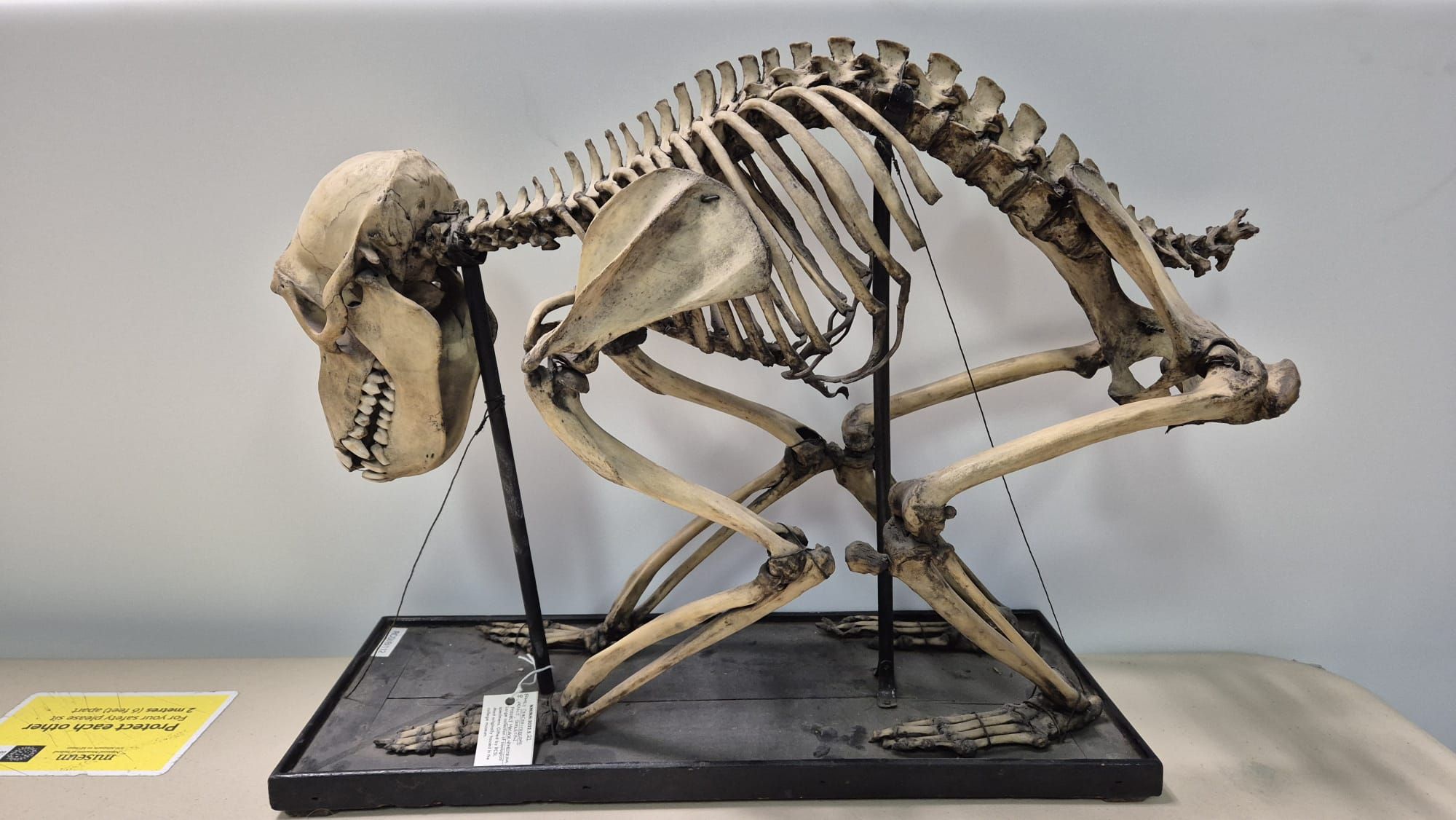
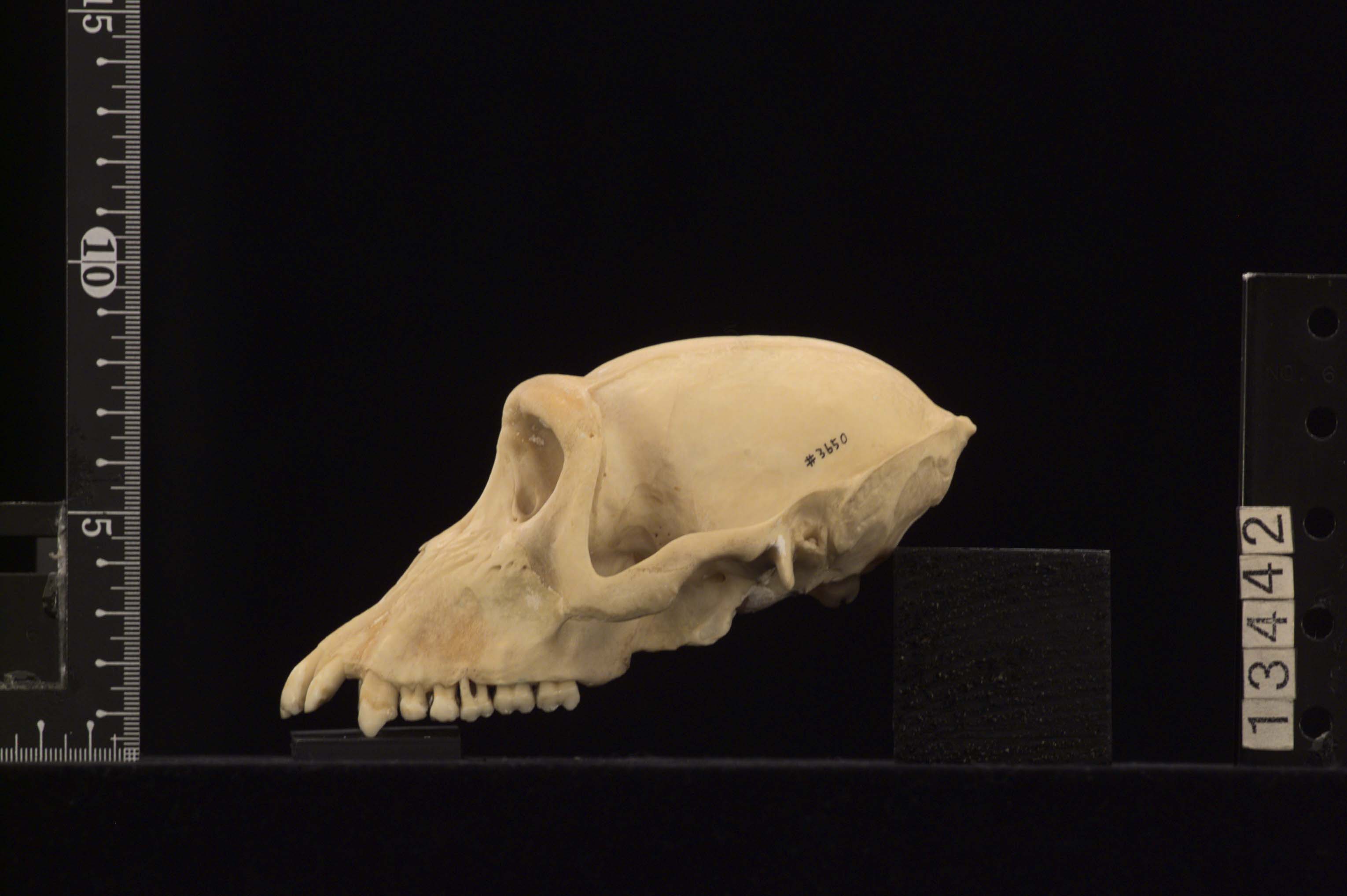
This specimen came to us from the Royal College of Surgeons of Ireland, and Emma Murphy, our curator responsible for the terrestrial zoology collections has been checking the identification. At the moment this is listed as being a “Baboon”, but there are 5 (maybe 6) species of baboon – so which could it be?
Just to complicate matters, Emma suspects that this may be a specimen referred to in an 1834 catalogue as a “pig-tailed baboon”, which may be where the “Baboon” listing came from. That’s not a recognised species anymore, they’re now called Southern Pig-tailed Macaques – or Northern Pig-tailed Macaques, since the Pig-tailed Macaques were split a decade or so ago.
Looking at the anatomy is always a good place to help work these issues out, but that requires comparative material – which is never as easy to find as you might like. However, there are some useful resources out there. A particularly good one is the Mammalian Crania Photographic Archive, and there are other useful sites like Skullbase and the Animal Diversity Web.
Looking through these various resources it becomes a bit easier to start picking out features to assist with identification, but it takes a bit of work and close scrutiny of a lot of different individuals within each species, to get a better idea of variation.
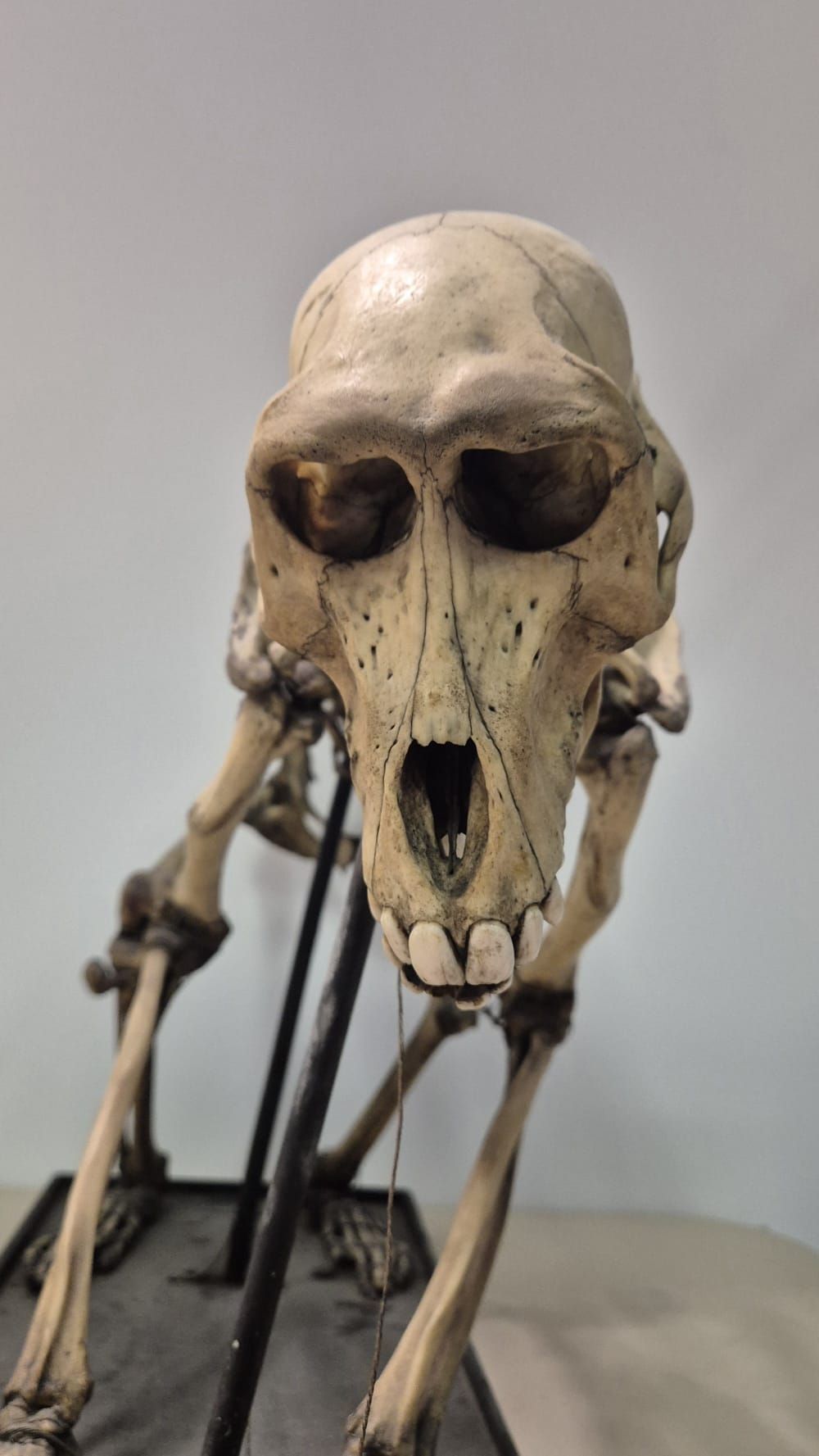
In profile the mystery specimen has relatively small canines and no sagittal crest, which suggests it’s a female. The face (or rostrum) is quite long, which rules out a lot of Macaque species, especially since the females tend to have shorter faces than males, and the females only develop the longer face when they are fully mature.
However, the baboons all have very long faces (even the females), so this specimen seems a little short for some of them. The Chacma Baboon is the closest I could find in proportion, but when viewed from above, the mystery specimen doesn’t seem to have the extremely well-defined cheek ridges that stand out in all baboon skulls (here’s a link to an example from the Animal Diversity Web).
Good cheekbones, but not the razor-ridges seen in baboons
After considerable comparison, the skull of the mystery specimen looks most similar to the skull of a Southern Pig-tailed Macaque featured on the Mammalian Crania Photographic Archive, although I feel that I want to look a little more closely at the confiuration of the nasal bones in relation to the frontals before making a final call, since photographs can sometimes be misleading.
My thanks to everyone for your suggestions – there were plenty that all fell in the same general area of the monkey family tree, with baboons and macaques all being suggested. Your thoughts helped me narrow down a list of likely candidates and on balance I suspect this is most likely the Southern (or possibly Northern) Pig-tailed Macaque specimen that Emma found the old entry for in the catalogue. It would probably have been much easier to figure out if the tail had survived intact!
Hopefully I’ll see you here next week for mystery object #501!
Well, this is a bit of a milestone – the 500th mystery object. Over 15 years’ worth of weekly posts, sharing some of the interesting objects that I’ve come across in my work, as a curator, or that have been shared with me by other people with a fascination with the natural world (particularly zoology).
This week I have a specimen from a new contributor to the blog, Emma Murphy, who is part of my curatorial team at the Dead Zoo (I’m still finding it hard to believe that I have a curatorial team!)
This specimen came to us from the Royal College of Surgeons of Ireland and we think it probably dates back to the 1830’s. As such, the identification that accompanies it is extremely out of date, so this specimen is in need of reidentification:
So, do you have any idea which species this skeleton might be from? As always, you can leave your thoughts in the comments box below – I hope it proves a fun challenge!
This week I have something a little fishy from the Dead Zoo for you to have a go at identifying:
Any thoughts as to which species this might be? As always, you can leave your questions, observations and suggestions in the comments box below – I look forward to hearing your thoughts!
Last week I gave you this mystery object to try your hand at identifying:
I picked this specimen because it’s from Ireland, but it’s not a species you might normally associate with Ireland. Plus it’s fragmentary and missing some parts that are useful for identification.
That said, after a little initial mis-step, the correct species – and indeed subspecies – identification was reached. So well done to James Bryant, Adam Yates, and Allen Hazen.
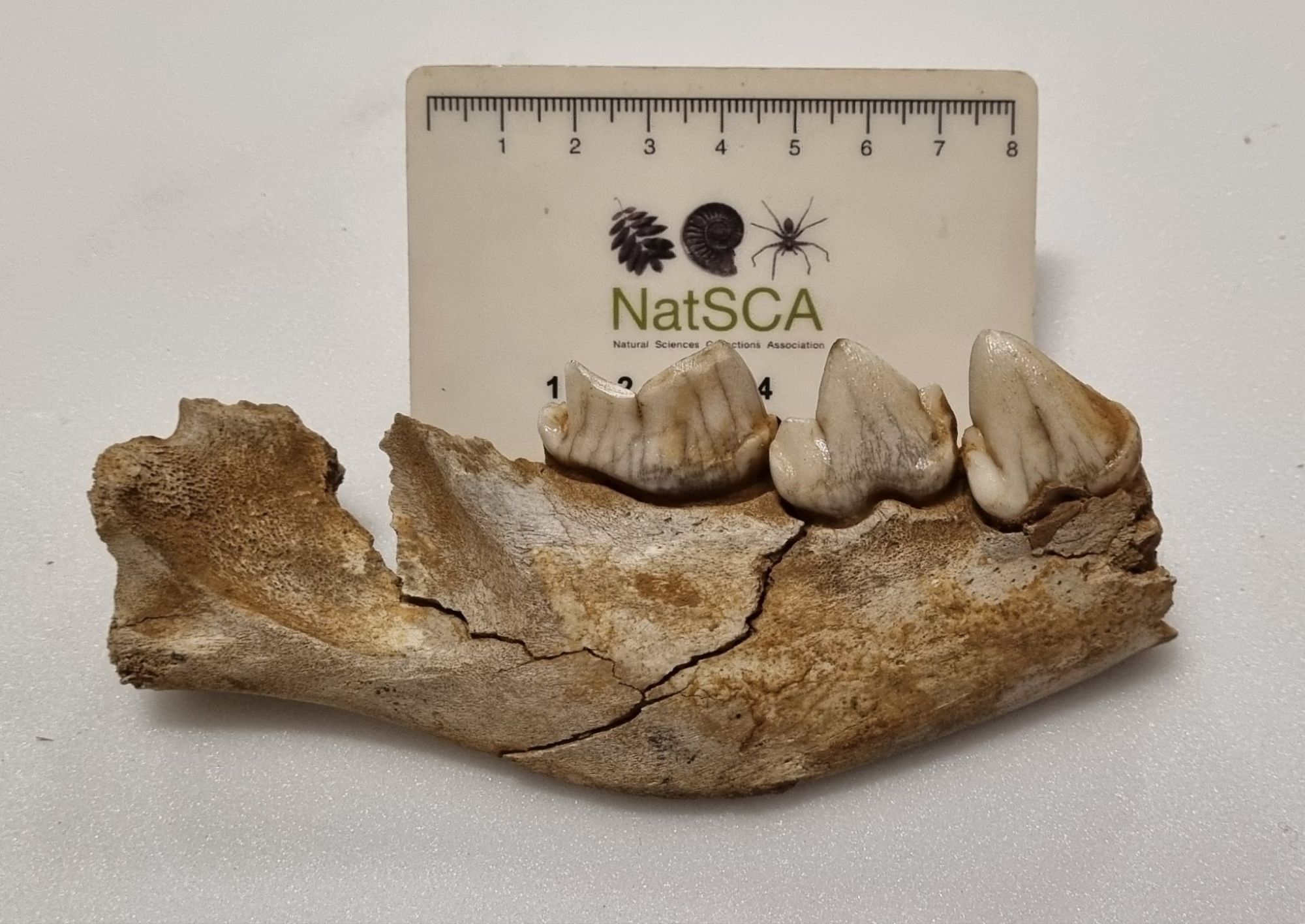
This is a section of mandible from a Cave Hyena Crocuta crocuta spelaea Goldfuss, 1823. This jaw shows just three teeth, but they are very useful teeth for identification, since they are characteristically robust, with really heavy conical premolars with well defined cingula (those ridges of enamel near the base). Perfect for smashing through bones. The curve of the jaw is also a useful clue.
The Cave Hyena was present in Ireland around 40,000 years ago we have several specimens in the Dead Zoo, mainly from Castlepook Cave in County Cork. These caves provide a rare glimpse of pre-glacial fauna, since most other sediments (and therefore fossils) from the Pleistocene period were scoured away by the glaciers of the last glacial period.
So well done to everyone who figured it out. Specimens like this provide a fantastic snapshot into the prehistory of Ireland, offering a sense of how changing climate and landscapes shape biodiversity over time.
Last week I gave you this cute little skull to identify:
This is an object I selected when I was recovering from Covid, so I picked it thinking that I knew what it said on the label and so it would be an easy one to write up an answer for. Of course, the Universe being the way it is, I came to write this answer and realised that I actually took note of the wrong label.
My brain is clearly still not fully recovered from being ill, so now comes the complicated bit where I have to work out what it is, with no more information than I gave you, since I’m writing this answer at home and I don’t have access to either the specimen or our database.
Fortunately a lot of that work has already been done by the wonderful regular visitors to Zygoma (thanks folks!)
This is one of the diminutive Artiodactyls. It has neither horns nor antlers (although the specimen is female, so those might not be present even if the males of the species had them). It lacks scars from scent glands, so it’s not a Dik-dik or other tiny antelope. However, it does have small but prominent canines, which offer a clue. As Chris Jarvis suggested, this is the skull of a Mouse-deer, in the family Tragulidae.
There are three possible Genera in the family, but a quick check against specimens from the Genus Hyemoschus show some clear differences – both in general proportions of rostrum (snouty bit), the number of foramina in the front part of the mandible (Hyemoschus normally have two, but our mystery specimen has just one).
There are also differences in comparison with specimens in the Genus Moschiola – which seem to more usually have two foramina in the maxilla and a somwhat open suture at the junction between the bones of the maxilla, frontal and nasal bones.
That leaves the Genus Tragulus, which the mystery skull fits with very well.
It all gets a bit more complicated from there. In terms of size, I think we can rule out the Greater Mouse-deer since the mystery skull is about 2cm shorter that an example of the Greater Mouse-deer that I featured on the blog about 12 years ago (where doe the time go?):
This size difference is not a perfect characteristic to use, since the skull length can overlap between the species, but the mystery specimen has all the indicators of being a mature adult and it would still be at the absolute smallest end of the spectrum for the Greater Mouse-deer.
Distinguishing between the other possible species is more problematic, since there can be quite a lot of regional variation within the remaining species. From looking at examples of skulls online I’m leaning towards the Lesser Mouse-deer rather than the Java, Philippine, Vietnam or Williamson’s Mouse-deer, but that’s based on the structre of the zygomatric arch and general proportions rather than any clearly distinctive features.
In this instance I can at least check my hunch tomorrow on our museum database, to see if my hunch plays out – I’ll update this answer with the result as soon as I have a chance!
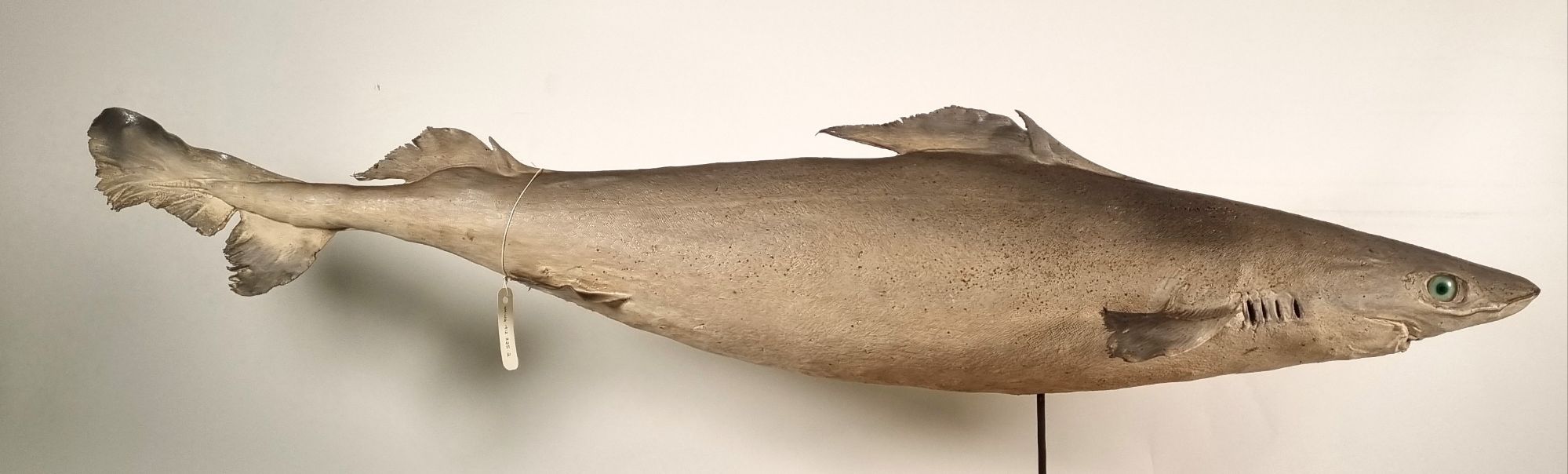
[Update: I’ve had a chance to check and my hunch was off – it’s listed as Java Mouse-deer Tragulus javanicus (Osbeck, 1765), so it goes to show that you do need those clearly distinctive features to get a good identification! This is why it’s better to rule out what it can’t be based on the data available and be happy with having a few possibile options, rather than making a misidentiifcation]
Thanks to everyone who had a stab at the identification – I hope you enjoyed the challenge!
This week we have a handsome specimen from the Dead Zoo for you to have a go at identifying:
Any idea which specie species this specimen might be? As always, you can leave your thoughts, questions and suggestions in the comments section below. Have fun!
This week I have a nice skull for you to have a go at identifying:
This specimen is around 52cm long and it had an incorrect label attached, so it needed to be identified, to work out what its correct label should be. What do you think?
As always, you can leave your thoughts, questions and suggestions in the comments box below. I hope you enjoy the challenge!
Last week I gave you this chunky chewer to try and identify:
It wasn’t the easiest challenge, since it’s clearly a rodent, and rodents are the most diverse Order of mammals, with over two thousand species. Not only that, but this specimen is badly faded – if you’re a regular reader of my blog you’ll know that’s a recurring theme for specimens from the Dead Zoo, due to the natural light that illuminated the space for over a century and a half.
However, to get started it’s worth taking a look at the size and overall shape of the specimen:
It has a shortish tail, short legs and a fairly long and cylindrical body. It also has tiny eyes, tiny ears, and incisors that protrude beyond the lips. These are all features that are common to rodents that have evolved to have a specialist fossorial (or burrowing) lifestyle, where digging is done with the teeth and usually it’s a way of getting to plant roots and tubers growing underground.
The obvious examples of rodents with a lifestyle matching this would be species like Gophers, the Naked Mole-rat, the somewhat-related blesmols (a group of African Mole-rats), the unrelated Blind Mole-rats and some of their relatives in the Family Spalacidae. All of these similar looking animals have converged on a body form that works for their way of life, but there is a key feature to help work out which of these groups of fossorial rodents to look at – the size.
Many burrowers (and most rodents in general) tend to be on the smaller side, but this specimen is around 50cm long – and that’s not including its tail. It may not quite be up there with rodent giants like the Capybara, but you could certainly consider it to be a fossorial rodent of an unusual size.
Hopefully, that should be all the additional information needed to narrow this species down to the Large Bamboo Rat Rhizomys sumatrensis (Raffles, 1821), a possible inspiration for Sir Arthur Conan Doyle’s mention of the Giant Rat of Sumatra (which I suspect in turn may have influenced William Goldman in his creation of the R.O.U.S.’s in the Princess Bride).
The Large Bamboo Rat feeds mainly, and perhaps unsurprisingly, on bamboo roots. They do also take other food, such as the roots of other plants and sometimes fruit and nuts that they find when on the surface, since they are less fussy about emerging from underground than some of the more dedicatedly fossorial rodents.
Of course, by emerging it does make them more likey to be eaten by predators, and given their large size, humans count in that number. However, one interesting thing to note about this species from Southeast Asia is that they are known to carry a bacterium that can be particularly problematic for people with immunodeficiency issues, particularly HIV/AIDS, so eating them can have its problems.
This week I have an handsome specimen from the Dead Zoo for your identification delectation:
Any idea of the species of this delightful critter? You can leave your thoughts, questions, and suggestions in the comments box below. Have fun with it!
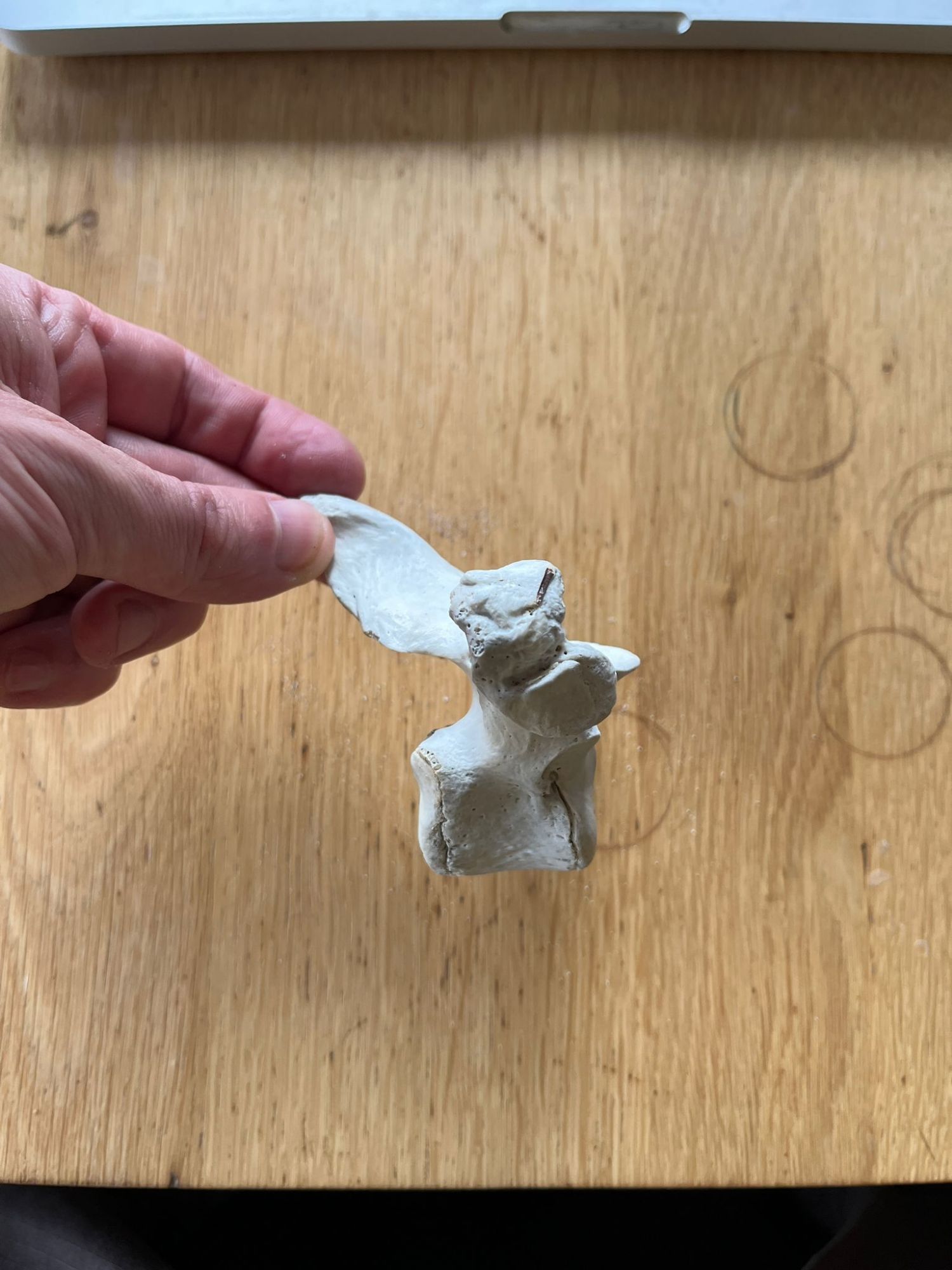
Last week I gave you this sturdy shoulder from a specimen in the Dead Zoo to try your hand at identifying:
It’s big, chunky and definitely not something you’re likely to find while digging in your garden.
The size might suggest something like a horse or cow, but it’s far too broad for either. The shape is a little more like a pig scapula, but as Sallie Reynolds pointed out, pigs have a more strongly curved scapular spine (the ridge of bone that sticks up along the middle). Plus pigs are a good bit smaller – this is a big scapula.
Rhinos have scapulae that are quite long and narrow – similar to a horse’s, and elephants have a very differently shaped shoulder:
Cetacean shoulders tend to be much more flattened and usually more circular, so it’s not one of them either. It is, however, from a distant cousin.
This is the scapula of a Hippo Hippopotamus amphibius Linnaeus, 1758.
Hippos used to be considered closer relatives of pigs and members of the Suborder Suina, but the discovery of the fossil whale Pakicetus in 1981 and various genetic studies over the last couple of decades have revealed that whales and hippos share a common ancestor and they have been grouped together in the Suborder Whippomorpha.
So well done to Adam Yates who dropped an equine hint about the source of this shoulderblade – since Hippopotamus does of course translate to “river horse”. I hope you enjoyed the challenge – there will be another next Friday!
Last week I gave you this specimen to identify, from the collections of the Dead Zoo:
I thought it might prove a little challenging, and I wasn’t mistaken, although some people did manage to get very close. Chris Jervis was the first, but Adam Yates also provided a nice analysis of the specimen:
It is blade shaped without cusps, so the incisor of a large animal seems possible (I’m ruling out a Thylacoleo premolar on the basis of the broad wear facet on the occlusal surface and single root).
The root is really short so I’m guessing its a deciduous incisor.
Horses are large mammals with incisors of this sort of shape. If it were a horse it would be a third incisor because of its less square crown. As the high point (presumed mesial side) is on the left side it is probably a right incisor.
So my guess is a right deciduous incisor three of a horse.
Adam then followed up with a note about the size being too big for a horse, and leaned in to Chris Jervis’ suggestion – a good decision.
So what is it?
This is in fact the upper right incisor (or tusk) from the skull of an Indian Rhinoceros Rhinoceros unicornis Linnaeus, 1758:
African rhino species have lost their incisors, but the Indian Rhinoceros have incisors that form self-sharpening tusks with open roots, which are used in fighting.
The full specimen that this is from is a mounted skeleton that was on display in the Dead Zoo for a century or so, and the animal clearly had a very tough life, as it shows a variety of pathologies that have healed.
In the mandible there is a huge abscess at the base of the lower right tusk, possibly due to fighting or maybe a bullet wound:
The animal also has a variety of other injuries, including a bullet wound in the ribs:
and a major trauma to the lower front left leg, which has resulted in the humerus and ulna fusing together:
I have these photos of the specimen as over the last couple of weeks we have started the decant of specimens from the Dead Zoo in earnest, as we’re getting moving on a major capital developement project in the Museum, to solve a number of issues with access for the public, problems with the museum environment, and conservation of the 168 year old building.
Stay tuned for more updates on the project, as I suspect it will be keeping me busy for the next few years!