This week I have a new specimen (well, specimens) to the Dead Zoo for you to have a go at identifying:
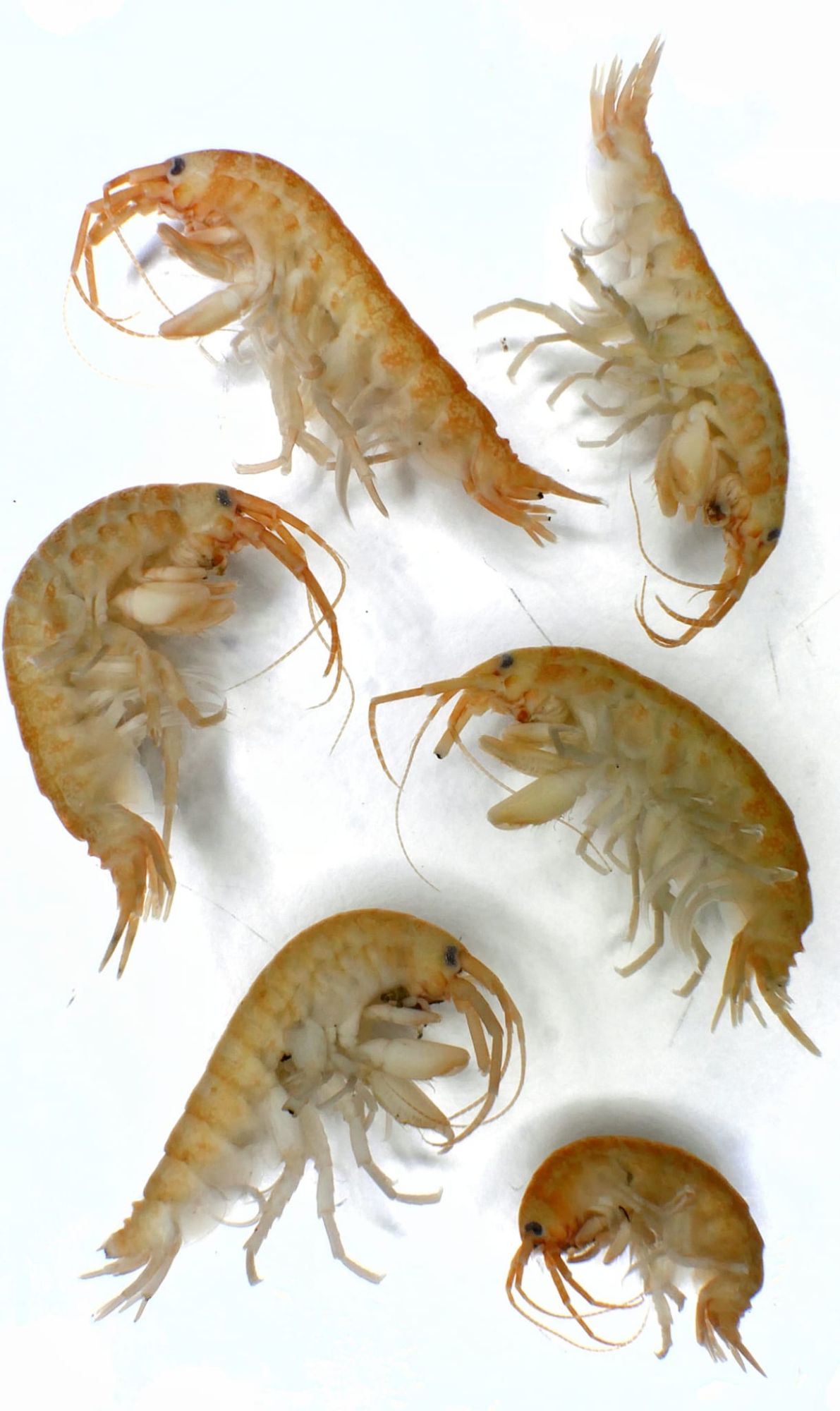
Any idea what these little critters could be? I look forward to hearing your thoughts!

This week I have a new specimen (well, specimens) to the Dead Zoo for you to have a go at identifying:
Any idea what these little critters could be? I look forward to hearing your thoughts!
Last week I gave you this skull from the collections of the Dead Zoo to have a go at identifying:
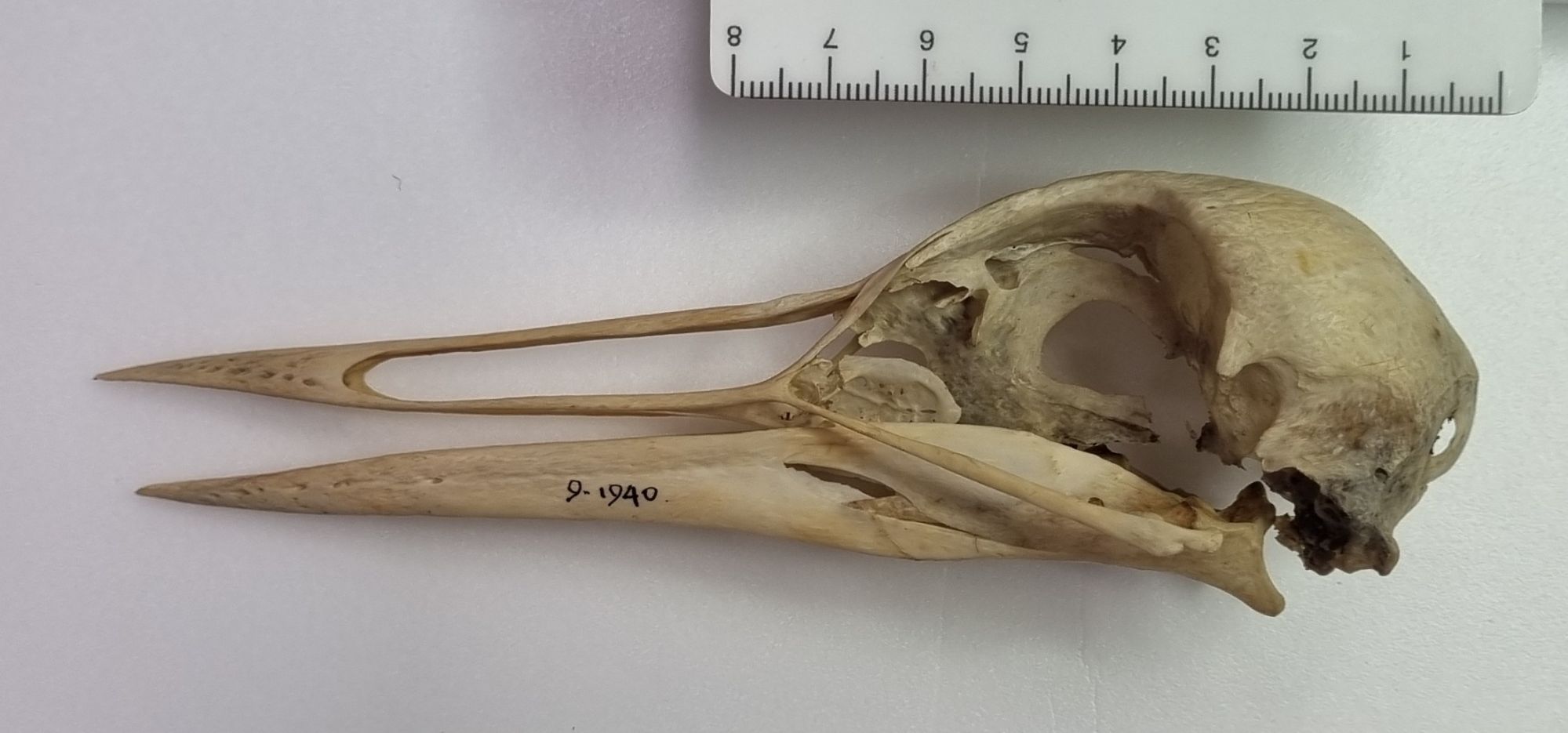
Bird skull identification can take a bit of work, until you get your eye in on things like the bill morphology (especially without the clues provided by the keratin sheath). Resources like the excellent Skullsite.com certainly help a lot, by providing a huge range of images of different species for comparison, and with tools to help narrow down options based on skull size and bill morphology.
As it turns out, Adam Yates certainly had his eye in, and he was first to comment with a correct identification for this specimen. It’s a Common or European Crane Grus grus (Linnaeus, 1758).
I chose this specimen as it’s one that we recently put on display in the Dead Zoo Lab as part of a community curated project called Our Irish Natural History. Eight community groups involved with iCAN (the Irish Community Archive Network) contributed to the work, which was coordinated by Adriana Ballinger – a fantastic postgraduate humanities researcher who has been working with us for the past year on a project with a focus on the wider cultural context surrounding natural history collections. The community groups involved each explored a different areas of interest, illustrating and exploring some of the connections between objects and local communities.
The Common Crane offered a fascinating topic explored by the Woodlawn Heritage Group and Galway Community Archaeology, who delved into the past history of the Crane in Ireland, and its importance to Bronze Age people, also touching on their recent return, with a pair of these fantastic birds recently recorded nesting in rewetted boglands. There’s too much information for me to cover it all here, so I recommend taking a look at the work for yourself on the Galway Community Archaeology web resource about the project.
These sorts of projects, that connect our ostensibly scientific objects back into local communities through a cultural link are a fantastic way to broaden the relevance and interest in our collections. As a scientist it can be easy to focus on one aspect of an object – but every item we look after can be viewed from multiple perspectives – all of which add value and relevance.
I look forward to working on similar projects in the future, while hopefully taking the opportunity to share more of the collection here, for those of you with an interest in identification!
For this week’s mystery object, I have a skull from the collections of the Dead Zoo to test your identification skills:

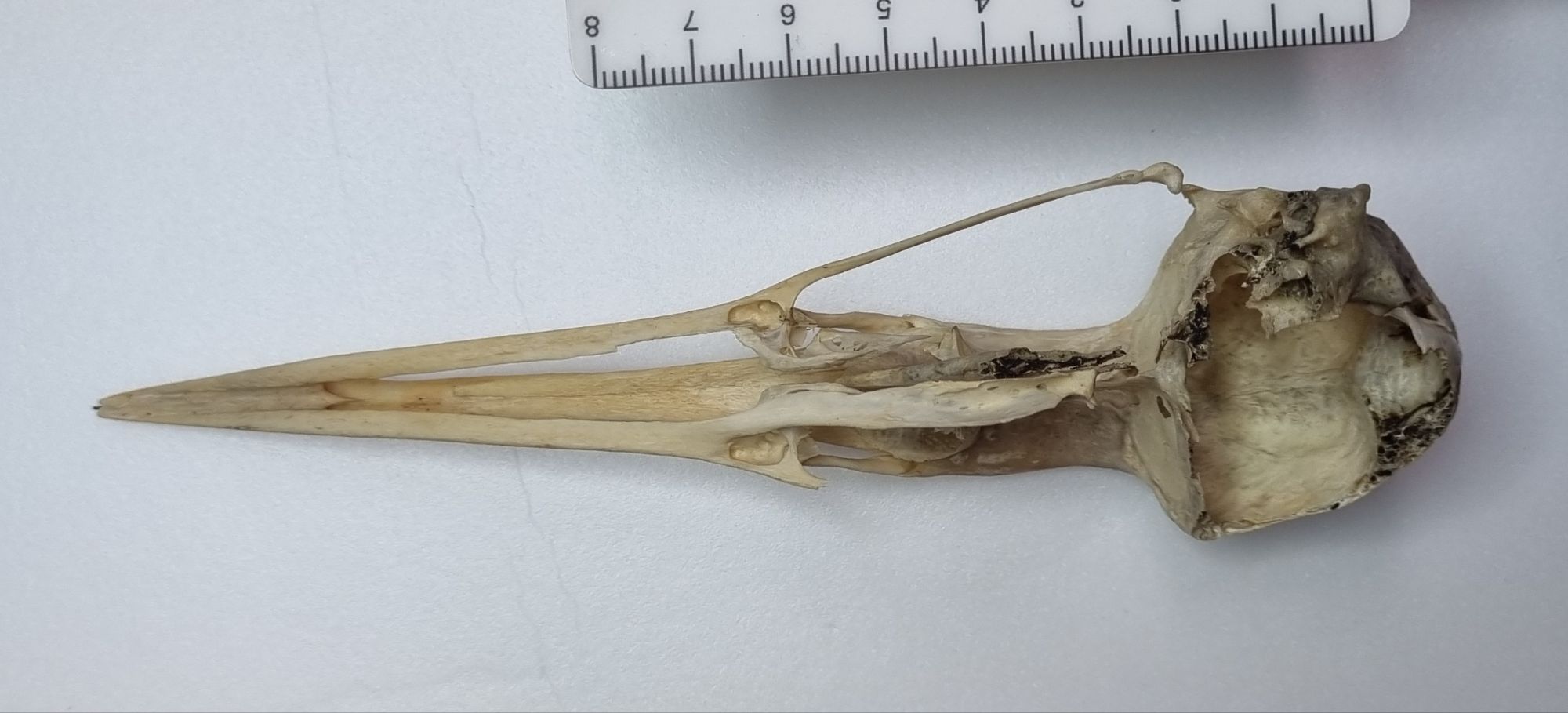
I look forward to hearing what you think it might be. Have fun with it!
Last week I gave you this mystery mandible to help me identify:
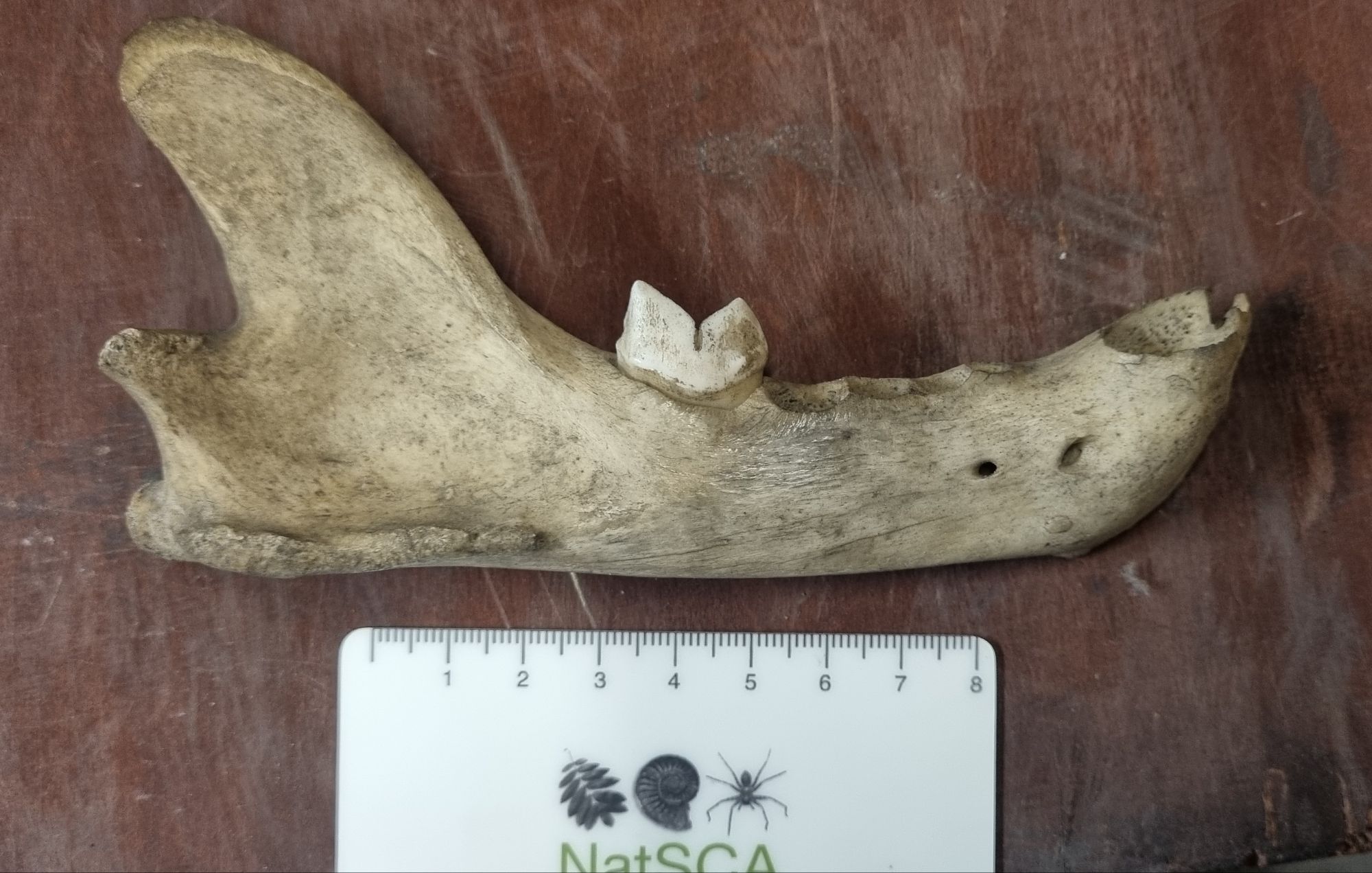
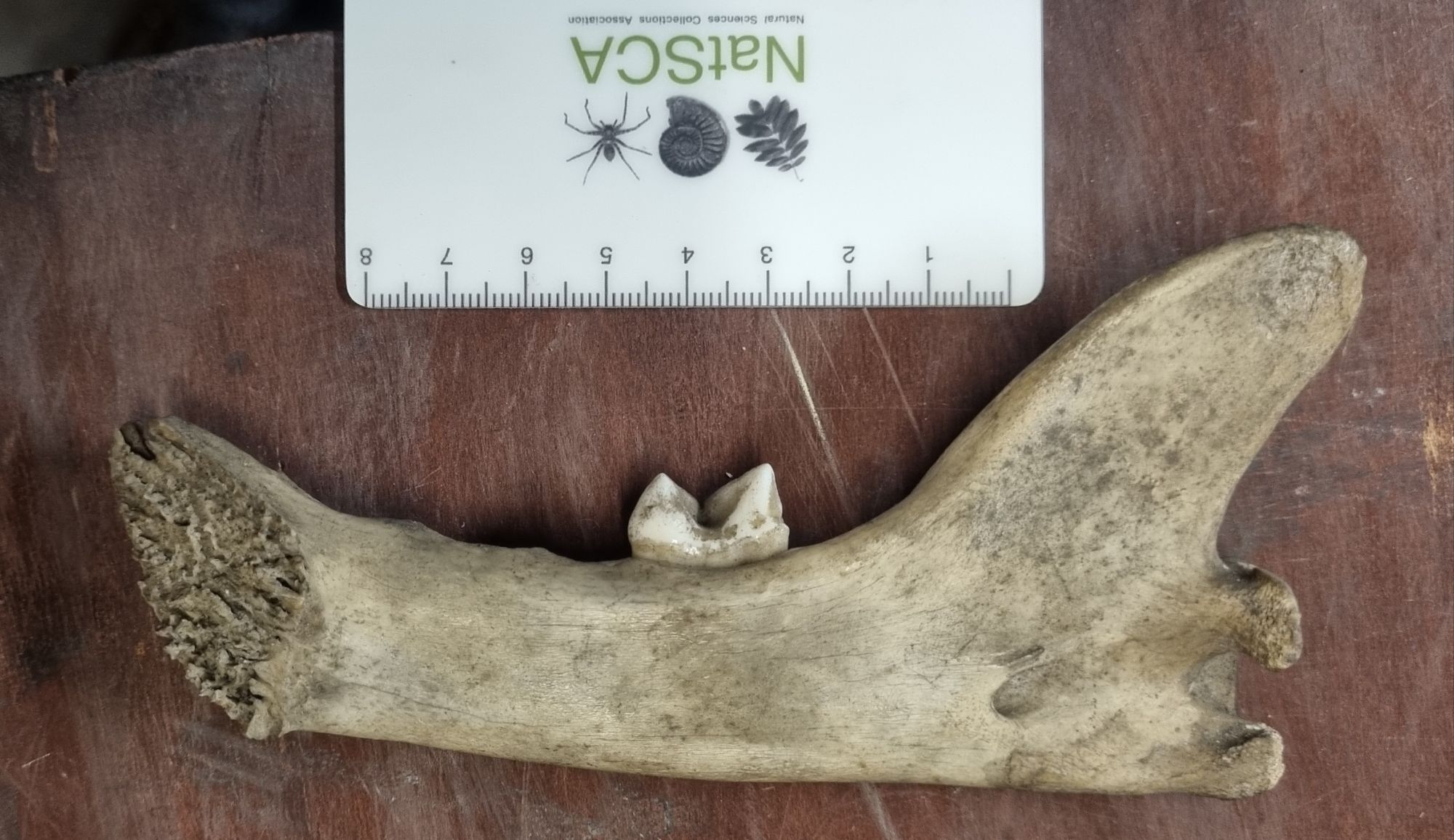
It was found in a box of mixed shells and bony fragments, with no label, and nothing to offer a clue to its origin. This is very unusual, since these sorts of boxes of miscellany were mainly addressed years ago, but this one was well tucked away and somehow escaped being dealt with.
It’s fairly easy to recognise this as being the right mandible of some kind of cat. The Felidae have a reduced tooth count, with those hyper-carnivorous bladed premolars forming a meat-shearing carnassial row that’s very distinctive. So that’s the easy bit done.
The hard bit comes next, since the cats all share this same dental configuration, making the specific kitty in question a bit harder to narrow down. However, the size is a useful clue. This is much too big to be something like a Domestic Cat, Serval or Ocelot, but it’s also too small to be one of the big Big Cats – like the Lion or Tiger:

This leaves some of the medium-large Big Cats and perhaps a very large Small Cat (i.e. the Cheetah). Let’s start by ruling out that last one – the size is still a bit on the big side, but also the Cheetah has a more gracile coronoid process that curves, and a relatively shorter toothrow. Pumas also have a more rounded coronoid process.
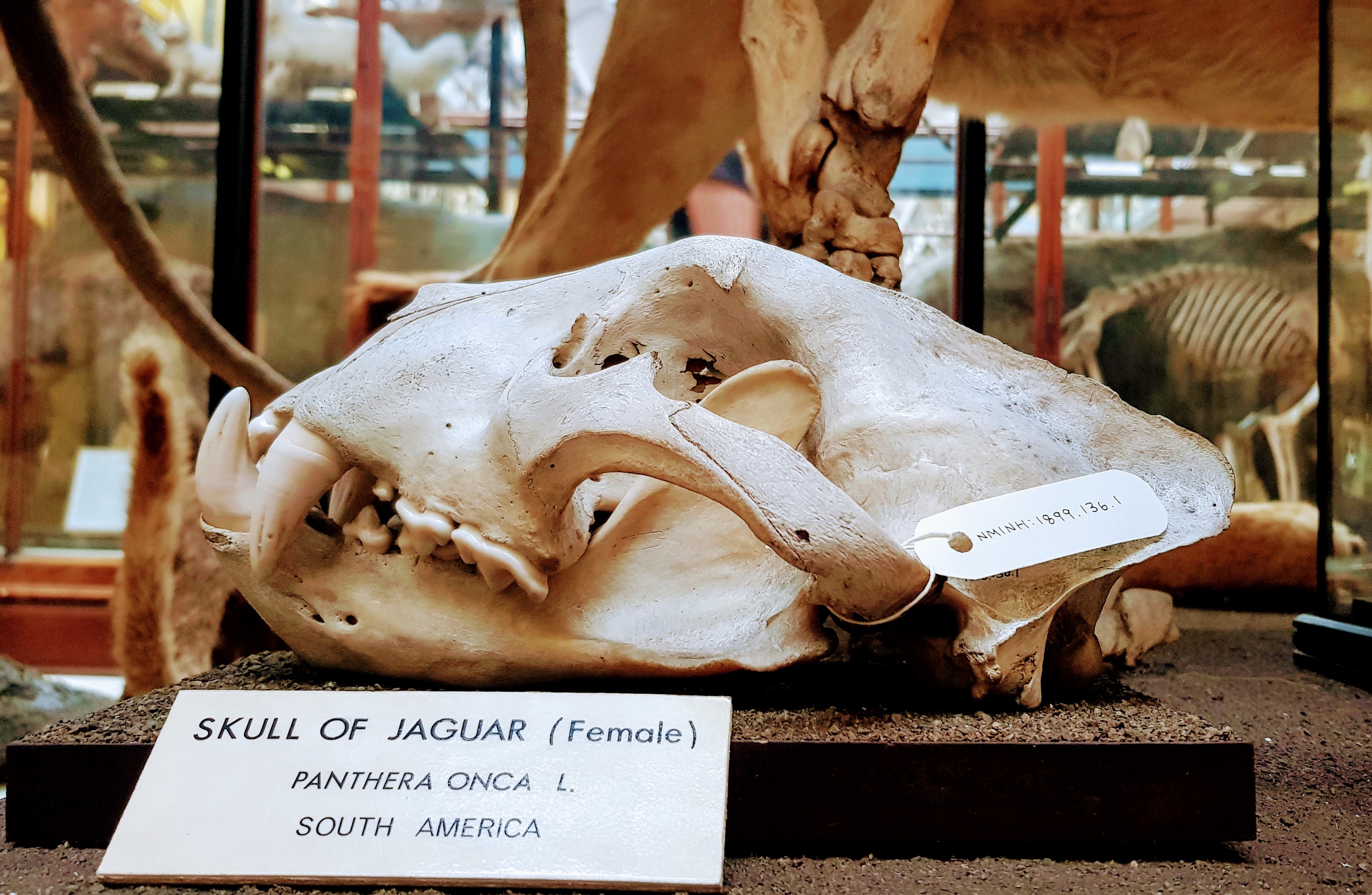
The Jaguar also has a more rounded coronoid process, and has a more robust mandible, that’s just built thicker to deal with the high bite forces these cats generate:
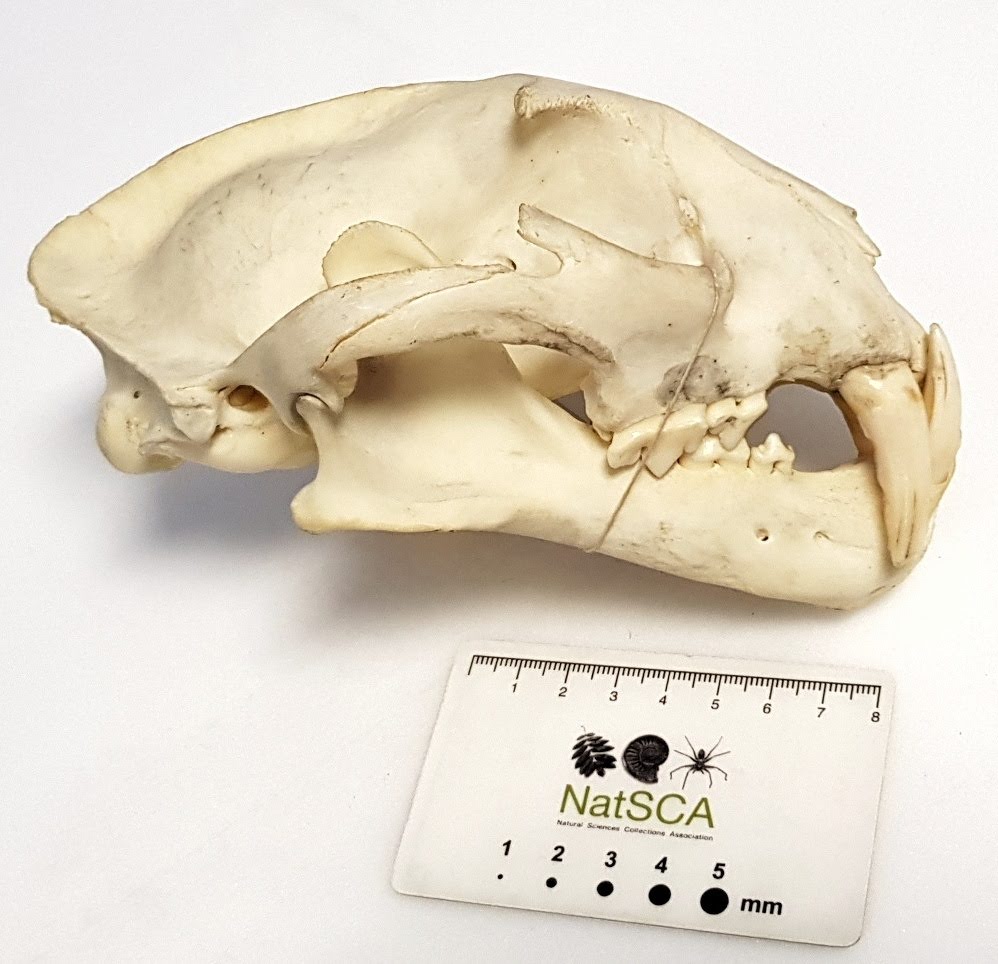
That leaves us with the Snow Leopard and the not-snow-Leopard, both of which have the more pointed coroid process that we see in the mystery object. However, the Snow Leopard has downwards inflected angular process, that’sI suspect may relate to the increased gape needed to use the excessively long canine teeth in this species:
So, by a process of elimination, we’re left with Leopard Pathera pardus (Linneaus, 1758). This species varies significantly in size and the morphology can be quite variable, since the species has a wide distribution, from Eastern Russia to as far West as Senegal.
This actually reminds me of a very similar mystery object from the Grant Museum of Zoology that I shared 10 years ago, so I’ hope that provided something useful for reference so I’m glad I trawled through some of my past posts to help solve this one. My thanks to everyone who offered their thoughts on this one – it’s great to see so many of you come to the same conclusion!
This week I have a genuine mystery object for you, found in an unmarked box in the depths of the Dead Zoo:
It’s not too tricky, but hopefully it’ll prove interesting to work out. Have fun!
Last week I presented this mystery bone from the Words on the Wave exhibition at the National Museum of Ireland on Kildare Street:
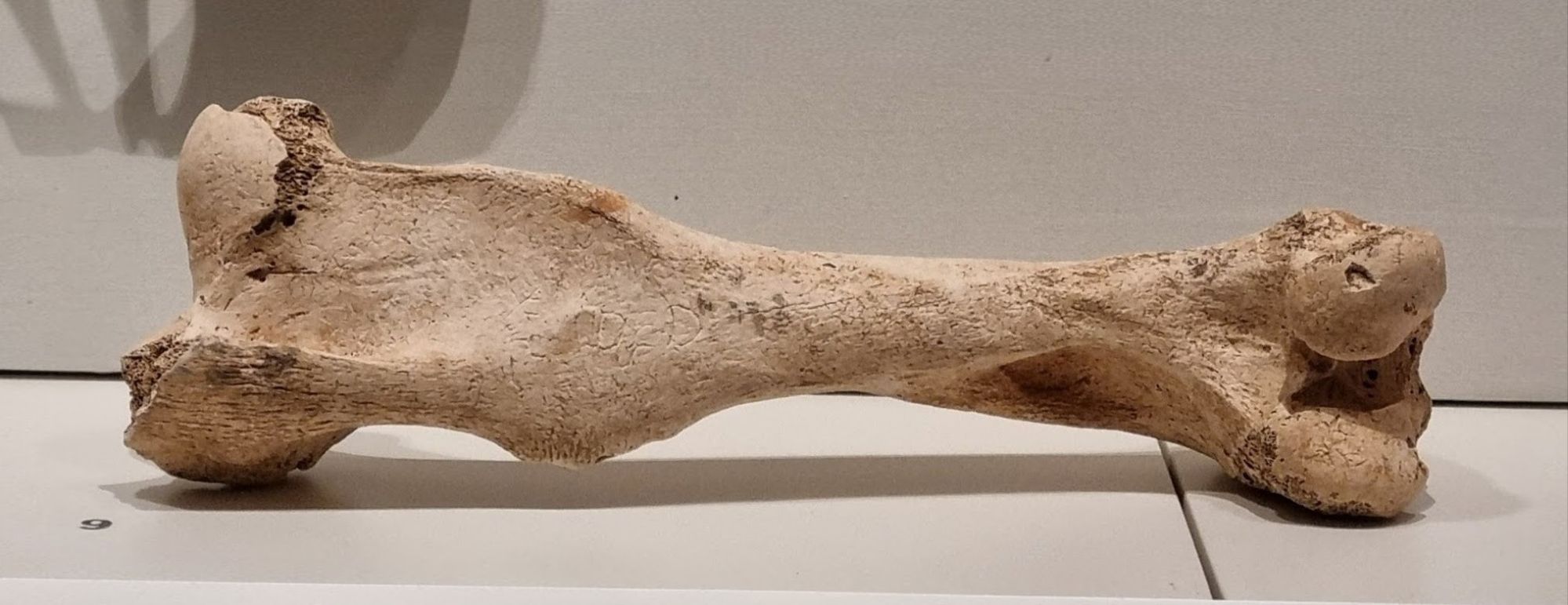
The bone is over a thousand years old, so it’s unsurprising that a few of the processes that could be useful for identification have been worn down a little:

That said, there was plenty of information remaining to allow several of you to identify the animal, bone type and side of the animal this is from. Adam Yates was first to the comments and he also left a very helpful Toot on Mastodon, detailing the diagnostic features:

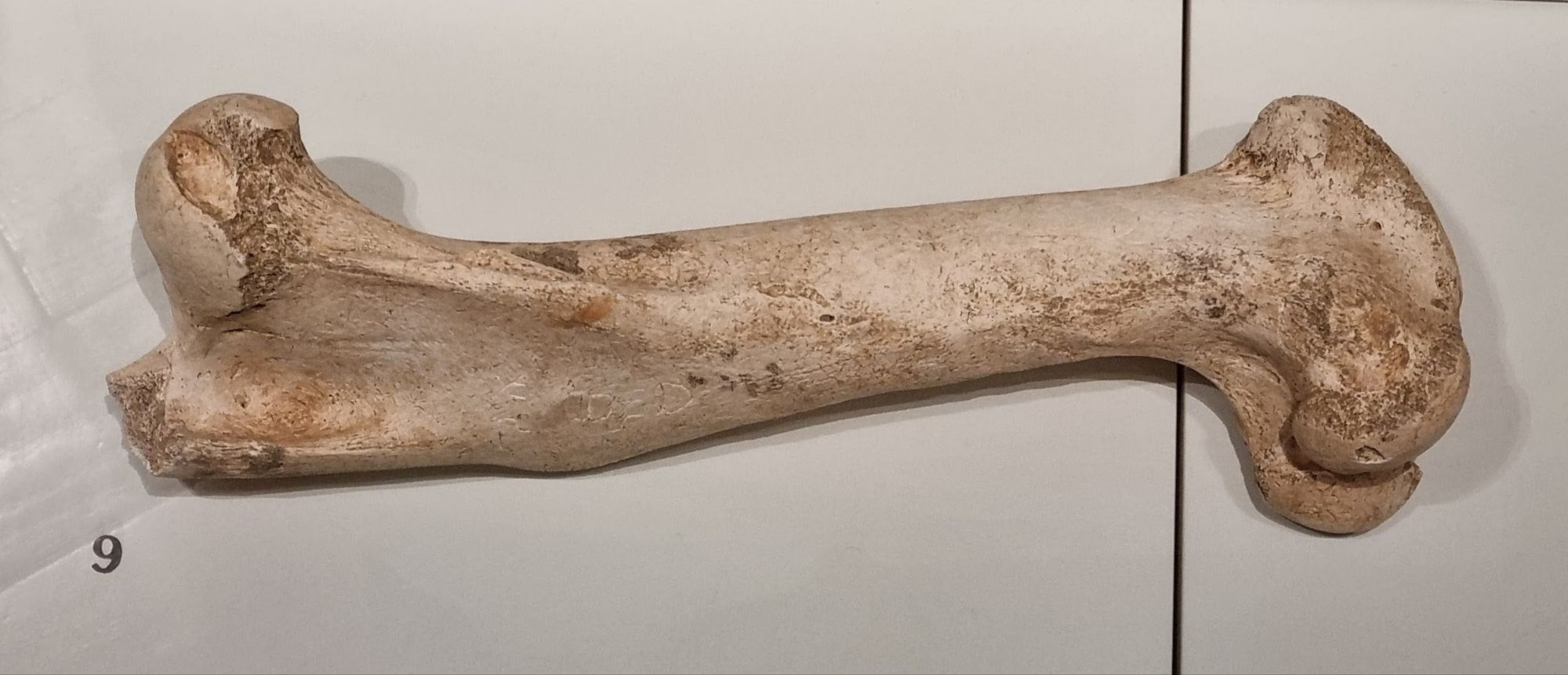
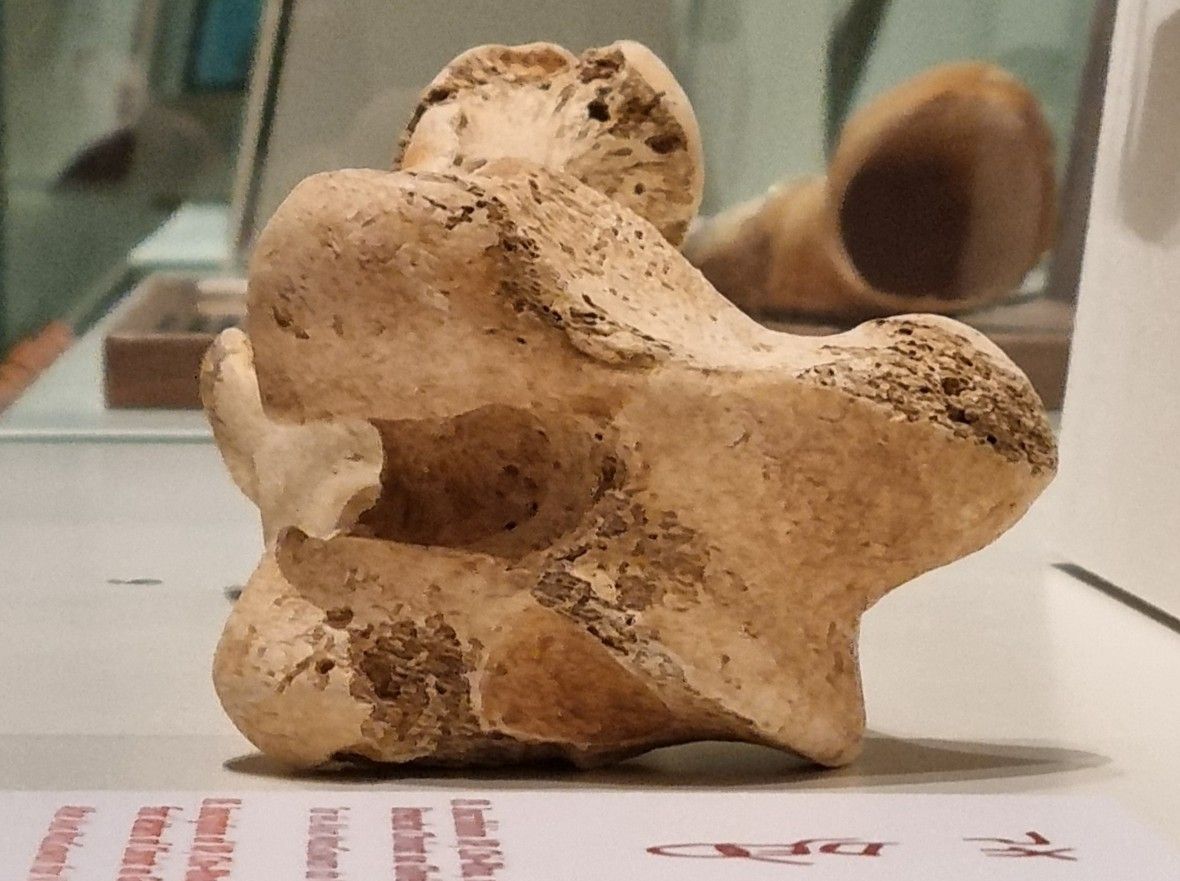
For me, the supracondylar fossa on the lateral caudal surface is the instant give-away. For those who don’t speak anatomese, that’s the bit that flares out from the side of the shaft of the bone (which is actually missing a bit in this example).
This is a feature I always associate with the Perissodactyla (the tapirs, rhinos and horses), and this one is nowhere near robust enough for anything other than one of the horses. It’s also fairly small (although the lack of a scale bar doesn’t make this obvious).
This a left femur that I suspect is from a Horse Equus ferus caballus Linnaeus, 1758, but it could also be from a Donkey Equus africanus asinus Linnaeus, 1758. It can be tricky to tell these species apart, especially when the bone is a little worn down and you only have a few photos to work from – so best to err on the side of caution and leave it at an identification of Equus sp.
If you’re in Ireland and wanted to take a look at this object – and a selection of remarkable mediaeval manuscripts from the Abbey of St Gall, Switzerland, some of which are returning to Ireland for the first time in 1000 years – you have until the 24th of this month, I’d definitely recommend it!
This week I have another bony mystery object for you:
This one is currently on display in the beautiful Words on the Wave exhibition at the National Museum of Ireland on Kildare Street, but the focus is on the inscription on the bone, rather than the species the bone came from:

So, I’d love to hear your thoughts on what this is? Have fun with it!
Last week I had a genuine mystery object for you to identify that was freshly dug out of the ground:
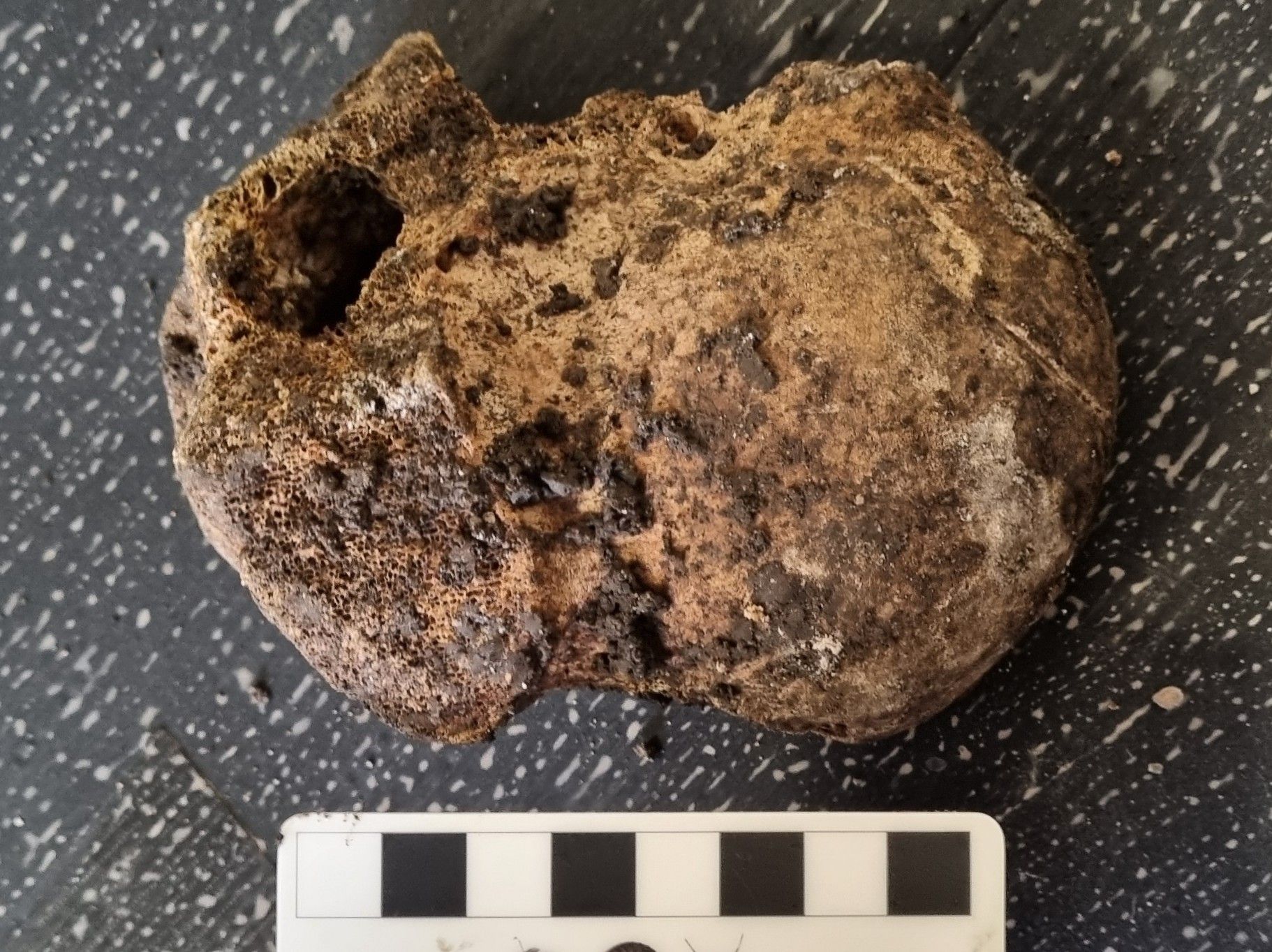
While there were a few suggestions of baked goods on social media, plenty of you spotted what it actually is – with a nod to Adam Yates who was first with the correct identification.
The side view is probably the most useful for setting context, as it shows the smooth curve of the head of an articular surface, with an adjacent tuberosity (or sticky-up-bit, if you prefer):
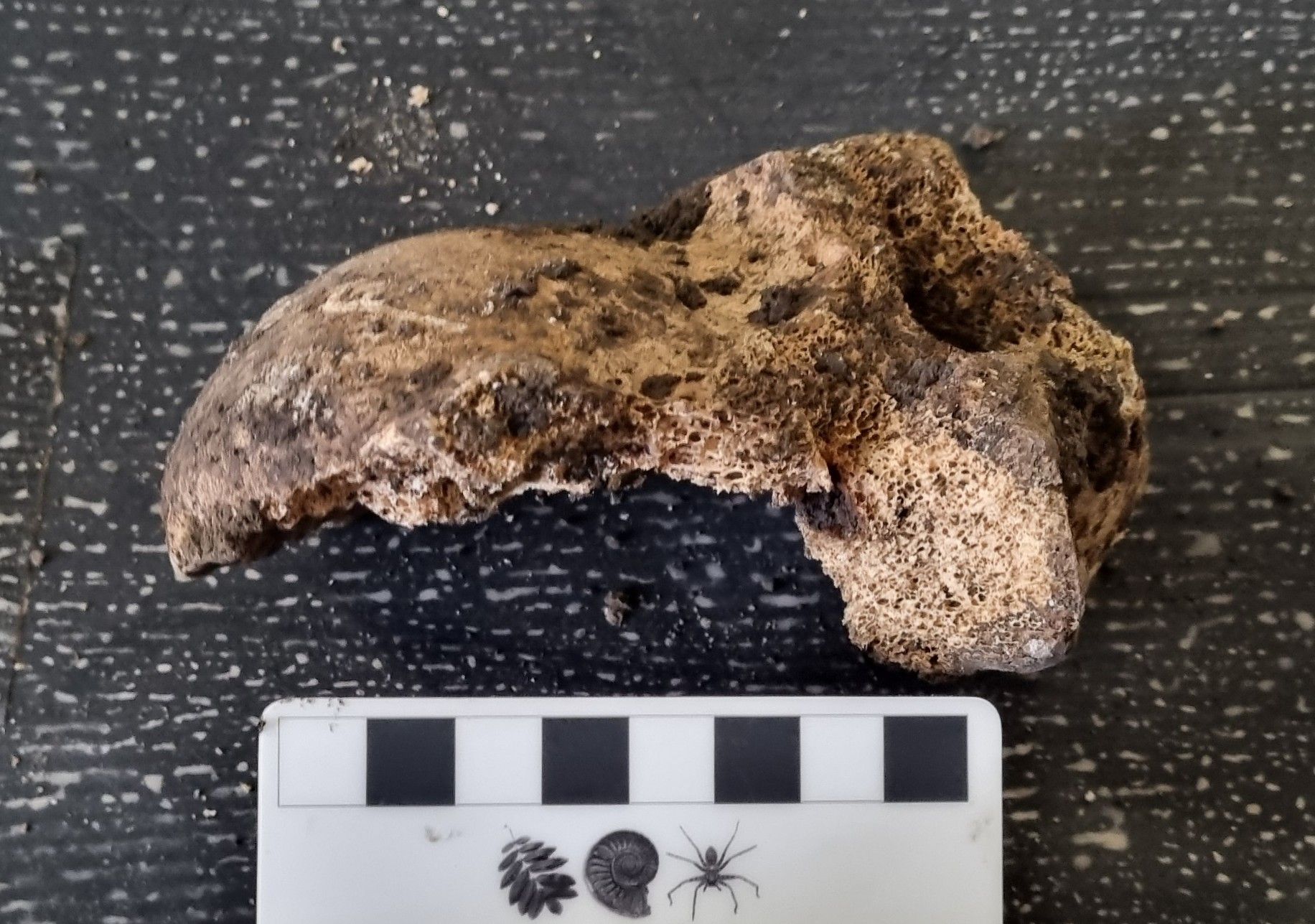
This is what you expect to see at the proximal end of a humerus (that’s bit that works with the shoulder). It’s pretty big – the scale bar is 8cm and the head of this humerus is a good bit wider across, so that also tells us something.
Another key observation comes from the underside of the humerus head:

You can just make out a rugose pattern on the underside of this piece of bone, which tells us that this is an unfused epiphysis that has become detached from the rest of the humerus. That means the animal that this piece of bone came from was young enough to still be growing, as the bones hadn’t fused.
All of that information leads us to the conclusion that the animal this piece of humerus came from was large, but still young. For me, that says that this humerus is from a Cow Bos taurus Linnaeus, 1758.
I suspect this mystery object represents the remains of a Victorian meal, based on where it was found – just under the floor of the Dead Zoo. It came to light during the investigation works on the building, which are currently underway. The building work started in 1856, so that gives us a good idea of when this beef shoulder was probably eaten.
This week’s mystery object is a return to bony form, with a genuine mystery object dug straight out of the ground:
Any idea what this could be? I’m keen to hear your thoughts in the comments below – I hope you have fun with it!
Last week I gave you this colourful chap to have a go at identifying:
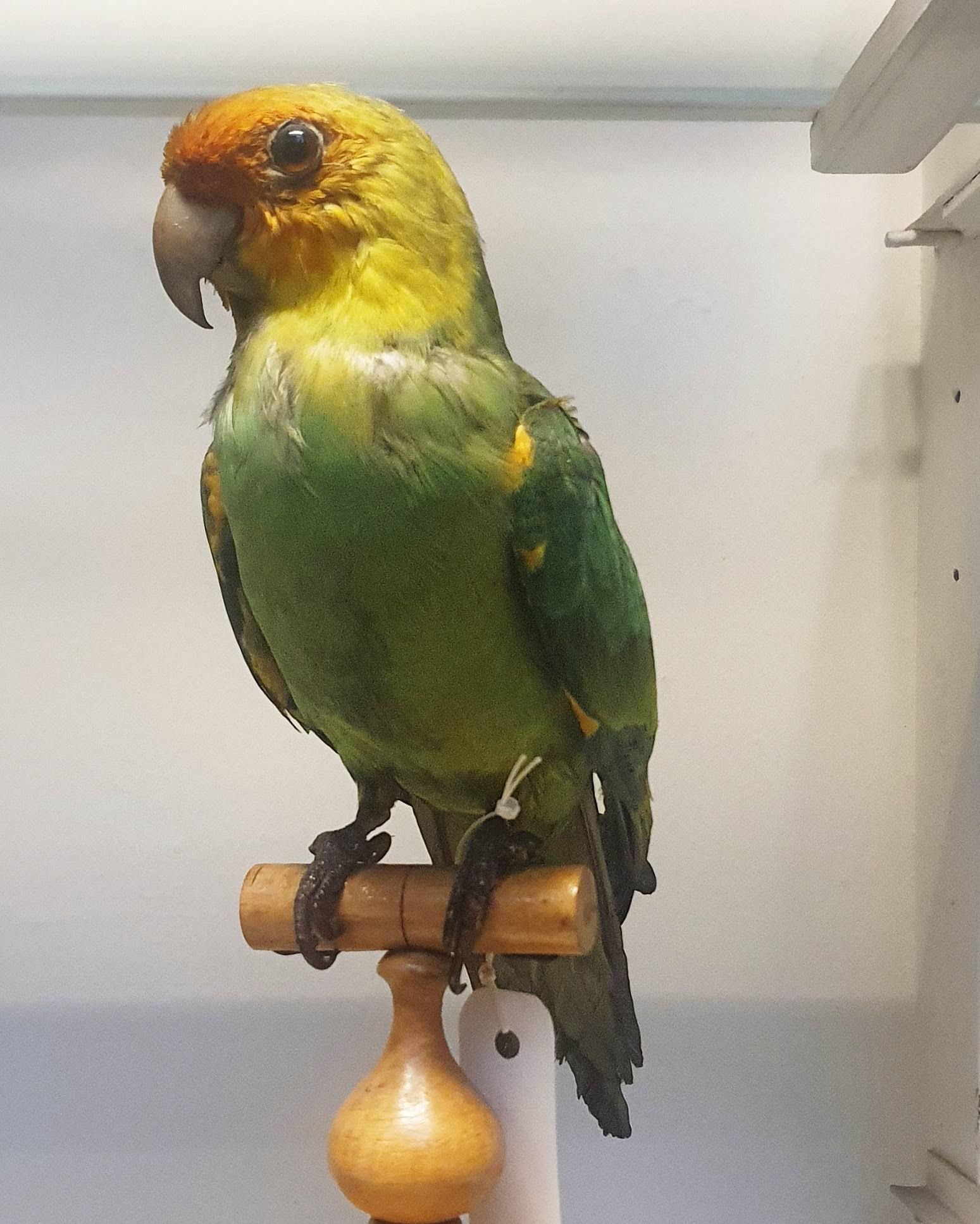
As I mentioned in the previous mystery object answer, parrots can be hard to identify due to the large number of species globally. However, this time the specimen posed no problems for people to identify – perhaps unsurprisingly, given its importance.
Chris Jarvis was first in the door with the correct answer – a nice cryptic clue using the Seminole name for the species:
What a Puzz ila!
Other clues came thick and fast, but they all pointed to this yellow-headed, orange-faced bird being the now extinct Carolina Parakeet Conuropsis carolinensis (Linnaeus, 1758).
This colourful small parrot weighed in at around 100g and hung around in large flocks of up to 300 birds. Until the middle of the 19th Century they were commonplace in swampy forest habitats in parts of North America. The main resident population was in Florida although their range spread northwards along the marshes of the East coast (into the Carolinas) and westwards along the Gulf of Mexico just into Louisana.
A subspecies of the Carolina Parakeet (C. c. ludovicianus) also occurred in much of the Midwest and as far south as the top of Texas and as far north as the bottom of New York state. This subspecies had bodies that were more blue, but they disappeared alongside their greener sibling subspecies by the beginning of the 20th Century.

It seems likely that the usual culprits played a role in the extinction of North America’s only endemic parrot – habitat loss and overhunting. Swamps were drained and forests cleared to make way for agricultural land, the birds were then shot for feeding on crops, and their beautiful plumage made the birds a target to supply the feather-forward fashions of the time.
While most of the shooting stopped before the birds went extinct, as people started to recognise the risk of extinction (especially in the context of the Passenger Pigeon that was being eradicated at around the same time), the last small wild population was vulnerable and it has been suggested that they were finally wiped out by an avian disease.
While a few stragglers likely remained living wild in the Florida swamps until the 1930s, the last known Carolina Parakeet (a male named Incas) died in Cincinati Zoo in 1918, just four years after Martha (the last Passenger Pigeon) died in the very same cage. A somewhat dismal end to colourful species.
The last mystery object proved to be quite difficult, but I gave some pointers on helping with parrot identification, and I thought it might be fun to try another Psittaciform this week:
I suspect this might prove to be a bit of an easier bird to identify, so I’m looking forward to hearing your thoughts on what it might be. Have fun!
Last week I gave you a bit of tricky mystery object in the form of this colourful character:
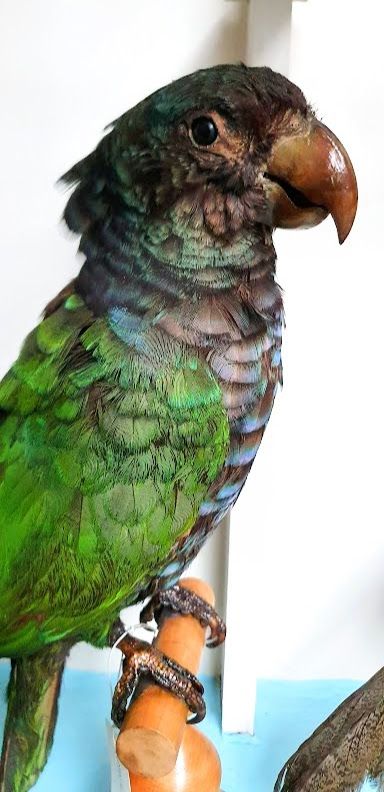
Obviously it’s a parrot of some sort, but there are LOTS of parrots. With over 400 species to choose from, identifying one from a single image is not easy at all. Generally when it comes to parrot identification it’s very useful to know where it came from, and without that information this mystery is made even harder – but if I’d provided the locality it would have been way too easy!
I find a useful way to narrow down possible species when looking at parrots is to simply use a search engine and add descriptive terms of the colours of parts of the external anatomy. In this instance I searched for “parrot with emerald green wings, blue and purple chest” which offered up a few possible species, but it significantly narrowed down the options to work through. Of course, I did that with some awareness of colours likely being a little off.
This is a specimen that arrived in the Dead Zoo in 1902 and it’s been progressively fading due to light exposure over the last 120+ years. The purples here are muted and I suspect the blue visible on the breast is actually residual following preferential colour loss of red pigments (types of carotenoid) that would have interacted with the structural blue colour of the feather (structural colours being much more light-stable than pigments) to create a much more vivid and robust purple colour than we see today. With that in mind, it becomes much easier to work out what this species is.
This is the Dominican Amazon (or Imperial Amazon, or Sisserou) Amazona imperialis Richmond, 1899 – one of just three species of parrot from the Commonwealth of Dominica, an Island in the Carribean. Here’s an illustration of what it looks like when it’s not faded:
This species features on the flag of the Commonwealth of Dominica and sadly there are very few of these stunning birds remaining, with estimated numbers somewhere between 40 and 60 mature individuals – making it Critically Endangered.
While numbers had been declining due to habitat loss, hunting and the taking of wild birds for the pet trade, the population has been significantly impacted by severe hurricanes hitting the island – which are increasing in frequency and severity due to climate change.
Hopefully, conservation efforts and the relatively inaccessible mountaious areas of the island in which the birds live will allow them a chance to recover, but they breed slowly and the threat from hurricanes remains.
Well done to everyone who had a go at this – it really was very difficult, so props to Katenockles who came close with a suggestion of the Blue-headed Parrot. Of course, there were lots of comments that referenced the infamous Norwegian Blue, which for younger readers might be unfamiliar, so here’s the source:
Just to note, while there are no parrots known from Norway, there are some fossil examples known from Denmark – so perhaps there is a chance the Norwegian Blue actually existed – albeit 55 million years ago,
This week I have a colourful character for you to have a go at identifying:
The Order will be easy to figure out, but I’d be keen to see how many of you can work out the species. I hope you have fun with this challenge!
Last week I gave you this mystery object to have a go at identifying:
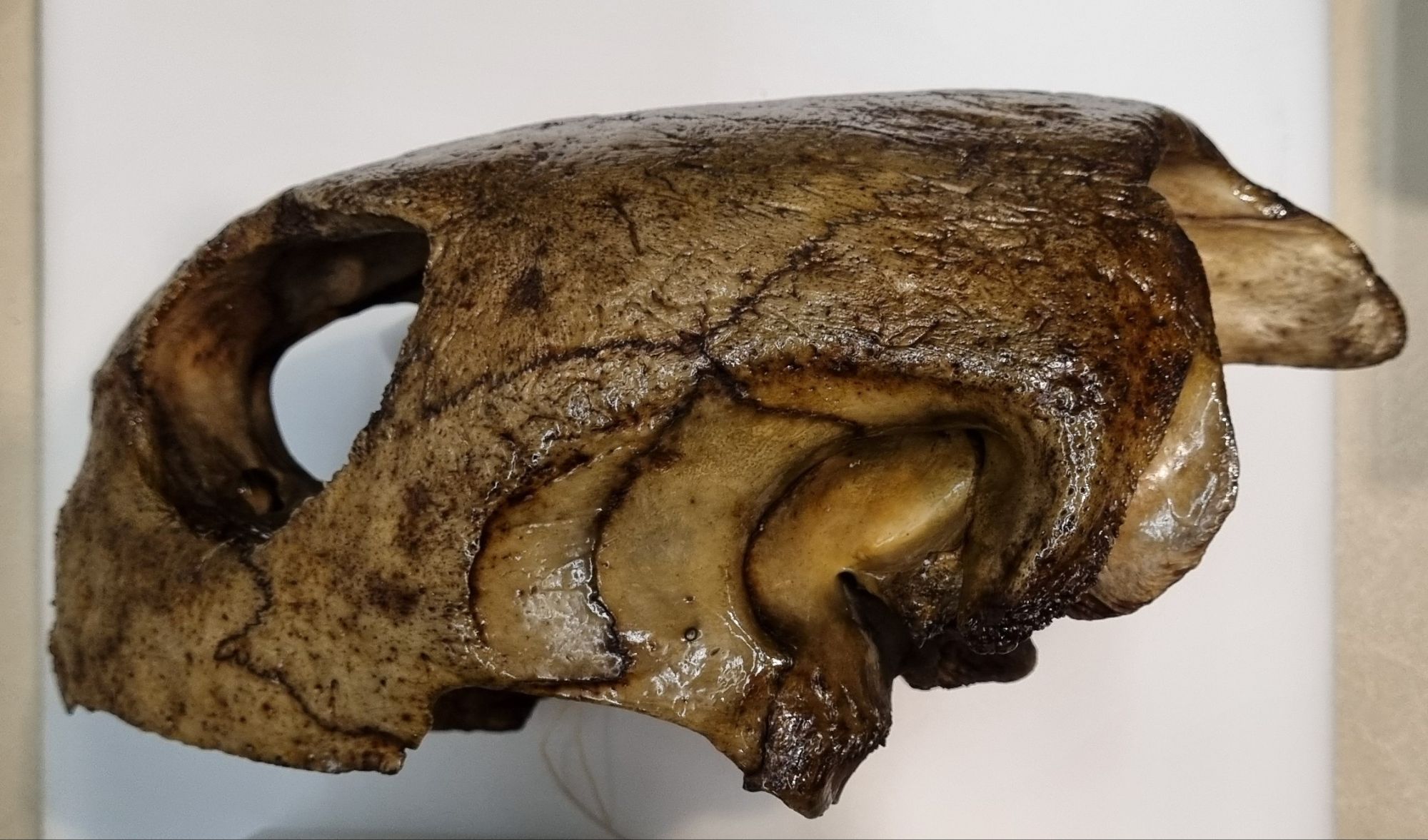
This one is fairly straightforward to get to the superfamily level – it’s one of the Sea Turtles (the Chelonioidea). However, despite there only being seven species alive today, their skulls can take a bit of careful observation to distinguish the diagnostic features that offer the clues to a species level identification.
When attempting this kind of thing, it’s always helpful to have access to a good key or guide that illustrates and describes those diagnostic features, and for me a very useful resource is The Anatomy of Sea Turtles by Jeanette Wyneken. Alas this excellent reference only covers six of the seven species, so it’s worth also taking a look at the Chatterji, Hutchinson and Jones redescription of the skull of the Australian flatback sea turtle for the sake of completeness.
In the comments on the mystery object this became something of a mix, with a variety of options being proposed. The first, from Adam Yates was actually the correct identification, but he then second-guessed himself.
In a nutshell, you can tell that this is a Green Turtle, Chelonia mydas (Linnaeus, 1758) based on the broad U-shaped curve of the upper jaw (other Sea Turtles have a more pointed bill).

There are plenty of other features as well, such as the configuration of the bones of the palate, a pair of ridges in the maxilla – which are admitedly a little hard to make out, so I’ve indicated them in red below to help you spot where to look:

Another useful feature visible from the palate is the lack of pterygoid processes, which rules out the Australian Flatback Turtle.
I also happen to know that this specimen was collected from Ascencion Island, which is slap bang in the middle of the Atlantic Ocean and is renowned as an important breeding site for Green Turtles.
So thanks to everyone for your thoughts on this one – I hope you had fun investigating, and I hope you find the references above useful if you stumble across more turtle skulls in need of identification.
I should probably add that I picked this specimen because I spotted it during the install of some displays in the new Dead Zoo Lab, which I’ve been working on intensively for the last few weeks. This is a space where we will be displaying some of our collections, and working with collaborators and our audiences on how we’ll be using our objects in the future redisplay of the Dead Zoo when the building has been refurbished.
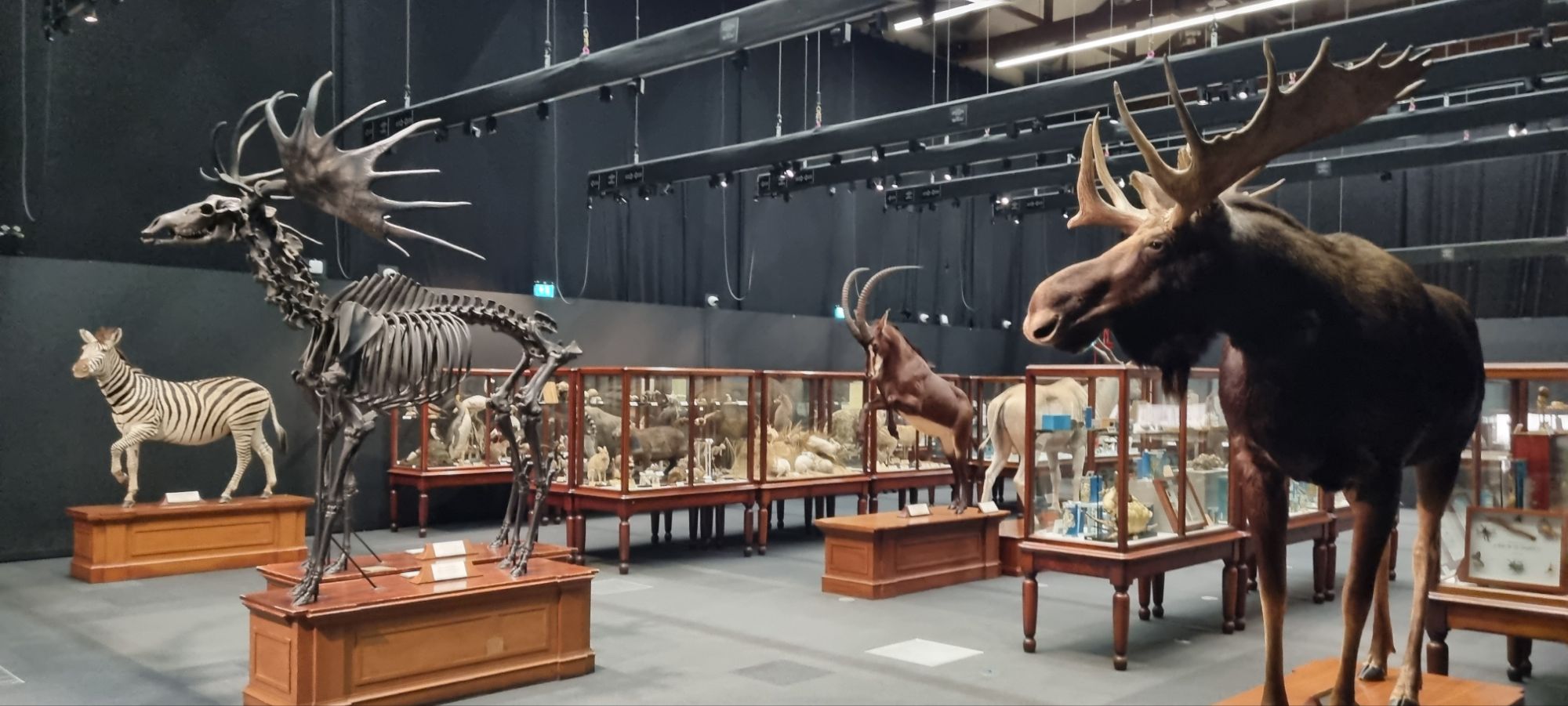
The Dead Zoo Lab is now open to the public, so I’ll add a photo of the space below, and you can read more about it in this article in the Irish Independent in case you’re interested. I hope you get to visit sometime – and if you do, be sure to let me know!
This week I have a nice straightforward one for you. The challenge here is mostly about the details to get the species identification, so I’m interested to hear your thoughts on this mystery object:
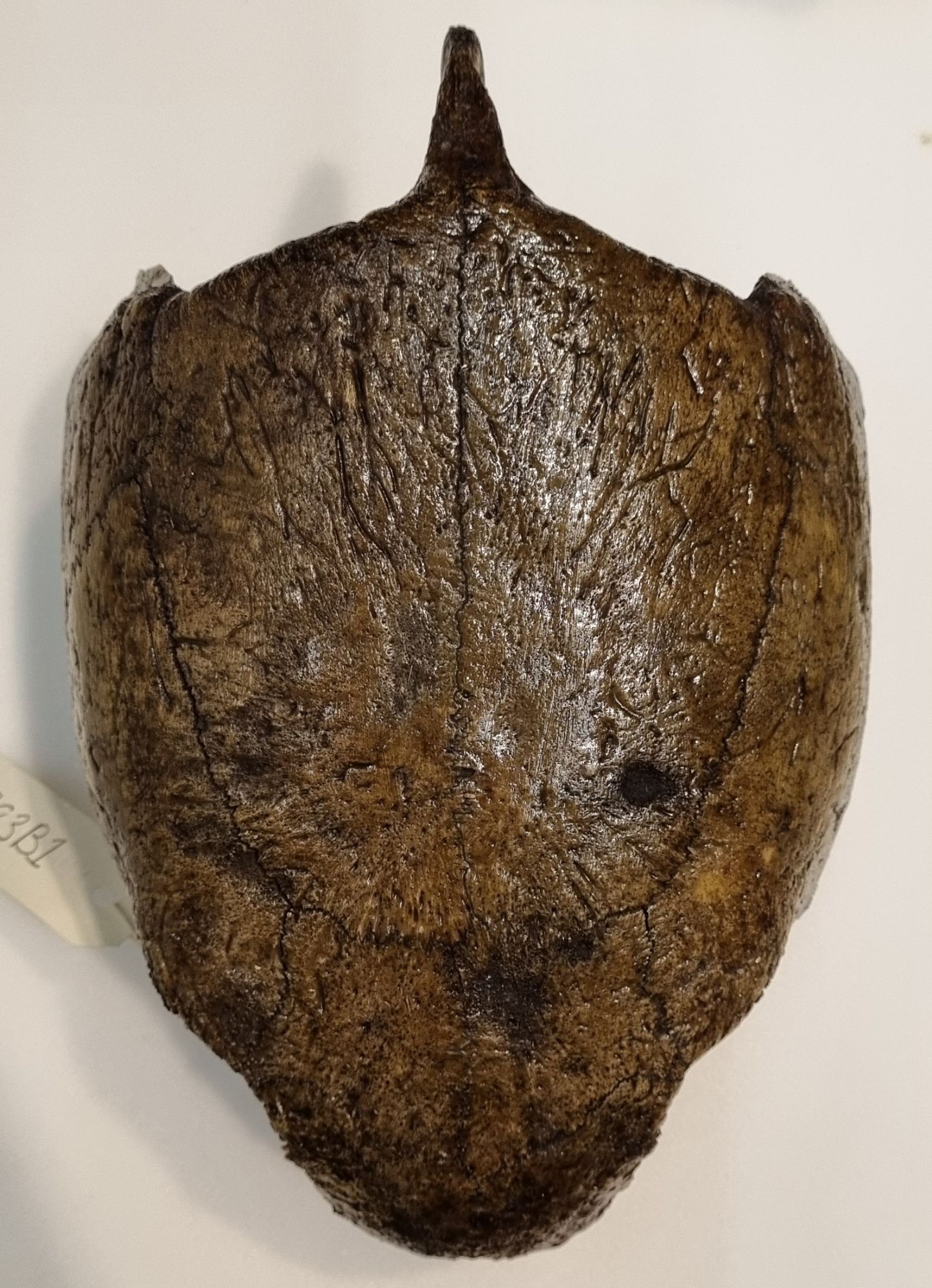
Let me know your thoughts in the comments section below. I hope you have fun with it.
Last week I gave you a close up of a specimen from the Dead Zoo to have a go at identifying:

I don’t think this proved too much of a challenge, since Chris Jarvis responded with a correct identification within the hour:
This one’s sent me into a spiral, kudyu show a bit more,. bucky?
chrisjarvise8da89e10d says: July 18, 2025 at 8:44 am
In case you missed the cryptic clues here (after all, I suspect that not everyone is as much of an antelope aficionado as Chris), this is a male Greater Kudu Tragelaphus strepsiceros (Pallas, 1766).
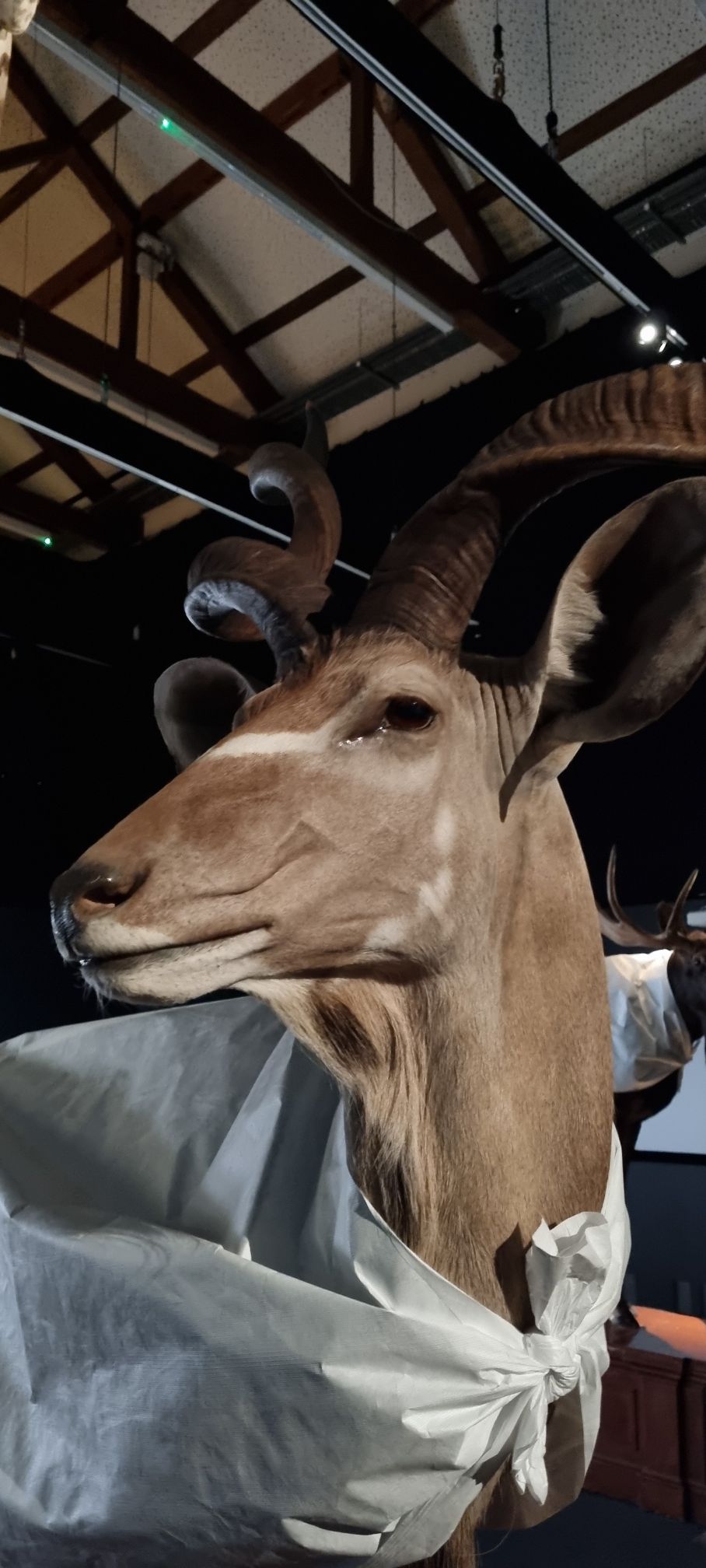
These handsome, large, spiral-horned antelopes have a distinctive white chevron that runs between their eyes – presumably the clue that Chris spotted to identify this specimen so quickly.
There are other species in the Genus Tragelaphus that look similar to the Greater Kudu, but they have different colouration and subtly different patterns on their faces.
I had the photo of this specimen because I’ve been working with my colleagues in the National Museum of Ireland team on getting objects ready for display at another of our Dublin sites called Collins Barracks. Obviously this is one of those objects.
The Dead Zoo has been closed since last September, while we’ve been emptying the space of collections for a major and much needed refurbishment. Of course, we want to make some of the collection available to the public while the Dead Zoo is closed, hence the work we’re doing now.
However, the display we’re working on is a bit weird – but it’s not intended to be an exhibition. I want it to be more of an iterative experiment for myself and my team to work out how we’re going to deal with redisplaying and interpreting the collections when the refurbishment works are done and we reopen the main Dead Zoo building on Merrion Street.
We’re calling the temporary display the “Dead Zoo Lab”, because of the experimental approach we plan to take. We want to involve the public in a conversation about how what we’re doing works for our audiences. I’m excited to see how we can build dialogue in this space to help inform our work over the next few years.
I am getting a bit ahead of myself though, as we still need to finish installing objects over the next week or so, before we can open the doors to the public. Once we get to that stage I’ll be sure to share some photos of the space for the Zygoma community – and I’ll be excited to hear your thoughts!
The last mystery object was a close-up detail of a specimen, and it proved tricky, but not impossible to identify. I thought I might try another close-up of a specimen, to see if it might yield a similarly balanced challenge for this week:
I feel like this has enough information to make an identification, but hopefully it’s not too easy.
Let me know what you think it could be in the comments box below – I hope it proves a fun challenge!
Last week I gave you a close-up of an object that caught my attention when visiting a friend who works at the Natural History Museum, Denmark:

The original image I had gave a bit too much information to make this a challenge, so I have to admit to doing some judicious cropping, and I wasn’t sure if this was going to be an easy or difficult one,
It turns out I made just difficult enough for most people to get in wrong, but there was one correct answer, from Katenockles on Mastodon:

Here’s my original photo:

As you can see, this is part of the antler of a Reindeer Rangifer tarandus (Linnaeus, 1758) that still bears the velvet, which is the hairy outer layer of skin covering various layers of tissue. These include the perichondrium and periosteum, which surround and protect the cartilage and bone being grown by highly vascularised mesenchyme tissue and specialised cells such as chondrocytes and osteoblasts. These cells create a scaffold of cartilage that becomes mineralised to form the bone that makes up the antler.
This mechanism for antler growth is really impressive, since it allows these strong and sometimes very large bony structures to develop in around 6 months – sometimes growing over 7cm a week when good nutrition is available.
This specimen was of particular interest for me, as I’ve never had the opportunity to see an example of the velvet up close. Normally my interactions with antlers involve historic museum specimens taken as trophies during the hunting season, or fossil examples – like this impressive specimen from the Pleistocene of Ireland:
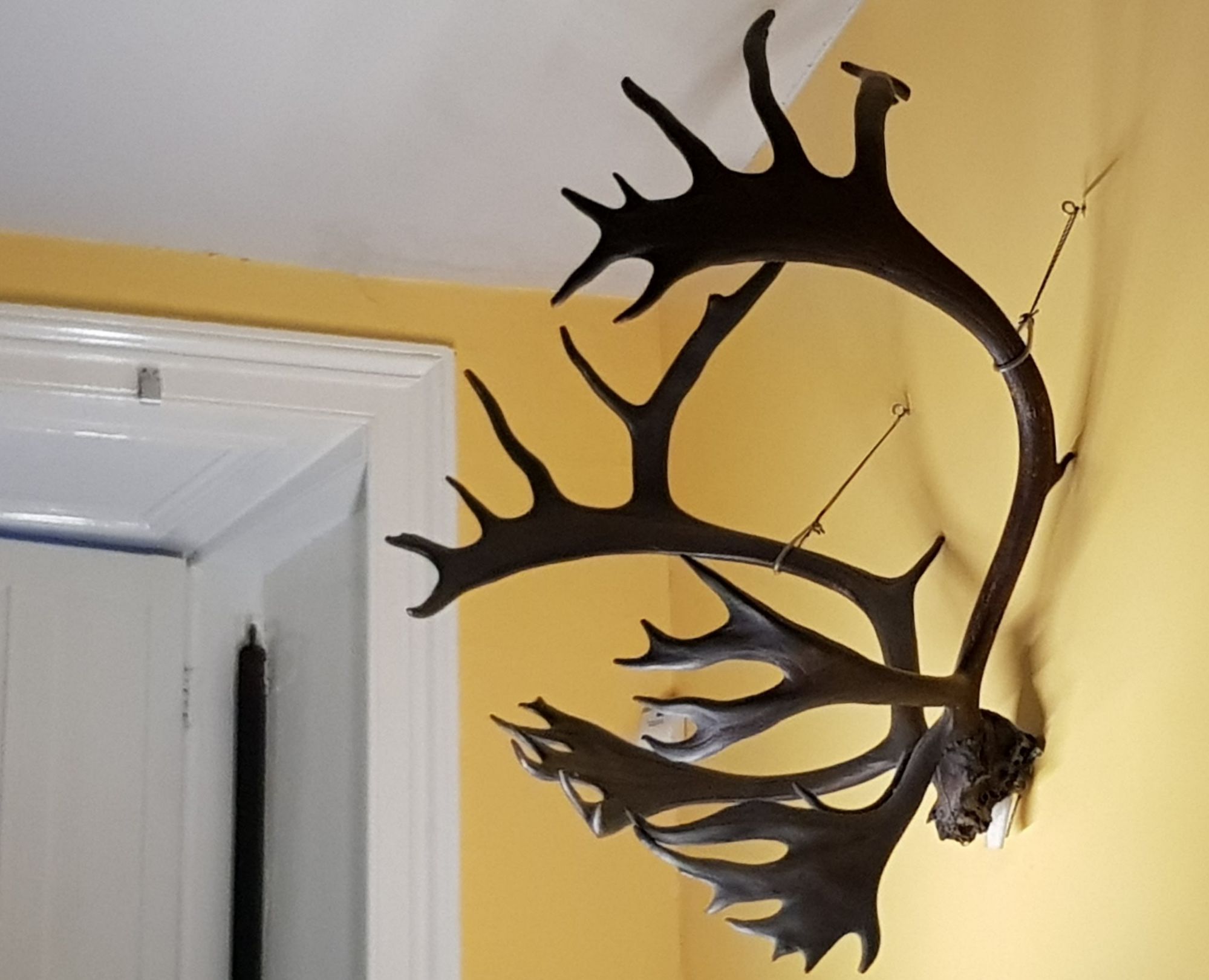
Thanks to everyone for their suggestions – I can certainly see why kangaroos and camels were suggested, and I’m a bit surprised that nobody suggested Platypus, as that was my immediate thought. Finally, very well done to Katenockles for working it out!
This week’s mystery object is a close-up of something I found interesting and thought it would be fun to share:
Any idea what this might be? I’m not sure if it’s really easy or really difficult, so I look forward to hearing your thoughts. Have fun with it!
Last week I gave you this fuzzy little fella to have a go at identifying:
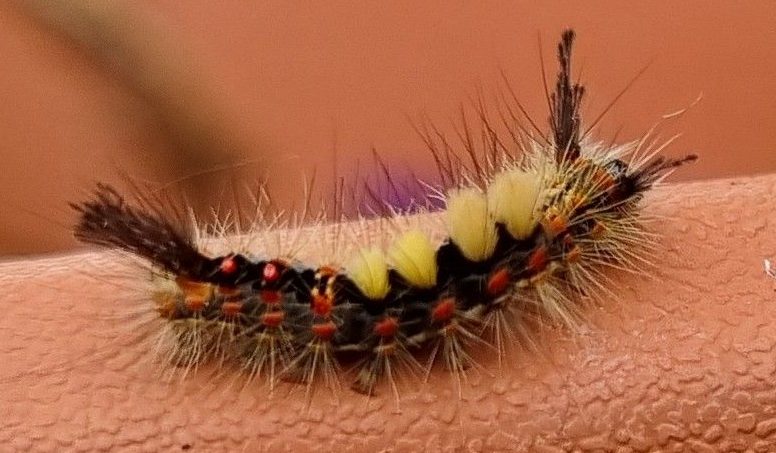
It’s a very distinctive caterpillar and I had a feeling it wouldn’t prove much of a challenge (correctly it turns it). Those tufts of hair, “horns” and bristles are a dead give-away.
As everyone who commented recognised, this is the larva of a Vapourer Moth, also known as a Rusty Tussock Moth Orgyia antiqua (Linneaus, 1758).
This day (and night) flying moth is fascinating, as the adults demonstrate quite extreme sexual dimorphism, with the female being almost wingless and the males flying around seeking her out by detecting her “vapours” – the pheromones she secretes that give these moths the name “Vapourer”.

The name Orgyia is apparently meant to derive from the ancient Greek word “órgyia” meaning “outstretched arms” – referencing the front legs of these moths, which splay out in front of them. However, knowing how much taxonomists enjoy a bit of wordplay, I wonder whether the clouds of males attracted to the vapouring females inspired the name for a different reason…
These moths are quite widespread, occurring in Ireland, the UK, across Europe and they are well established in America. They feed on a wide variety of different plants, but generally don’t cause many issues for gardeners as they tend to not be around in very high densities.
This may be a bit surprising, considering the flightless females can carry and lay large numbers of eggs, since they don’t have to worry about maintaining flight weight. But, numbers of moth eggs laid rarely equate to the number of surviving offspring, due to predation and the actions of parasitoid wasps.
I hope you enjoyed working out the identity of this mystery object, and maybe finding out more about a pretty interesting insect.

 Zygoma