Friday mystery object #520 answer

Last week I gave you this colourful chap to have a go at identifying:
As I mentioned in the previous mystery object answer, parrots can be hard to identify due to the large number of species globally. However, this time the specimen posed no problems for people to identify – perhaps unsurprisingly, given its importance.

Chris Jarvis was first in the door with the correct answer – a nice cryptic clue using the Seminole name for the species:

What a Puzz ila!

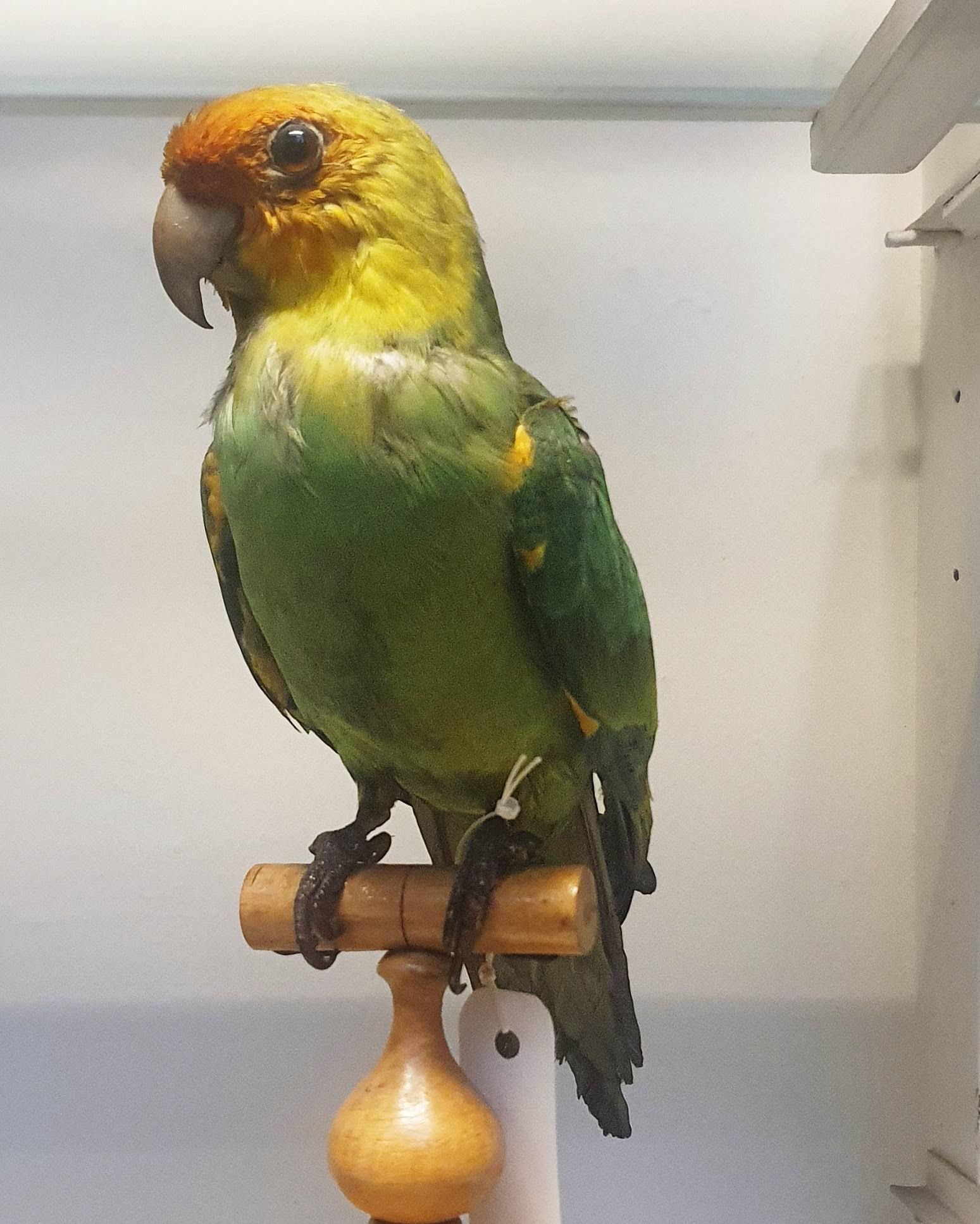
Other clues came thick and fast, but they all pointed to this yellow-headed, orange-faced bird being the now extinct Carolina Parakeet Conuropsis carolinensis (Linnaeus, 1758).

This colourful small parrot weighed in at around 100g and hung around in large flocks of up to 300 birds. Until the middle of the 19th Century they were commonplace in swampy forest habitats in parts of North America. The main resident population was in Florida although their range spread northwards along the marshes of the East coast (into the Carolinas) and westwards along the Gulf of Mexico just into Louisana.

A subspecies of the Carolina Parakeet (C. c. ludovicianus) also occurred in much of the Midwest and as far south as the top of Texas and as far north as the bottom of New York state. This subspecies had bodies that were more blue, but they disappeared alongside their greener sibling subspecies by the beginning of the 20th Century.

Conuropsis carolinensis ludovicianus by John James Audubon, 1811

It seems likely that the usual culprits played a role in the extinction of North America’s only endemic parrot – habitat loss and overhunting. Swamps were drained and forests cleared to make way for agricultural land, the birds were then shot for feeding on crops, and their beautiful plumage made the birds a target to supply the feather-forward fashions of the time.

While most of the shooting stopped before the birds went extinct, as people started to recognise the risk of extinction (especially in the context of the Passenger Pigeon that was being eradicated at around the same time), the last small wild population was vulnerable and it has been suggested that they were finally wiped out by an avian disease.

While a few stragglers likely remained living wild in the Florida swamps until the 1930s, the last known Carolina Parakeet (a male named Incas) died in Cincinati Zoo in 1918, just four years after Martha (the last Passenger Pigeon) died in the very same cage. A somewhat dismal end to colourful species.
Friday mystery object #519 answer

Last week I gave you a bit of tricky mystery object in the form of this colourful character:

Obviously it’s a parrot of some sort, but there are LOTS of parrots. With over 400 species to choose from, identifying one from a single image is not easy at all. Generally when it comes to parrot identification it’s very useful to know where it came from, and without that information this mystery is made even harder – but if I’d provided the locality it would have been way too easy!

I find a useful way to narrow down possible species when looking at parrots is to simply use a search engine and add descriptive terms of the colours of parts of the external anatomy. In this instance I searched for “parrot with emerald green wings, blue and purple chest” which offered up a few possible species, but it significantly narrowed down the options to work through. Of course, I did that with some awareness of colours likely being a little off.

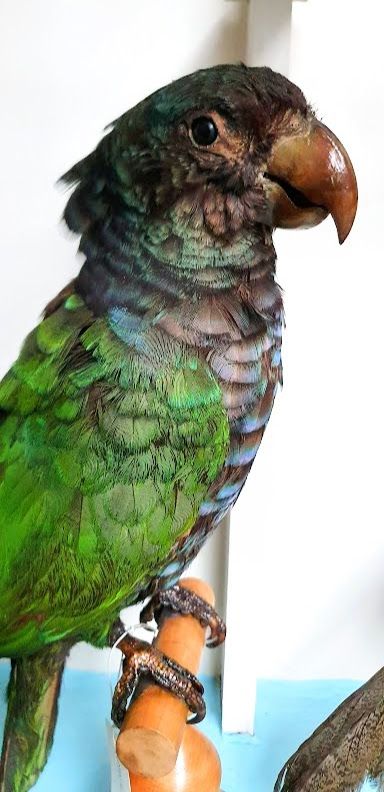
This is a specimen that arrived in the Dead Zoo in 1902 and it’s been progressively fading due to light exposure over the last 120+ years. The purples here are muted and I suspect the blue visible on the breast is actually residual following preferential colour loss of red pigments (types of carotenoid) that would have interacted with the structural blue colour of the feather (structural colours being much more light-stable than pigments) to create a much more vivid and robust purple colour than we see today. With that in mind, it becomes much easier to work out what this species is.

This is the Dominican Amazon (or Imperial Amazon, or Sisserou) Amazona imperialis Richmond, 1899 – one of just three species of parrot from the Commonwealth of Dominica, an Island in the Carribean. Here’s an illustration of what it looks like when it’s not faded:

This species features on the flag of the Commonwealth of Dominica and sadly there are very few of these stunning birds remaining, with estimated numbers somewhere between 40 and 60 mature individuals – making it Critically Endangered.

While numbers had been declining due to habitat loss, hunting and the taking of wild birds for the pet trade, the population has been significantly impacted by severe hurricanes hitting the island – which are increasing in frequency and severity due to climate change.

Hopefully, conservation efforts and the relatively inaccessible mountaious areas of the island in which the birds live will allow them a chance to recover, but they breed slowly and the threat from hurricanes remains.

Well done to everyone who had a go at this – it really was very difficult, so props to Katenockles who came close with a suggestion of the Blue-headed Parrot. Of course, there were lots of comments that referenced the infamous Norwegian Blue, which for younger readers might be unfamiliar, so here’s the source:

Just to note, while there are no parrots known from Norway, there are some fossil examples known from Denmark – so perhaps there is a chance the Norwegian Blue actually existed – albeit 55 million years ago,

Friday mystery object #510 answer

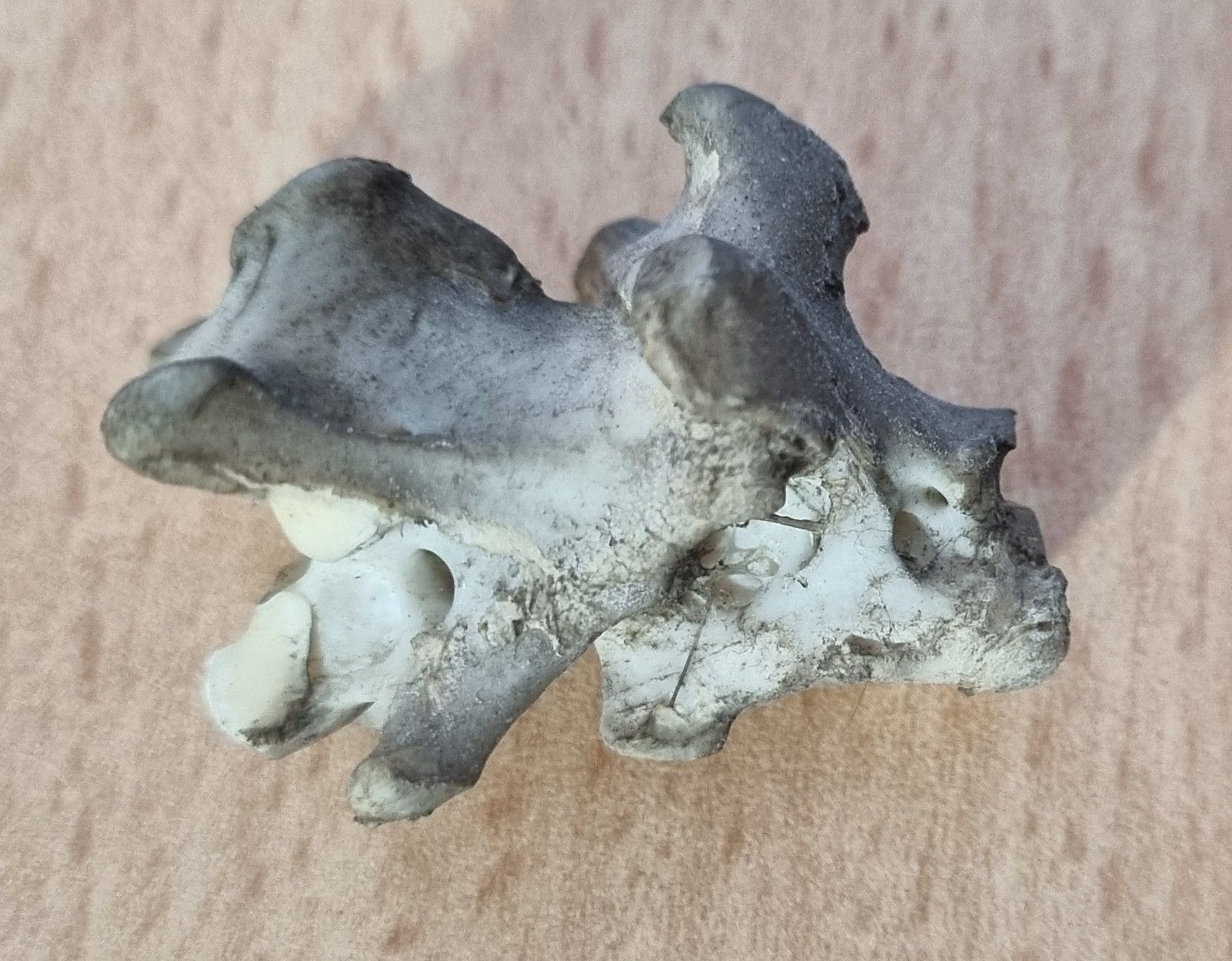
Last week I gave you this genuine mystery object to have a go at identifying:

This came to light when we were clearing out cupboards in the Dead Zoo, and it may have been an ill-considered option, considering how tricky vertebrae can be to narrow down to species and how little time I’ve had to research this particular specimen.

I was hoping that someone in the comments might spot something I’d missed, and Adam Yates certainly spotted everything I’d noted from my inspection of the specimen:

Clearly birdy (pneumatic foramina and saddle-shaped posterior centrum face). The odd short anterior of the pair is probably the axis, and the one behind, Ce 3. I can’t do better than that right now, but will return to this puzzle later…

He also added a useful comment about size which I hadn’t really considered fully:

…The first few cervical vertebrae of birds are surprisingly small and I judge this axis to be about 25 – 30 mm across the postzygapophyses, using Paolo’s thumbnail as scale. That would suggest a raft of large species. I’m going to guess this one rhymes with “he knew”.
I’m assuming that’s a reference to Emu, and the size of the vertebrae certainly seem to be in the right size range (at least according to this paper by Baranowski et al, from 2018). However, I’m not entirely convinced that the shape is quite right, Rheas might be a little more similar, and there was a hint at a pouched animal by katedmonson, which I suspect is a reference to a Pelican.

I think these are a little bit too short for a Pelican, but I’ll certainly keep that identification in mind as I try to find where these came from. However, without spending a good bit more time trying to find comparative specimens, it’s going to be a challenge. It may be that the easiest way to work out what this is will be to search for a large mounted bird skeleton that’s missing these vertebrae, since there are not too many such specimens in the Dead Zoo.

But before I start a wider search, I have a hunch that I want to check out. There is a King Vulture specimen that I’ve blogged about previously (way back in 2018) that is large and consists of a partially dismounted skeleton. I think I’ll make that my first port of call, as (if memory serves) it has similar levels of soot build up on the bones, and I suspect it’s in the right sort of size range, as vultures have fairly large and robust cervical vertebrae for their size.

So my thanks to everyone for their suggestions and observations – if I eventually discover the identity of these bones I’ll be sure to update this post, and if you think you know what it is, I’d love to hear your thoughts!

Oh, and if you celebrate Easter, I hope you have a great one!

Friday mystery object #509 answer

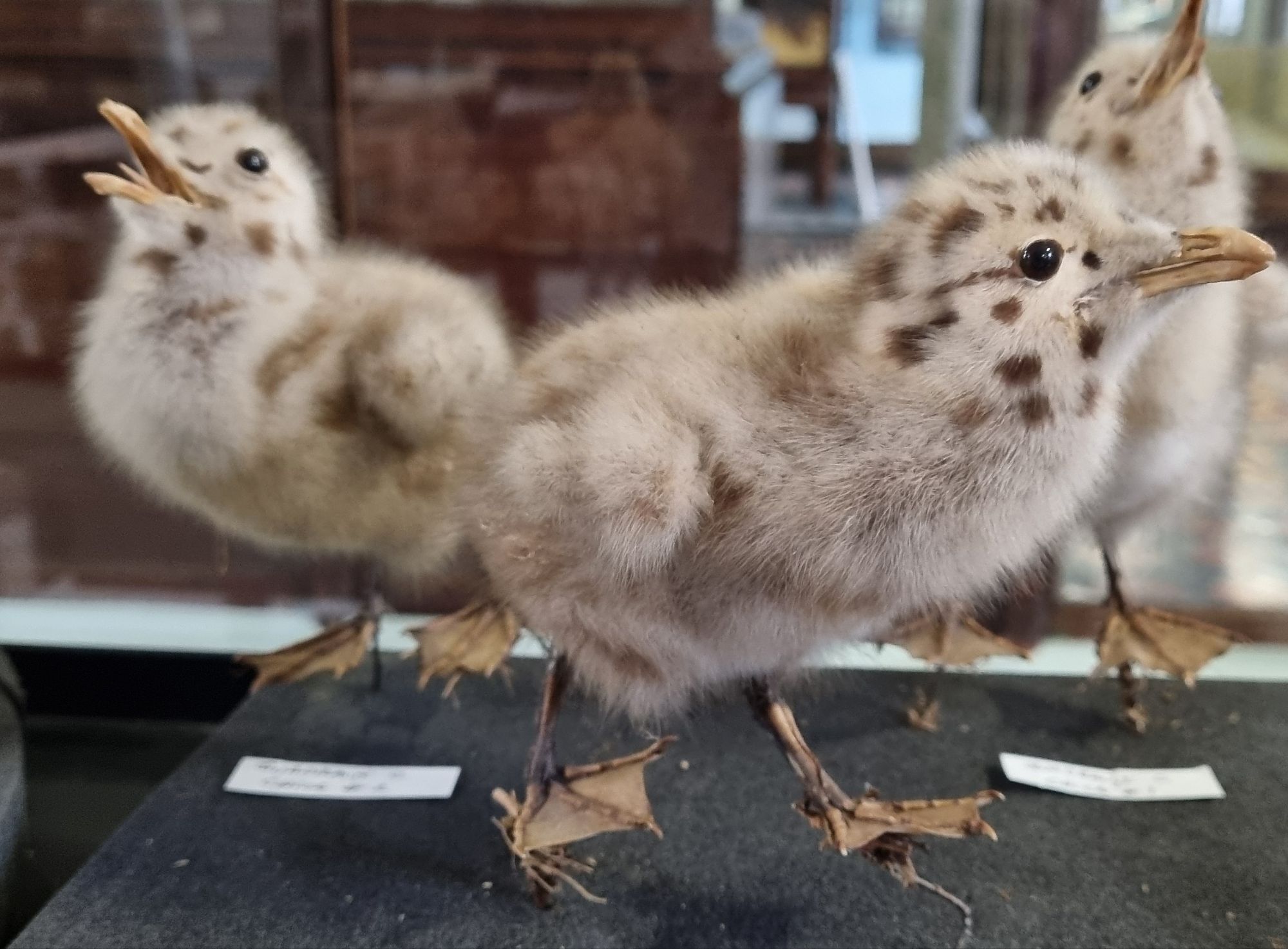
Last week I gave you these fuzzy chicks to try your hand at identifying:

Their speckled camouflage is perfect for pebbly beaches and it’s just what you’d expect from a member of the Gull Family (the Laridae). This is something that everyone picked up on, with a variety of excellent clues.

pleasantly78f070d606 was first in the door, with a great clue identifying the correct species in three words:

Silvery chip thief

The chip stealing (both in the UK and USA meaning of chips) encapsulates one of the more familiar and frustrating behaviours of this commonly kleptoparasitic species:

The “silvery” references the species name argentatus (which in tern references the silvery shade on back of these cheeky birds). So this is the chick of a Herring Gull Larus argentatus Pontoppidan, 1763.

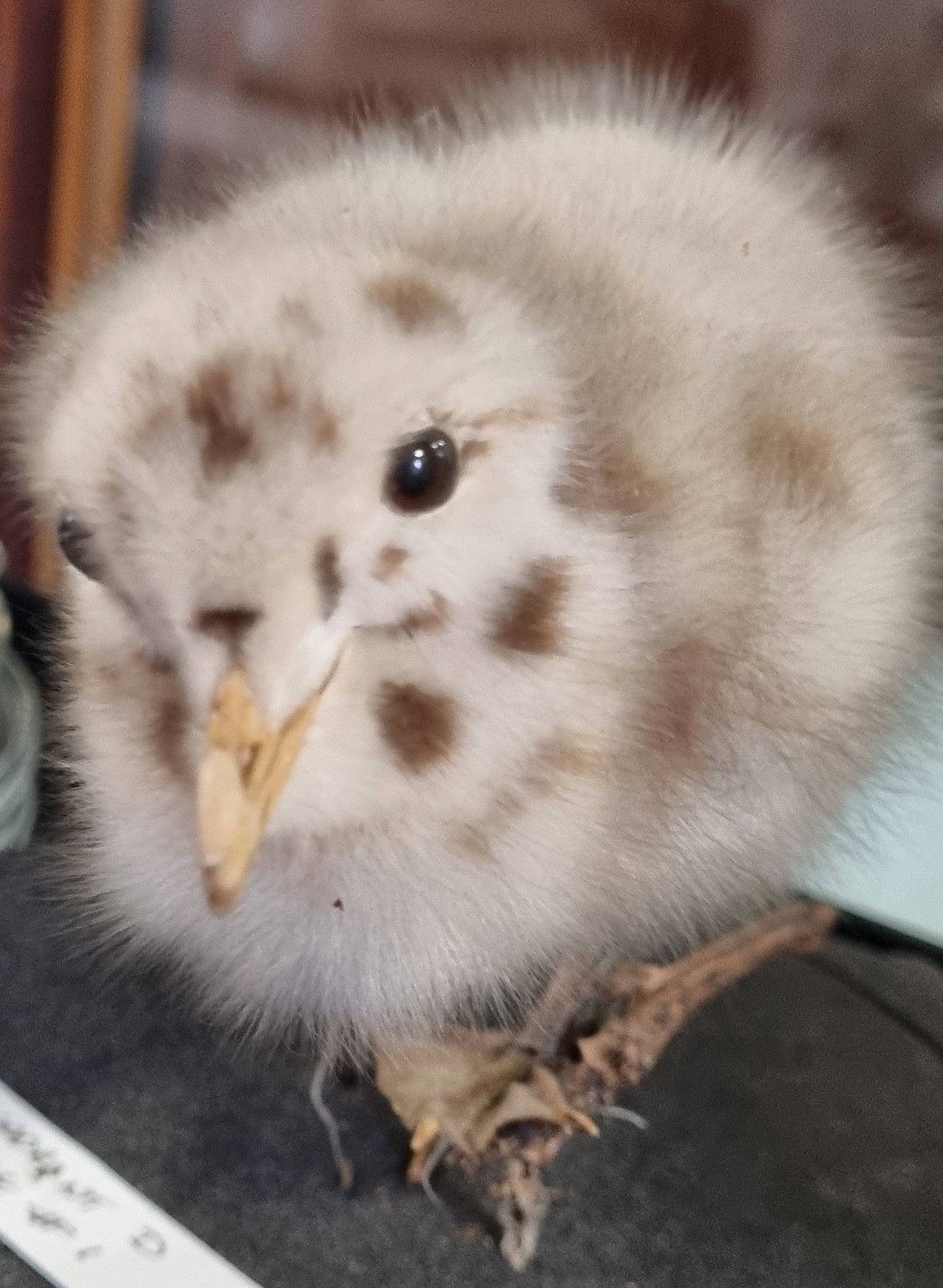
It can be tricky to distinguish between the chicks of various different gull species, but you may notice that these look a bit like they’ve gone for, what I can probably best describe as an eyeliner flick. This bar behind the eye is variable, but occurs frequently in Herring Gull chicks, but less so in the similar looking chicks of other closely related species.

These chicks are from a particularly nicely done diorama in the Dead Zoo, which we’ve been in the process of preparing for transport out of the building. We’ll be sharing some of the progress on the project on some social media platforms (Bluesky and Instagram) soon – so I’ll be sure to share some of those stories from our hard-working team here as well.

Friday mystery object #498 answer

Last week I gave you this somewhat challenging bird to have a go at identifying:

The challenging part was not simply due to this being one of the wading birds (a group within the Order Charadriiformes), which can be quite hard to identify for the uninitiated, but it’s also a species that is quite unfamiliar. This is because one hasn’t been seen since 2006 (and possibly much longer ago than that).

A similar looking relative of this bird is the Whimbrel, which is a species that several people suggested. However, as Adam Yates spotted, the Whimbrel has a strong dark bar in front of the eye running from the base of the bill, whereas this specimen has a weak stripe behind the eye, that doesn’t connect up to the bill.

This bird is a Northern, or Eskimo, Curlew Numenius borealis (Forster, 1772), as correctly spotted by Sallie Reynolds. The species is considered likely to be extinct, with the last confirmed sighting in 1963.

The species used to be numerous across their range, migrating from their breeding grounds in the Arctic, all the way down the length of America to Argentina for the summer. It seems likely that this particular specimen was blown off course, since it ended up in Ireland.

Well done to Sallie, Adam and everyone who figured out the mystery!

Friday mystery object #497

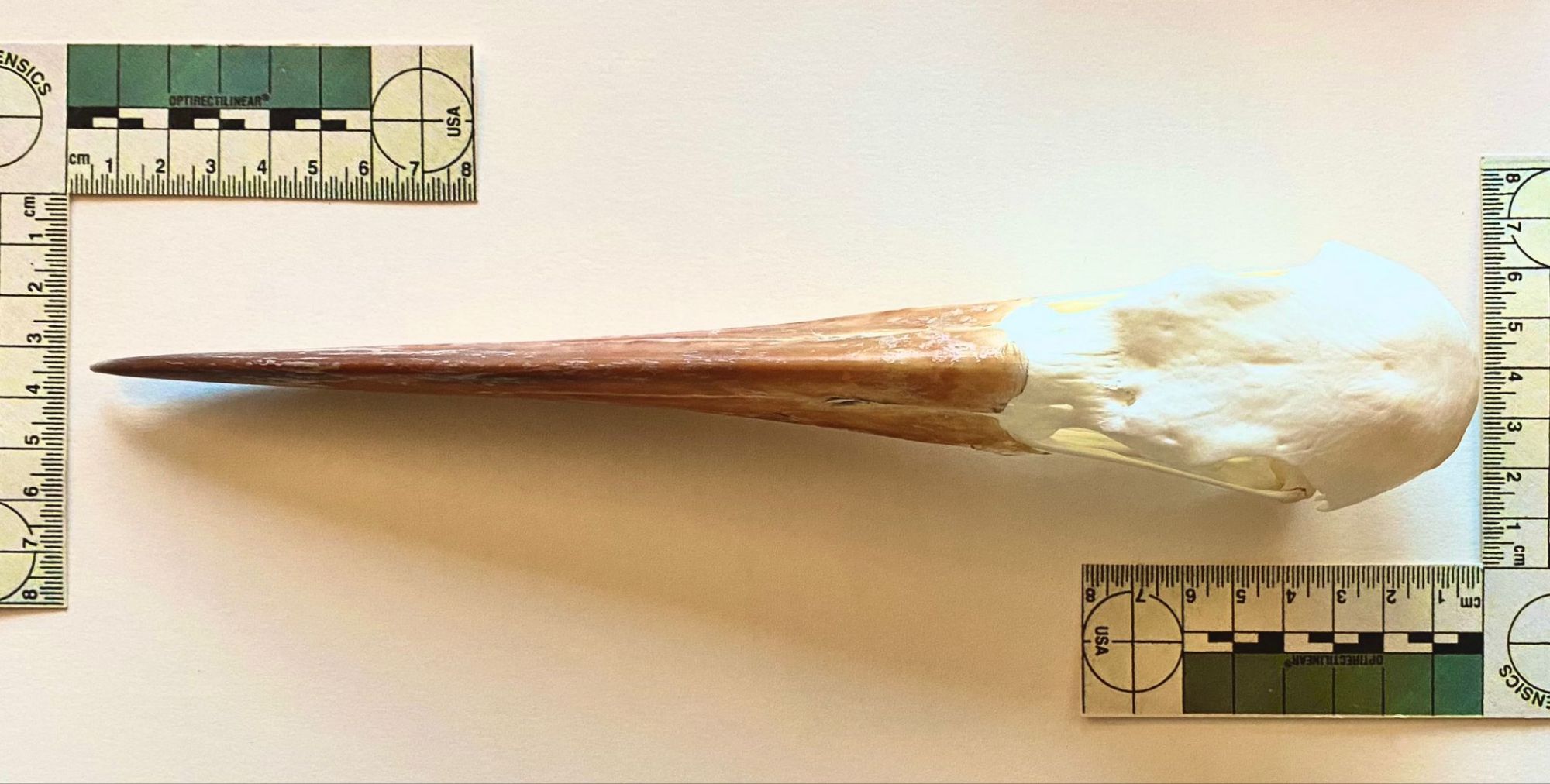
This week I have a guest mystery object for you, from avid naturalist and frequent contributor, Andy Taylor, FLS:

Image by Andy Taylor FLS, 2024.

I suspect that some of you will get this one easily, so it’s time to break out your creativity and let me know what you think it is with a cryptic clue.

I hope you have fun with it!

Friday mystery object #484 answer

Last week I gave you this fantastic specimen from the Dead Zoo to have a go at identifying:

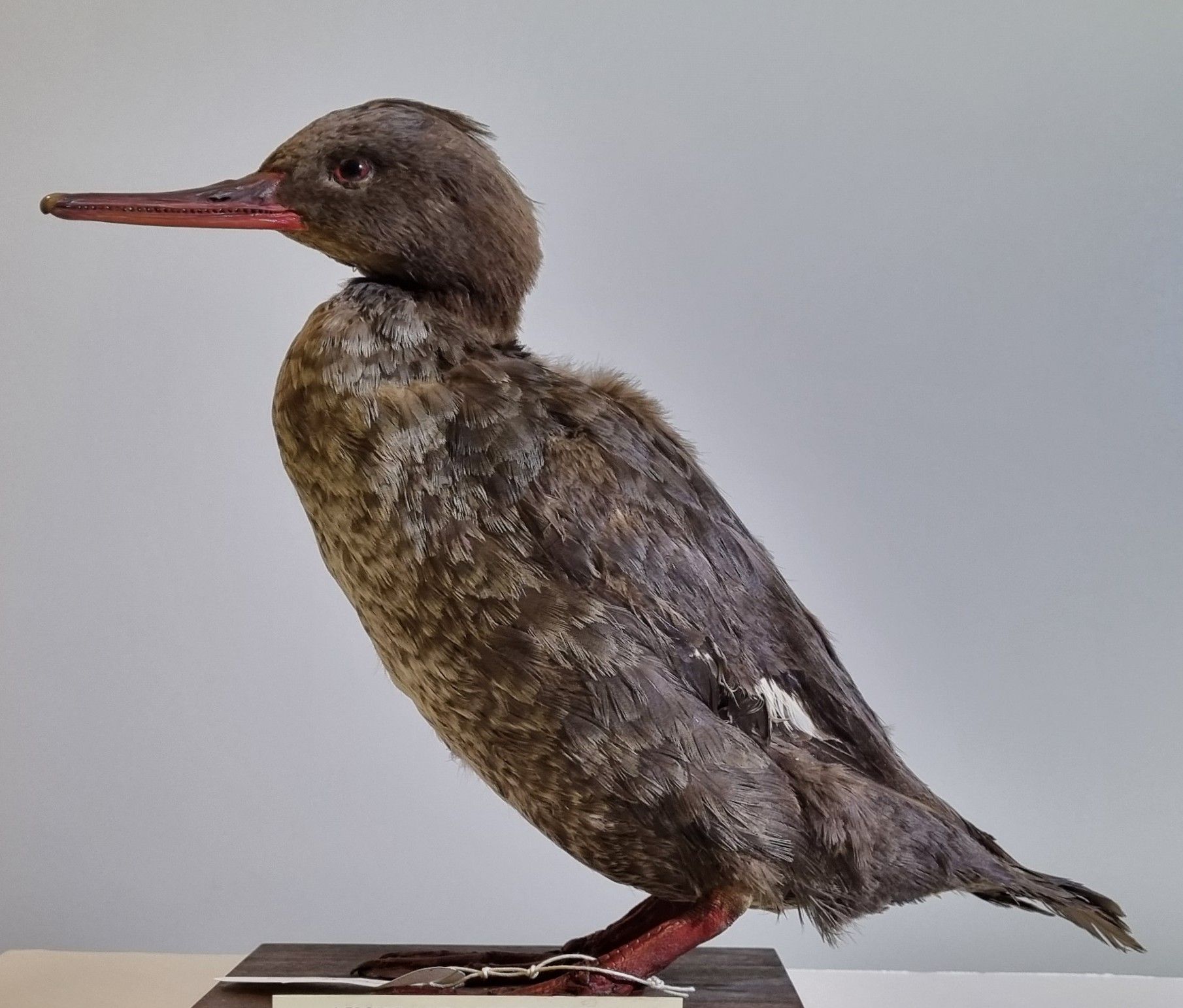
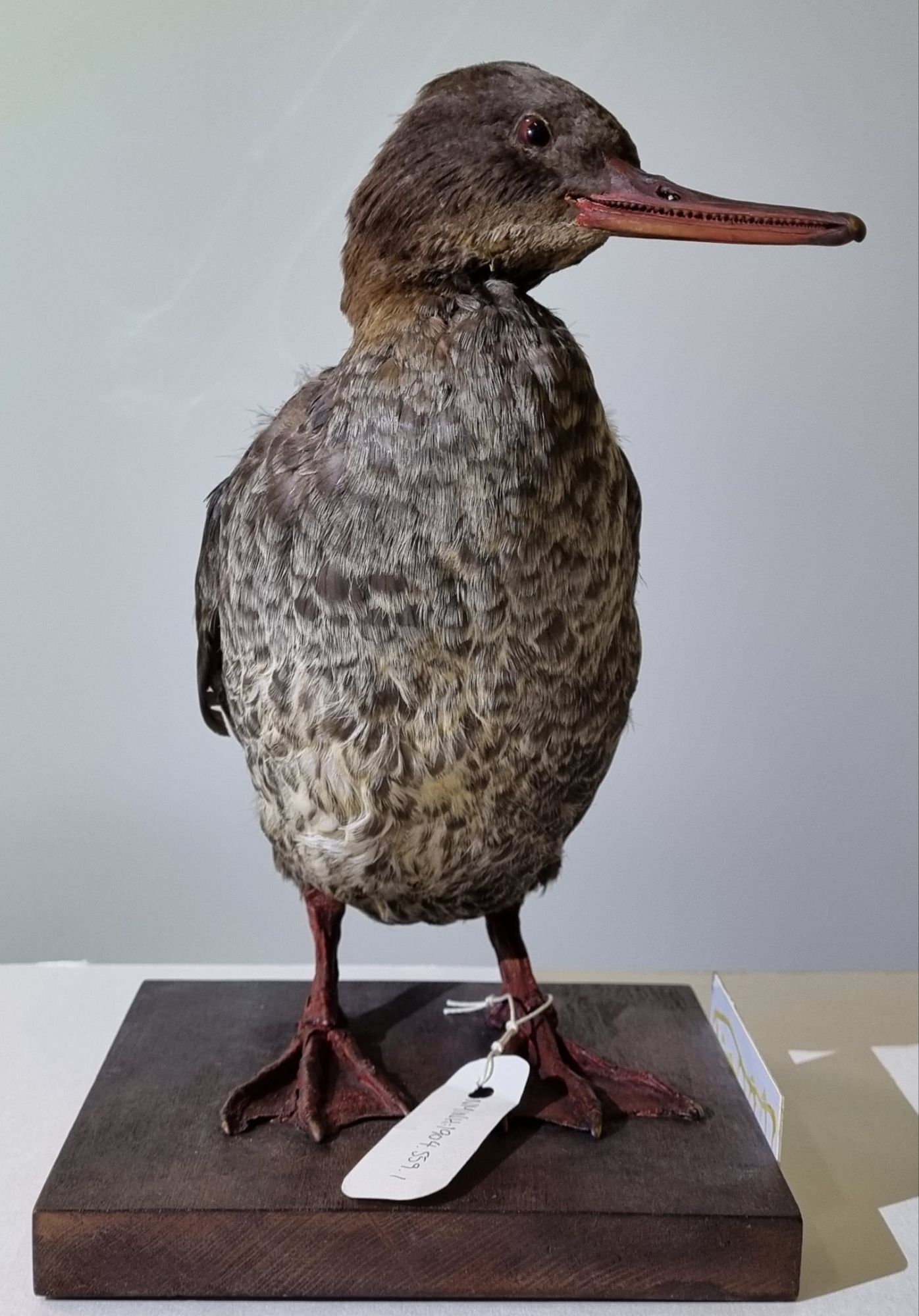
It wasn’t a hugely difficult object to identify, given its distinctive narrow serrated bill on a duck-like body, which are hallmarks of the mergansers – a genus of piscivorous ducks:

There aren’t many species of merganser – just six alive today, so on the face of it, there aren’t many to choose from. This particular specimen looks most like a juvenile Red-breasted Merganser, as several people suggested – but it’s not one of those.

This particular specimen is one of two other known merganser species that survived until historic times, but which are now extinct. The other species has no taxidermy specimens to represent it, and is only known from subfossil material from Chatham Island, off the coast of New Zealand.

Our mystery object is one of the very few taxidermy mounts that can show us what the Auckland Island Merganser (Mergus australis Hombron & Jacquinot, 1841) looked like. There are only 27 existsing specimens of this species in the world, most of which are preserved in fluid, and have lost most of their colour as a result – although ours is no doubt a little faded from the natural light in the galleries.

The Auckland Island Merganser is a good example of a species that did not survive contact with humans. Their original distribution was much more widespread on New Zealand and Chatham Island, but the arrival of Polynesian peoples led to their loss everywhere except on Auckland Island.

The arrival of Europeans and the pigs and cats they brought with them to Auckland Island pushed the population to the brink, and then hunting expeditions around the turn of the 19th to 20th century wiped out the rest. This particular specimen was shot on the 5th January 1901. One year and four days later the last pair were killed by the same man – Lord Ranfurly, the Governor of New Zealand.

Ranfurly finished his term as Governor in 1904 and it seems likely that some of the skins of the specimens he collected in New Zealand returned with him. Some went to the British Museum (Natural History), while this one was prepared at “The Jungle” – Rowland Ward’s by shop at 167 Piccadilly, London before coming to Dublin.

It’s saddening to think that a species was pushed over the brink of extinction so deliberately, with no effort to preserve or protect it. Around the same time in North America the Passenger Pigeon became extinct in the wild, but at least the decline of the species had spurred efforts to preserve the remaining individuals in an effort to breed them. Meanwhile in New Zealand, it seems that the scarcity of the Auckland Island Merganser increased the demand for specimens, thereby sealing the fate of the species.

If you want to know more about the life and habits of these birds, New Zealand Birds Online is a great resource, with excellent information, so do check it out.

On a final note, I am currently attending the excellent NatSCA conference in Oxford at the moment, so extinct birds are very much on my mind. Later today I am looking forward to seeing the remains of the last fragments of surviving skin from the Dodo. We once shared our planet with these animals, and while it’s remarkable that we still have these specimens that help us understand what has been lost, it would be better if they had never been lost at all.

Friday mystery object #473 answer

Last week I gave you this specimen from the Dead Zoo to have a go at identifying:

Evidently it was a bit too easy, since everyone who commented not only worked it out, but took the time to come up with clever cryptic clues to reveal the identity. The first was Tony Irwin with:

I suppose that a pencil sketch of this would qualify as a labradoodle?

Tony Irwin November 10, 2023 at 9:34 am

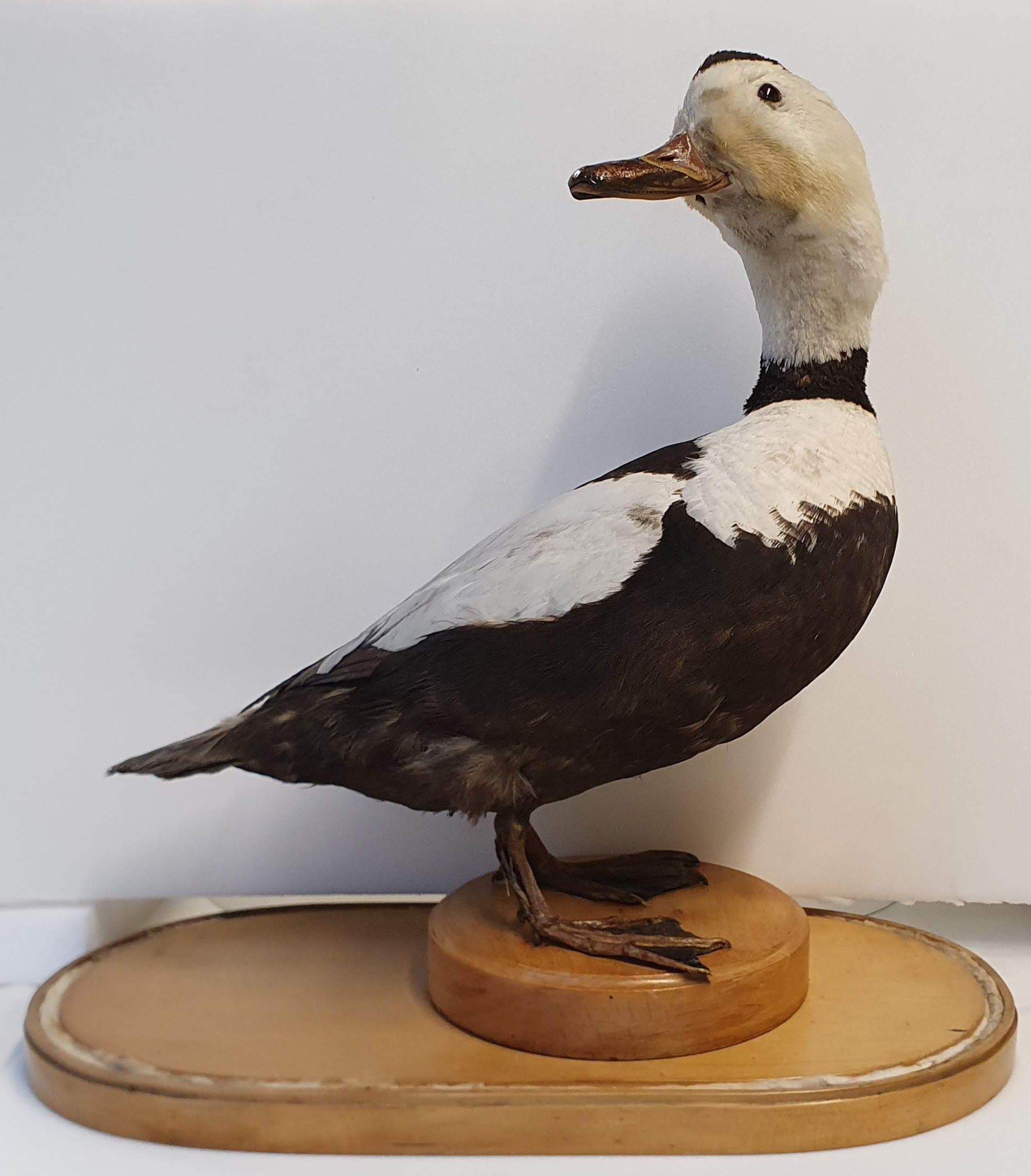
This is a specimen of Labrador Duck Camptorhynchus labradorius (Gmelin, JF, 1789), an endemic North American duck that has the dubious honour of being the first American species to be pushed into extinction following the European invasion of the continent. The exact reasons for the extinction are unsure, but between the adult birds being shot or caught on fishing lines, their eggs being over-exploited as a food source by settlers, and competition with humans for mussels and other marine molluscs, the already small populations were quickly reduced to nothing.

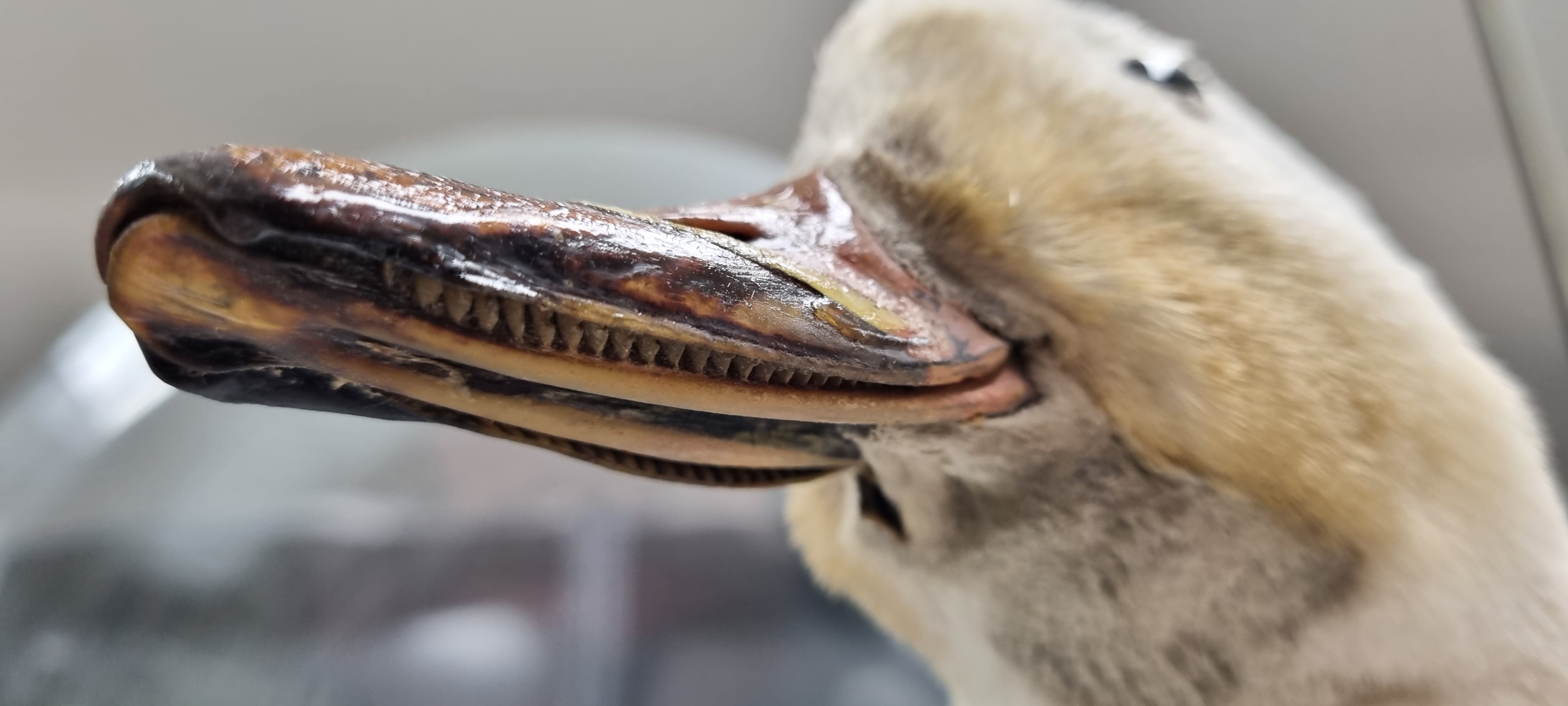
Lamellae in the bill of the Labrador Duck.

The last sighting was in 1878, but the museum bought this specimen in 1892 for the princely sum of £30-0-0 (that’s the equivalent of about €5,376 in today’s money). It had passed through a few pairs of hands before the Museum got hold of it, but we’re fortunate in knowing that the specimen was brought to Ireland in August 1838 from New York by Lt. W. Swainson R.N. who was in command of The Royal William, a paddle steamer in the service of the City of Dublin Steam Packet Co.

Only 55 specimens of Labrador Duck are known from museums around the world, so all information about them is valuable, especially when you consider how scarce and irreplacable they are. Specimens like this really hammer home the responsibility we have as museum professionals who are responsible for their care.

Friday mystery object #470 answer

Last week we had these two skulls from Andy Taylor, FLS to have a go at identifying:

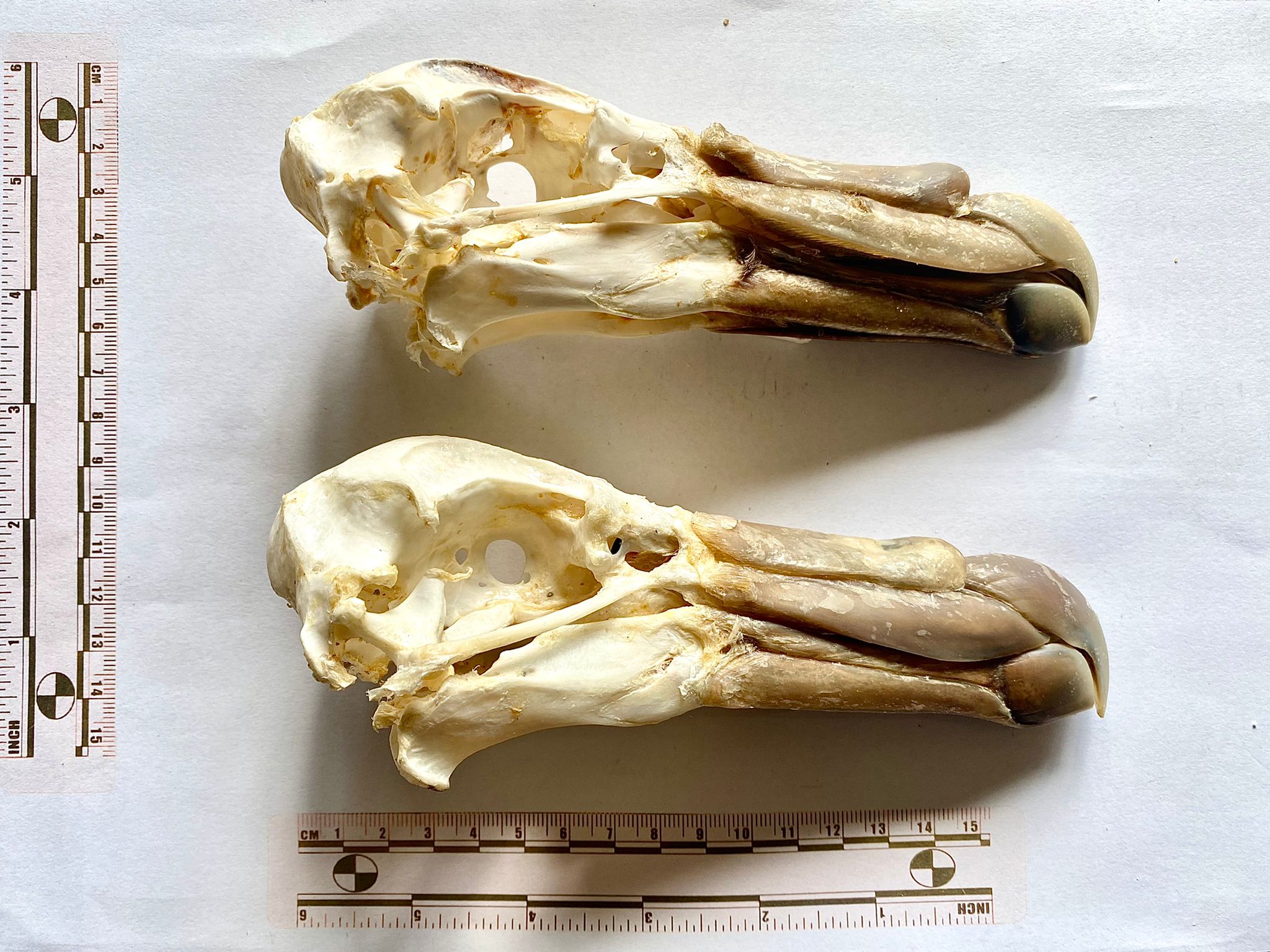
Everyone recognised that these are the skulls of Tube-nosed birds in the Order Procellariiformes – very large Tube-nosed birds.

Usually, you’d think of albatrosses when considering large Procellariiformes, but they have proportionally longer bills than this and while they have the nose-tube characteristic of the group, the tube is quite small and to the sides and rear half of the bill. In the mystery specimens, the tube is large and located on the top, and in the front half of the bill.

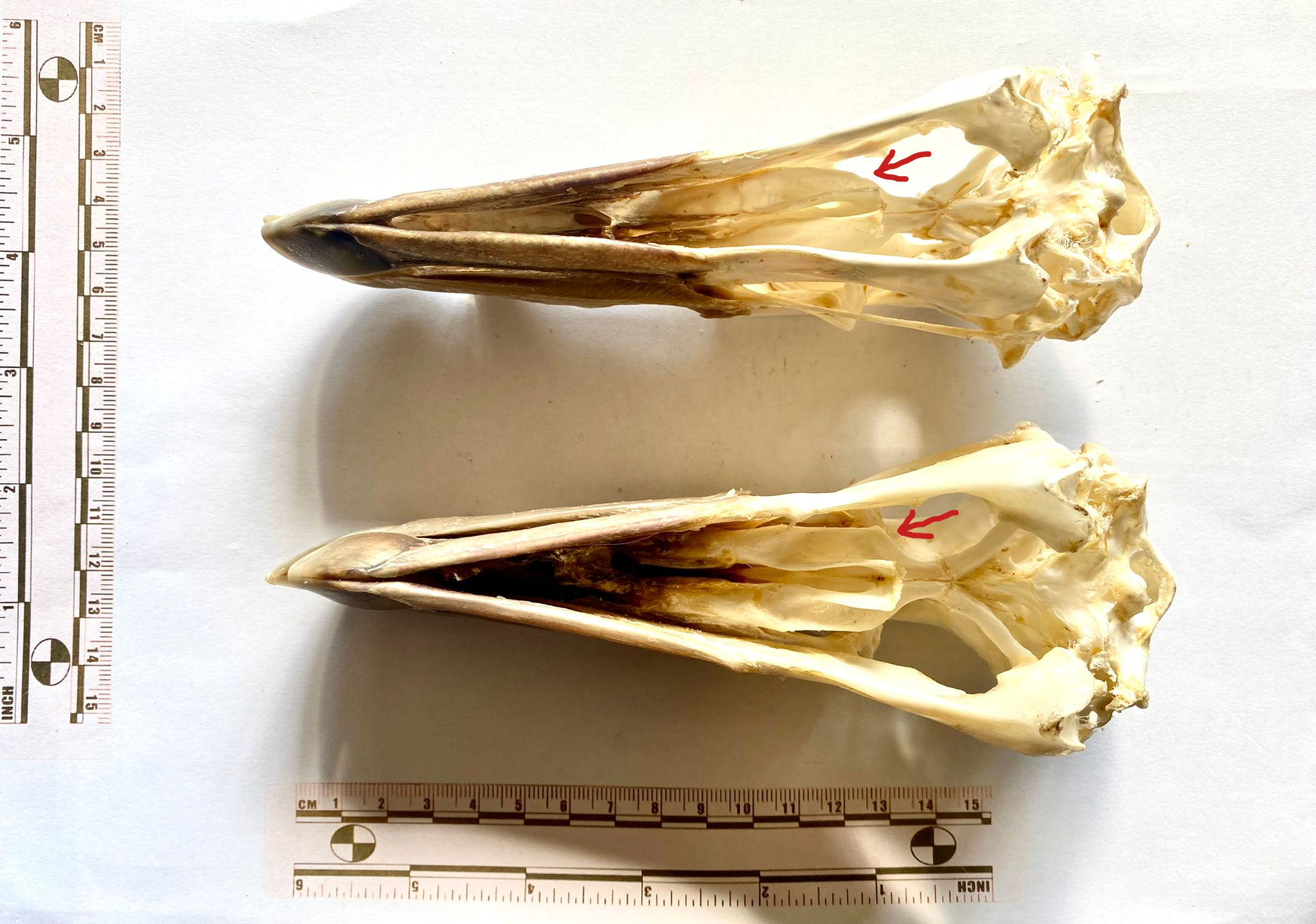
As Wouter van Gestel recognised, these skulls are from Giant Petrels in the Genus Macronectes. They actually represent both species in the Genus – the top one is the Southern Giant Petrel Macronectes giganteus (Gmelin, 1789) and the lower one is the Northern Giant Petrel Macronectes halli Mathews, 1912.

They’re quite hard to tell apart, and the best feature I noticed for distinguishing them is the shape of the palatine, with the Southern having a very gentle curve to the rear section – as indicated below (in a very rudimentary way):

Andy has already written up some information about these birds on his Instagram account, which is well worth checking out:

Thanks for all your observations and thoughts on these rather impressive specimens!

Friday mystery object #451 answer

Last week I gave you this bird specimen to have a go at identifying:

In the ornithological community, birds like this are sometimes referred to as an LBB / LBJ (Little Brown Bird / Job), because they are small, brown and hard to identify (especially in the field) due to the large number of similar looking species.

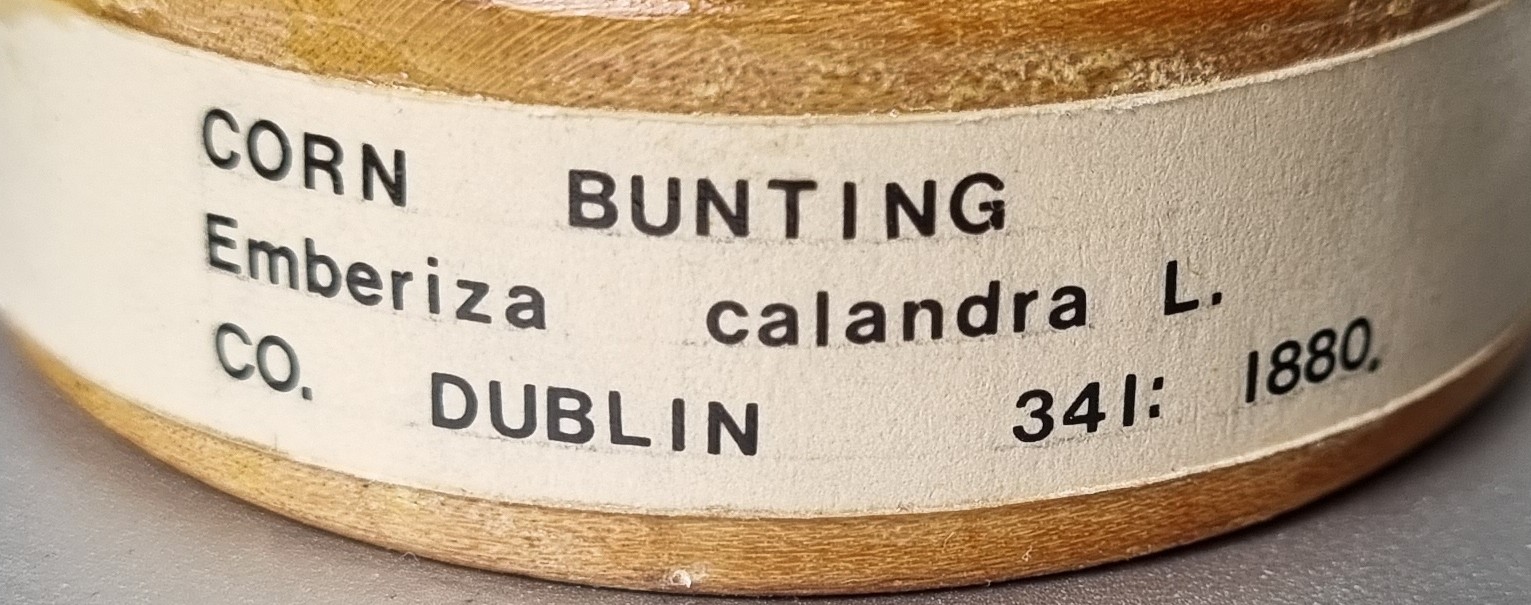
This specimen has a robust, conical bill and grey-streaked breast, which led some of you to think it could be a juvenile Crossbill or perhaps a female Grosbeak. However, as indicated by Wouter van Gestel in an excellent cryptic clue (and by Tim Dixon in a rather rude one), this is a Corn Bunting Emberiza calandra Linnaeus, 1758. It was collected in County Dublin and donated to the Dead Zoo in 1880.

These seed-eating passerines were widespread in arable farmland across Ireland in the 19th and early 20th centuries. However, changing land use practices reduced the available habitat until they became locally extinct as a breeding species in the late 1990s – well within living memory for many people.

The Irish name for the Corn Bunting is Gealóg bhuachair and an interesting fact about these birds is that their populations are remarkably sedentary, allowing them to develop unique dialects in their breeding area. This means that even if this species is reintroduced to Ireland – assuming farming practices become better suited to their survival – the landscape will never again ring with quite the same song that these birds would have sung in the past.

Friday mystery object #450 answer

Last week I gave you this mystery object to have a go at identifying:

Perhaps not the most festive of objects to consider over the Christmas weekend, but it’s a very interesting one that is on display in the Museo Nacional de Ciencias Naturales in Madrid.

I had a pretty good idea of what this was likely to be as soon as I saw it, based on my memory of a badly pest damaged taxidermy specimen of this species I saw about 12 years ago. But, the skull shap alone is distinctive, and the fringe of feather stumps around the eyes makes this fairly staraightforward to work it out – and a lot of you did just that.

This is the partially mummified skeleton of a Barn Owl Tyto alba (Scopoli, 1769).

That fringe around the orbits is made up of the nibbled down rachides (the stiff central vane of the feather is called a rachis and rachides is plural) of the feathers that created the facial disc. This structure acts a bit like a radar dish to help channel sound into the auditory openings (AKA earholes), and it’s what gives owls that distinctive flat-looking face, belying the shape of the underlying skull. The skull itself is particularly long and low for an owl, which is what screams Barn Owl to me, as other owls have a higher domed skull and relatively shorter bill.

You may have seen images of a similar looking specimen in the last couple of years, as a photo of a specimen on display as part of a special exhibition in Museum Natur und Mensch (Museum of nature and man) in Freiburg, Germany did the rounds on Twitter. Unfortunately I missed that exhibiton, but Markus Bühler did visit and wrote about it on his blog, which I strongly recommend taking a look at.

I hope you enjoyed the Christmas mystery object this year – let’s see what I can find for you in 2023. Have a very happy New Year!

Friday mystery object #407 answer

Last week I finally got a chance to share a nice skull from the Dead Zoo for you to identify:

Bird skulls are always an interesting challenge, because the bill can give away some useful clues and there is a fantastic online resource available to help with their identification, in the form of SkullSite, run by Zygoma regular Wouter van Gestel. Perhaps unsurprisingly Wouter tends to be one of the first to get a correct answer when the mystery object is avian – and this one was no exception.

One of the useful features on SkullSite is the ability to do a custom search, which allows you to restrict the size range of skulls and the bill shapes to search through. This allows easy comparison between the skulls of possible taxa, making identification more straightforward, once you get your eye trained to recognise useful features.

In this case there are a few species in the same size range with similar shaped bills. The closest species in size and shape (that’s not a close relative) is the Great Bustard. However, the Great Bustard has much longer nares (the fancy name for nose-holes) than the mystery object and the bustard’s lacrimal bones (the small bones that flare out just to the front of, and above, the eye sockets) are much smaller and less pronounced than what we see in the mystery specimen.

That leaves the two species in the Family Cariamidae (or Seriemas) to pick from. The size of the specimen alone makes that fairly straightforward, as there’s around 15mm difference in the skull length between the two. However, if you want a morphological feature, the mandibular fenestra (the ‘window’ visible in the side of the lower jaw slightly back from the midway point) is proprtionally a lot larger in the Black-legged Seriema compared to that of the Red-legged Seriema.

The fenestra is small in the mystery object, while the skull is large, making this a specimen of the Red-legged Seriema Cariama cristata (Linnaeus, 1766).

A Red-legged Seriema in Reserva Ambiental, Piraju, São Paulo, Brazil. Image by Dario Sanches, 2010

I tend to think of Seriemas as the South American equivalent of the Secretarybird, since they are ground-hunting predators in scrubby environments that have a fondness for venomous snake snacks.

Both have long legs and small feet, neither fly much and both have eyelashes, as pointed out by Goatlips on Twitter:

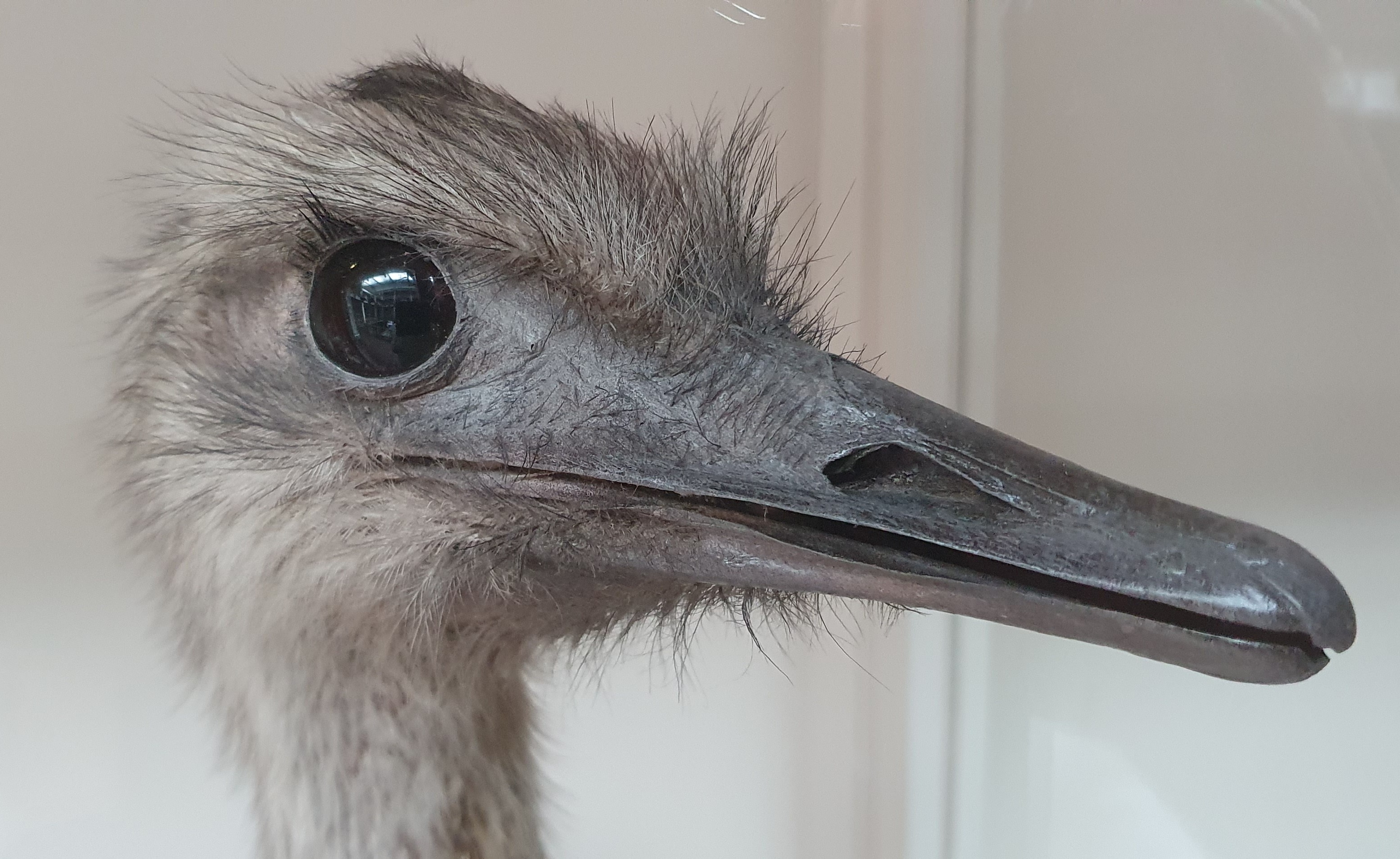
I’d never really consider the bird eyelashes thing and it makes perfect sense for terrestrial birds foraging on the ground in arid environments to have some extra eye protection from sun and dust afforded by filamentous feathers around the eyes. It turns out this holds true for birds like Ostriches, Emus, Cassowarys, Rheas, Road-runners and the Ground Hornbills.

However, some other Hornbills that live in very different environments also have eyelashes as do those odd arboreal Hoatzins, so there must be something else going on with those lovely lashes that I’m missing.

I hope you enjoyed this bony challenge – please feel free to add your thoughts on the eyelash situation and perhaps mention any species you’ve noticed this feature in before. You never know, together we might figure out what those lashes are all about.

Friday mystery object #405 answer

Last week I gave you this mystery object from the Dead Zoo to have a go at identifying:

There was no scale and admittedly there’s not much of the specimen visible, but I didn’t think that would pose much of a problem. And I was right. Tony Irwin immediately indicated the identity of this rather rare specimen with the anagram:

Maybe found it – in rosy pea?

The “in rosy pea” unscrambles to Aepyornis which is the generic name for the Elephant Bird.

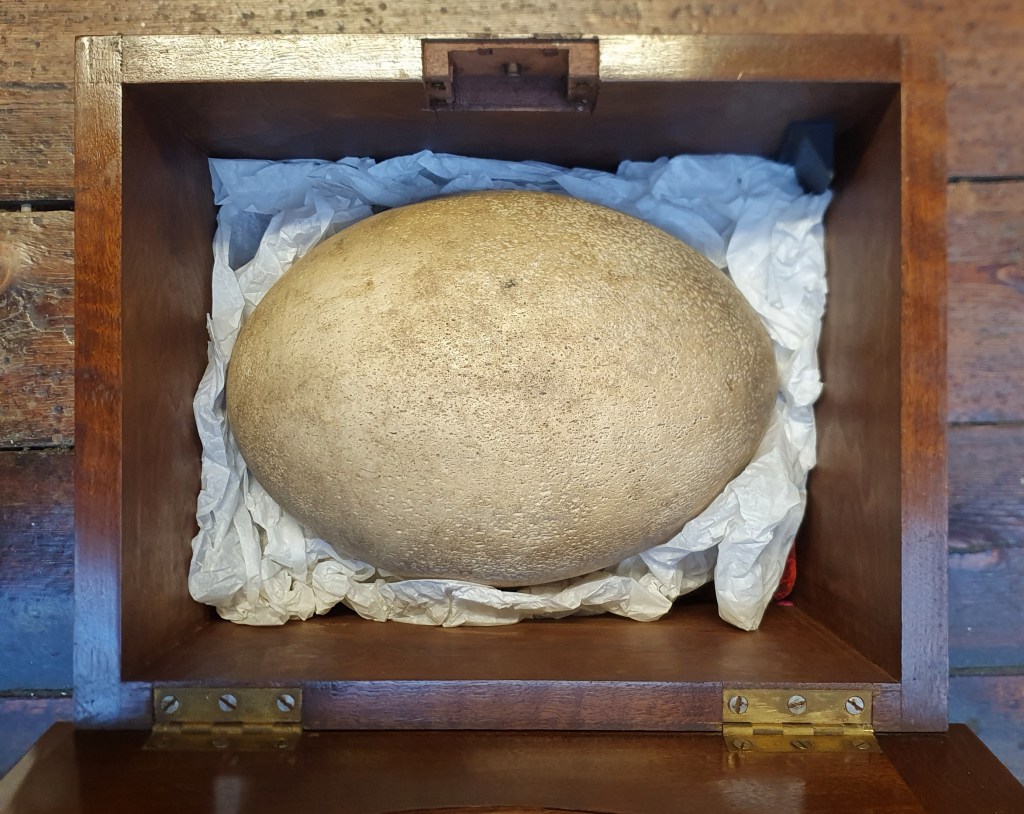
Of course, this isn’t a complete Elephant Bird, it’s only an egg (had to get some Eastery link in there somehow). Elephant Birds have been extinct for about 1,000 years, so surviving eggs are very rare, hence the special fancy box. Here’s the actual egg:

The total length is just shy of 1 foot at 29.6cm, making this one of the largest eggs ever laid by any animal. There are other Elephant Bird eggs that are a bit bigger (up to 34cm), but no other type of animal ever laid a bigger egg, even the vast sauropod dinosaurs laid eggs that were smaller than this.

I’m not going to tell the story of this specimen here, since it’s already on the National Museum of Ireland’s website. If you have a read of that, you’ll see that this specimen is from the southern end of Madagascar (the island on which these birds lived) and that plus the particularly large egg size suggests that this is from Aepyornis maximus I. Geoffroy Saint-Hilaire 1851.

This is not the first time I’ve dealt with Elephant Bird eggs, since I borrowed one from David Attenborough for an exhibition at the Horniman Museum about 5 years ago, which I talked about here.They are remarkable objects and it’s strange to think of something as fragile and seemingly ephemeral as an egg surviving intact for over a thousand years.

So well done to everyone who worked out what this mystery was – eggcelent work!

Friday mystery object #404 answer

Last week I gave you this bird from the Dead Zoo to have a go at identifying:

It wasn’t really much of a challenge for the usual suspects, with everyone recognising this as a Common Hill Myna Gracula religiosa Linnaeus, 1758.

However, my reason for picking this as a mystery object wasn’t for the challenge offered, but as an illustration of just how frustrating the taxonomy of old collections can be. Everyone recognised this bird, which is not a huge surprise, given how familiar this species has become due to the pet trade, but anyone looking at this specimen on display would probably struggle to match the specimen to the species considering the label that was attached:

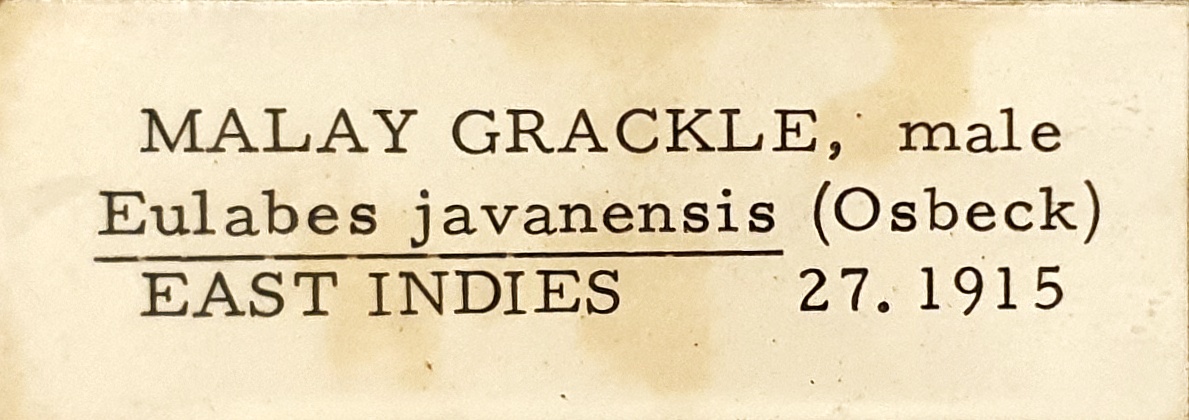
The common name here suggests that the specimen is from Malaysia, then the scientific name suggests Java, but then the locality associated is just “East Indies”. The genus name does at least bear a passing relationship to the modern specific name (“Eulabes” means “pious” or “devout” while “religiosa” is self-explanatory). Similarly “Grackle” does hold a clue to the modern Genus name of “Graculus“. Most confusing.

To make things worse, the Graculus is now recognised as forming a species complex across Asia, so it would be good to narrow down which subspecies this specimen belongs to:

Distribution of the various species and subspecies within the genus Gracula. Image by L. Shyamal, 2009

The pattern of coloured feathers on the neck and head on the Dead Zoo specimen appears to match G. religiosa intermedia most closely, so when I eventually reach the stage of rewriting labels for specimens on display, I’ll do my best to improve the information. Unfortunately, this will probably need to happen for around 75-80% of the collection, so no pressure…