
Last week I gave you this rather lovely skull to try your hand at identifying:
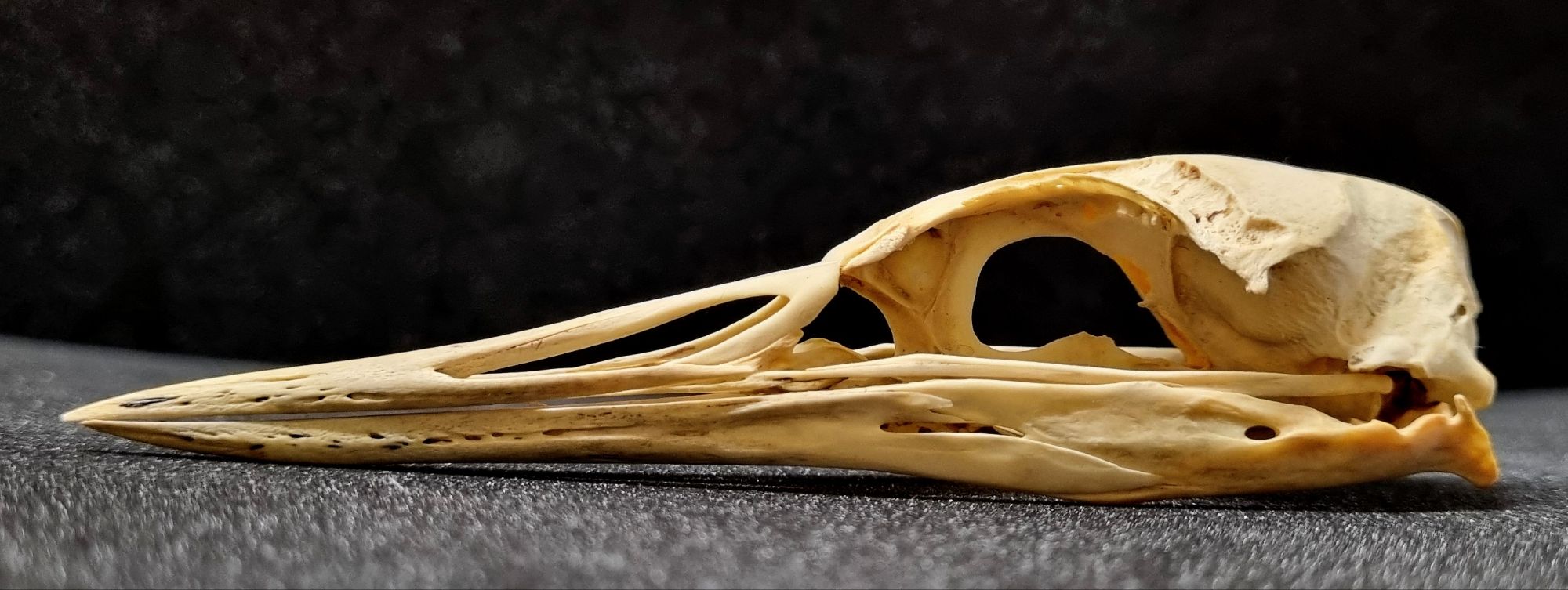
Obviously it’s from a bird, but which one?
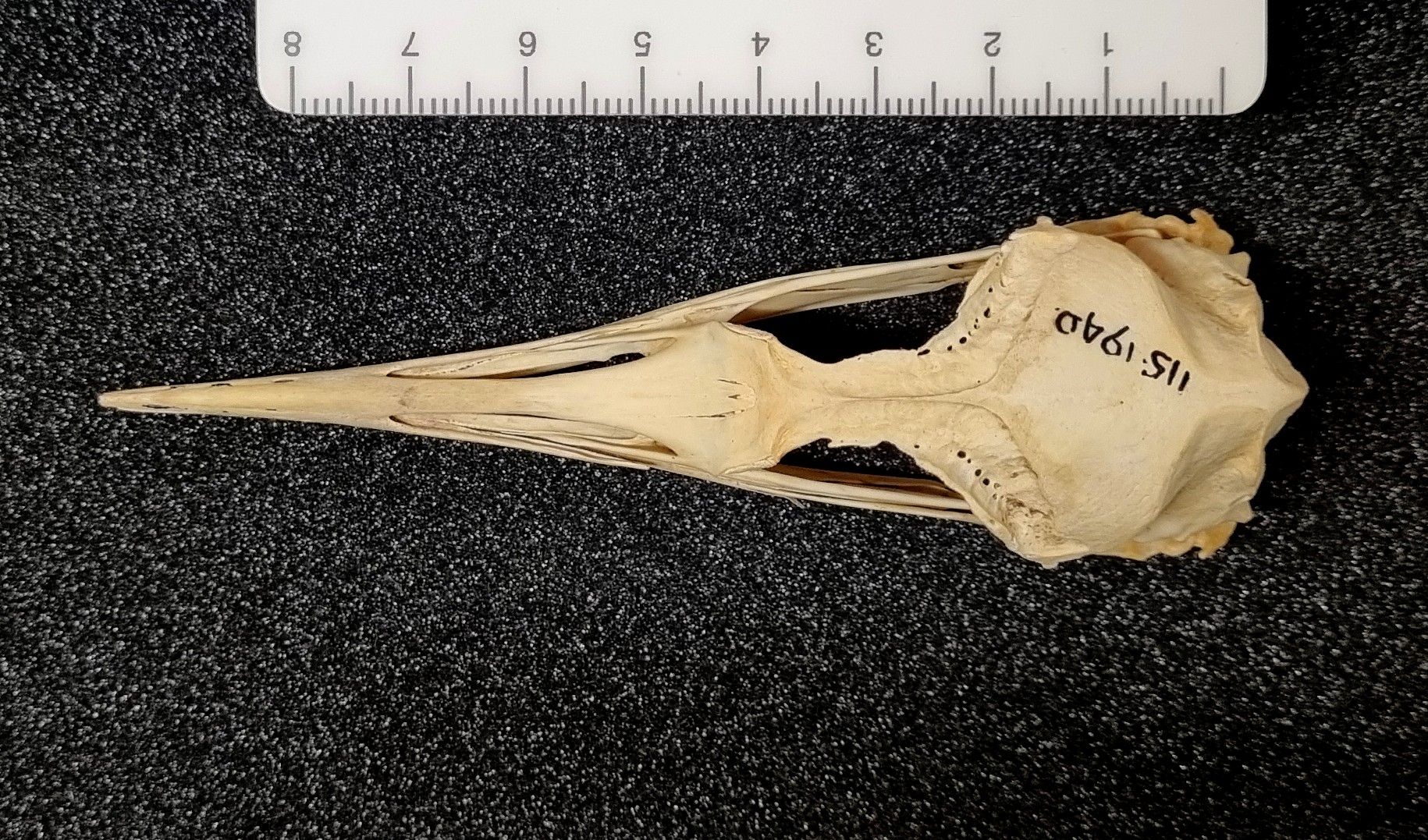
The top of the skull offers an immediate clue as to the environment this bird lives in, as you can clearly see the scars in the bone above the eyes where the salt glands of a marine bird would sit. The bill is also long, narrow and spear-shaped, which is generally a good indicator of a bird that catches fish.
However, the skull is a lot lower in profile than you see in most marine birds. If you compare this to the skulls of Guillemots, Puffins, Razorbills, Gulls and generally most of the Charadriiformes, you’ll see that they sit higher. Other options like Gannets are more robust, plus they lack salt gland scars above their eyes (theirs sit under the frontal bone) and Cormorants also lack the scars above the eyes, as their salt glands sit in their nasal region.
As you rule out the various options, you end up with Grebes (who have similar skulls, but still not as long and low as this) and Divers or Loons as they are also known on the other side of the Atlantic. You guessed it, this is the skull of a Diver.
There are five species of Diver and I have to admit that this one is a little hard to nail down to species, since the size (one of the simplest methods of differentiating between species) and even the anatomy are misleading, as it’s not from an adult.
In the words of Skullsite’s avian anatomy expert Wouter van Gestel:
Yes, this specimen is rather young, that’s why the palates and the lacrimals fell off and the premaxilla is not fully fused to the other bones. The quadrates and pterigoids are missing too but they never fused to the rest of the skull. The result is a very incomplete skull, but that makes the game more interesting;)
As Wouter recognised, this skull is from a Red-throated Diver (or Red-throated Loon if you prefer) Gavia stellata (Pontoppidan, 1763).

The Red-throated Diver occurs as a visitor all around the coast of Ireland, with a very few that breed in County Donegal – which marks the southernmost breeding population for the species, which normally breed in places like Iceland and northern Russia.

So well done to everyone who recognised this as a Diver, and if you figured out it was the Red-throated species, you should be feeling proud of yourself!


If you recognize this skull as a diver, there are two European species you have to take into consideration; red-throated- and black throated (arctic) diver/loon, and I forgot to mention how to distinguish them.
Red-throated diver has a straight culmen (top side of the beak) and a lower jaw that is hooked upward. The result is a bill that looks turned upwards.
Black-throated has a culmen that this sligthly curving down toward the tip with a lower jaw that is slightly curving upward to the tip, resulting in a dagger shaped bill
Interesting, the two other European species, white-billed and great northern diver, have the same difference in bill shape. Because they are much bigger than the other two, they are easily distinguised