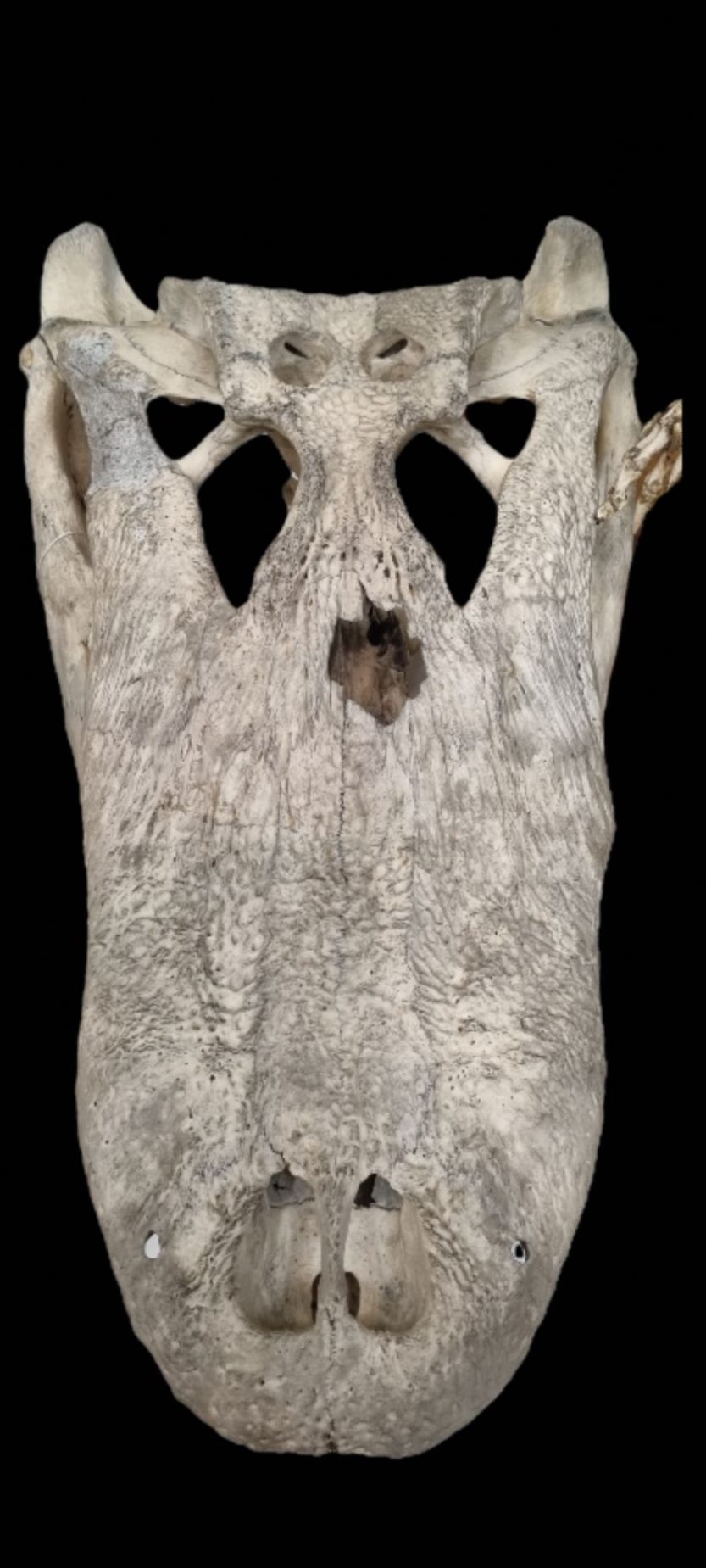
I hope you had an enjoyable Christmas! Last week I gave you this chonky skull as a mystery object to have a go at identifying:
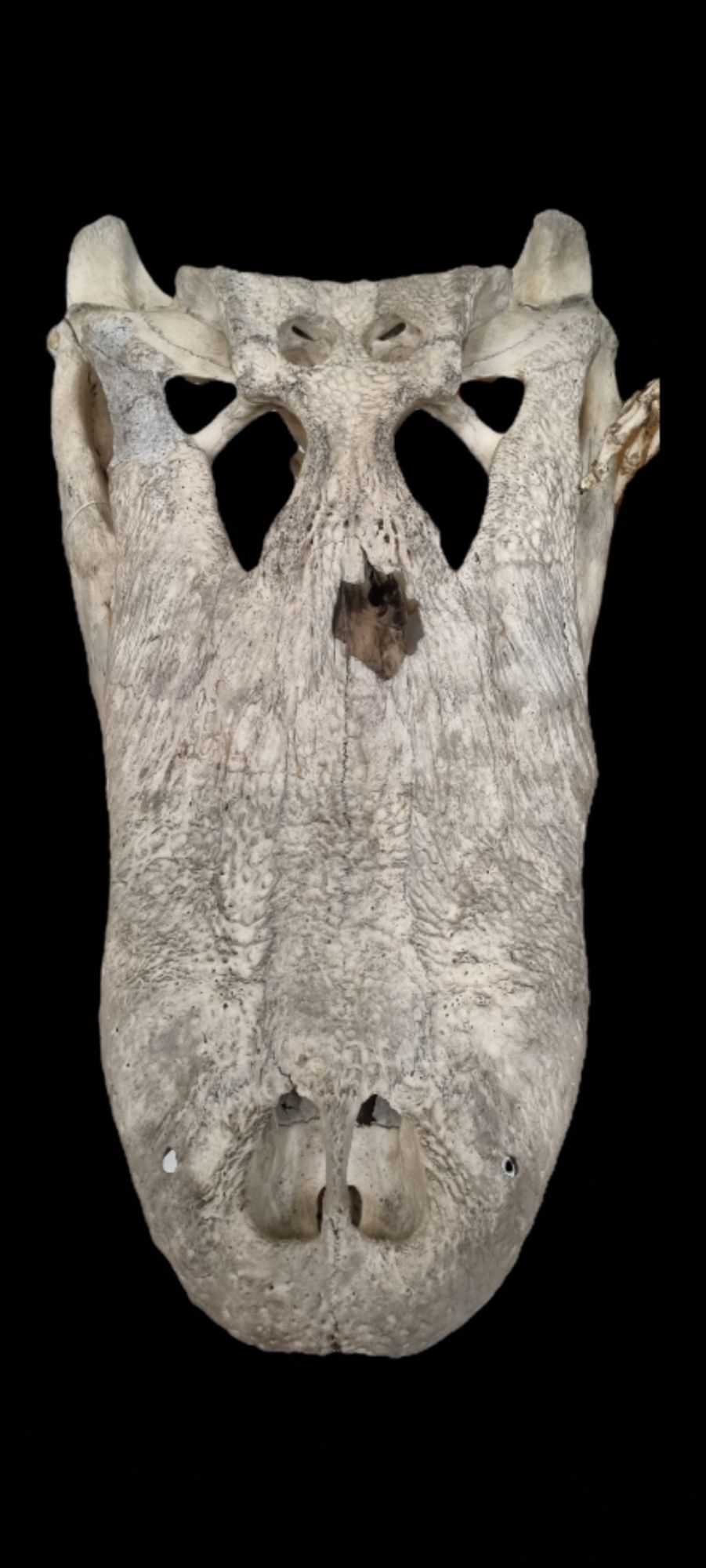
It wasn’t anything particularly challenging or unusual, but it’s a very cool skull that we recently put on display in the Dead Zoo Lab in Dublin, and it’s nice to have a chance to share it here.
While Caimans did get a mention, pretty much everyone worked out that this is the skull of an Alligator – although which of the two living species it might be sparked some conversation.
In the words of Adam Yates:
Clues include snout shape and length, divided nostrils and lack of a lateral notch for receiving the big fangs from the lower jaw.
Excellent advice, although the simplest way I use to tell the difference is to check how much of a U-shape the maxilla forms. In this case it’s very U-shaped, which says American Alligator Alligator mississippiensis (Daudin, 1802).
I’m keeping this answer brief for this mystery object, since I’m sitting at a dinner table with family after a fantastic – and very large – meal, so I’m struggling to be creative with all my blood rushing to my stomach rather than my brain.
I hope you had a great Christmas, and I look forward to sharing more mystery objects for you in 2026!
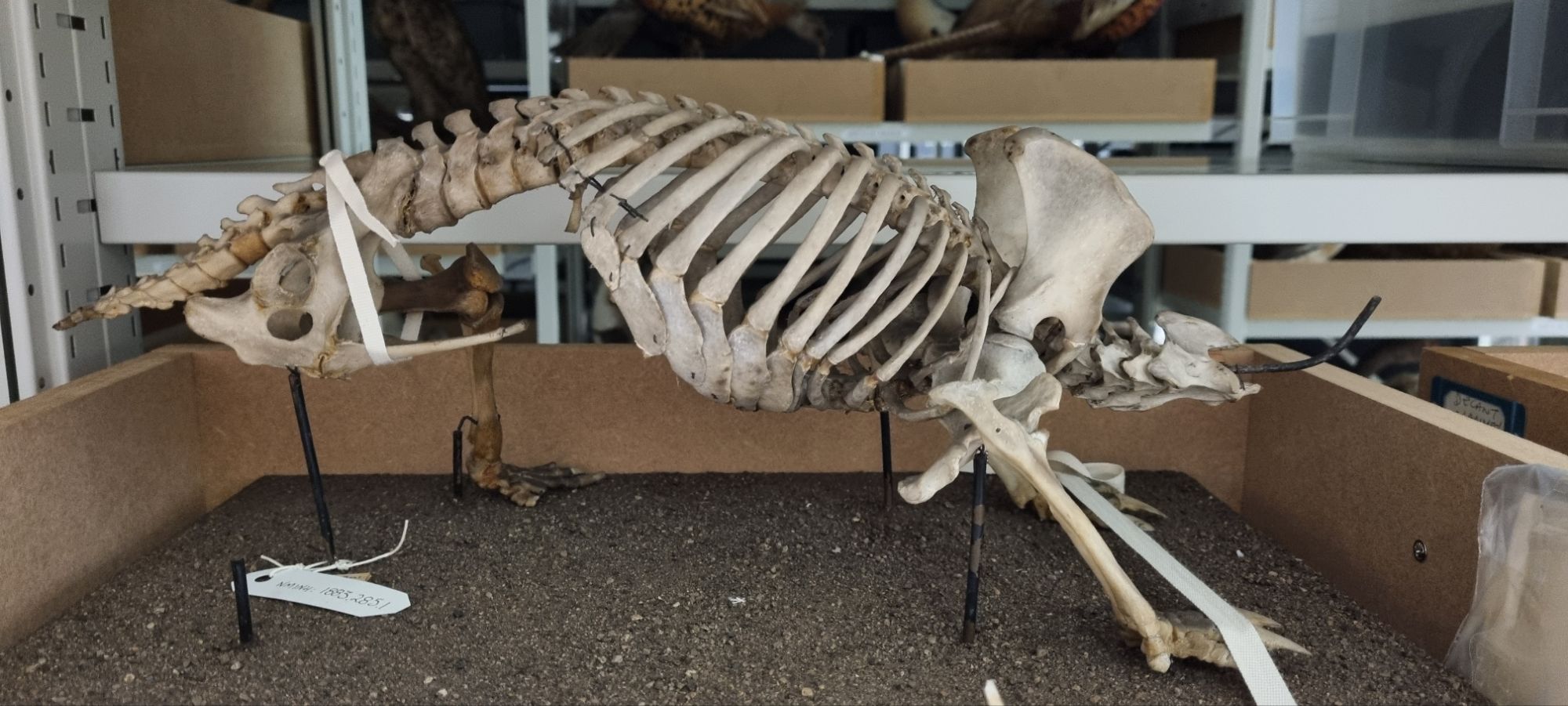
Last week I gave you this skeleton from the stores of the Dead Zoo to have a go at identifying:
The comments came flooding in, with some slightly off and some very much on target.
The robust skeleton and stocky build of this animal, combined with some interesting bony processes – especially in the pelvic region – offered up some pretty good indicators of the type of critter we’re looking at.
The forward-facing processes of the pelvis were initially mistaken for a baculum, but on a closer look their dual nature becomes more apparent:
These are epipubic bones, which aren’t found in Placental mammals – but this is definitely a mammal – so this is either a Marsupial or Monotreme.
The lack of a skull makes it a little harder to immediately figure out what this might be, but the feet are useful – very useful in fact:
These look like the feet of a digger with those big, robust, triangular claws – but not just a burrowing digger like a Wombat – more like an ant and termite specialist whocan break open their nests. That offers a key clue.
This is the skeleton of a species of spiny anteater – one of the four species of Echidna. The feet actually offer a further diagnostic clue to the species, since most species have five claws, while just one has three – the Three-toed or Western Long-beaked Echidna Zaglossus bruijnii (Peters & Doria, 1876).
This particular specimen was originally on display in the Dead Zoo under its old name Pro-echidna Bruijnii:
Photo of Three-toed Echidna skeleton NMINH:1883.285.1 at the National Museum of Ireland – Natural History taken by Illustratedjc, 2015.
The specimen has been taken off display along with everything else in the building over the last year or so, in preparation for a big refurbishment project.
When it was decanted, along with skull, the fragile right-hand-side rear limb was removed. In the photo above you can see where a claw is detaching – possibly as a result of incorrect foot positioning on the mount (Echidna feet point sideways and backwards, which seems to have confused some mounters). In other places, cotton tape was used to stabilise some of the more wobbly robust elements.
Being able to work through items like this while they’re in storage will be helpful, since it will allow us a chance to remove the worst of the dust from what may have been 140 years of display, and to make some small repairs to things like the detaching claw so it doesn’t get lost. Changing the foot position may be a bigger job, but it’s something to consider.
So while the Dead Zoo may be closed, we’re keeping busy checking the condition of the other 10,000 object we had on display, and working out what we need to do to put them back!



 Zygoma