Friday mystery object #524 answer

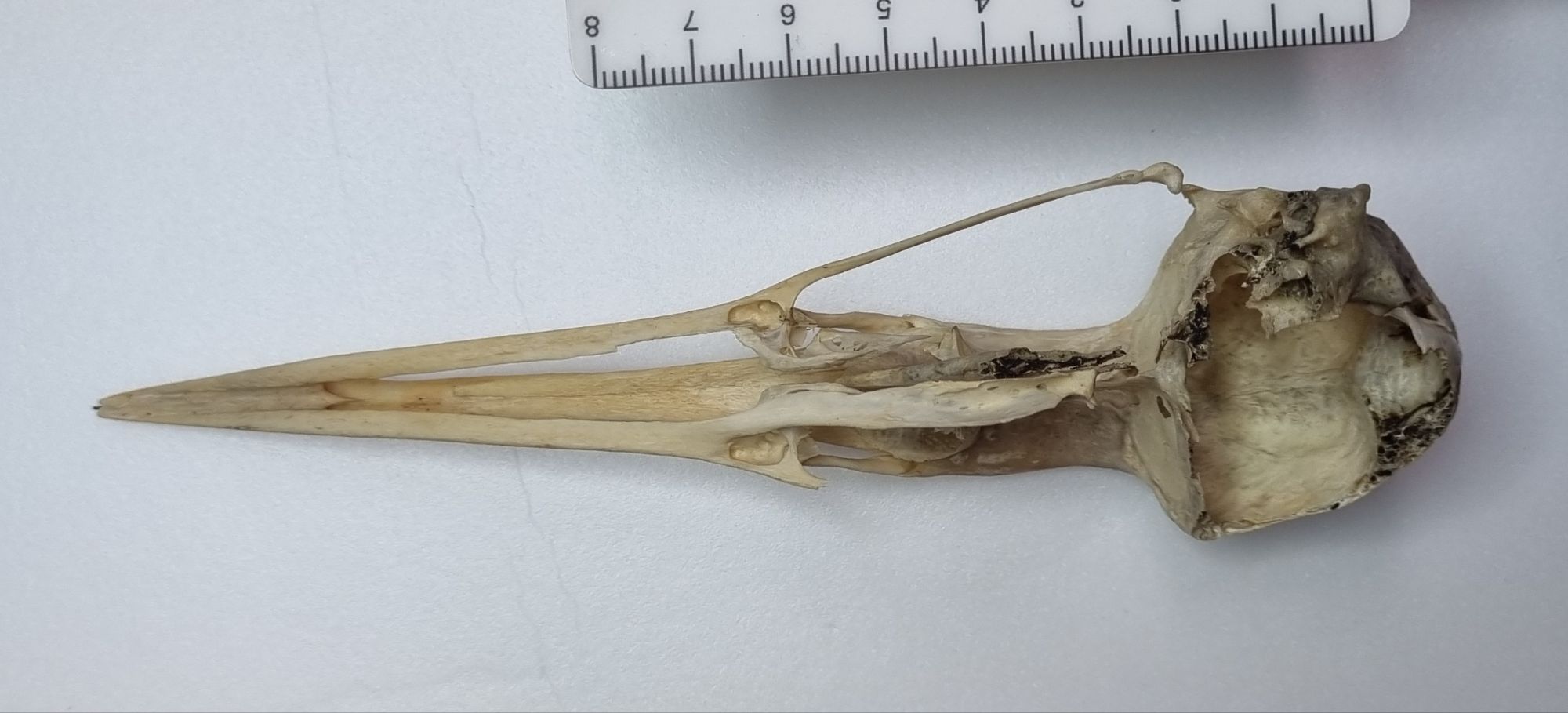
Last week I gave you this skull from the collections of the Dead Zoo to have a go at identifying:
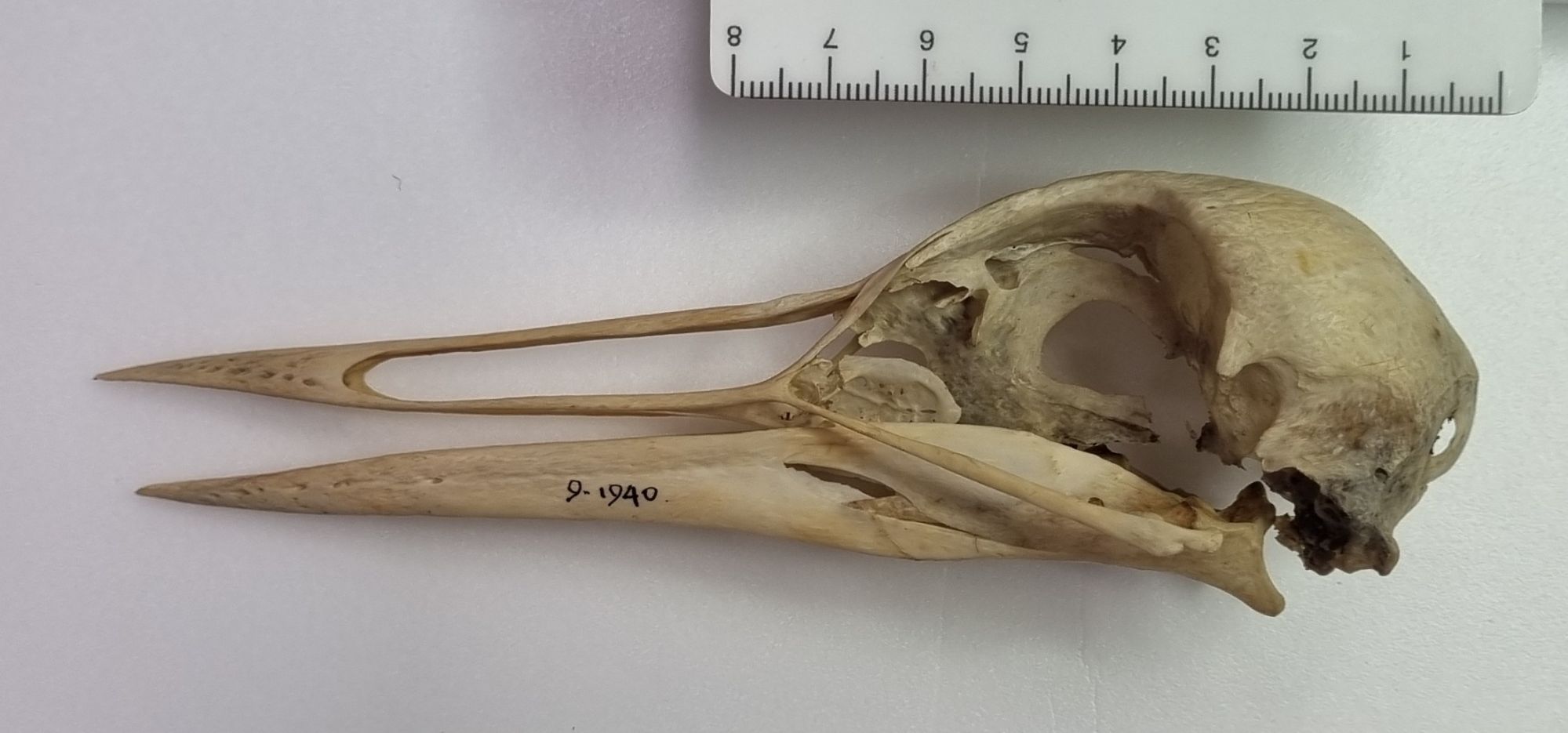
Bird skull identification can take a bit of work, until you get your eye in on things like the bill morphology (especially without the clues provided by the keratin sheath). Resources like the excellent Skullsite.com certainly help a lot, by providing a huge range of images of different species for comparison, and with tools to help narrow down options based on skull size and bill morphology.

As it turns out, Adam Yates certainly had his eye in, and he was first to comment with a correct identification for this specimen. It’s a Common or European Crane Grus grus (Linnaeus, 1758).

I chose this specimen as it’s one that we recently put on display in the Dead Zoo Lab as part of a community curated project called Our Irish Natural History. Eight community groups involved with iCAN (the Irish Community Archive Network) contributed to the work, which was coordinated by Adriana Ballinger – a fantastic postgraduate humanities researcher who has been working with us for the past year on a project with a focus on the wider cultural context surrounding natural history collections. The community groups involved each explored a different areas of interest, illustrating and exploring some of the connections between objects and local communities.

The Common Crane offered a fascinating topic explored by the Woodlawn Heritage Group and Galway Community Archaeology, who delved into the past history of the Crane in Ireland, and its importance to Bronze Age people, also touching on their recent return, with a pair of these fantastic birds recently recorded nesting in rewetted boglands. There’s too much information for me to cover it all here, so I recommend taking a look at the work for yourself on the Galway Community Archaeology web resource about the project.

These sorts of projects, that connect our ostensibly scientific objects back into local communities through a cultural link are a fantastic way to broaden the relevance and interest in our collections. As a scientist it can be easy to focus on one aspect of an object – but every item we look after can be viewed from multiple perspectives – all of which add value and relevance.

I look forward to working on similar projects in the future, while hopefully taking the opportunity to share more of the collection here, for those of you with an interest in identification!

Friday mystery object #523 answer

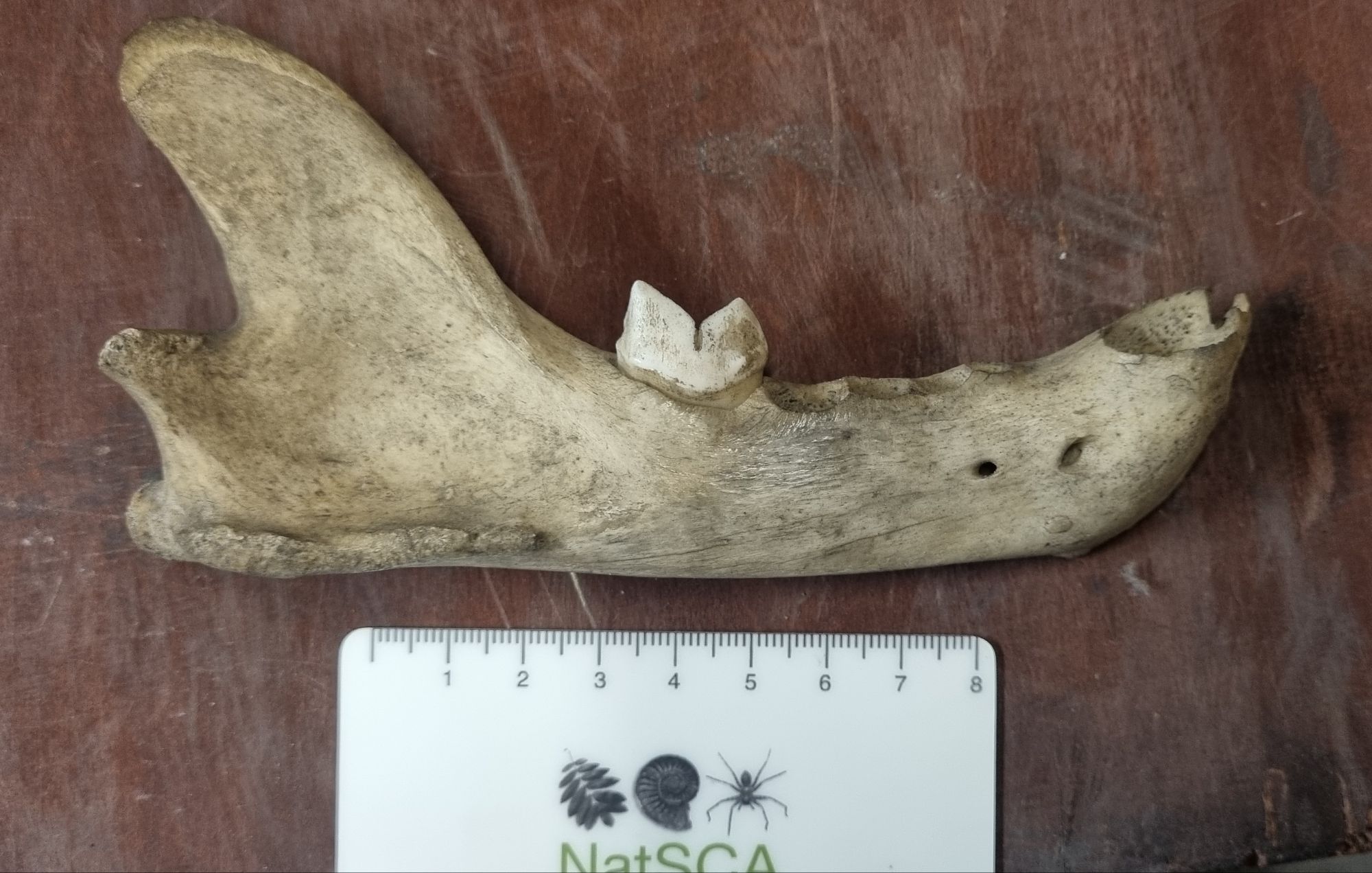
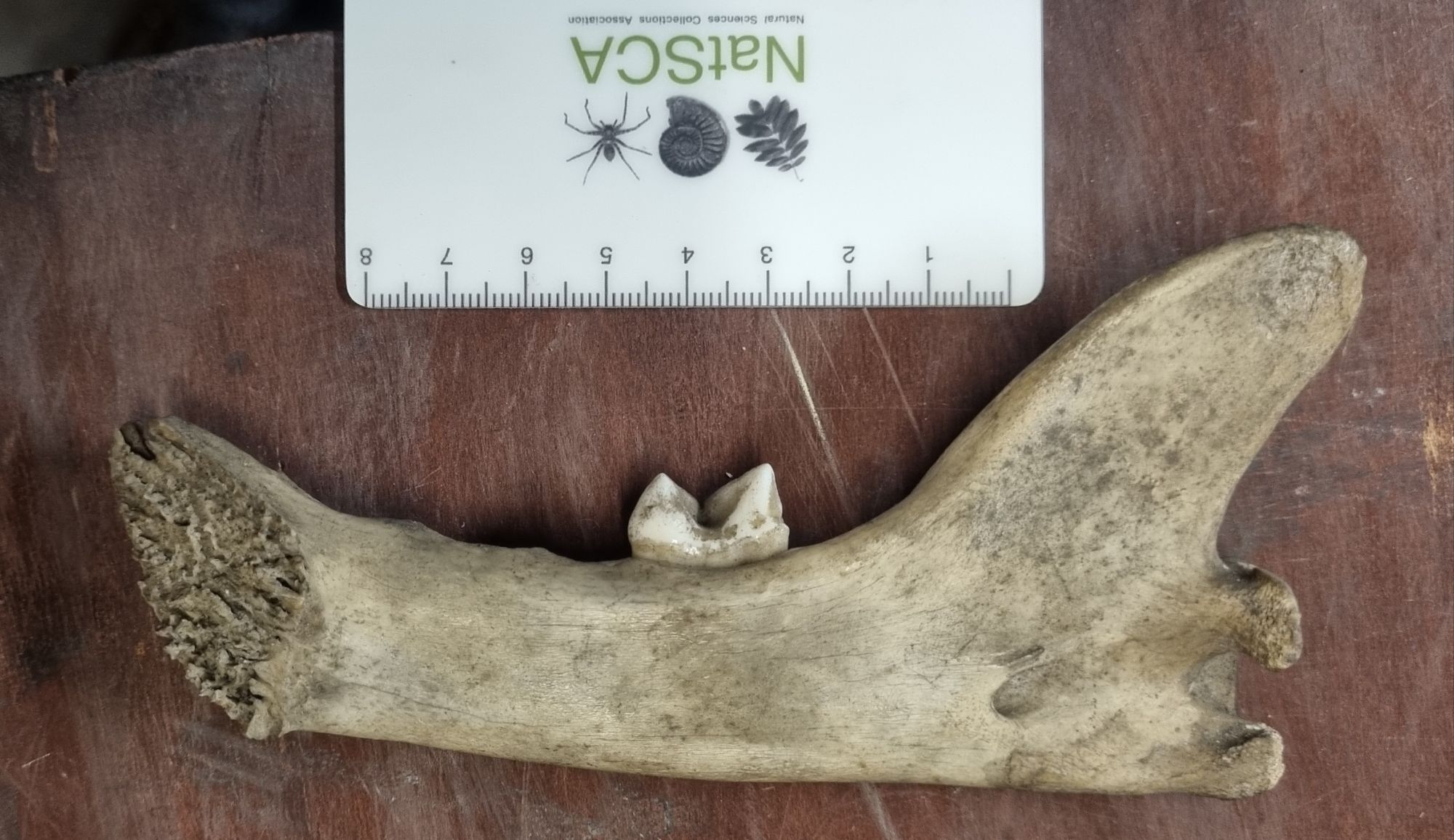
Last week I gave you this mystery mandible to help me identify:

It was found in a box of mixed shells and bony fragments, with no label, and nothing to offer a clue to its origin. This is very unusual, since these sorts of boxes of miscellany were mainly addressed years ago, but this one was well tucked away and somehow escaped being dealt with.

It’s fairly easy to recognise this as being the right mandible of some kind of cat. The Felidae have a reduced tooth count, with those hyper-carnivorous bladed premolars forming a meat-shearing carnassial row that’s very distinctive. So that’s the easy bit done.

The hard bit comes next, since the cats all share this same dental configuration, making the specific kitty in question a bit harder to narrow down. However, the size is a useful clue. This is much too big to be something like a Domestic Cat, Serval or Ocelot, but it’s also too small to be one of the big Big Cats – like the Lion or Tiger:

Tiger skulls facing off – the scale of these skulls is much greater than the mystery mandible

This leaves some of the medium-large Big Cats and perhaps a very large Small Cat (i.e. the Cheetah). Let’s start by ruling out that last one – the size is still a bit on the big side, but also the Cheetah has a more gracile coronoid process that curves, and a relatively shorter toothrow. Pumas also have a more rounded coronoid process.

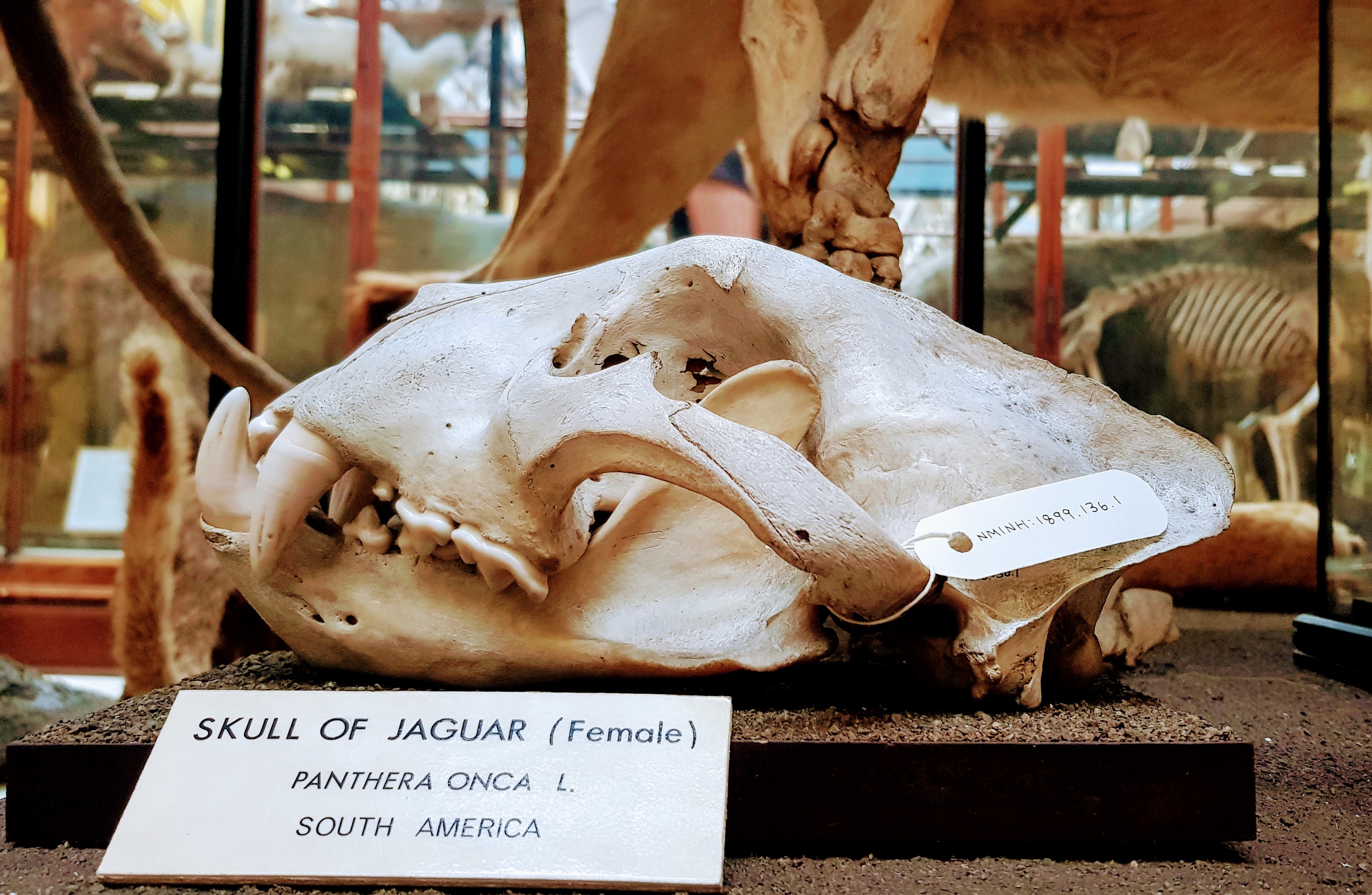
The Jaguar also has a more rounded coronoid process, and has a more robust mandible, that’s just built thicker to deal with the high bite forces these cats generate:

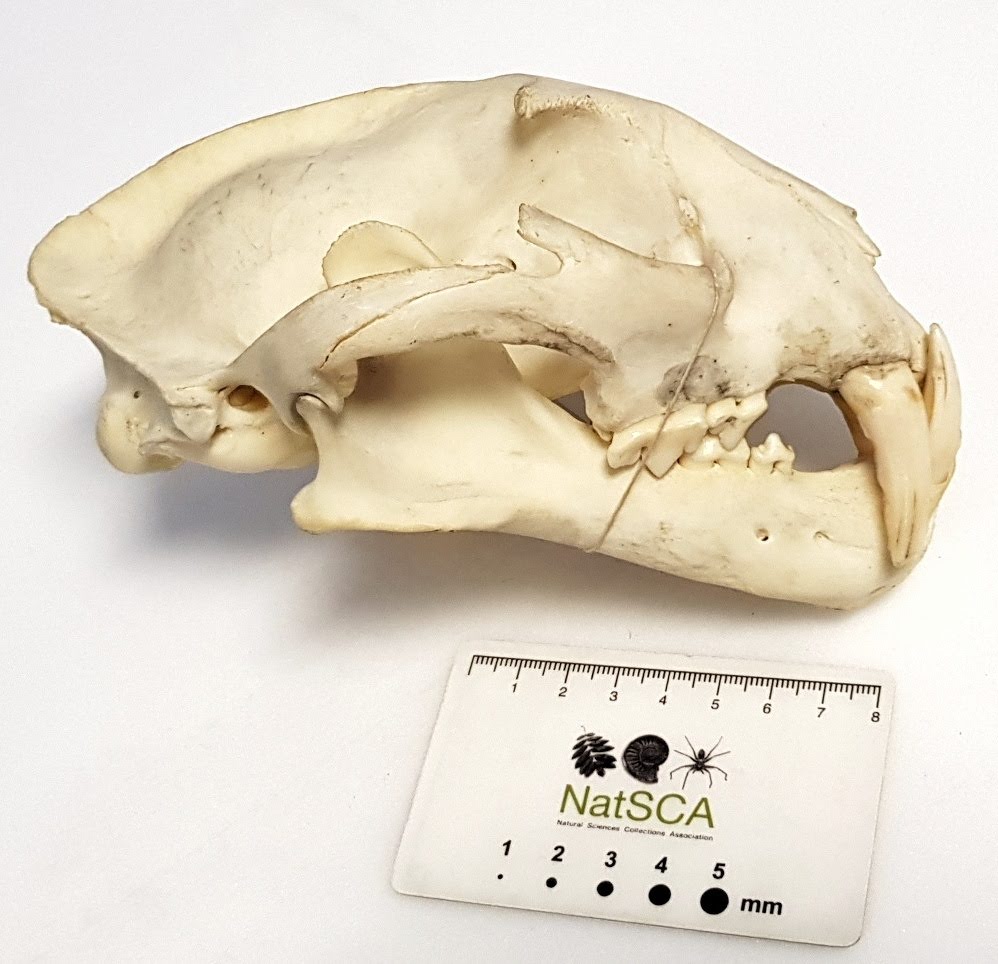
That leaves us with the Snow Leopard and the not-snow-Leopard, both of which have the more pointed coroid process that we see in the mystery object. However, the Snow Leopard has downwards inflected angular process, that’sI suspect may relate to the increased gape needed to use the excessively long canine teeth in this species:

The answer to last week's mystery mandible
Snow Leopard skull, showing the hypertrophied canines normal in this species.

So, by a process of elimination, we’re left with Leopard Pathera pardus (Linneaus, 1758). This species varies significantly in size and the morphology can be quite variable, since the species has a wide distribution, from Eastern Russia to as far West as Senegal.

This actually reminds me of a very similar mystery object from the Grant Museum of Zoology that I shared 10 years ago, so I’ hope that provided something useful for reference so I’m glad I trawled through some of my past posts to help solve this one. My thanks to everyone who offered their thoughts on this one – it’s great to see so many of you come to the same conclusion!

Friday mystery object #522 answer

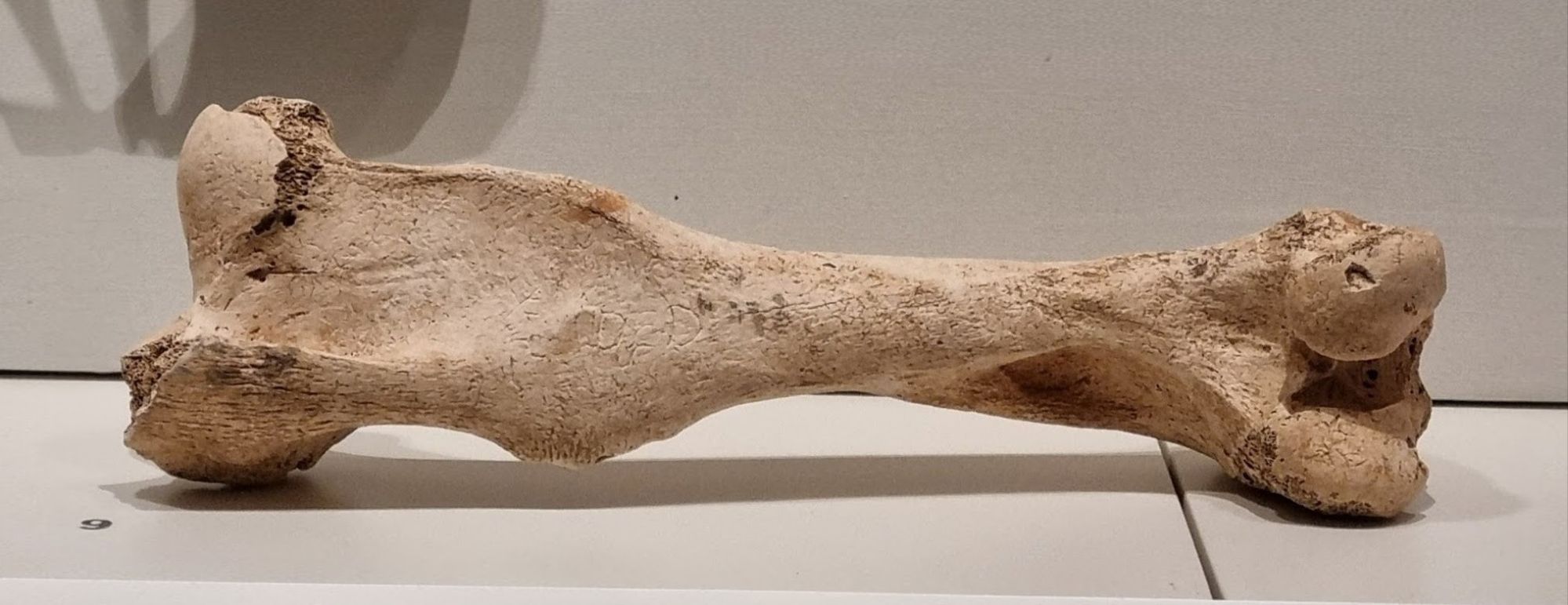
Last week I presented this mystery bone from the Words on the Wave exhibition at the National Museum of Ireland on Kildare Street:

The bone is over a thousand years old, so it’s unsurprising that a few of the processes that could be useful for identification have been worn down a little:

That said, there was plenty of information remaining to allow several of you to identify the animal, bone type and side of the animal this is from. Adam Yates was first to the comments and he also left a very helpful Toot on Mastodon, detailing the diagnostic features:

@mike @PaoloViscardi 
The prominent third trochanter and really well-developed supracondylar fossa on the lateral caudal surface at the distal end of the shaft should get you there. You won't have to look beyond  familiar farmyard beasts to find it.

For me, the supracondylar fossa on the lateral caudal surface is the instant give-away. For those who don’t speak anatomese, that’s the bit that flares out from the side of the shaft of the bone (which is actually missing a bit in this example).

This is a feature I always associate with the Perissodactyla (the tapirs, rhinos and horses), and this one is nowhere near robust enough for anything other than one of the horses. It’s also fairly small (although the lack of a scale bar doesn’t make this obvious).

This a left femur that I suspect is from a Horse Equus ferus caballus Linnaeus, 1758, but it could also be from a Donkey Equus africanus asinus Linnaeus, 1758. It can be tricky to tell these species apart, especially when the bone is a little worn down and you only have a few photos to work from – so best to err on the side of caution and leave it at an identification of Equus sp.

If you’re in Ireland and wanted to take a look at this object – and a selection of remarkable mediaeval manuscripts from the Abbey of St Gall, Switzerland, some of which are returning to Ireland for the first time in 1000 years – you have until the 24th of this month, I’d definitely recommend it!