
Last week I gave you a bit of tricky mystery object in the form of this colourful character:
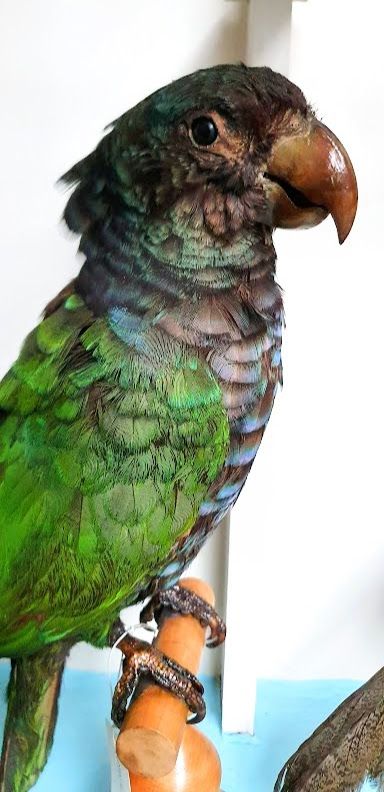
Obviously it’s a parrot of some sort, but there are LOTS of parrots. With over 400 species to choose from, identifying one from a single image is not easy at all. Generally when it comes to parrot identification it’s very useful to know where it came from, and without that information this mystery is made even harder – but if I’d provided the locality it would have been way too easy!
I find a useful way to narrow down possible species when looking at parrots is to simply use a search engine and add descriptive terms of the colours of parts of the external anatomy. In this instance I searched for “parrot with emerald green wings, blue and purple chest” which offered up a few possible species, but it significantly narrowed down the options to work through. Of course, I did that with some awareness of colours likely being a little off.
This is a specimen that arrived in the Dead Zoo in 1902 and it’s been progressively fading due to light exposure over the last 120+ years. The purples here are muted and I suspect the blue visible on the breast is actually residual following preferential colour loss of red pigments (types of carotenoid) that would have interacted with the structural blue colour of the feather (structural colours being much more light-stable than pigments) to create a much more vivid and robust purple colour than we see today. With that in mind, it becomes much easier to work out what this species is.
This is the Dominican Amazon (or Imperial Amazon, or Sisserou) Amazona imperialis Richmond, 1899 – one of just three species of parrot from the Commonwealth of Dominica, an Island in the Carribean. Here’s an illustration of what it looks like when it’s not faded:

This species features on the flag of the Commonwealth of Dominica and sadly there are very few of these stunning birds remaining, with estimated numbers somewhere between 40 and 60 mature individuals – making it Critically Endangered.
While numbers had been declining due to habitat loss, hunting and the taking of wild birds for the pet trade, the population has been significantly impacted by severe hurricanes hitting the island – which are increasing in frequency and severity due to climate change.
Hopefully, conservation efforts and the relatively inaccessible mountaious areas of the island in which the birds live will allow them a chance to recover, but they breed slowly and the threat from hurricanes remains.
Well done to everyone who had a go at this – it really was very difficult, so props to Katenockles who came close with a suggestion of the Blue-headed Parrot. Of course, there were lots of comments that referenced the infamous Norwegian Blue, which for younger readers might be unfamiliar, so here’s the source:
Just to note, while there are no parrots known from Norway, there are some fossil examples known from Denmark – so perhaps there is a chance the Norwegian Blue actually existed – albeit 55 million years ago,
 Zygoma
Pingback: Friday mystery object #520 answer | Zygoma