
Last week I gave you this very tricky object to have a go at identifying:

It certainly proved a challenge and I have to admit to feeling a little guilty about setting such a difficult one. The reason it was such a challenge is because this is an abberant form.
I’m not sure if anyone worked it out fully, but katedmonson dropped in the word “Oughter” and Adam Yates spotted that it has a long-slung body that looked like it might belong to a mustelid… which it does.
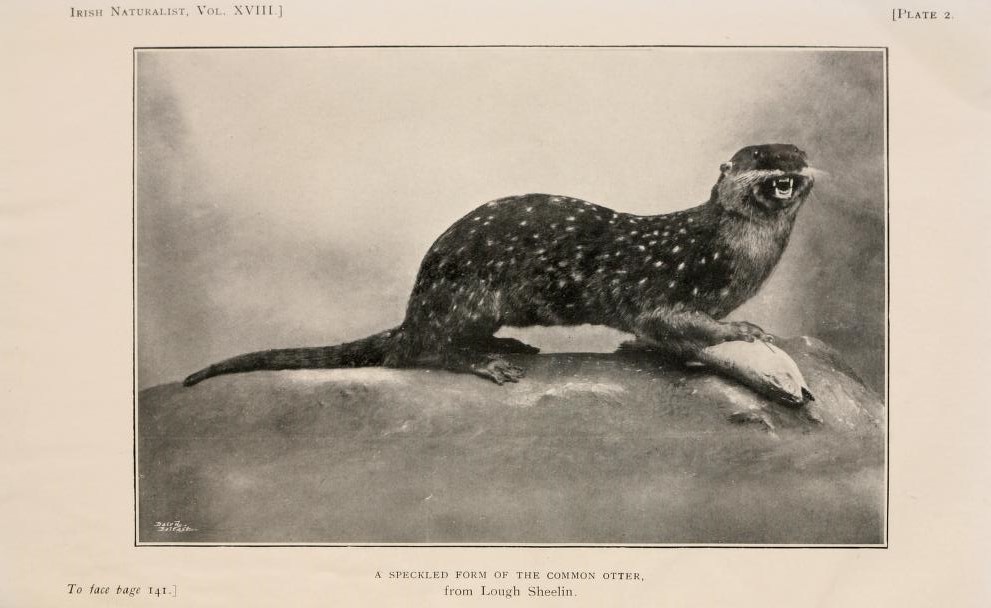
This is in fact a Eurasian Otter Lutra lutra Linnaeus, 1758 – a particular noteworthy specimen due to its speckles:

And when I say it’s noteworthy, I mean there was a note written about it – published in Volume 18 of The Irish Naturalist in 1909. It’s an interesting note, that draws on the experience and knowledge of Mr Williams, the hugely experienced taxidermist who prepared the specimen – along with many others in the Dead Zoo.
Here’s the note for your perusal, and while we’re talking about notes – it’s worth noting how much darker the fur is in the photo from 1909 – this is the problem we have with fading due to light over time:


Thanks for all your thoughts on what it could be – it was really interesting to see how everyone went about solving this one!
 Zygoma
Thanks, and good to know that the small felted otter made for a friend’s Christmas Tree (Julia Bruce, ex NHM Banks Correspondence and a SHNH member) was the right shape, but I should have used tiny black beads, rather than white ones, for the eyes. It joins ed a huge menagerie of ornamental creatures, added to each year.
Awesome, thanks for sharing this specimen! It’s honestly so cool to me how we’re able to look at a modern photo of something like this and compare it to a photo taken over a hundred years ago.