
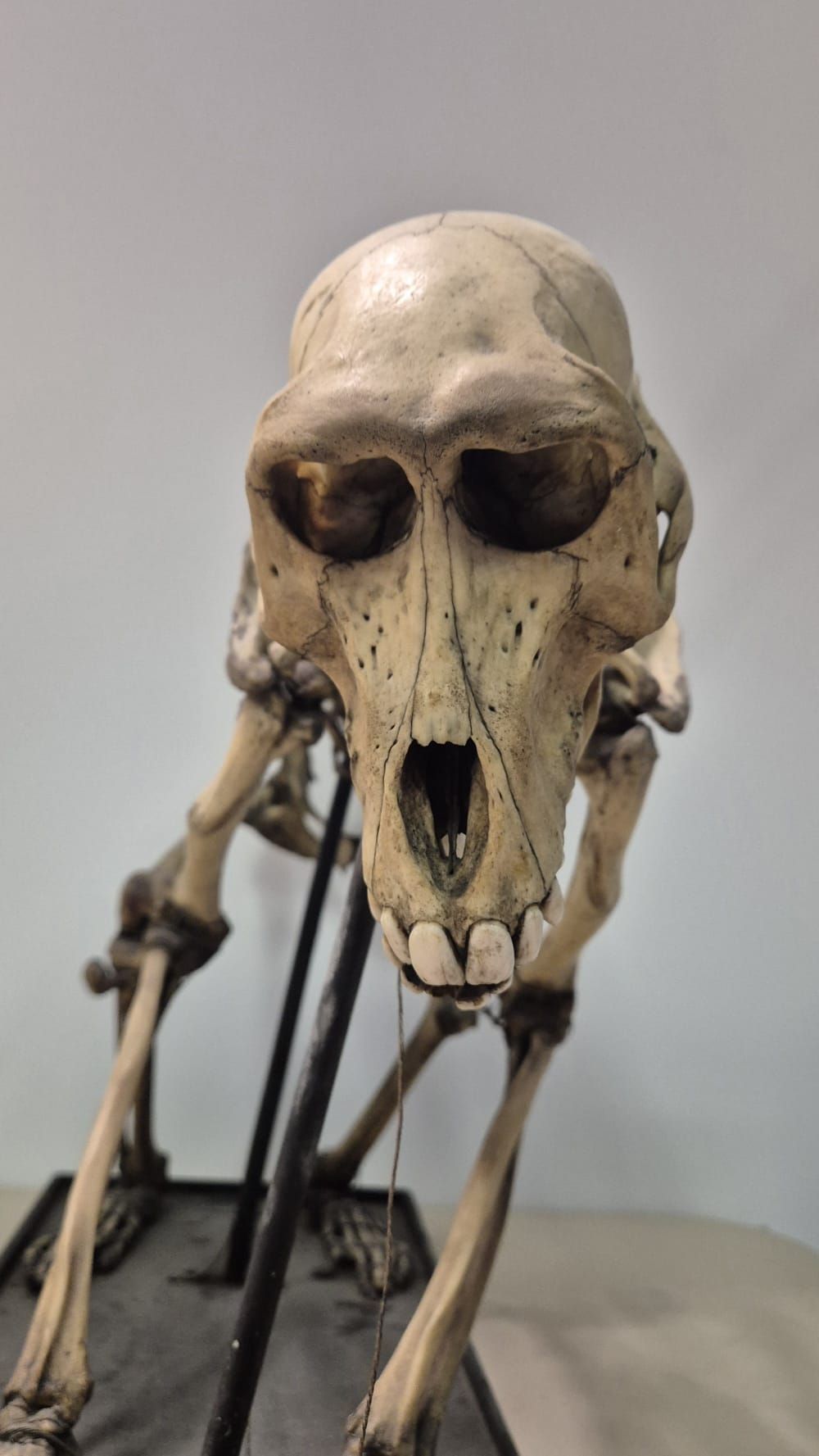
Last week I hit the 500th mystery object milestone, with this skeleton from the collections of the Dead Zoo to identify:

This specimen came to us from the Royal College of Surgeons of Ireland, and Emma Murphy, our curator responsible for the terrestrial zoology collections has been checking the identification. At the moment this is listed as being a “Baboon”, but there are 5 (maybe 6) species of baboon – so which could it be?
Just to complicate matters, Emma suspects that this may be a specimen referred to in an 1834 catalogue as a “pig-tailed baboon”, which may be where the “Baboon” listing came from. That’s not a recognised species anymore, they’re now called Southern Pig-tailed Macaques – or Northern Pig-tailed Macaques, since the Pig-tailed Macaques were split a decade or so ago.
Looking at the anatomy is always a good place to help work these issues out, but that requires comparative material – which is never as easy to find as you might like. However, there are some useful resources out there. A particularly good one is the Mammalian Crania Photographic Archive, and there are other useful sites like Skullbase and the Animal Diversity Web.
Looking through these various resources it becomes a bit easier to start picking out features to assist with identification, but it takes a bit of work and close scrutiny of a lot of different individuals within each species, to get a better idea of variation.
In profile the mystery specimen has relatively small canines and no sagittal crest, which suggests it’s a female. The face (or rostrum) is quite long, which rules out a lot of Macaque species, especially since the females tend to have shorter faces than males, and the females only develop the longer face when they are fully mature.

However, the baboons all have very long faces (even the females), so this specimen seems a little short for some of them. The Chacma Baboon is the closest I could find in proportion, but when viewed from above, the mystery specimen doesn’t seem to have the extremely well-defined cheek ridges that stand out in all baboon skulls (here’s a link to an example from the Animal Diversity Web).
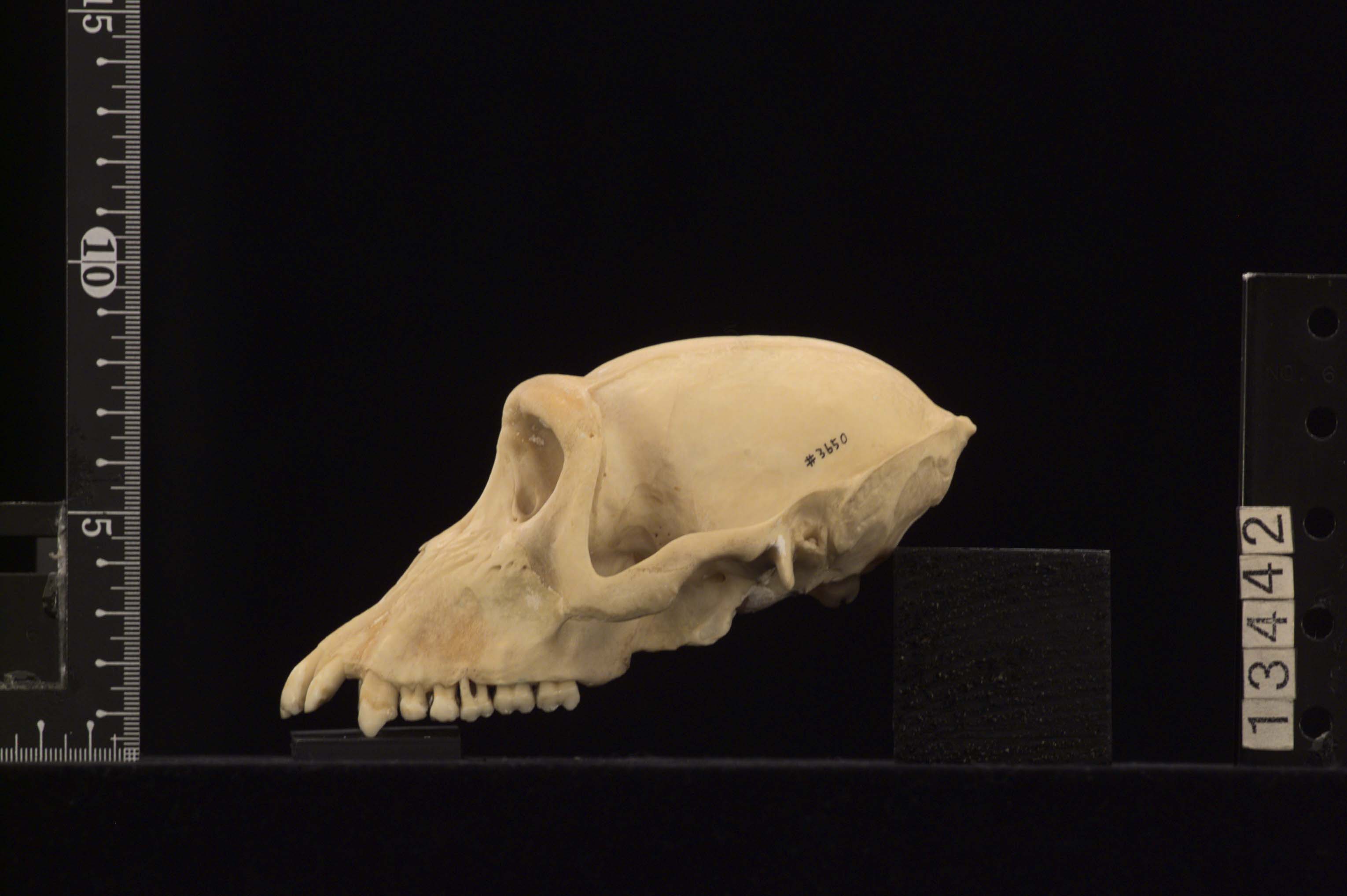
After considerable comparison, the skull of the mystery specimen looks most similar to the skull of a Southern Pig-tailed Macaque featured on the Mammalian Crania Photographic Archive, although I feel that I want to look a little more closely at the confiuration of the nasal bones in relation to the frontals before making a final call, since photographs can sometimes be misleading.
My thanks to everyone for your suggestions – there were plenty that all fell in the same general area of the monkey family tree, with baboons and macaques all being suggested. Your thoughts helped me narrow down a list of likely candidates and on balance I suspect this is most likely the Southern (or possibly Northern) Pig-tailed Macaque specimen that Emma found the old entry for in the catalogue. It would probably have been much easier to figure out if the tail had survived intact!
Hopefully I’ll see you here next week for mystery object #501!
 Zygoma
What is the object in the right eye socket?