
Last week I gave you this cute little skull to identify:
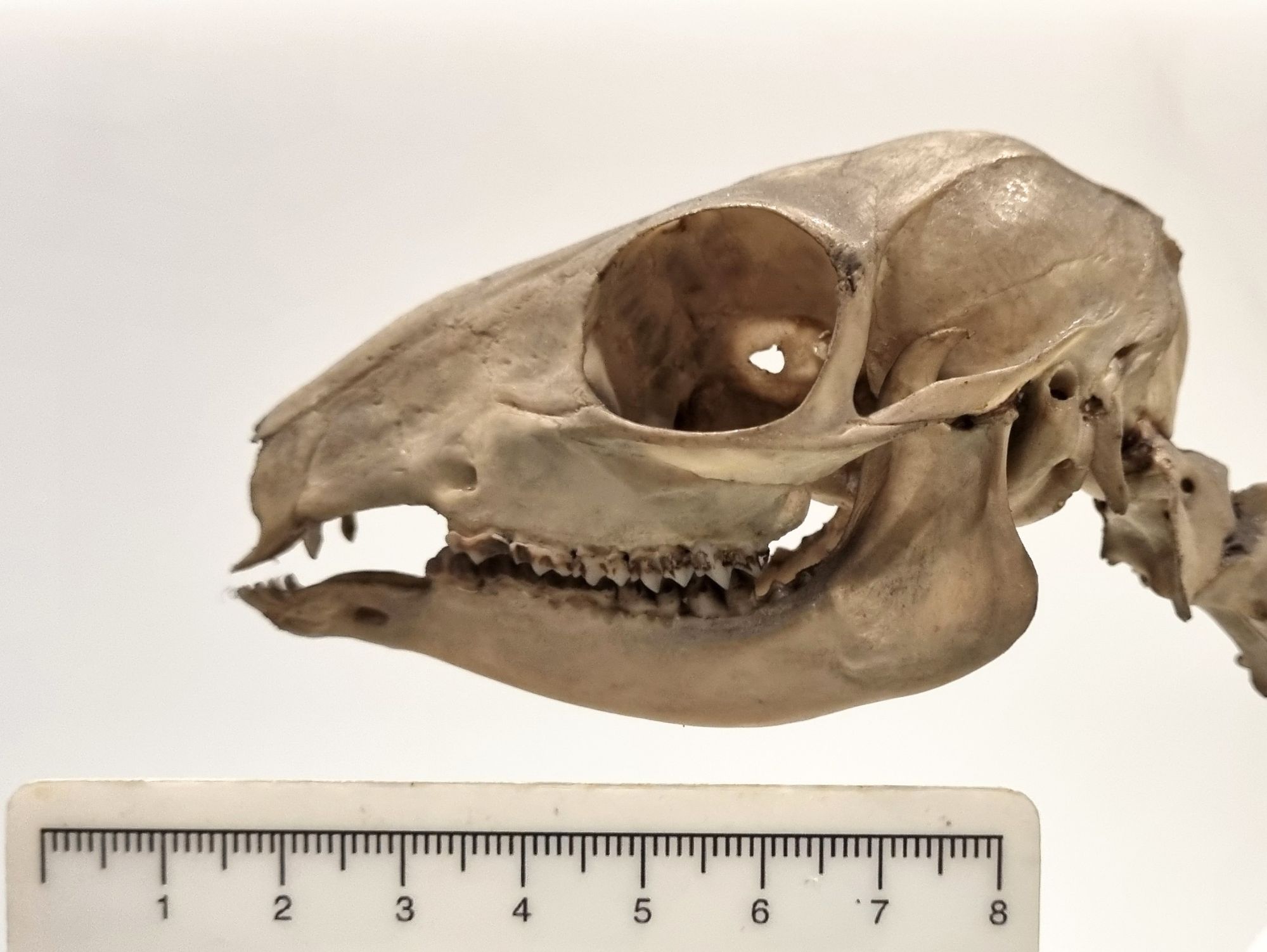
This is an object I selected when I was recovering from Covid, so I picked it thinking that I knew what it said on the label and so it would be an easy one to write up an answer for. Of course, the Universe being the way it is, I came to write this answer and realised that I actually took note of the wrong label.
My brain is clearly still not fully recovered from being ill, so now comes the complicated bit where I have to work out what it is, with no more information than I gave you, since I’m writing this answer at home and I don’t have access to either the specimen or our database.
Fortunately a lot of that work has already been done by the wonderful regular visitors to Zygoma (thanks folks!)
This is one of the diminutive Artiodactyls. It has neither horns nor antlers (although the specimen is female, so those might not be present even if the males of the species had them). It lacks scars from scent glands, so it’s not a Dik-dik or other tiny antelope. However, it does have small but prominent canines, which offer a clue. As Chris Jarvis suggested, this is the skull of a Mouse-deer, in the family Tragulidae.
There are three possible Genera in the family, but a quick check against specimens from the Genus Hyemoschus show some clear differences – both in general proportions of rostrum (snouty bit), the number of foramina in the front part of the mandible (Hyemoschus normally have two, but our mystery specimen has just one).
There are also differences in comparison with specimens in the Genus Moschiola – which seem to more usually have two foramina in the maxilla and a somwhat open suture at the junction between the bones of the maxilla, frontal and nasal bones.
That leaves the Genus Tragulus, which the mystery skull fits with very well.
It all gets a bit more complicated from there. In terms of size, I think we can rule out the Greater Mouse-deer since the mystery skull is about 2cm shorter that an example of the Greater Mouse-deer that I featured on the blog about 12 years ago (where doe the time go?):

This size difference is not a perfect characteristic to use, since the skull length can overlap between the species, but the mystery specimen has all the indicators of being a mature adult and it would still be at the absolute smallest end of the spectrum for the Greater Mouse-deer.
Distinguishing between the other possible species is more problematic, since there can be quite a lot of regional variation within the remaining species. From looking at examples of skulls online I’m leaning towards the Lesser Mouse-deer rather than the Java, Philippine, Vietnam or Williamson’s Mouse-deer, but that’s based on the structre of the zygomatric arch and general proportions rather than any clearly distinctive features.
In this instance I can at least check my hunch tomorrow on our museum database, to see if my hunch plays out – I’ll update this answer with the result as soon as I have a chance!
[Update: I’ve had a chance to check and my hunch was off – it’s listed as Java Mouse-deer Tragulus javanicus (Osbeck, 1765), so it goes to show that you do need those clearly distinctive features to get a good identification! This is why it’s better to rule out what it can’t be based on the data available and be happy with having a few possibile options, rather than making a misidentiifcation]
Thanks to everyone who had a stab at the identification – I hope you enjoyed the challenge!
 Zygoma
Bravo!
Again a specimen shows the wonder and complications that nature can provide.
Glad you are recovering and back on the path to full activity.
Thanks for a fun one.
Joe