
Last week I gave you this 6 million year old fossil skull to have a go at identifying:
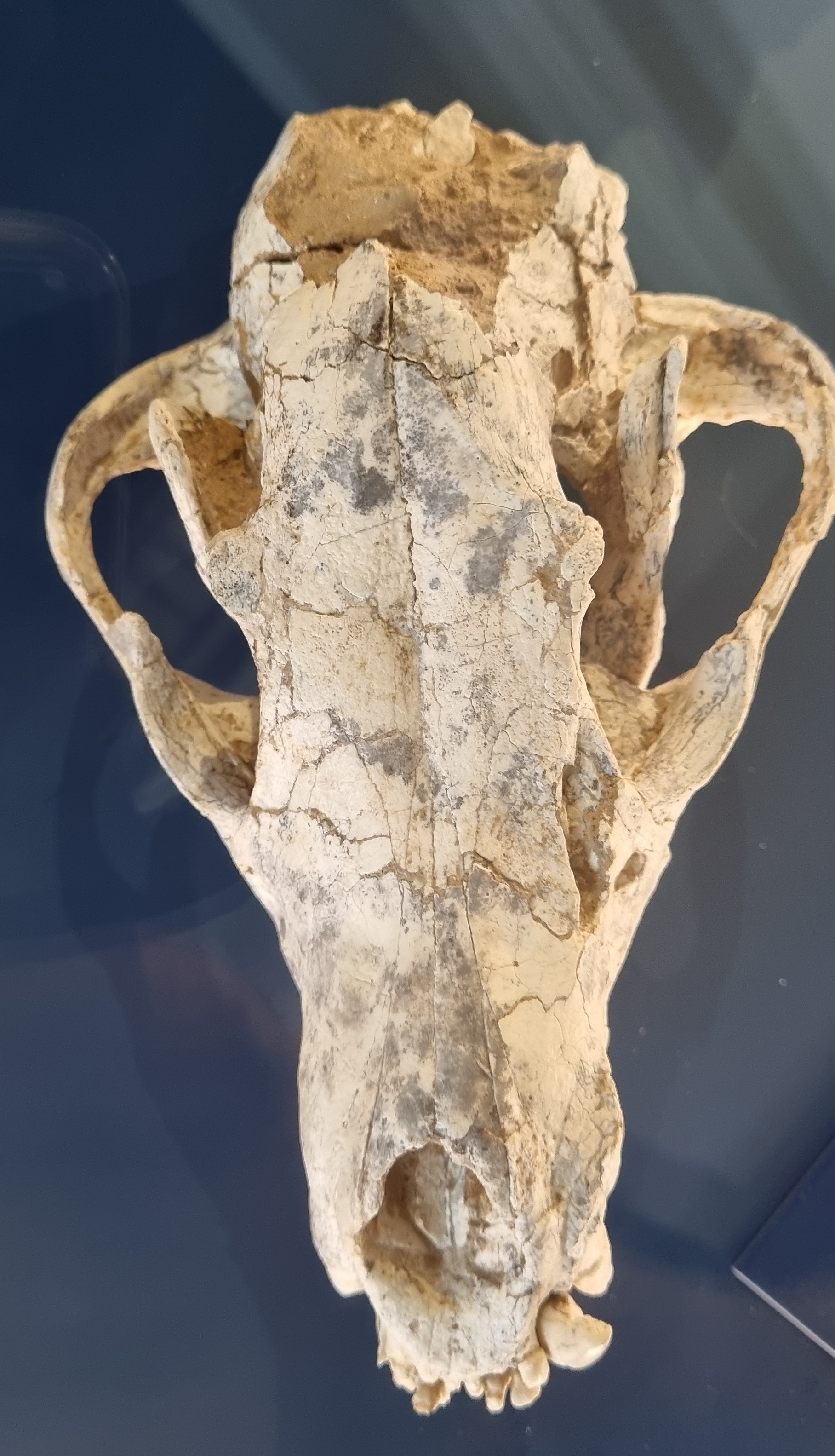
The specimen is on display in the geology galleries of the Natural History Museum at the University of Oslo (which is well worth a vist). However, this did mean the photos provided weren’t quite as good as I’d like, particularly notable being the lack of a scale bar (sorry!)
Even without a scale, consensus shifted towards this being some kind of hyena, thanks to the curved mandible and (hint of) robust molars and shorter toothrow than you might expect to see in a canid. The broad and flat profile of the frontals between the eye sockets probably helped too:
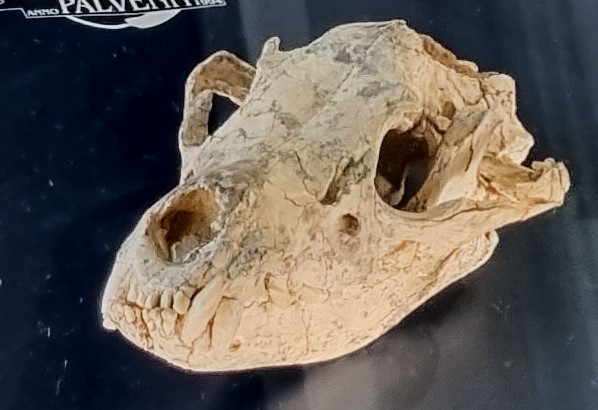
Hyenas have an interesting evoloutionary history, branching off from the basal feliforms around 22 million years ago and adapting to fill a terrestrial carviore niche in Eurasia and becoming quite diverse. In America the canids were filling that same niche, which led to some competition when the canids made it to Eurasia (spoiler alert – the hyenas lost that competition, leaving us with just three highly specialised bone crushers and the decidedly weird Aardwolf living today).

The mystery specimen was labelled as Thalassictis wongii (Zdansky, 1924), a species described from China and originally placed in the genus Icititherium, but reassessed by Kurtén (1985). A cladistic treatment of the Hyaenidae by Werdelin & Solunias (1991) later placed it in the genus Hyaenotherium, but that may not have been accepted by the curatorial team in Oslo without an accompanying formal taxonomic treatment.
These are the sorts of decisions that need to be made when considering something as simple as a label stating a species name, so you can imagine my sense of trepidation as we are about to embark on a major project at the Dead Zoo, which will allow us to reassess the information with our 10,000 or so display specimens. Fun times ahead!
 Zygoma