Friday mystery object #441 answer

Last week I gave you this rather impressive spider to have a go at identifying:

The huge size had a several people on Twitter and in the comments here suggesting it’s a Goliath Birdeater Theraphosa blondi. It is big, with a leg span of around 19-20cm, but not quite as big (or as chunky) as the Goliath.

Also, although it’s probably not easy to see from the main image, this specimen has tibial spurs on the first pair of legs – which are absent in Goliath Birdeaters:

Tibial spurs on first pair of legs (don’t confuse them with the hooked mating organ at the end of the pedipalp)

Another thing that’s not easy to see in the main image is some subtle purple iridescence on the first three legs, pedipalps and chelicerae:
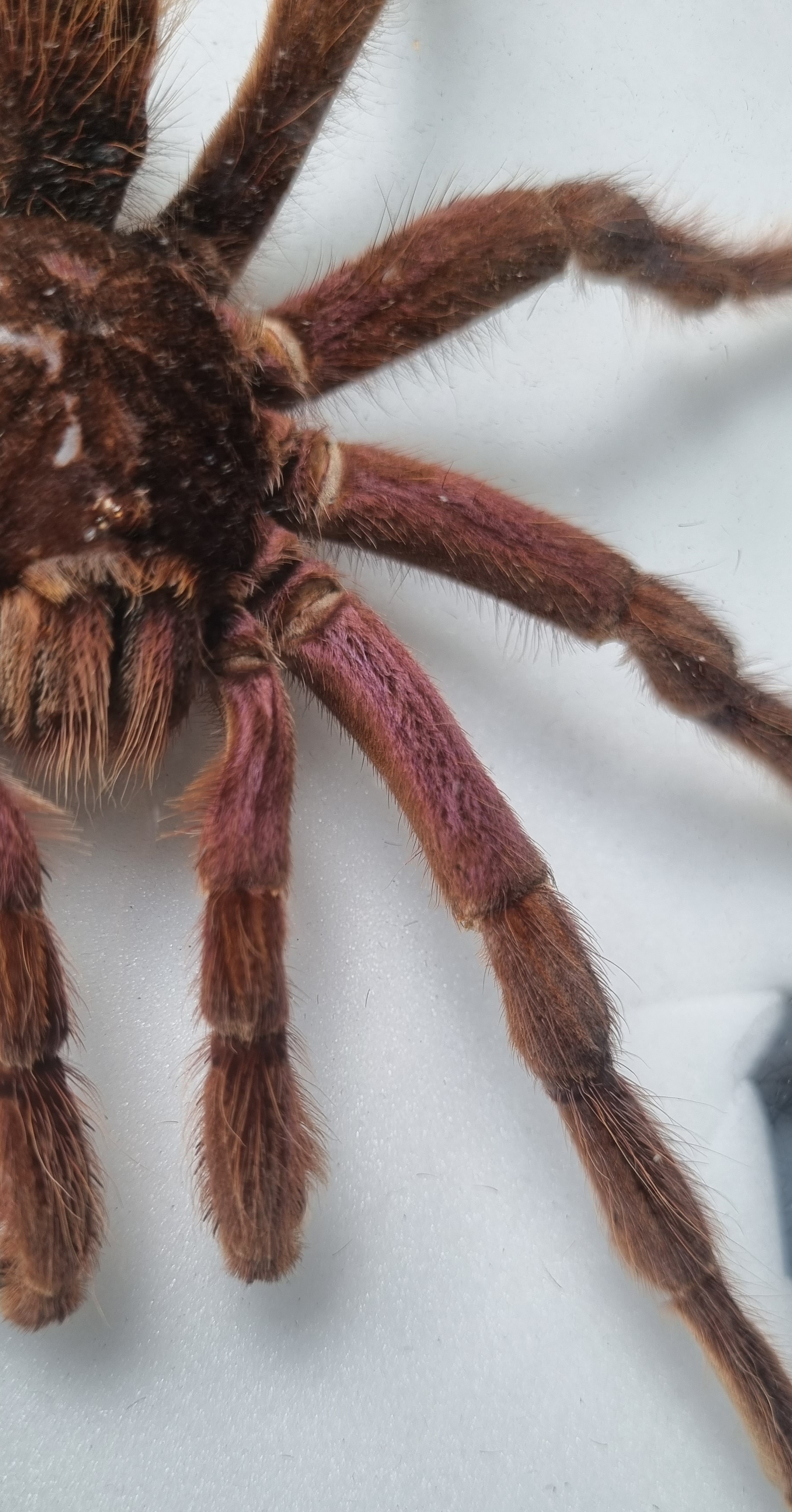
This is something I only noticed after looking for it with a light and it offers some support for the identification on the side of the box:

This label suggests the specimen is Bolivian (or in this case Peruvian) Blue-leg Birdeater Pamphobeteus antinous Pocock, 1903, but that species (as hinted at by the name) has quite distinctly blue legs:

There are fourteen other species in the genus Pamphobeteus, some of which also display some degree of iridescence on the same parts of the body, so I suspect that what we have here is one of the other species. I’m wondering if it might be Pamphobeteus grandis Bertani, Fukushima & Silva, 2008, which is very similar in appearance to P. antinous, except it has purple iridescence rather than violet/blue.

Unfortunately, I’m no spider expert and I don’t have time at the moment to go through the diagnostic features of P. grandis and relatives under a microscope, but when I get a chance I’ll check my tentative identification!
Friday mystery object #440 answer

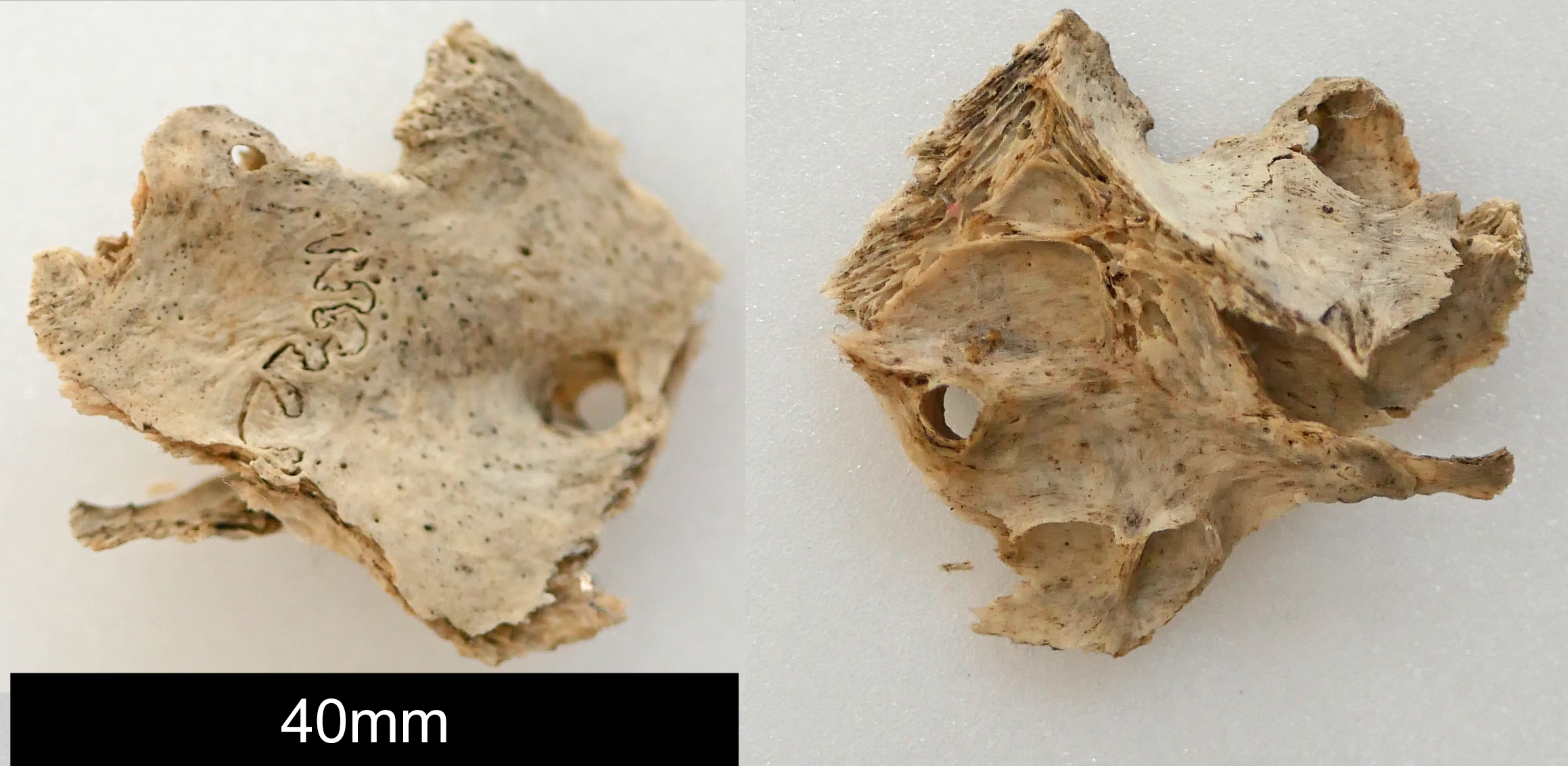
Last week I gave you this piece of bone to have a go at identifying:

It was a particularly difficult challenge and I’m still not 100% sure of what it is, but I was very interested to hear your thoughts.

There was a general leaning towards one of the (many) bones of the skull – although since there’s a suture running through the middle of this, it must consist of at least two different bones that have fused.

This feels right to me, since there aren’t many other parts of the skeleton consisting of fused bony plates containing foramina. But as to which bones of the skull and which animal, that’s a much more difficult identification prospect.

Unfortunately this kind of identification usually depends on a combination of familiarity with a range of skulls and comparative collections to figure it out and, I’m sad to say, that I’ve had very little opportunity to immerse myself in cranial collections for several years now and I rarely get a chance to work on comparative material these days.

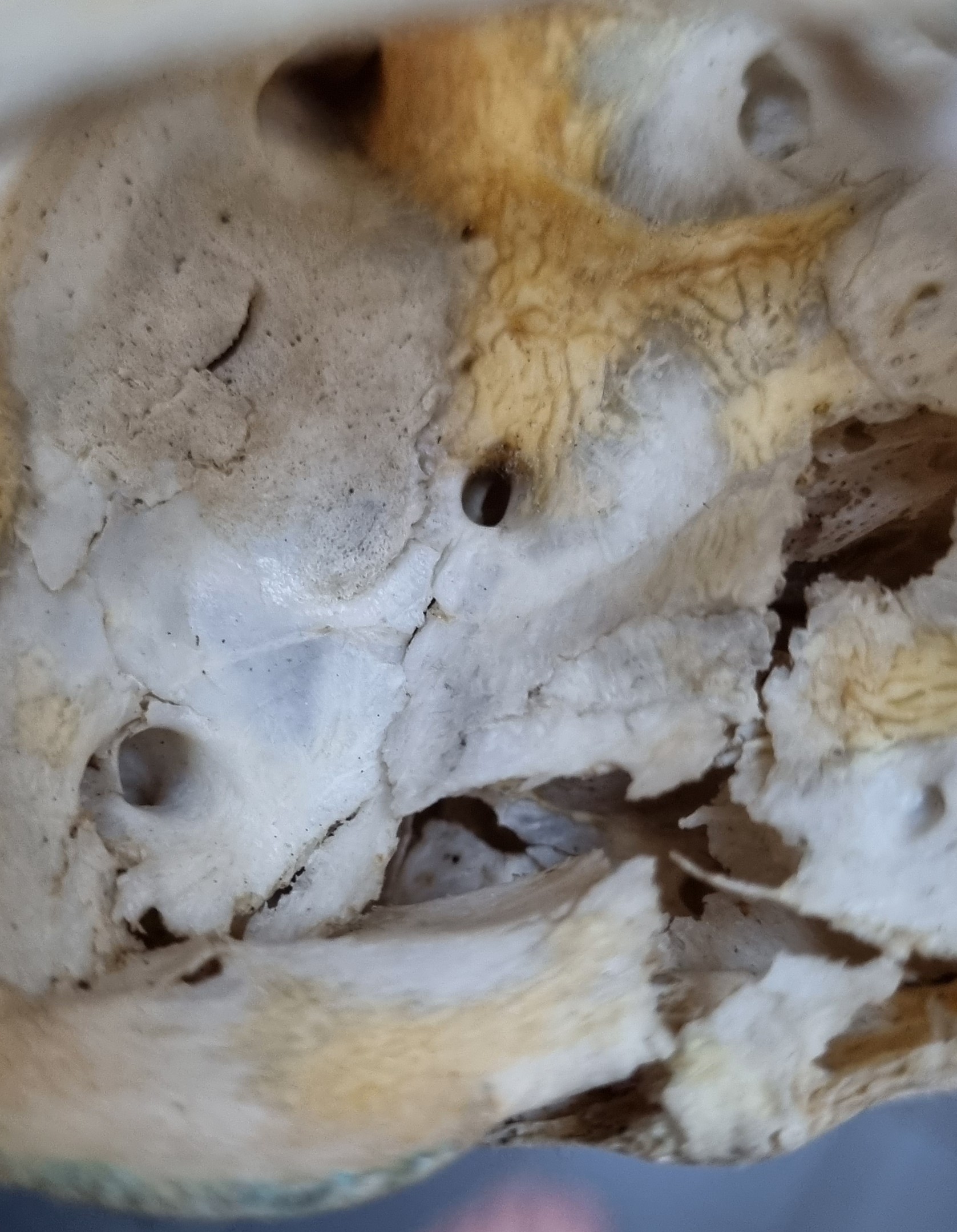
The best I could come up with is this being a section from the upper internal portion of the orbit of a Sheep Ovis aries Linnaeus, 1758 (or something quite similar).

I’m thinking this partly due to the V-shaped notch in the margin of the bone, which can be hard to spot in the initial photos, so here it is from the side:

This notch is something I think of as being present in some (but by no means all) Sheep specimens (e.g. take a look at the dorsal view in Mike Taylor’s fantatsic SV-POW! blogpost featuring a very helpful Sheep skull multiview). When I checked with a couple of my own specimens, I think I can just make out where this mystery section might sit – but it’s very hard to be sure since the region is quite variable between individuals (or perhaps breed) by the looks of my specimens:

I hope that wasn’t too disappointing as a challenge, and I apologise for not offering a definitive answer, but if I manage to track down some old specimen that is missing this exact section of bone, I’ll be sure to share it here!

In the meantime, please feel free to offer more suggestions and, if you have comparative material of your own, maybe see what you think? Thanks everyone!

Friday mystery object #440

This week I have some news to accompany the mystery object.

After two years of hard work we have reopened the Dead Zoo. As part of that process, we came across this small piece of bone, which was caught in the historic furniture for several decades before jolting loose during some of the moves that have happened recently in the Museum:

A top tier challenge for a seasoned bone geek by the looks of it. So do you have any thoughts on what it might be from?

Oh, and in case you’re in Ireland (or have a VPN) you might be interested in this documentary that was aired on Monday, which follows the work I did on our whale specimens back in 2020. There’s a trailer for it here:

I hope you enjoy!