This week I’m able to get back to my favourite type of object. Any idea of which species this skull comes from?

Hope you have fun with this one!

This week I’m able to get back to my favourite type of object. Any idea of which species this skull comes from?
Hope you have fun with this one!
Last week I gave you this mystery object from the Dead Zoo:

Usually I don’t give you clues, but for this one I thought it might be helpful in narrowing down possibilities since this specimen is faded and is probably lacking a lot of the colour features that might help with an identification. The clue wasn’t hugely helpful however, just a reference to the collector – one Major St. Leger Moore.
Palfreyman1414 and salliereynolds made the inital observation that this is an ungulate, but there are very many ungulates and that doesn’t narrow it down by much. Goatlips went on a bit of an adventure with Major St. Leger Moore and found some useful information – the Major served in the 9th Lancers who were posted to India during his service, in which time he picked up polo (which he was apparently involved in appropriating for Britain) and most likely this particular trophy.
With this information it becomes a bit easier to start narrowing down likely possibilities – there are around 21 species of bovid in India and only one of them looks anything like this – the Chinkara or Indian Gazelle Gazella bennettii (Sykes, 1831), which Goatlips hinted at with a cryptic reference to a cricketer. Of course, there are plenty of gazelle species in Africa, which Major St. Leger Moore may have visited outside his time in the military, since he was a keen sportsman and recognised as being able to “shoot straight”.
Checking the features of the Chinkara helps to add confidence to the identification. According to the ADW the Chinkara is:
…characterized by a sandy, yellowish and red colored fur with a pale white ventral region. Facial markings are well developed: they have a dark brown or black forehead and a light face with dark stripes and a noticeable nose spot. Fur color varies seasonally. In the winter, Indian gazelles are a dark grayish sandy color, and there is a distinct brown band edging the white ventral area of the torso. In the summer, the fur is a darker brown.
McCart, D. 2012. “Gazella bennettii” (On-line), Animal Diversity Web. Accessed April 22, 2021 at https://animaldiversity.org/accounts/Gazella_bennettii/
Indian gazelles have straight horns with prominent rings and tips that are slightly out-turned. Horns are found on both males and females, although they are relatively shorter in females. Sub-adult males are hard to distinguish from females because of their intermediate horn length. Horns can reach lengths of 250 to 350 mm in adult males. Female horns are usually half the length of and thinner in width than male horns and have less prominent rings. Average male horn length of the subspecies Gazella bennetti fuscifrons and G. b. shakari is 256.6 mm. Females of these subspecies have an average horn length of 184.7 mm.


While the colours preserved on the specimen aren’t quite good enough to provide much assurance, the details of the horns (especially when compared to other gazelle species, that often have much longer and more lyrate horns) correspond very well with the Chinkara. Not a certain identification, but pretty convincing.
So well done to Goatlips for some nice detective work!
Happy Friday everybody! This week I have a genuine mystery object to solve from the Dead Zoo:

This specimen has no location information and only a generic name associated with it – the only other information is that it was collected by Major St. Leger Moore. That might help. Or it might not. Let’s see what you manage to come up with!
Last week I gave you this mystery object from the Dead Zoo to have a go at identifying:
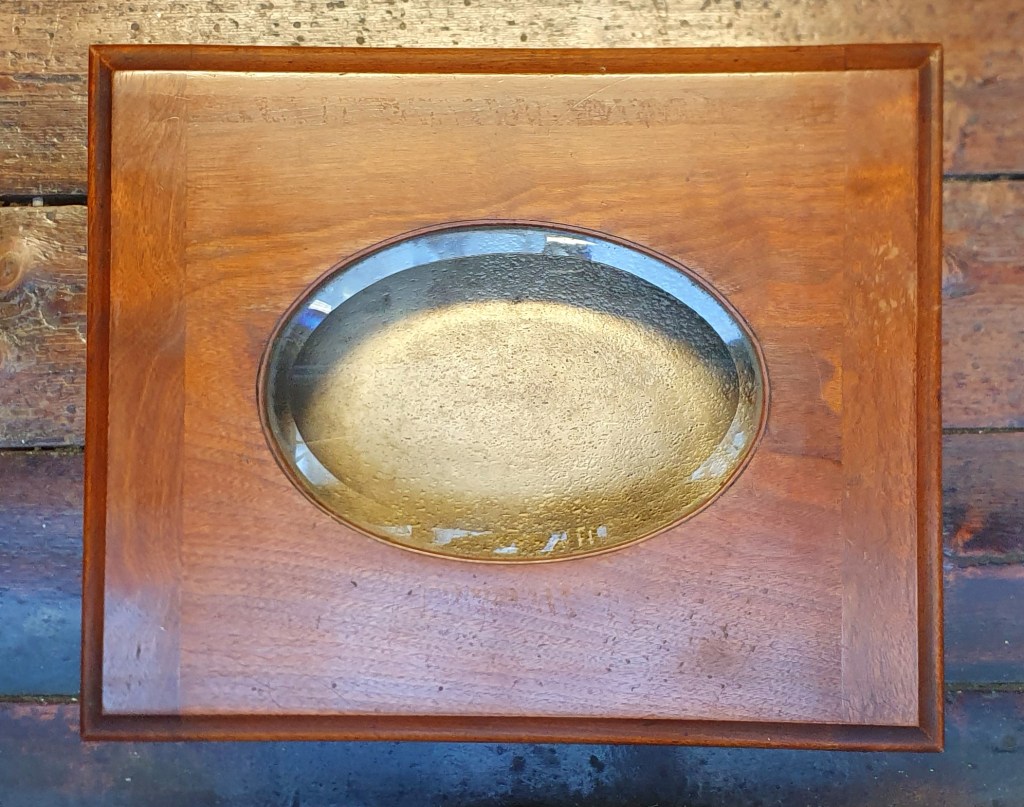
There was no scale and admittedly there’s not much of the specimen visible, but I didn’t think that would pose much of a problem. And I was right. Tony Irwin immediately indicated the identity of this rather rare specimen with the anagram:
Maybe found it – in rosy pea?
The “in rosy pea” unscrambles to Aepyornis which is the generic name for the Elephant Bird.
Of course, this isn’t a complete Elephant Bird, it’s only an egg (had to get some Eastery link in there somehow). Elephant Birds have been extinct for about 1,000 years, so surviving eggs are very rare, hence the special fancy box. Here’s the actual egg:
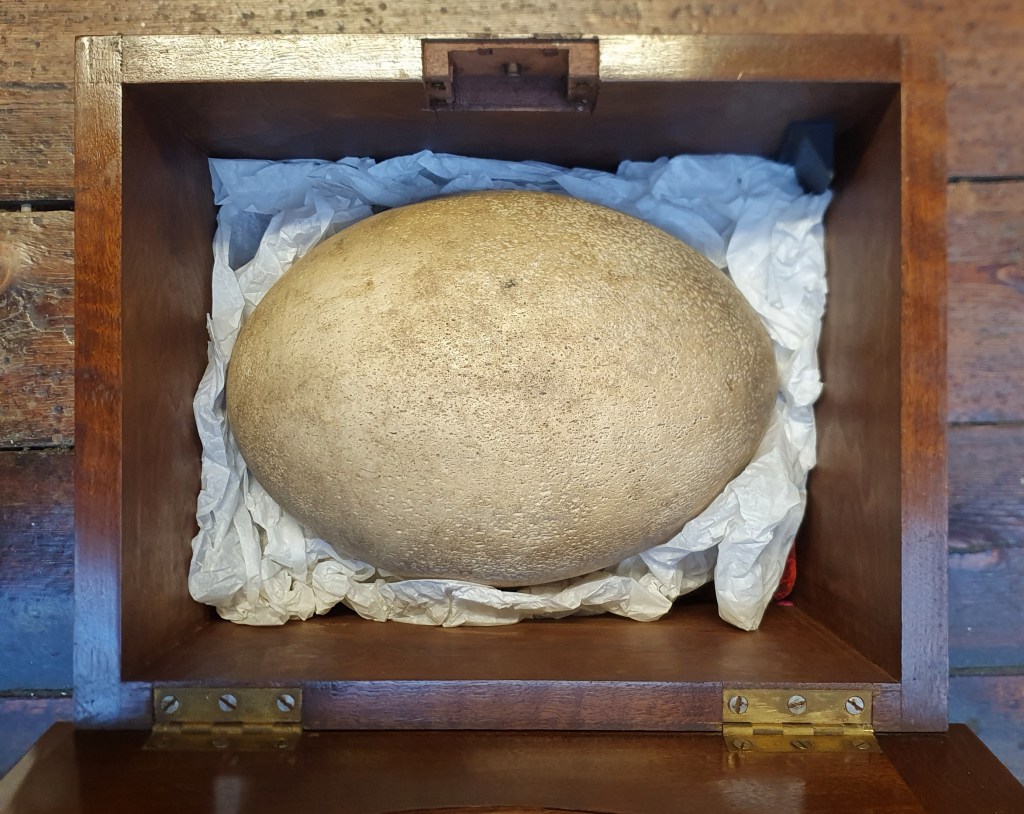
The total length is just shy of 1 foot at 29.6cm, making this one of the largest eggs ever laid by any animal. There are other Elephant Bird eggs that are a bit bigger (up to 34cm), but no other type of animal ever laid a bigger egg, even the vast sauropod dinosaurs laid eggs that were smaller than this.
I’m not going to tell the story of this specimen here, since it’s already on the National Museum of Ireland’s website. If you have a read of that, you’ll see that this specimen is from the southern end of Madagascar (the island on which these birds lived) and that plus the particularly large egg size suggests that this is from Aepyornis maximus I. Geoffroy Saint-Hilaire 1851.
This is not the first time I’ve dealt with Elephant Bird eggs, since I borrowed one from David Attenborough for an exhibition at the Horniman Museum about 5 years ago, which I talked about here.They are remarkable objects and it’s strange to think of something as fragile and seemingly ephemeral as an egg surviving intact for over a thousand years.
So well done to everyone who worked out what this mystery was – eggcelent work!
This week I have a suitably mysterious (and perhaps seasonal) object for you to try identifying, from the collections of the Dead Zoo:

Any idea what’s in the box?
It might be a bit too easy for some of you, so keep it cryptic in the comments. Have fun!
 Zygoma