
This week I have another mystery specimen from the collections of the Dead Zoo. This skull is labelled as ‘unidentified’ but I have a pretty good idea what it is and I want to know if you agree:
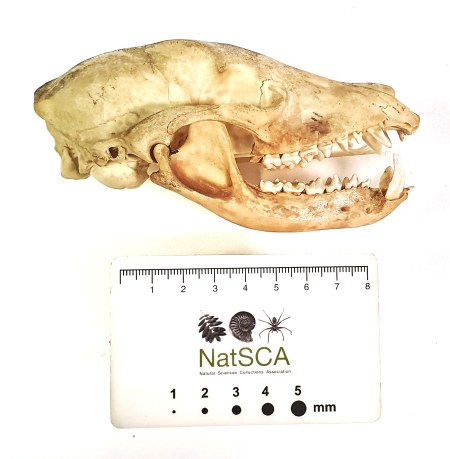
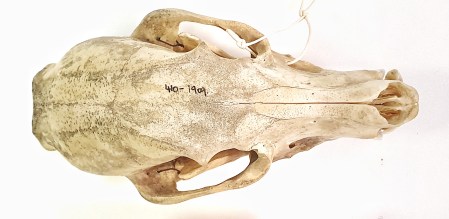
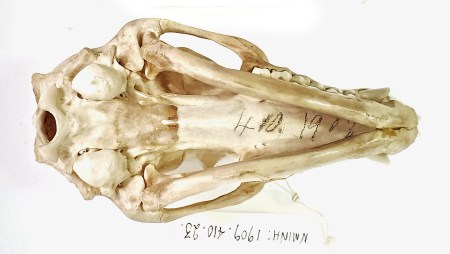
So let me know which species you think this skull is from, in the comments below. Have fun!
 Zygoma
So many canids, so little time.
ought ta I know this, from visits to ‘ear sum?
the molars look less canid than i’d like… more crushing and grinding, less shearing.
Must be a reason we get that underside view. Has the right number of teeth for some canids? More than any feline, no? How vivid.
Clearly a Carnivoran of some sort. My initial thought was like James Bryant’s: a canid, but which kind? Joe Vans’s remark about the molars is a worry, but not all canids are hypercarnivorous: I think I’d still bet on it being some species that would get called a “fox” by the laity. Could it be a member of some other family? I think we’d see the division across the bulla if it was a Feliform, so I’m sticking with Caniforms. Small and gracile, I’d think, to be a bear. Mustelids tend to have shorter snouts and fewer teeth. Procyonid? Not a raccoon, at least: they have a more convex profile of the snout. Maybe one of the others, though…
I still suspect its a canid.
The posterior molars on a Grey Fox
https://www.hideandfur.com/inventory/5169.html
are pretty low-crowned, so I don’t think Joe Vans’s comment gives a conclusive reason for excluding a Canid identity. (Though it’s not actually a Grey Fox, I don’t think.)
Termites call for crushing rather than tearing molars if you are fox-sized. I’m not confident of an identity, but at least the teeth look sorta like those of a big-eared species…
Here’s my quandary: why are the maxillary canines so weird if it’s not (as it’s complete palate suggests) a marsupial, and everyone else seems, reliably, to be dogging?
I’m guessing coati 🤔
Any kind of Coati in particular?
Nobody–
If it’s a coati, it’s female: male skulls look very different, with much more prominent sagittal crests, and big upper canines mounted on a projecting … not sure what to call it: maybe “inverted plinth” … of bone.
Something on the WWWeb says that Coati’s have two upper and two lower molars on each side: I think this critter had three lower m on the side shown.
I did a quick search on the WWWeb for Procyonid skulls, and didn’t see any that matched. But maybe…
Premolars can look quite molary…
Might be worth looking on the WWW a little more 😉
Yes, premolars can be quite molary. I once asked a real (= not just an interested layman) palaeontologist how, in the case of fossils where you may have only one jaw, and nothing like a developmental series showing which teeth are replaced, you can tell the difference between a molar and a “polarized premolar.” As I recall, the response I got was (i) my informant wasn’t specifically a paleoMAMMALogist and (ii) that from an outsider’s viewpoint it sometimes looked more like an art than a science.
What I should do now is take your advice and look for more relevant images…
But I’m … surprised and puzzled … by your comment. I’m assuming that this is a Carnivoran (and not a Pinniped with their weird dentition), so the first lower molar should be the carnassial. Since the third tooth from the back in the lower jaw seems to be the most elaborate of the bunch, I was taking it to be the Carnassial and hence m1. (And that p1 had been small and was now missing — that seems to happen often.) If, as I take your comment to suggest, that third-from-the-back tooth is p4, then the one behind it must be m1, and it looks very, very, UNCARNASSIAL!
So… Chances are I won’t come up with more to suggest before you post your answer, but, please: I’d love some comments with your answer!
Well…. It looks a tiny bit — one cm or so — smaller than the length Skulls Unlimited gives for their replica Coati skull.
And — just to check my mental image of what a Carnassial ought to look like — I’ve googled a couple of photos of bear skulls: the lower carnassial (= m1) of a more-omnivorous-than-carnivorous Carnivoran ban be pretty low-crowned. So I’m coming around toward the Coati identification. By may earlier comment on sagittal crests and “plinths” for upper canines, I’d say a female. No idea which of the four species, though.
The lower jaw is the key – rounded. That’s a marsupial. I think you have it palfreyman1414.
I’d go for a Thylacinus cynocephalus or Tasmanian Tiger / Wolf although it’s very small. And it is an adult skull. So… the devil if I know….
Oh wait – it IS the right size. I was thinking so much about this I thought I was seeing spots before my eyes… when in fact it was stripes.
Katedmonson–
“Rounded” lower jaw. As in: no obvious angular process in side view?
Could be. I haven’t looked at marsupials until now. I’ve just looked at a Thylacinus skull (on the WWWeb), and I don’t think that’s what Paolo has.
(i) Paolo’s critter does not have palatal vacuities, Th. c. does (thanks Palfreyman for reminding us of that common difference between euth. and metath.).
(ii) In ventral view the “inflected angles” of the lower jaw should be more prominent. (There is a projection inward at the right place in Paolo’s photo, but it is the inner end of the (cylindrical) condyle, not an inflected angle.)
(iii) I think the posterior molars would be bigger on a Th. c.
I seem to be into negative comments. Sorry. I don’t have a more positive suggestions to make.