This week I have another specimen from the Grant Museum of Zoology for you to have a go at identifying:

This specimen has an identification, but I’m not sure I agree with it, so I want to see what you think it is.
Have fun with it!

This week I have another specimen from the Grant Museum of Zoology for you to have a go at identifying:
This specimen has an identification, but I’m not sure I agree with it, so I want to see what you think it is.
Have fun with it!
Last week I gave you this crocodilian skull from the Grant Museum of Zoology to see if you had any thoughts about which species it might be:

It turns out that you did indeed have some excellent thoughts about the identification, with Cindy Nelson-Viljoen immediately getting it right, with astute observations from David Godfrey and palfreyman1414, plus another correct responses from Joe Vans (as well as Tone Hitchcock and Henry McGhie not via the comments section).
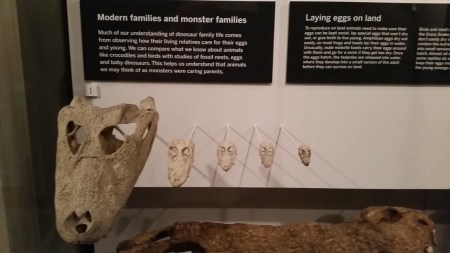
This is a skull of the Dwarf Crocodile Osteolaemus tetraspis Cope, 1861. It’s small size is the first clue, but given how crocodiles grow this could pass as the skull of a young individual of a much larger species. As David Godfrey pointed out, there may be some paedomorphism (where adults look like juveniles) in effect in this species, since the adults as well as being small, have relatively short snouts and big eyes – which are features of juvenile animals as you can see in this display of crocodile development I did for Dinosaurs! Monster Families just before leaving the Horniman:
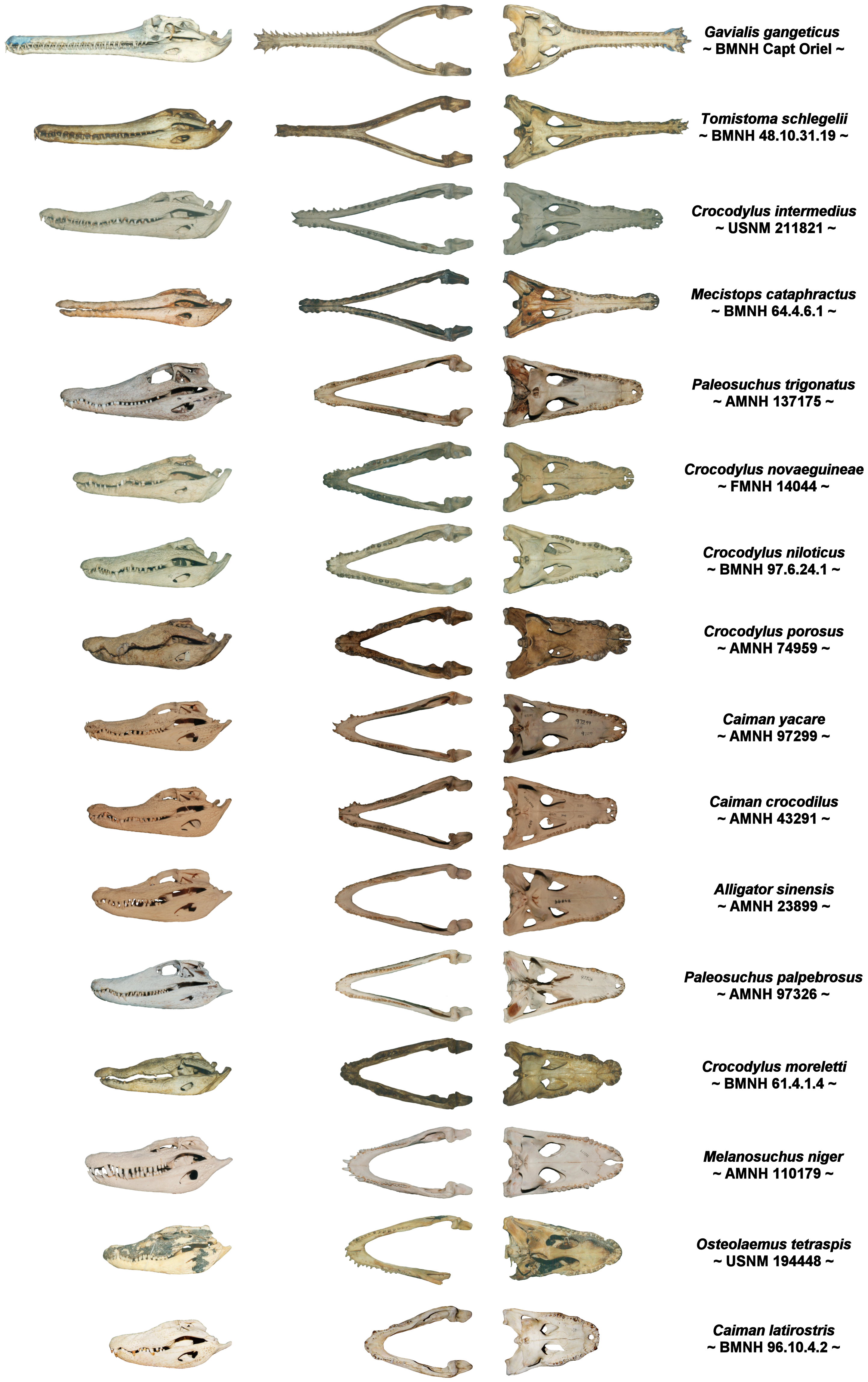
Part of my reason for wanting to show you this specimen was to force myself to look for some good online resources to get more familiar with crocodilian morphology. As it turns out, I did find a very useful comparative image, which shows the size and shape of the mandibular foramen (a large gap between the bones in the side of the lower jaw) is a helpful feature:
In this species the foramen is small, which when considered with the overall proportion is quite distinctive. Of course, this image does not include all 24(ish) living crocodilian species, but it does provide a pretty good range. Hopefully this will help speed up future croc skull identifications, at least allowing certain species to be discounted.
If you have any good tips for crocodile identification please share below!
Last week the answer to the mystery object was a Gharial – a very weird crocodilian from India. I realised that I didn’t know much about identifying the Crocodyliformes, so I thought it might be fun to have a go at working out what this species might be:
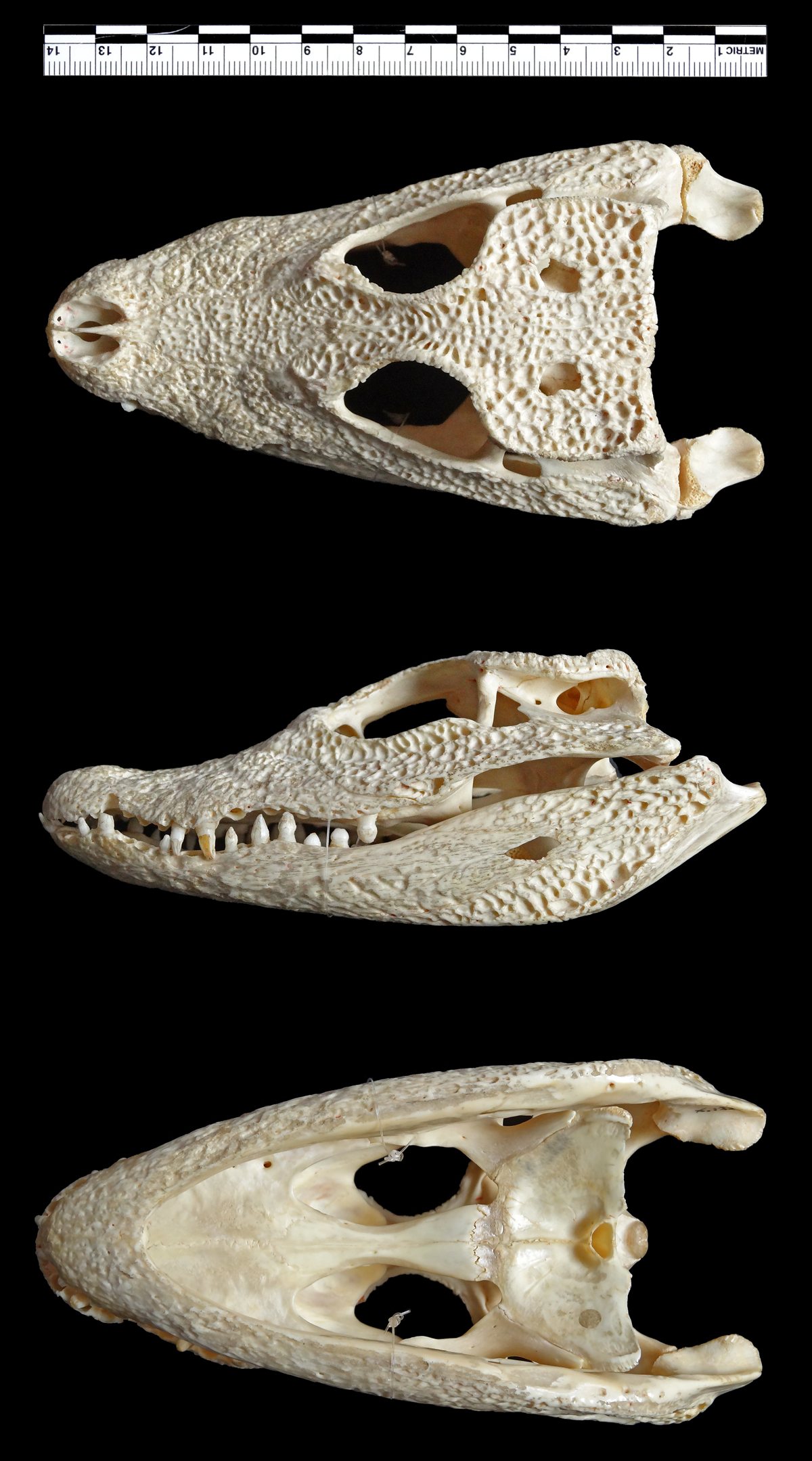
As always, I would love to hear your thoughts below and let’s see if we can find some good diagnostic features!
Last week I gave you this mystery object to identify:

It’s the kind of thing you find in museum collections quite often, but it will commonly be misidentified – especially in anthropology collections where (in my experience) it will commonly be referred to as a claw or big cat tooth.
However, nobody who commented went down that route, recognising that the hollow base and well defined crown indicates that it’s an open rooted tooth of some sort. In mammals an open root at this size that would suggest a pig tusk or perhaps a whale tooth, but this isn’t mammalian.
In fact, this tooth is from something even less cuddly than a whale, something crocodilian. This was recognised first by Carlos Grau, but others who came to the same conclusion included Jonathan Larwood, Daniel Jones, palfreyman1414, Wouter van Gestel and Charne. More specifically, this tooth is from a Gharial, Gavialis gangeticus (Gmelin, 1789). This Gharial from the Grant Museum of Zoology in fact:

Grant Museum of Zoology Specimen LDUCZ-Y215
Gharial teeth are a bit less conical than the teeth of most crocodiles and alligators. Presumably the curve helps prevent their main diet of fish from getting free when caught.
Gharials are sexually dimorphic, with the adult males bearing a big rounded bony knob on the end of their rostrum, this is where the name Gharial comes from, as this feature resembles a local earthenware pot called a “ghara”. Sadly, these distinctive crocodilians are critically endangered, with just a few hundred left alive in the wild. They are affected by habitat loss, egg theft and use in traditional medicines.
More mysteries next week and if you fancy hearing me talking about animals you might be interested in coming to Animal Showoff at the Grant Museum of Zoology next Thursday evening!
 Zygoma