
On Monday I said I may find something different for a mystery object, so I’ve called upon the collections knowledge of Helen (our Collections Access Officer) and Rebecca and India (two of our hard-working volunteers), to help find something from the wider collections of the Horniman (we do have more than just skulls you know…). As you might guess, I like things with a natural history spin, so I settled on this rather beautiful object that they suggested:

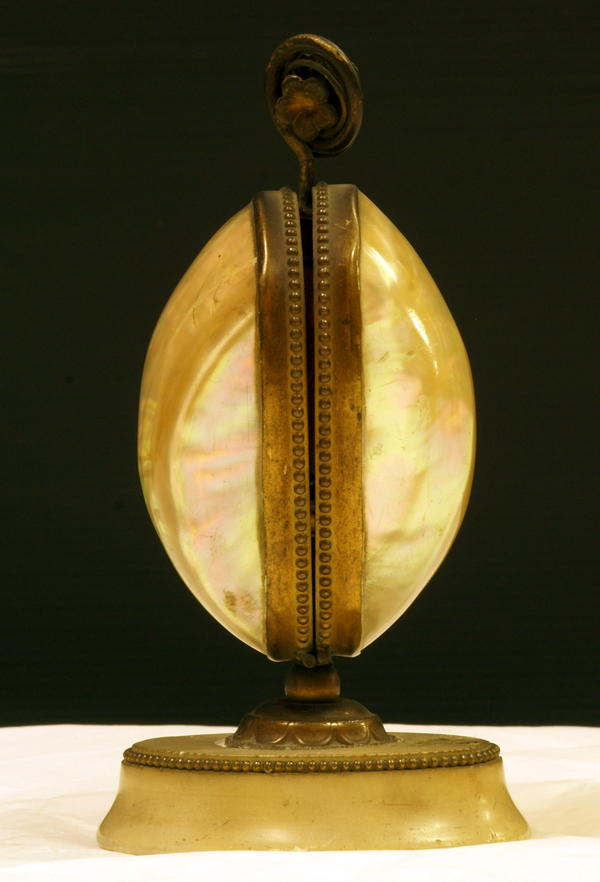 Can you tell me what materials this is made from and what the function of this object might be?
As usual you can put your suggestions, observations and questions in the comments section below and I will do my best to answer. Good luck!
 Zygoma
How large is it?
Hmm. I think the edging might be made of brass.
Are the pale bits animal or mineral?
The two halves look like they fold down. Is it for serving condiments such as mustard or similar sauces?
It’s about 17-18cm high or 7″ to the Imperialists.
The pale bits are both animal and mineral and the two halves do indeed fold down – but not for serving condiments.
Hmm. Larger than I expected.
Some form of shell then. Mother-of-pearl?
Are they scales?
Is the base bone?
It looks a little as though in the side shot there’s a ridge running along the edge, so the two halves aren’t a smooth curve. I suspect that’s from the interference colours however, and its an optical illusion. Are the sides made of Nautilus shell?
If you opened it up would it be really obvious what it was?
Some kind of bivalve coin purse?
Not a coinpurse and I think they’re not bivalves either, although they’re so worked it’s hard to be sure of that…
Are they opercula?
The reason I ask if they’re opercula is because they’re both the same thin round shape, they’re both beautiful, gem-like, and they take a great polish. Plus you said they’re natural history related, and although they look like bone or tooth, they aren’t either. And the only other calcium carbonate kind of natural history objects that take a shine like that are from mollusks, and the only part of a mollusk that looks like those round things are opercula. I love opercula. Those things at the end of the opening that lots of gastropods use to protect themselves when they retreat into their shells. Now for the real question, can I remember which gastropods have opercula like that? I saw some in the IndoPacific. But what were they? Give me a while and they’ll probably come to me.
Not opercula, although they are related. The two valves are about 9.5cm (3 3/4″) high, which would mean a very large aperture.
Is the animal a vertebrate?
Of that I can certainly say ‘no’ in relation to the main part of the object, although I think the base may be derived from a vertebrate…
There’s a hinge at the bottom and the top spiral looks like an ornate handle. Does it open up to become a ladies make-up dispensary of some kind? Is the pearly bit from the shell of a LIKELY CORRECT ANSWER perhaps?
It does indeed open up, although not into a make-up dispensary (which is what I thought when I first saw it).
That looks like mother-of-pearl, or nacre, for the body. Animal and mineral because nacre is a composite of calcium carbonate crystals in a protein matrix (v. clever stuff). It exhibits interference colour. The base looks like it might be ivory.
What’s the leaf in the top – looks like ivy to me
Your materials for the body are spot-on, it is indeed nacre. I don’t think the base is ivory though.
The leaf and the flower on top are beyond my ken – they may be entirely invented by whoever crafted it for all I know!
Could it be a musical box of some kind?
That would be really cool, but it’s something a bit more practical…
Hm. This may sound like I am taking wild guesses here, but if it’s a more practical, could it be an ink and sand set?
Closer, but still not there…
Typical – you have a FMO where I get the material in a nanosecond and I am so busy I don’t even look until it’s too late. I am rather fond of mother-of-pearl. The base looks more like onyx or a similar stone than something organic and the metal is probably brass as has been said.
As to function – I suspect, though could be way out here, that this is something to sit on a tabletop and when opened what is inside is a little brush for sweeping crumps into the opened egg.
I love the idea of the wee dustpan & brush function, but I’m afraid not. The base is too light to be onyx, although of course you can’t tell that from a photo!
The folding halves are mother-of-pearl, the base is whalebone, and the whole thing is a reliquary to hold the Pope’s left testicle. (The other one is in the Albert Hall, as any fule kno).
Just how many testicles are stored in the Albert Hall? If I remember correctly there’s a song stating that one of Hitler’s is also in there…
Cigar caddy or cigar casket, for holding cigars.
Another lovely idea, but not right I’m afraid.
Curious…this looks like such a similar piece. Do you think this auctioneer actually has the description incorrect? Is this what the interior of your piece looks like? BTW-Thanks for posting something more general this week.
Whoops forgot to attach the link to my reply. Sorry. http://www.rubylane.com/item/135488-1107rmopcig/LG-Antique-Palais-Royal-Gilt
Actually, now looking at smaller versions on the same site, it looks like they could be used to hold salt and pepper or small vials of perfume maybe as well.
Good find! This is a very similar piece and it’s made me wonder if I was correct in my identification of the base since these are so similar. Nonetheless, the contents are totally different!
If it is not a holder for perfume, possibly jewelery? Maybe earrings held up by the central mechanism. It is also very oblong so maybe a small necklace?
None of these options, but you’re reducing the possibilities!
Must be a wax seal set then?
Nope…
Wee dustpan and brushes for crumbs are not my idea, my grandmother and Hilda’s mother not only had them they used them as a matter of course. So the idea of hiding one in this beautiful egg wasn’t a stretch.
Now, is the bone from a whale or an elephant? Suspect possibly the latter simply because it was such a favourite material for working into these wonderful objets. What was commonly called whalebone, as in corsets, was the baleen, I don’t know whether actual whale bones were worked much, suspect would have been thrown overboard to save weight and room for the more valuable meat, ivory, etc.
Whale’s bones (as opposed to whalebone, which is baleen) are actually quite well packed with oil, so they would sometimes be drilled and drained before being discarded.
However, the base doesn’t appear to be bone of any kind.
My first thought was maybe an abalone.. but its lackeing the respirationg pores. So maybe not. But maybe something from the family Haliotidae ?