
Last week I gave you this chunky chewer to try and identify:

It wasn’t the easiest challenge, since it’s clearly a rodent, and rodents are the most diverse Order of mammals, with over two thousand species. Not only that, but this specimen is badly faded – if you’re a regular reader of my blog you’ll know that’s a recurring theme for specimens from the Dead Zoo, due to the natural light that illuminated the space for over a century and a half.
However, to get started it’s worth taking a look at the size and overall shape of the specimen:
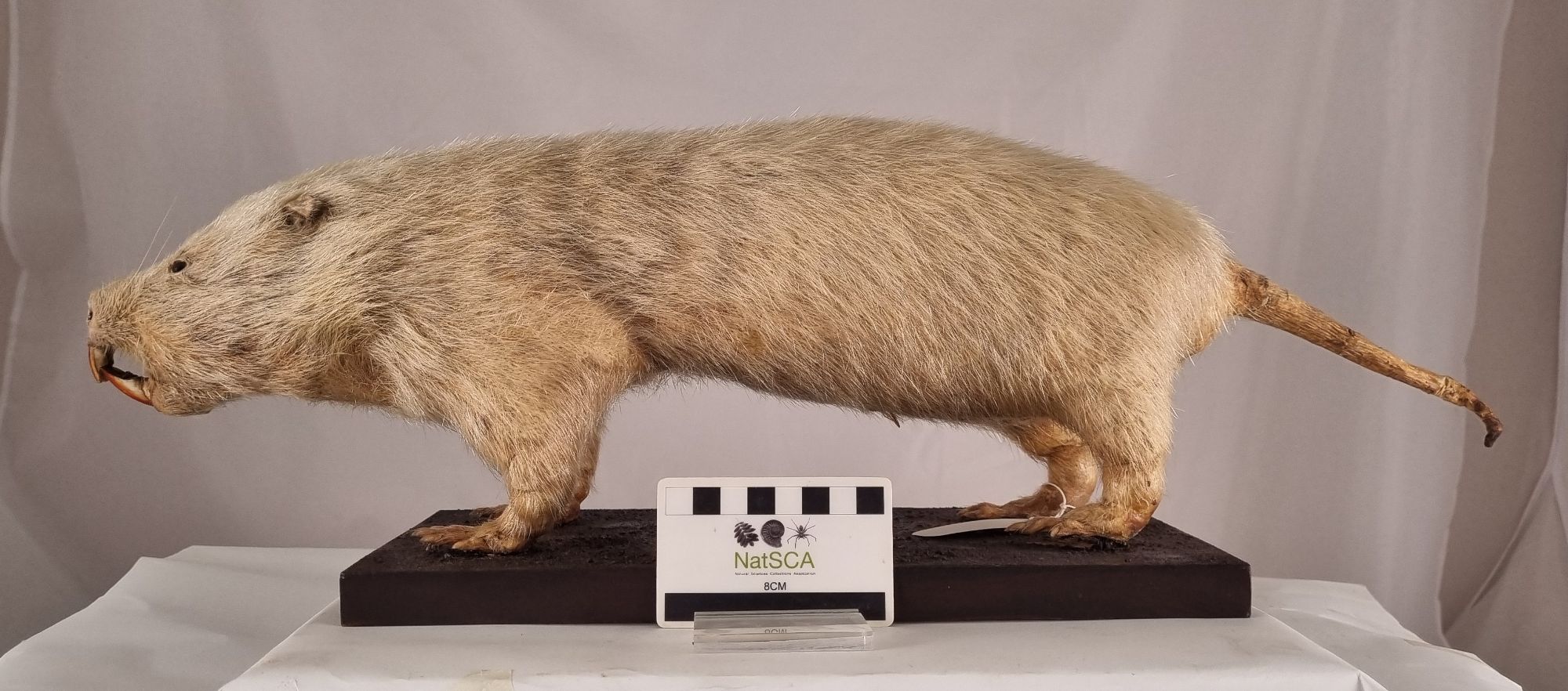
It has a shortish tail, short legs and a fairly long and cylindrical body. It also has tiny eyes, tiny ears, and incisors that protrude beyond the lips. These are all features that are common to rodents that have evolved to have a specialist fossorial (or burrowing) lifestyle, where digging is done with the teeth and usually it’s a way of getting to plant roots and tubers growing underground.
The obvious examples of rodents with a lifestyle matching this would be species like Gophers, the Naked Mole-rat, the somewhat-related blesmols (a group of African Mole-rats), the unrelated Blind Mole-rats and some of their relatives in the Family Spalacidae. All of these similar looking animals have converged on a body form that works for their way of life, but there is a key feature to help work out which of these groups of fossorial rodents to look at – the size.
Many burrowers (and most rodents in general) tend to be on the smaller side, but this specimen is around 50cm long – and that’s not including its tail. It may not quite be up there with rodent giants like the Capybara, but you could certainly consider it to be a fossorial rodent of an unusual size.
Hopefully, that should be all the additional information needed to narrow this species down to the Large Bamboo Rat Rhizomys sumatrensis (Raffles, 1821), a possible inspiration for Sir Arthur Conan Doyle’s mention of the Giant Rat of Sumatra (which I suspect in turn may have influenced William Goldman in his creation of the R.O.U.S.’s in the Princess Bride).
The Large Bamboo Rat feeds mainly, and perhaps unsurprisingly, on bamboo roots. They do also take other food, such as the roots of other plants and sometimes fruit and nuts that they find when on the surface, since they are less fussy about emerging from underground than some of the more dedicatedly fossorial rodents.
Of course, by emerging it does make them more likey to be eaten by predators, and given their large size, humans count in that number. However, one interesting thing to note about this species from Southeast Asia is that they are known to carry a bacterium that can be particularly problematic for people with immunodeficiency issues, particularly HIV/AIDS, so eating them can have its problems.
I hope you enjoyed the challenge!



 Zygoma