
Last week I gave you this mystery object to try your hand at identifying:

I picked this specimen because it’s from Ireland, but it’s not a species you might normally associate with Ireland. Plus it’s fragmentary and missing some parts that are useful for identification.
That said, after a little initial mis-step, the correct species – and indeed subspecies – identification was reached. So well done to James Bryant, Adam Yates, and Allen Hazen.
This is a section of mandible from a Cave Hyena Crocuta crocuta spelaea Goldfuss, 1823. This jaw shows just three teeth, but they are very useful teeth for identification, since they are characteristically robust, with really heavy conical premolars with well defined cingula (those ridges of enamel near the base). Perfect for smashing through bones. The curve of the jaw is also a useful clue.
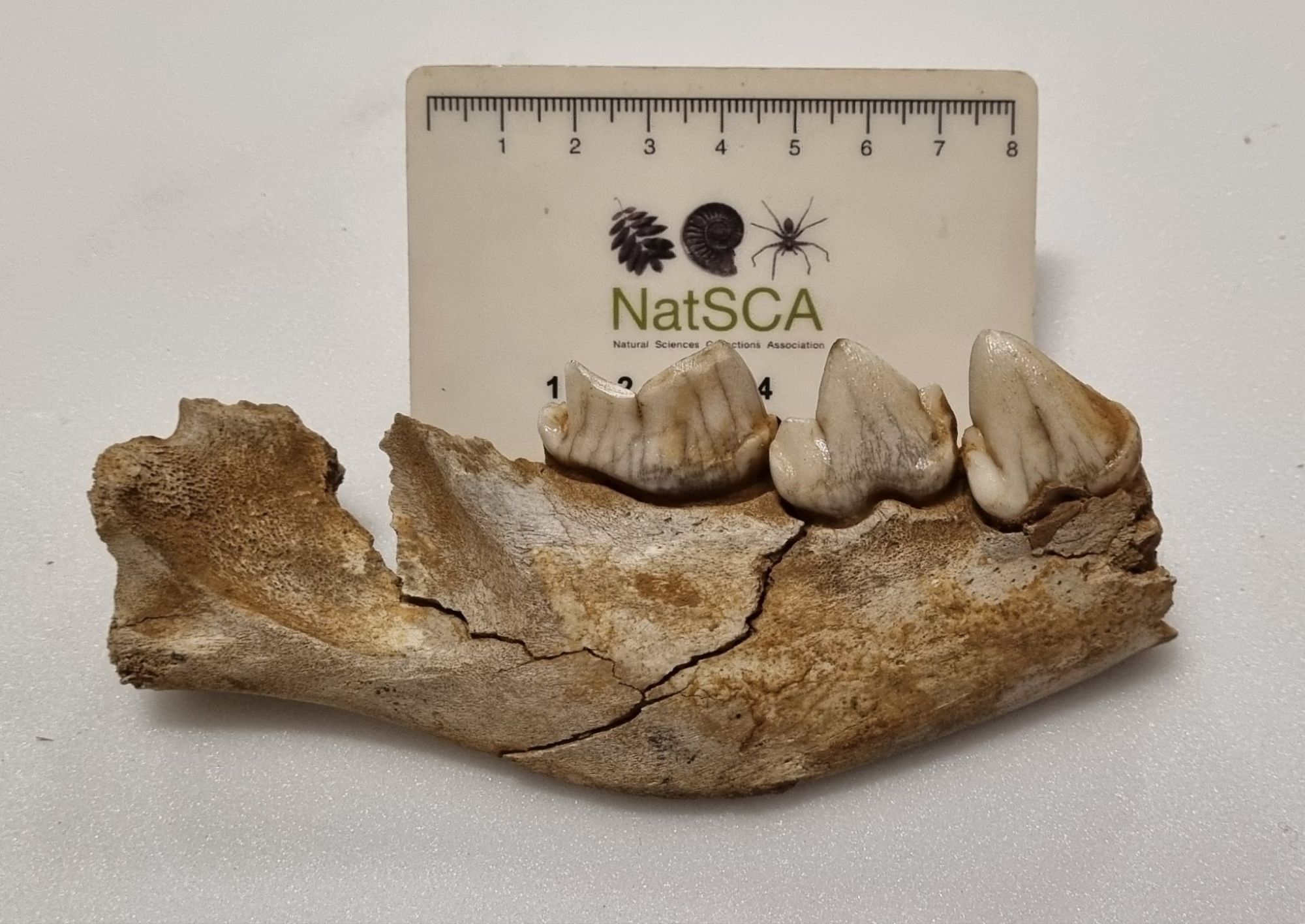
The Cave Hyena was present in Ireland around 40,000 years ago we have several specimens in the Dead Zoo, mainly from Castlepook Cave in County Cork. These caves provide a rare glimpse of pre-glacial fauna, since most other sediments (and therefore fossils) from the Pleistocene period were scoured away by the glaciers of the last glacial period.
So well done to everyone who figured it out. Specimens like this provide a fantastic snapshot into the prehistory of Ireland, offering a sense of how changing climate and landscapes shape biodiversity over time.
 Zygoma
That was a fun one to try and work out! Thanks Paolo!