
Last week I gave you this sturdy shoulder from a specimen in the Dead Zoo to try your hand at identifying:

It’s big, chunky and definitely not something you’re likely to find while digging in your garden.
The size might suggest something like a horse or cow, but it’s far too broad for either. The shape is a little more like a pig scapula, but as Sallie Reynolds pointed out, pigs have a more strongly curved scapular spine (the ridge of bone that sticks up along the middle). Plus pigs are a good bit smaller – this is a big scapula.
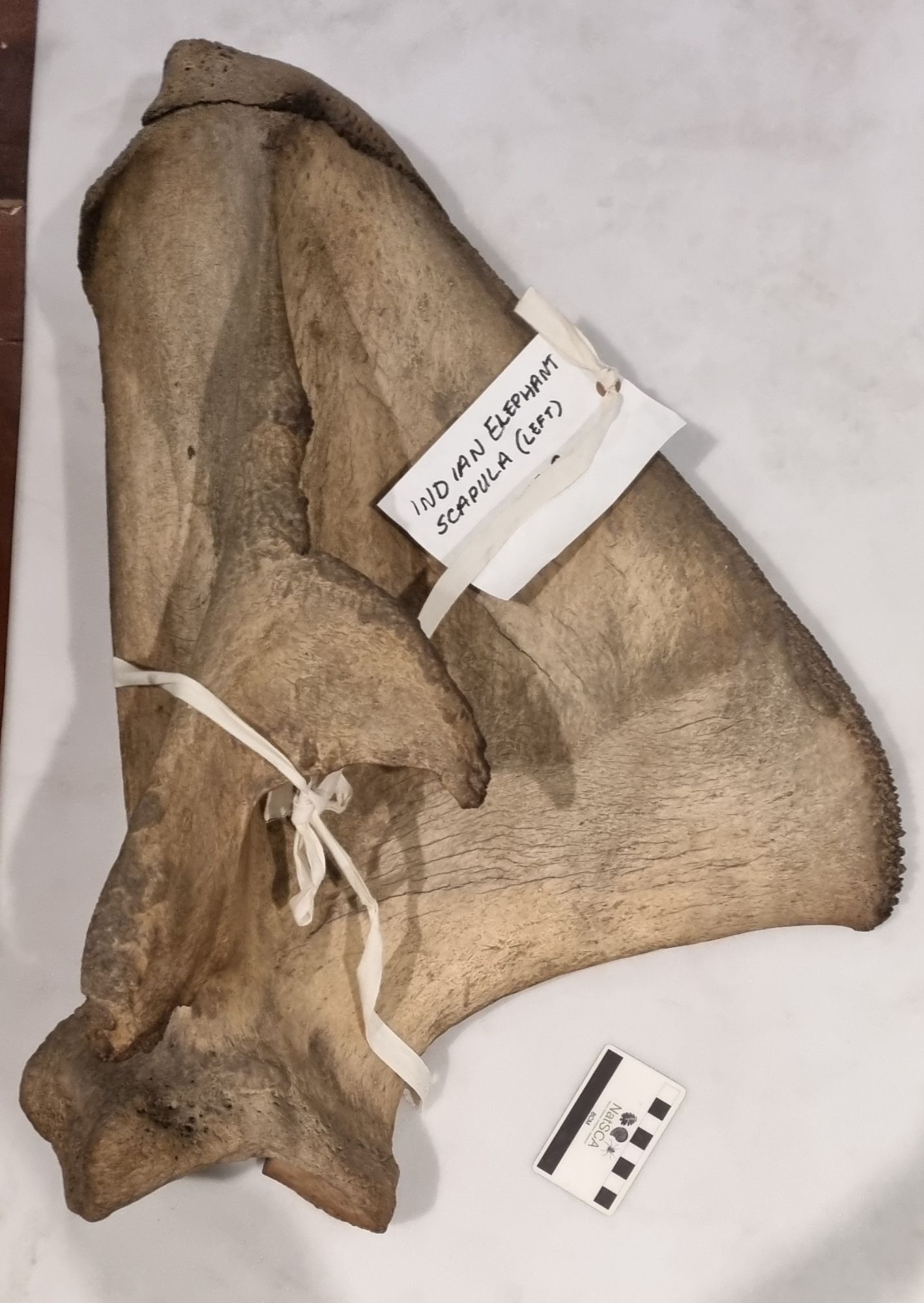
Rhinos have scapulae that are quite long and narrow – similar to a horse’s, and elephants have a very differently shaped shoulder:
Cetacean shoulders tend to be much more flattened and usually more circular, so it’s not one of them either. It is, however, from a distant cousin.
This is the scapula of a Hippo Hippopotamus amphibius Linnaeus, 1758.
Hippos used to be considered closer relatives of pigs and members of the Suborder Suina, but the discovery of the fossil whale Pakicetus in 1981 and various genetic studies over the last couple of decades have revealed that whales and hippos share a common ancestor and they have been grouped together in the Suborder Whippomorpha.
So well done to Adam Yates who dropped an equine hint about the source of this shoulderblade – since Hippopotamus does of course translate to “river horse”. I hope you enjoyed the challenge – there will be another next Friday!
 Zygoma
arrgh! I misjudged the size again and went for pygmy hippo, hence the “looks like a pig” clue ( Choeropsis = pig look alike)