Friday mystery object #315 answer

Last week I gave you this big bug to identify:

mystery315

I had a feeling it would be fairly straightforward for some of you, since insects as big as this are reasonably distinctive, and I was therefore not disappointed with the flurry of correct identifications.

The first with a correct identification in the comments was Chris, who hinted at the scientific name with this suggestion:

Trying to identify this Cic-sac? Tho phar, Tho good! (Excuth the lithp!)

On social media people made suggestions relating to the common name for the species, mostly pointing out that it’s very loud. Putting the various hints together gives you the Double-drummer Cicada Thopha saccata (Fabricius, 1803).

Cicadas are weird. They’re in the Order Hemiptera (the true bugs) and the Suborder Homoptera (although that’s disputed and it’s probably safer to say Auchenorrhyncha). Best known for being noisy and having some species with synchronised emergence times that vary between every year and up to every 17 years, or somewhere in-between depending on species and environment. They have widely spaced eyes and a blunt head that is pretty distinctive.

As jennifermacaire pointed out regarding cicadas:

According to Plato, “[This species] used to be human beings who lived before the birth of the Muses. When the Muses were born and song was created for the first time, some of the people of that time were so overwhelmed with the pleasure of singing that they forgot to eat or drink; so they died without even realizing it. It is from them that the race of the [these insects] came into being; and, as a gift from the Muses, they have no need of nourishment once they are born. Instead, they immediately burst into song, without food or drink, until it is time for them to die. After they die, they go to the Muses and tell each one of them which mortals have honored her.”
– Phaedrus

The implications of this is that adult cicadas have a general inability to feed, although this isn’t quite true, since adult cicadas may still feed on sap.

This particular cicada is Australian and is one of the loudest insects on the planet, able to produce a call of over 120 decibels – loud enough to cause permanent hearing damage if right up against a human ear.

The abdomen is fairly hollow in the males of these insects, creating a resonating chamber, but sadly the last segment of this specimen has fallen off, making it hard to be sure of the gender on the basis of the genitals. However, the males have a couple of resonating sacs behind the hind-wing that is missing from this specimen, suggesting that it’s a female.

As far as noisy neighbours go, these insects are an occasional disruption, popping up every 4-6 years and making a noise that is apparently similar to high-pitched bagpipes.

It doesn’t sound great to me, so I’m (not so) secretly glad that I only have to deal with dead examples of these fascinating insects.

More mystery object fun next week!
Friday mystery object #315

It’s been another week of working with the Dead Zoo insect collection for me, so I thought I’d give you one of them to have a go at identifying:

mystery315

A big bug  at around 135mm wingtip to wingtip

I don’t think it’ll be particularly difficult for some of you, so please try to offer cryptic suggestions if you know what is, to keep it challenging for others who aren’t as familiar with these impressive invertebrates.

Have fun!

Friday mystery object #314 answer(ish)

Last week I gave you this guest mystery object, courtesy of Joseph van Sambeek:

Mystery object. Image by Joseph van Sambeek, January 2000

The bony struts reinforcing thin plates of bone show it’s from something that lives in water all the time and which lacks lungs – you can tell this because this structure is what you get when you’re dealing with forces moving in a variety of directions, rather than mainly dealing with the constant force of gravity or compensating for buoyancy that is unavoidable when you live in water, but have lungs.

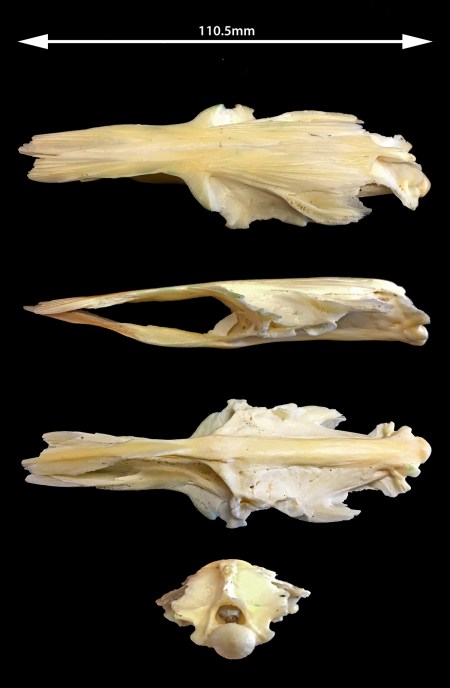
This means that many of you recognised it as being the neurocranium (that’s the bit of the skull that surrounds the brain) from a fish – more specifically from Sarah Gibson:

The first image is the skull roof, showing the elongated frontals and parietals (front of snout is left in first three images). Second image is a left lateral view, showing the internal parasphenoid that would pass between the two eye sockets. Third image is a ventral view, showing the bottom of the parasphenoid. And obviously last image is posterior view, showing the foramen magnum where the spinal cord would pass through, over the occipital condyle. It just may not look like a skull to some because it’s missing the eye sclera bones, jaws, cheek bones, pretty much anything that is not the skull roof or braincase.

However, as we all know, there are a LOT of different sorts of fish – around 33,600 described species and counting. This can make fish a nightmare to identify. However, there are some great resources out there, like Osteobase which has a very useful identification guide for various elements of a range of fish.

Alas, Osteobase didn’t have anything that fits this mystery specimen, so narrowing down to a species is rather difficult. I had the advantage of knowing that the specimen was collected in Baja California, although that was of little help in trying to get in an approximate area of the fishy family tree based on morphology, and there are still a ridiculous number of fish species is the area.

Sarah Gibson suggested that it may be a Barracuda, and it certainly fits in many aspects, but the shape of the frontals and parietals and details of the point of connection between the parasphenoid (that’s the bottom bar bit you see in the side view) don’t quite fit.

I had almost given up hope, when it occurred to me to concentrate on understanding the unusually large occipital condyle that Allen Hazen noticed, which suggested that it might be a taxon with an extremely extended rostrum (like the paddlefish or swordfish that Jennifer Macaire suggested) but with a weedier body and defined neck region since there would be no need for such a large articulation in a fusiform fish (they’re the muscular type that taper at both ends and have no neck, so don’t move their heads).

With this bizarre sounding fish in mind I was able to fairly rapidly narrow down the possibilities to one of the three species of cornetfish that live in the Pacific. I was delighted to find some great images of the skull of a Red Cornetfish, which matches the morphology very well.

Red Cornetfish Fistularia petimba from the Gulf of Mexico. Image by SEFSC Pascagoula Laboratory; Collection of Brandi Noble, NOAA/NMFS/SEFSC

Red Cornetfish Fistularia petimba from the Gulf of Mexico. Image by SEFSC Pascagoula Laboratory; Collection of Brandi Noble, NOAA/NMFS/SEFSC

However, the Red Cornetfish doesn’t really occur in the eastern Pacific, so it’s very unlikely to be that species. The Reef Cornetfish does occur in the eastern Pacific, but has only been reported in Californian coastal waters since November 2015 and this mystery specimen was collected back in January 2000 (which doesn’t make it impossible to be a Reef Cornetfish, just very unlikely). Which leaves us with the most likely identification (although by no means confirmed) of Deepwater Cornetfish Fistularia corneta Gilbert & Starks, 1904.

These long, thin fish can reach up to 2m, but they have tiny mouths that limit them to eating crustaceans, marine worms and smaller fish that they pick up from near the surface of reefs and the sea bed – presumably being harder to spot as a predator thanks to their very small frontal projected area.

I’ve asked Joe to check his specimen against the images of the cornetfish, since there’s nothing better than having a specimen in your hand when attempting an identification.

I hope you enjoyed the challenge!