
Last week I presented this mystery bone from the Words on the Wave exhibition at the National Museum of Ireland on Kildare Street:
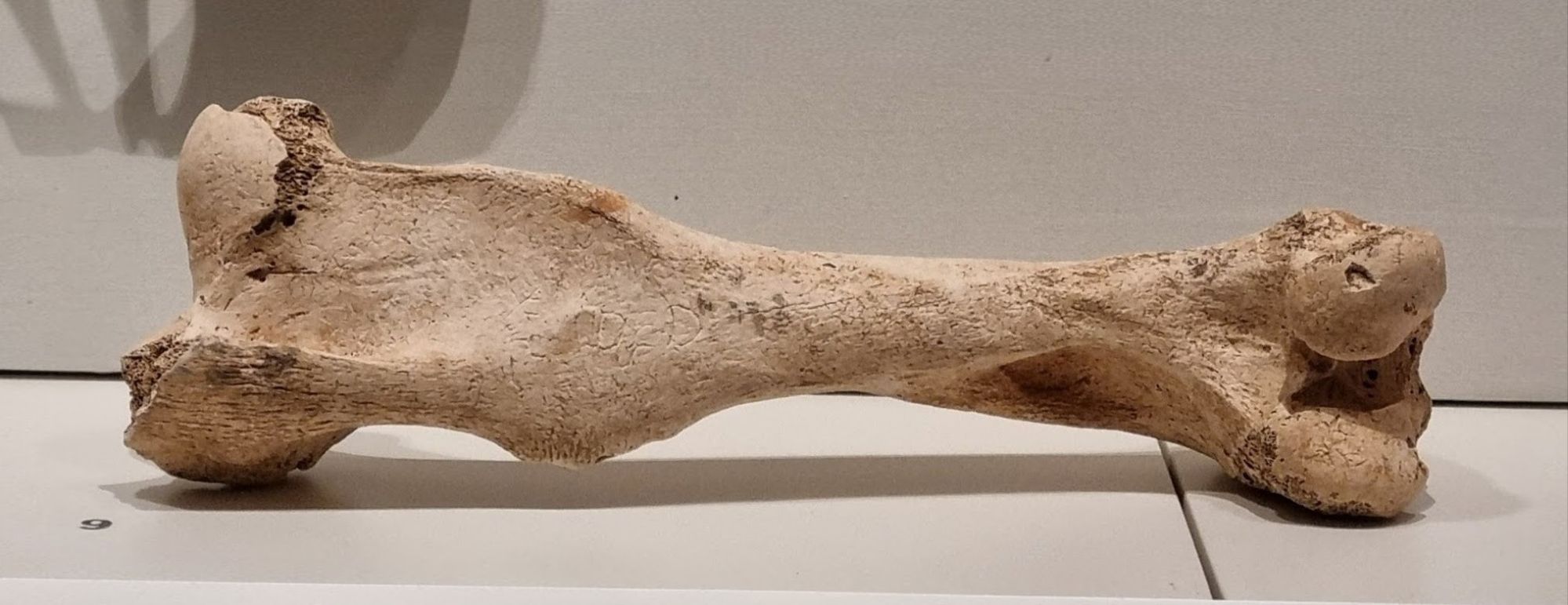
The bone is over a thousand years old, so it’s unsurprising that a few of the processes that could be useful for identification have been worn down a little:

That said, there was plenty of information remaining to allow several of you to identify the animal, bone type and side of the animal this is from. Adam Yates was first to the comments and he also left a very helpful Toot on Mastodon, detailing the diagnostic features:

For me, the supracondylar fossa on the lateral caudal surface is the instant give-away. For those who don’t speak anatomese, that’s the bit that flares out from the side of the shaft of the bone (which is actually missing a bit in this example).
This is a feature I always associate with the Perissodactyla (the tapirs, rhinos and horses), and this one is nowhere near robust enough for anything other than one of the horses. It’s also fairly small (although the lack of a scale bar doesn’t make this obvious).
This a left femur that I suspect is from a Horse Equus ferus caballus Linnaeus, 1758, but it could also be from a Donkey Equus africanus asinus Linnaeus, 1758. It can be tricky to tell these species apart, especially when the bone is a little worn down and you only have a few photos to work from – so best to err on the side of caution and leave it at an identification of Equus sp.
If you’re in Ireland and wanted to take a look at this object – and a selection of remarkable mediaeval manuscripts from the Abbey of St Gall, Switzerland, some of which are returning to Ireland for the first time in 1000 years – you have until the 24th of this month, I’d definitely recommend it!
 Zygoma